DLL Overview and MAC MCQs: 12 Solved Data Link Layer Questions
Test your Data Link Layer basics with 12 solved MCQs. Attempt each one first, then use the compact explanations to fix the rule behind the answer.
KnowledgeGate Team
Exam prep & CS education
Updated 16 Aug 20267 min read
MAC questions often look like one-line recall, but their distractors mix Layer 2 addresses with IP addresses, ports, routing, ARP and RARP directions, address width, and multicast-bit reading. Attempt each question below before reading its explanation. The method that survives all twelve is the same: identify the layer, inspect the exact address bits or format, and then eliminate the options. Layer 3 and Layer 4 questions sit in the wider Computer Networks MCQs collection.
Layer placement and DLL boundaries
Keep this three-line map beside you. Ports identify applications or processes at Layer 4. IP provides logical addressing and routing at Layer 3. MAC provides local-link hardware addressing at Layer 2. Computer Networks sits with the other core subjects in the CS Fundamentals category.
Q1
Which addressing scheme is used for identifying devices at data link layer ?
(A) IP
(B) Port
(C) MAC
(D) URL
Explanation: MAC is the Layer 2 device or interface identifier in this option set. IP is Layer 3 logical addressing, a port identifies a process at Layer 4, and a URL locates an application-layer resource. Asked in TPSC 2026, System Analyst. Check the solved question. Correct option: (C) MAC.
Q2
The media access control sublayer resides in which OSI layer?
(A) Transport
(B) Network
(C) Physical
(D) Data link
Explanation: The Data Link Layer has LLC above and MAC below. MAC controls access to the transmission medium, while the Physical Layer carries signals. Transport and Network are higher layers. Asked in UPLT 2018. Review the solved question. Correct option: (D) Data link.
Q3
Which of the following is not a responsibility of the Data Link Layer (DLL)?
(A) Framing
(B) Error & Flow control
(C) Routing
(D) None
Explanation: Framing and frame-level error and flow control belong to the Data Link Layer. Routing selects paths between networks, so it sits at Layer 3, which also rules out option D. More frames-versus-paths practice sits in the DLL Overview & MAC practice hub. Correct option: (C) Routing.
What the MAC sublayer actually controls
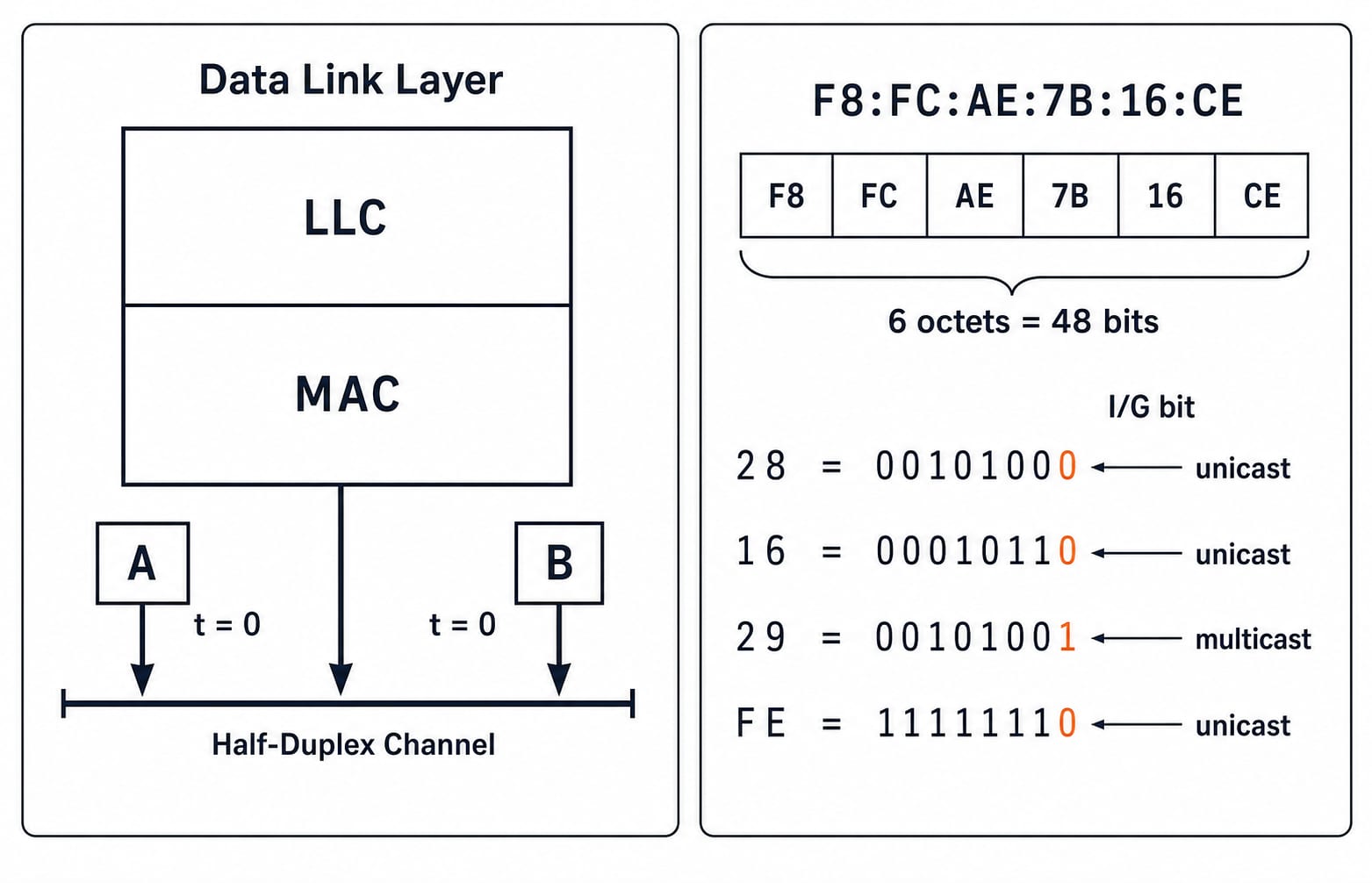
Stations A and B both try to transmit at t = 0 on one shared half-duplex channel. MAC rules decide who may send and how contention or collision is handled. Routing and application ports do not participate.
Q4
Which sublayer of the data link layer performs data link functions that depend upon the type of medium?
(A) Logical Link Control (LLC) sublayer
(B) Media Access Control (MAC) sublayer
(C) Network Interface Control sublayer
(D) More than one of the above
(E) None of the above
Explanation: Access rules vary by medium, such as wired Ethernet or Wi-Fi, so they belong to MAC. LLC presents a common interface above it. Asked in BPSC 2023, PGT Tier-1. See the solved question. Correct option: (B) Media Access Control (MAC) sublayer.
Q5
In the Data Link Layer, the main purpose of Medium Access Control (MAC) is:
(A) To establish a reliable channel over unreliable physical media
(B) To avoid and resolve collisions in shared communication channels
(C) To provide error detection and correction
(D) To perform routing of packets between networks
Explanation: Return to A and B at t = 0: a shared channel needs an access rule. Routing is Layer 3, while reliability and error control are broader DLL concerns. Option A sounds like Layer 2 but describes what LLC and the protocols above it add. Correct option: (B) To avoid and resolve collisions in shared communication channels.
The 48-bit MAC address and its written form
A conventional MAC address has 48 bits. Check it two ways: 6 octets x 8 bits = 48 bits, and 12 hexadecimal digits x 4 bits = 48 bits. The usual split is a 24-bit organisational prefix plus a 24-bit interface-specific portion. This model does not mean every modern interface exposes an immutable factory value.
Q6
Every NIC Card attached to the node of a network has a unique MAC address. This MAC address is of _____ bit address.
(A) 48
(B) 96
(C) 128
(D) 256
Explanation: Six bytes times eight bits gives 6 x 8 = 48. Check again with 12 hex digits times four bits: 12 x 4 = 48. Asked in RSSB 2023, Informatic Assistant. Open the solved question. Correct option: (A) 48.
Q7
Which of the following is correct physical address of a computer?
(A) FC : F8 : AE : 7B
(B) F8 : FC : AE
(C) F8 : FA : 7B : FC : 16 : 1B : AB
(D) F8 : FC : AE : 7B : 16 : CE
Explanation: This address has six groups of two hex digits, meaning six octets and 12 digits. Option A has four octets, B has three, and C has seven. Asked in UGC NET 2025, June. Verify it in the solved question. Correct option: (D) F8 : FC : AE : 7B : 16 : CE.
MAC properties and the multicast I/G bit
Keep three ideas separate. A conventional 48-bit MAC uses 12 hexadecimal digits, identifies a network interface, and need not change merely because the device moves between IP networks. ISP or location wording usually confuses MAC with Layer 3 addressing.
Q8
Which of the following statement(s) is/are TRUE in respect of Media Access Control (MAC) Address? (A) It can be changed if a node is removed from one network and connected to another network. (B) Each MAC address is a 12 -digit hexadecimal number. (C) It is a unique value associated with a network adapter called NIC. (D) It is provided by the Internet Service Provider to locate computers connected to the internet.
(A) (B) and (C) only
(B) (A), (B) and (C) only
(C) (C) and (D) only
(D) (A) and (B) only
Explanation: In the standard model, B gives the 12-hex-digit form and C links the address with the NIC. Reject A because changing IP networks does not require a MAC change. Reject D because ISP-provided logical addressing is not a MAC address. Asked in Bihar STET 2025. See the solved question. Correct option: (A) (B) and (C) only.
Q9
Which of the following is a valid Multicast address?
(A) 28:00:5E:1F:2F:33
(B) 16:01:EE:1F:2F:33
(C) 29:8C:7E:7F:FF:FF
(D) FE:10:FF:2F:FF:68
Explanation: Read only the first octet and inspect its least significant Individual/Group bit:
28 = 00101000, final bit016 = 00010110, final bit029 = 00101001, final bit1FE = 11111110, final bit0
Only 29 ends in 1, so C is multicast. The shortcut is that an odd first octet has I/G bit 1. FF:FF:FF:FF:FF:FF is the special broadcast address, but not every multicast address is broadcast. Broadcast is itself a group address, so FF also carries I/G bit 1. Correct option: (C) 29:8C:7E:7F:FF:FF.
ARP versus RARP, then the Wi-Fi standard
Use one reversible mapping as a memory aid. 192.0.2.10 -> 00:1A:2B:3C:4D:5E is IP to MAC, tested as ARP. Reverse it to 00:1A:2B:3C:4D:5E -> 192.0.2.10, and it becomes MAC to IP, tested as RARP. These arrows are not a full description of modern address configuration.
Q10
Name the protocol used to find MAC address from IP address.
(A) RARP
(B) ARP
(C) ICMP
(D) SMTP
Explanation: Write the direction as known IP -> required MAC. RARP runs in reverse, ICMP carries network control and error messages, and SMTP transfers email. The word reverse inside RARP is the giveaway: it starts from the hardware address, not the IP address. Asked in UP Police 2017, Paper 2 (Subject Oriented, Shift I). Correct option: (B) ARP.
Q11
Which protocol is used to discover an IP address from a known MAC address?
(A) ARP
(B) RARP
(C) GARP
(D) DNS
Explanation: Reverse the values: 00:1A:2B:3C:4D:5E -> 192.0.2.10. ARP takes the opposite direction, while DNS resolves names rather than MAC addresses. GARP is a gratuitous ARP announcement, which broadcasts a mapping instead of requesting one. Asked in MPPSC 2025. Correct option: (B) RARP.
Q12
The IEEE name of Wi-Fi is ______.
(A) 802.3
(B) 802.11
(C) 802.15
(D) 802.2
Explanation: 802.11 is the IEEE standard family for wireless LANs, which is what Wi-Fi equipment is certified against. Associate 802.3 with Ethernet, 802.15 with wireless personal-area networks such as Bluetooth, and 802.2 with the LLC sublayer. Do not choose 802.3 merely because Ethernet and Wi-Fi both use MAC addressing. Asked in UGC NET 2025, June. Correct option: (B) 802.11.
Score the set and choose the next drill
Use the score as a diagnosis. If you got 10-12 correct, the basics are stable. At 7-9, redo the 48-bit format, the layer map, and the ARP/RARP arrows. At 0-6, rebuild the DLL and MAC concept map before timing another set. After one day, reattempt only the missed questions and explain each answer aloud without looking.
The five tested patterns were Layer 2 placement, LLC versus MAC, the 48-bit and six-octet format, I/G-bit reading, and ARP/RARP direction plus 802.11 recall. Next, use the solved Subnetting MCQs for Layer 3 address work and the TCP and UDP MCQs for Layer 4.
For a broad, sequenced CS curriculum, follow the Zero to Hero complete CS course. If your focus is recruiter-style core CS revision, use Computer Science Fundamentals for Placements. Choose the track that matches your goal, then return to the missed questions until you can explain the rule without seeing the options.
Keep learning
Computer Networks Basics & Criteria MCQs: 12 Solved Questions with Explanations
Solve 12 Computer Networks questions, then use clear explanations and worked criteria checks to separate similar terms confidently.
3 Oct 20268 min readComputer Networks MCQs
TCP Timers, RTT Estimation & SWS: 10 Solved MCQs and NATs
Solve 10 TCP exam questions covering timer roles, Silly Window Syndrome, recursive RTT estimates, Jacobson/Karels RTO and Karn's rule.
Updated 28 Sep 20267 min readComputer Networks MCQs
RSA Algorithm MCQs: 12 Solved Questions with Step-by-Step Explanations
Practise RSA key generation, modular inverses, encryption, signatures and defining equations, with concise working for conceptual and numerical answers.
25 Sep 20268 min readComputer Networks MCQs
Firewall, VPN, IDS and IPS MCQs: 11 Network Security Questions Solved
Solve 11 previous-year questions on firewalls, VPNs, IDS and IPS. Learn rule filtering, connection state, DMZ design, IPsec modes, tunnels and signatures.
Updated 24 Sep 20267 min readComputer Networks MCQs