Computer Networks Application Layer MCQs: 12 solved DNS, HTTP and email questions
Application layer MCQs with solutions: 12 solved GATE, PSC and PSU questions on DNS, Telnet, FTP, HTTP over TCP, cookies, and the SMTP to POP3 email flow.
KnowledgeGate Team
Exam prep & CS education
12 Jul 20266 min read
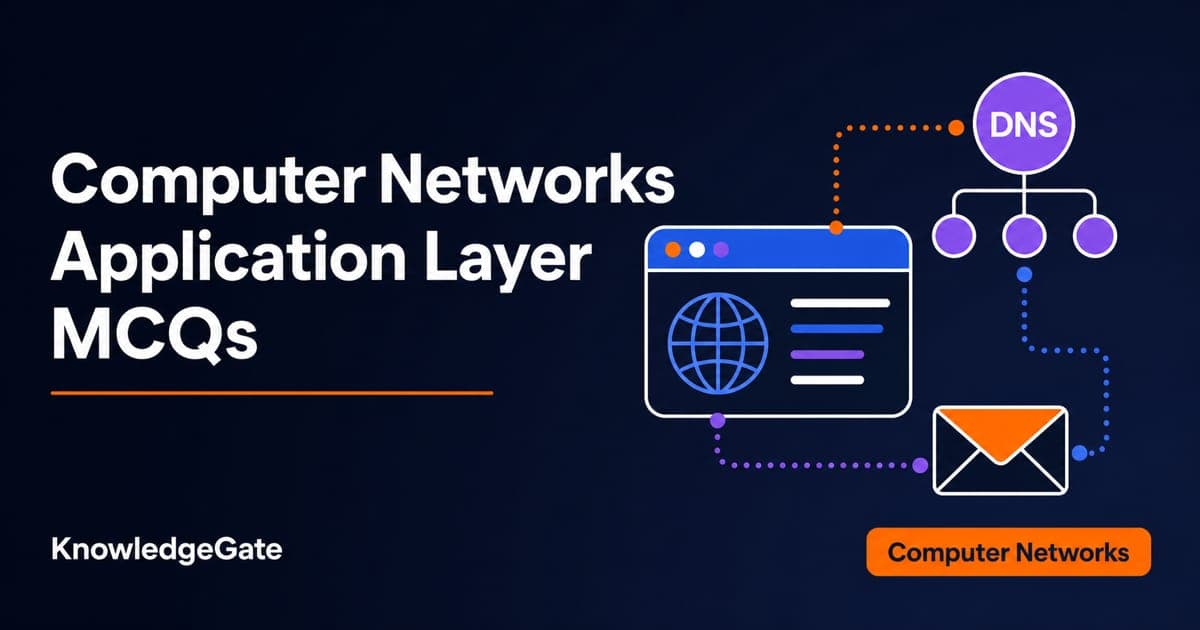
The application layer question in GATE, state PSC, STET and PSU papers is usually about matching a task to the right protocol: DNS for name resolution, SMTP to send mail, POP3 to fetch it, HTTP over TCP for the web, and knowing which one is not really client-server at all. The distinctions are small but decisive, and one confusion between sending mail and retrieving it costs a full mark. Every one of these protocols ultimately hands its bytes to TCP or UDP, and that single fact settles more options than any mnemonic. Papers repeat a small set of shapes: a full form, a task-to-protocol match, a default port number, and a FALSE-statement question about HTTP or cookies. Work out each option before you read the answer. If a protocol still feels vague, the full theory sits in the Computer Networks learn module.
DNS, Telnet, FTP and SMTP: matching the task to the protocol
Q1. The role of DNS is best described as (RPSC 2024)
(a) translating a host's IPv6 address to an IPv4 address
(b) mapping a MAC address to an IP address
(c) translating a private IP address to a public IP address
(d) mapping a domain name to an IP address
Answer: (d). DNS is the internet's naming system, converting a human-readable name like www.example.com into the numeric IP address a machine needs. Address translation and NAT are separate functions, and MAC-to-IP mapping is ARP's job. DNS maps names to IP addresses.
Q2. Telnet is commonly used for (Bihar STET 2025)
(a) secure file transfers
(b) remote terminal access
(c) web browsing
(d) email communication
Answer: (b). Telnet opens a bidirectional text-based virtual terminal to a remote host, letting a user log in and run commands as if seated at that machine. File transfer, browsing and email each have their own protocols. Telnet's purpose is remote terminal access.
Q3. What is the full form of FTP? (Bihar STET 2025)
(a) File Transfer Protocol
(b) File Transmission Protocol
(c) Fast Transfer Protocol
(d) Fast Transmission Protocol
Answer: (a). FTP stands for File Transfer Protocol, the standard for moving files between hosts over a network. The word is Transfer, not Transmission, and there is nothing Fast in the name. Option (a) is exact.
Q4. Which protocol is used for sending emails? (Bihar STET 2025)
(a) HTTP
(b) FTP
(c) SMTP
(d) SNMP
Answer: (c). SMTP, the Simple Mail Transfer Protocol, moves outgoing mail from a client to a server and between mail servers. HTTP serves web pages, FTP transfers files, and SNMP manages network devices. Sending mail is SMTP's role.
Email protocols and the client-server model: SMTP and POP3
Q5. Which one of the following is not a client-server application? (GATE 2010)
(a) internet chat
(b) web browsing
(c) email
(d) ping
Answer: (d). Ping uses ICMP echo request and reply as a network-layer diagnostic between hosts; there is no application server answering requests. Chat, browsing and email each involve a client talking to a dedicated application server. So ping is the non-client-server case (see the full solution).
Q6. Which protocol pair can be used to send and then retrieve emails, in that order? (GATE 2019)
(a) IMAP, POP3
(b) SMTP, POP3
(c) SMTP, MIME
(d) IMAP, SMTP
Answer: (b). Sending outgoing mail is SMTP's job, while retrieving mail from the server to a client is done by POP3. The order asked is send then retrieve, which is SMTP followed by POP3. MIME is a content format, not a retrieval protocol, so (b) is correct (see the full solution).
Q7. For m1: send an email from client to mail server, m2: download an email from server to client, m3: check email in a web browser, the protocols used are (GATE 2011)
(a) m1 HTTP, m2 SMTP, m3 POP
(b) m1 SMTP, m2 FTP, m3 HTTP
(c) m1 SMTP, m2 POP, m3 HTTP
(d) m1 POP, m2 SMTP, m3 IMAP
Answer: (c). Submitting outgoing mail to the server uses SMTP, downloading messages to a client uses POP, and reading mail through a browser is plain web access over HTTP. That maps to SMTP, POP, HTTP in order, which is option (c) (see the full solution).
Q8. Which TCP port does POP3 use by default? (Beltron Programmer 2025)
(a) 25
(b) 143
(c) 110
(d) 587
Answer: (c). POP3 retrieves mail over an unencrypted TCP connection on port 110 by default, switching to 995 when SSL or TLS is used. Port 25 is SMTP and 143 is IMAP. The default POP3 port is 110.
HTTP and the web
Q9. Which one of the following statements is FALSE? (GATE 2004)
(a) HTTP runs over TCP
(b) HTTP describes the structure of web pages
(c) HTTP allows information to be stored in a URL
(d) HTTP can be used to test the validity of a hypertext link
Answer: (b). HTTP is a transfer protocol; the structure and content of a web page are defined by HTML, not HTTP. HTTP does run over TCP, can carry information in a URL, and can check a link with a HEAD request. So the false statement is (b) (see the full solution).
Q10. Which statement about HTTP cookies is NOT correct? (GATE 2015)
(a) a cookie is a piece of code that can compromise a user's security
(b) a cookie reaches the user through an HTTP header
(c) a cookie has an expiry date and time
(d) cookies can track a user's browsing pattern at a site
Answer: (a). A cookie is data, a name and value with some attributes, not executable code, so it cannot run or directly compromise security. Cookies do arrive via the Set-Cookie header, can carry an expiry, and are used to track browsing. The incorrect claim is (a) (see the full solution).
Q11. A browser at client Q loads a static HTML page from server S, and the page has exactly one embedded image also on S. Assuming no caching, which is correct? (GATE 2014)
(a) at least 2 HTTP requests, each in a separate TCP connection
(b) at least 2 HTTP requests, but a single TCP connection is sufficient
(c) a single HTTP request is enough, and one TCP connection is necessary
(d) a single HTTP request is enough, with no TCP connection needed
Answer: (b). The browser first fetches the HTML, then issues a second request for the embedded image referenced inside it, so at least two HTTP requests are needed. A persistent TCP connection can carry both requests, so one connection suffices. That is option (b) (see the full solution).
Q12. The term HTTP stands for (Bihar STET 2025)
(a) Hyper Terminal Tracing Program
(b) Hypertext Tracing Program
(c) Hypertext Transfer Protocol
(d) Hypertext Tracing Protocol
Answer: (c). HTTP is the Hypertext Transfer Protocol, the rules by which browsers and servers exchange hypertext over the web. Hypertext is text linked to other text, and Transfer Protocol names the exchange mechanism. The correct expansion is (c).
How the application layer is examined
Application layer questions arrive in three predictable shapes. The naming and access block (Q1 to Q4) is quick recall: DNS maps names to addresses, Telnet gives a remote terminal, FTP moves files, and SMTP sends mail. The email block (Q5 to Q8) is the reliable scoring zone, and it hinges on the send-versus-retrieve split of SMTP and POP3, plus the odd fact that ping is not client-server. The HTTP block (Q9 to Q12) rewards knowing that HTML, not HTTP, structures pages, that a cookie is data not code, and that an embedded image forces a second request on one connection.
For how these protocols fit together, work through our Application Layer Protocols: DNS, HTTP and More deep dive, then drill the practice sets in the Application Layer module. GATE aspirants get the full networks sequence inside GATE Guidance by Sanchit Sir. Solve, note the port numbers you keep missing, and the recall sharpens on the second pass.
Keep learning
Repeater, Hub, Bridge & Switch MCQs: 12 Solved Questions with Explanations
Solve 12 exam questions on device layers, MAC forwarding, VLANs, collision and broadcast domains, port mirroring, bridges and crosspoint counting.
Updated 20 Oct 20267 min readComputer Networks MCQs
Ethernet IEEE 802.3 MCQs: 12 Solved Questions with Explanations
Solve 12 Ethernet questions on IEEE 802.3, speed generations, hubs, MAC addresses, multicast, CSMA/CD and the first binary backoff race.
Updated 16 Oct 20267 min readComputer Networks MCQs
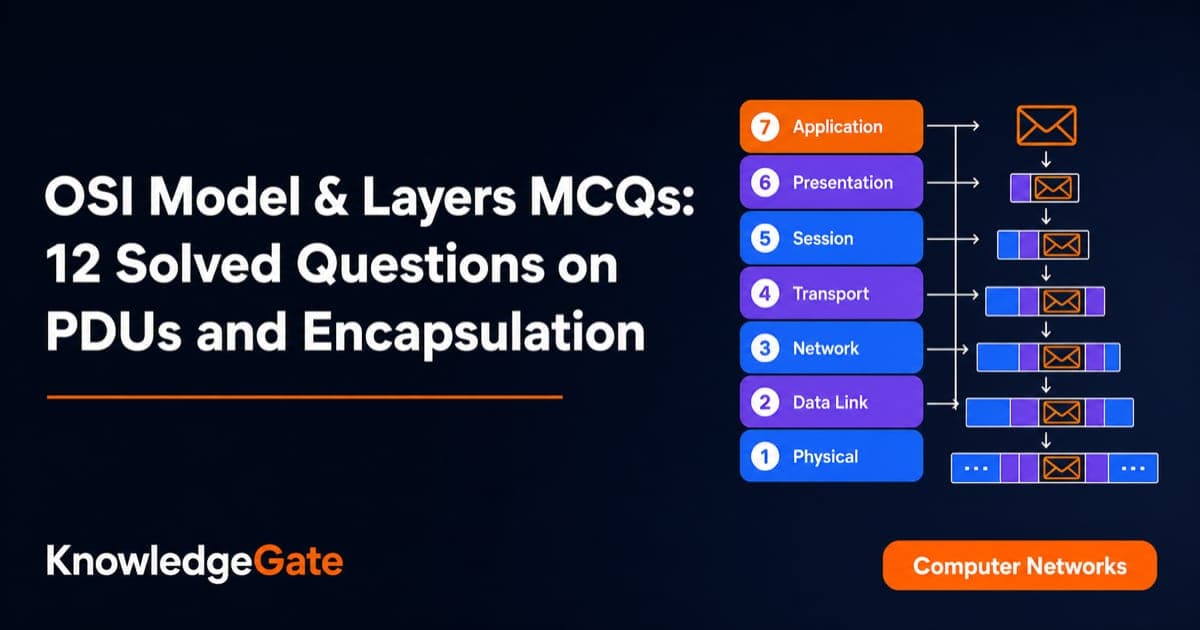
OSI Model & Layers MCQs: 12 Solved Questions on PDUs and Encapsulation
Test OSI layers, PDUs, encapsulation and router traversal through solved MCQs, with explanations, a byte-by-byte frame trace and a layer-visit method.
12 Oct 20267 min readComputer Networks MCQs
Mobile Computing MCQs: Solved Questions on Concepts, Features and Applications
Work through 10 solved questions covering portability, cellular standards, Bluetooth, CDMA, Android, mobile cloud, and device constraints. Each answer has a concise explanation.
7 Oct 20267 min readComputer Networks MCQs