HPSC PGT Computer Science PYQs: Build an Error-Driven Practice Loop
Turn every past-paper miss into a next action: tag the cause, repair the concept, retest with fresh values, and space the retests across a 12-hour study week.
KnowledgeGate Team
Exam prep & CS education
Updated 26 Jul 20266 min read
An HPSC PGT Computer Science aspirant can solve a past-paper set, note the score, and still repeat the same paging, subnetting, condition-reading or time-allocation error in the next set. What closes that gap is a solve -> tag -> repair -> retest -> space loop, where every miss earns one named cause, one repair matched to that cause, and a date to be retested on. Syllabus mapping, weightage and timed practice for this exam sit in the HPSC preparation category.
1. Make every PYQ produce a next action
A score is an outcome. An error record is a study instruction. Why Solving PYQs Beats Buying Another Question Bank explains the paper-first rationale. Count a correct guess as unresolved because you cannot reproduce its reasoning.
Use these ledger columns exactly:
set and question ID | source | subject | micro-concept | result | time | primary error tag | correction | fresh variant | retest dates
Record a question as paper history only when you can name the paper it came from; otherwise label it practice. A concept exits the active ledger only after two fresh questions are correct on separate days, with the rule or calculation written out and neither answer guessed.
2. Work a 30-question baseline without hiding the misses
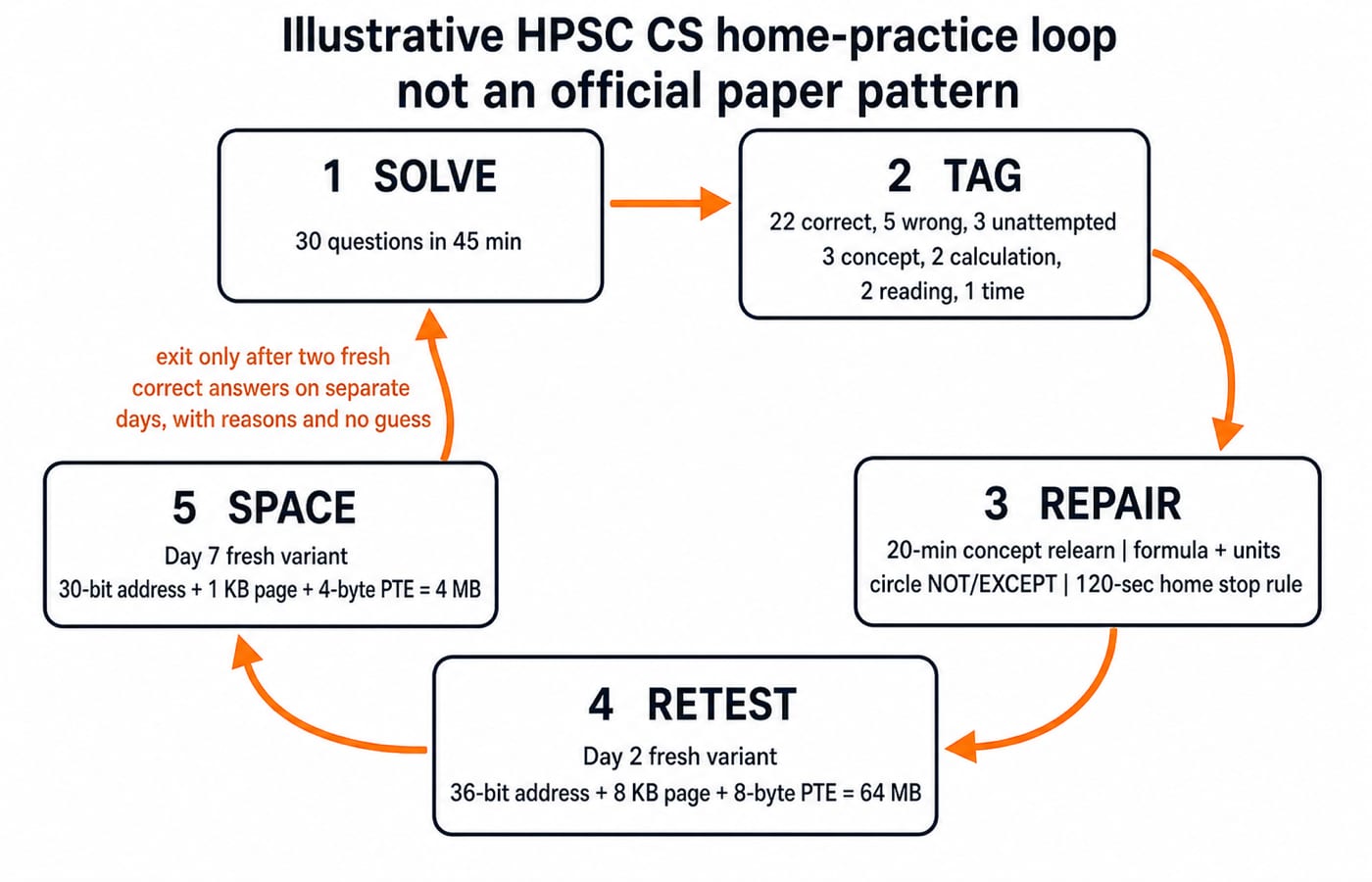
Take one worked case. In 45 minutes, a learner attempts 27 of 30 mixed CS questions, gets 22 correct and 5 wrong, and leaves 3 unattempted.
Attempted accuracy =
22 / 27 x 100 = 81.5%.Completion =
27 / 30 x 100 = 90%.Repair queue =
5 wrong + 3 unattempted = 8 items.
Give each item one primary cause: concept 3, calculation 2, reading 2, time 1. Check: 3 + 2 + 2 + 1 = 8. Tag the earliest cause. An unknown formula is concept; a known method broken by arithmetic or units is calculation.
Record C = correct with reason, G = correct guess, W = wrong, and U = unattempted. Queue every G, W and U. Never let the score erase a guess or unseen question.
3. Use four tags that prescribe four different repairs
Tag earliest failure. CONCEPT: cannot state the rule. CALCULATION: rule known, but arithmetic, units or order fail. READING: missed NOT, EXCEPT, arrival time or unit. TIME: can begin but crosses a self-set stop or never reaches the item. Ban silly mistake; it prescribes nothing.
Four rows from that learner's ledger:
OS-PG-04 | 32-bit byte address, 4 KB pages, 4-byte PTE | W | CONCEPT | answered 1 MBCN-IP-02 | /26 usable hosts | W | CALCULATION | wrote 64 instead of 2^6 - 2 = 62OS-DL-03 | asks which condition is NOT required for deadlock | W | READING | missed NOTDS-SCH-05 | CPU-scheduling calculation | U | TIME | spent 7 minutes before moving on, leaving two later SQL items unseen
Repairs: connect page size to offset bits and PTE size to table bytes; subtract the network and broadcast addresses; circle the polarity word (NOT, EXCEPT, INCORRECT) before you read a single option; set a 120-second first-pass stop and obey it.
4. Repair the cause, then change the values
Work OS-PG-04 from units. 4 KB = 2^12 bytes, so a 32-bit logical address leaves 32 - 12 = 20 page-number bits. A single-level table has 2^20 entries. Thus, 2^20 x 4 bytes = 2^22 bytes = 4 MB. Replace 1 MB and write the chain without notes.
Match repair to cause. Concept gets a 20-minute relearn, closed-book explanation and two fresh applications. Calculation gets a formula rebuilt from meaning, visible units and three fresh-value drills. Reading gets five items with polarity and constraints circled first. Time gets a first-pass stop rule, second-pass return and time record.
Change the values. Day 2: a 36-bit address, 8 KB = 2^13 page and 8-byte PTE give 2^23 x 8 = 2^26 bytes = 64 MB. Day 7: a 30-bit address, 1 KB = 2^10 page and 4-byte PTE give 2^20 x 4 = 2^22 bytes = 4 MB. Reusing the original options is recall, not transfer. When a worked solution alone does not close the gap, KnowledgeGate's HPSC PGT Computer Science course rebuilds the unit underneath it.
5. Retest on a fixed clock, not when the answer feels forgotten
Match the clock to the error. Concept: relearn Day 0, explain closed-book Day 1, solve fresh Day 3, mixed retest Day 10. Calculation: correct once Day 0, then use fresh values on Days 2, 7 and 14. Reading: five condition-marking items next session, mixed retest Day 7. Time: a timed mini-set next session and at week's end.
On Day 2, the learner attempts 8 flagged items plus 8 fresh variants, scores 13/16, and returns the remaining 3 to the ledger under their current causes. On Day 7, a 20-question, 30-minute mixed set yields 17 correct, 2 wrong and 1 unattempted. Improvement means fewer repeated causes under fresh conditions, not merely a larger percentage. Move repaired concepts into mixed work with Teaching Exam Mock Strategy for CS Papers. KnowledgeGate's HPSC PGT test series supplies timed mixed sets once you have worked through your own.
6. Run the loop inside a 12-hour week
Monday to Thursday use 75 minutes each: concept, calculation, reading, then mixed PYQs. Friday uses 60 for due retests. Saturday: 45 solve, 90 review and tag, 75 repair. Sunday: 60 spaced retests, 45 fresh mixed, 30 planning, 15 buffer. Check: 300 + 60 + 210 + 150 = 720 minutes = 12 hours.
Weeks 1-2:
300diagnostic solving +240correction and tagging +120repair +60retesting =720minutes.Weeks 3-4:
240repair +180fresh variants +150mixed timed work +90retests +60ledger maintenance =720.Weeks 5-6:
240mixed sets +240review +120targeted repair +60spaced retests +60planning =720.
If one 75-minute weekday is lost, use Sunday's 15-minute buffer and replace only 60 minutes of lower-priority fresh work. If two are lost, carry the lower-priority new set forward. Preserve the due retests; never build a punishment double-session.
7. Audit the repeated cause, then choose the next set
Audit three weekly numbers: repeated errors by tag, fresh-question success by topic, and time per repaired question. If 7 unresolved items contain concept 4, calculation 1, reading 1 and time 1, and 3 concept misses concern DBMS normalization, assign the next two repair blocks to normalization before another broad mock.
Write repeated in my sets, single observation, or not yet observed beside each one. A 3/8 concept share describes your week, not the paper, so never promote it, or a thin stack of collected papers, into a weightage prediction. Marks, dates, syllabus rules and stage details count as settled only once you have matched them against a notice on the Haryana Public Service Commission website.
The short version
Solve, tag the earliest cause, repair with fresh values, retest on schedule, and keep only unresolved items active. Spend 60 minutes creating the ledger and coding one small PYQ set. Use the HPSC PGT Computer Science 2026 complete course for structured learning or the HPSC PGT (CS) Test Series for timed practice.
Keep learning
HPSC PGT Computer Science: Algorithms and Computer Architecture Problems
Learn a two-lane method for Algorithms and Computer Architecture practice, with verified Dijkstra, direct-mapped cache, and pipeline examples.
Updated 6 Aug 20265 min readHPSC Teaching
HPSC PGT vs DSSSB TGT Computer Science: Choose Haryana or Delhi
Use a qualification gate, syllabus-overlap calculation and weighted fit score to decide whether HPSC PGT or DSSSB TGT Computer Science deserves your next study block.
Updated 4 Aug 20266 min readHPSC Teaching
HPSC Teaching CS Weightage: Rank Topics with Four Evidence Signals
Build a defensible HPSC Computer Science revision order without invented percentages. Score syllabus gaps, verified recurrence, prerequisite reach and fresh weakness, then turn the result into a ten-hour week.
Updated 1 Aug 20265 min readHPSC Teaching
HPSC PGT Computer Science Syllabus: Topic Map and Study Order
Turn a flat HPSC PGT Computer Science checklist into six connected preparation lanes. Use the worked school-lab case and balanced diagnostic to decide what to repair next.
Updated 29 Jul 20266 min read75 viewsHPSC Teaching