HPSC PGT vs DSSSB TGT Computer Science: Choose Haryana or Delhi
Use a qualification gate, syllabus-overlap calculation and weighted fit score to decide whether HPSC PGT or DSSSB TGT Computer Science deserves your next study block.
KnowledgeGate Team
Exam prep & CS education
Updated 4 Aug 20266 min read
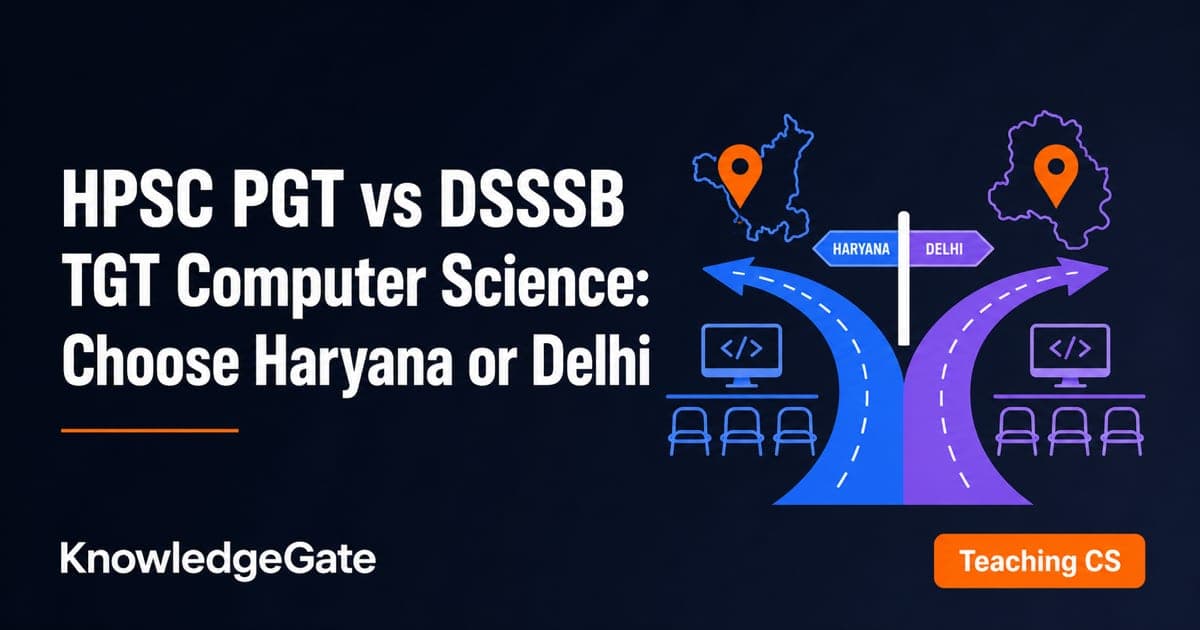
HPSC PGT Computer Science and DSSSB TGT Computer Science are not two doors into one job. One is a Haryana Public Service Commission post at the post-graduate teacher level, the other a Delhi Subordinate Services Selection Board post at the trained-graduate level. They share a Computer Science core, so a wrong choice is recoverable, but the parts they do not share, a degree-level theory tail and an interview in Haryana, a general paper half in Delhi, are where a mis-aimed study block is lost. If the teaching route itself is still open, Which Teaching CS Exam Should You Target? narrows the wider field first.
HPSC PGT vs DSSSB TGT: what the two labels name
The level sits in the name. A Post Graduate Teacher post is built on a post-graduate qualification, a Trained Graduate Teacher post on a graduate one, and both expect a recognised teacher-training qualification such as B.Ed.
What differs | HPSC PGT Computer Science | DSSSB TGT Computer Science |
|---|---|---|
Post level | Post-graduate teacher | Trained-graduate teacher |
Recruiting body | Haryana Public Service Commission | Delhi Subordinate Services Selection Board |
Where you can be posted | Any district in Haryana | Schools inside Delhi NCT |
Shape our coverage prepares for | Subject paper plus an interview stage | One computer-based test: general Section A plus Computer Science Section B |
CS depth expected | Degree-level theory, including automata, compilers and computer organisation | Fundamentals, ICT and classroom tools over core programming and data structures |
Keep one note per route, built only from issued commission documents: the advertisement number and date, the exact post name and code, the department, any corrigenda, and the title of the syllabus or exam scheme. From those documents alone, give each route one status: an open application window, a selection stage under way, a closed earlier cycle, or nothing current. Vacancy counts, exam dates and cutoffs move every cycle, so take them only from the advertisement, its corrigenda and the commissions' own result pages.
Eligibility: the degree-level gate that settles most of this
The gate is the level, and it usually decides before preference gets a say. A PGT post is built on a post-graduate qualification, so a Computer Science bachelor's with teacher training normally sits outside the PGT gate and leaves Delhi as the live route this cycle. With a master's in the subject, both routes stay open. Confirm your own position against the essential-qualification clause in the current advertisement.
Everything finer than the level belongs to that advertisement: accepted degree titles and subject combinations, whether a related computing degree counts as equivalent, any marks condition, the age band for your category, and the date each qualification must be held by. Copy each clause next to your own document and mark yourself matching, missing or unresolved; unresolved, such as a pending equivalence confirmation, means wait for clarification, not that you are out. For the Delhi side, the DSSSB TGT Computer Science eligibility and exam-pattern audit works through those clauses one by one.
Selection stages: one CBT in Delhi, a paper plus an interview in Haryana
DSSSB TGT Computer Science runs as a single computer-based test carrying a general Section A and a Computer Science Section B, with a deduction for wrong answers. Both halves sit in the same paper, so a weak general section cannot be repaired by a strong subject score in a later round. The question split, the marks, the duration and the exact penalty all come from the advertisement you apply under.
The Haryana route is shaped differently. Our HPSC PGT Computer Science 2026 course carries a dedicated interview-preparation block alongside the full subject spine, so budget for part of the outcome being decided in a room, defending your subject aloud, rather than entirely on a marked screen. Check the stage list, and any screening step before the main paper, in the current HPSC advertisement.
That contrast is a real decision input. If nerve and speed under negative marking are your weak point, Haryana spreads the risk across more than one kind of test. If facing a board unsettles you more than a timed paper does, Delhi keeps the whole assessment written.
Syllabus overlap: the shared core and the tail each route adds
The shared core is why keeping both routes warm is even an option. Programming, data structures, database management, operating systems and computer networks are studied once and count towards both papers, and they are the bulk of any serious Computer Science teaching preparation.
The tail is what does not transfer. The Haryana PGT route reaches into degree-level theory: computer organisation and digital logic, theory of computation, compiler design and software engineering, plus emerging technology trends and the society, law and ethics topics. The Delhi TGT route instead asks for the general Section A half, meaning general awareness, reasoning, arithmetic and language, plus the computer fundamentals, MS Office and ICT layer a trained-graduate paper leans on.
Size the overlap from the two current syllabus documents, not from a ready-made percentage. Tag both line by line as shared, Haryana-only, Delhi-only or unclear, and leave unclear lines out of your estimate.
Haryana or Delhi: what the posting commits you to
A Haryana post is a state-cadre post, so your school can sit in any district of the state and a later transfer can move you a long way from where you live now. A Delhi post keeps you inside one city's transport network, which matters if moving house is not an option, and equally offers no move out of Delhi if you later want one. Domicile, language, reservation and transfer rules are written post by post, so read them in the advertisement instead of inferring them from a state name.
Score the fit, then run one route as primary
Weigh preference only after both eligibility gates are checked; no weight rescues a route missing a mandatory requirement. If only one route clears every requirement, that route is the choice. If both clear, rate each factor below from 1 to 5 for each route, multiply by its weight, and add the four products:
Role fit, post-graduate teacher work or trained-graduate teacher work: weight 30.
Location commitment, how honestly you can accept a posting in that state: weight 25.
Reuse, how much of the preparation you already hold counts towards that syllabus: weight 25.
Absorbable extra work, whether the route-specific tail fits your weekly hours: weight 20.
Worked through: rating Haryana 4, 3, 4 and 3 on those factors gives 120 plus 75 plus 100 plus 60, a total of 355, while Delhi at 3, 5, 3 and 4 gives 90 plus 125 plus 75 plus 80, a total of 370. Delhi wins that sheet by 15.
The higher total is your primary route for this study block, and the other goes on watch, which means saving its notices and nothing more. Inside roughly ten points the two are close enough that the calendar breaks the tie: prepare the shared core and target whichever notification opens first. If one factor is non-negotiable, raise its weight and cut the others to keep the total at 100, location at 40 when you cannot relocate at all.
Keep both routes genuinely active only when your line-by-line tagging showed high shared coverage and the second route's tail fits your weekly hours. Plan those hours around the shared core first, add the primary route's tail after it, and make up a missed block over the following weeks rather than the next day. The Govt Teaching Jobs category keeps the related route pages together.
HPSC PGT or DSSSB TGT: the short version
Decide in this order: the degree-level gate, the post level you want, the selection shape you can survive, the state you can accept, syllabus reuse, then weekly hours. One sitting with both current notifications settles all six.
If Haryana wins, HPSC PGT Computer Science 2026 is built for that shape, the subject spine plus the interview block. If Delhi wins, the DSSSB TGT Computer Science bundle prepares Section A and Section B together. Either way, score every practice set the way the real paper will.
Keep learning
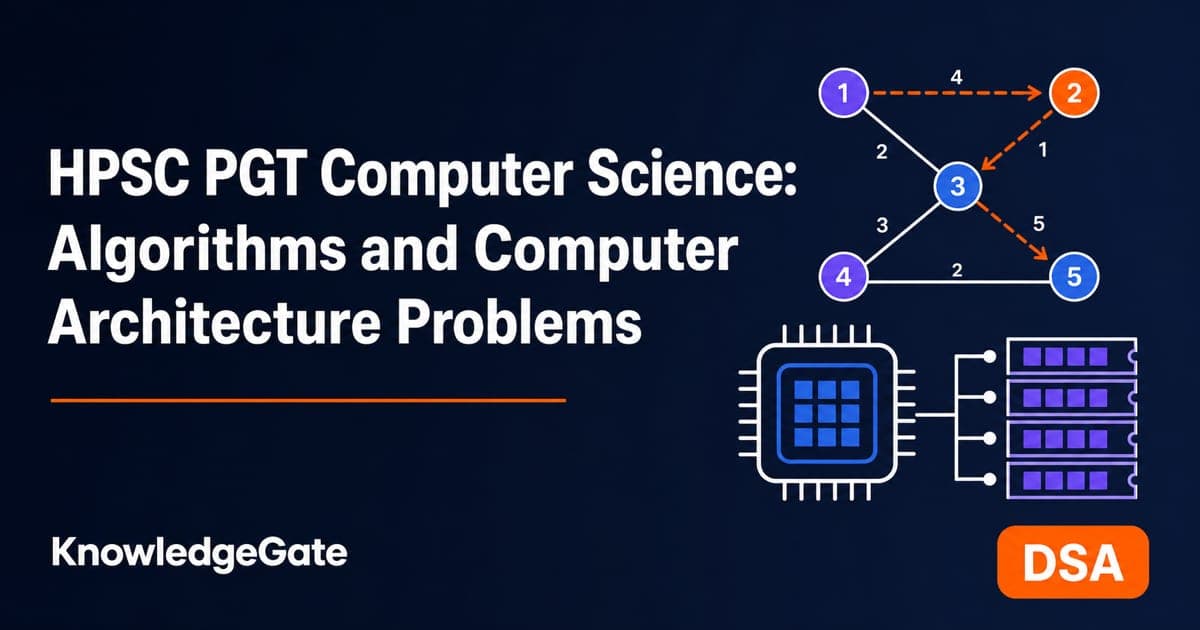
HPSC PGT Computer Science: Algorithms and Computer Architecture Problems
Learn a two-lane method for Algorithms and Computer Architecture practice, with verified Dijkstra, direct-mapped cache, and pipeline examples.
Updated 6 Aug 20265 min readHPSC Teaching
HPSC Teaching CS Weightage: Rank Topics with Four Evidence Signals
Build a defensible HPSC Computer Science revision order without invented percentages. Score syllabus gaps, verified recurrence, prerequisite reach and fresh weakness, then turn the result into a ten-hour week.
Updated 1 Aug 20265 min readHPSC Teaching
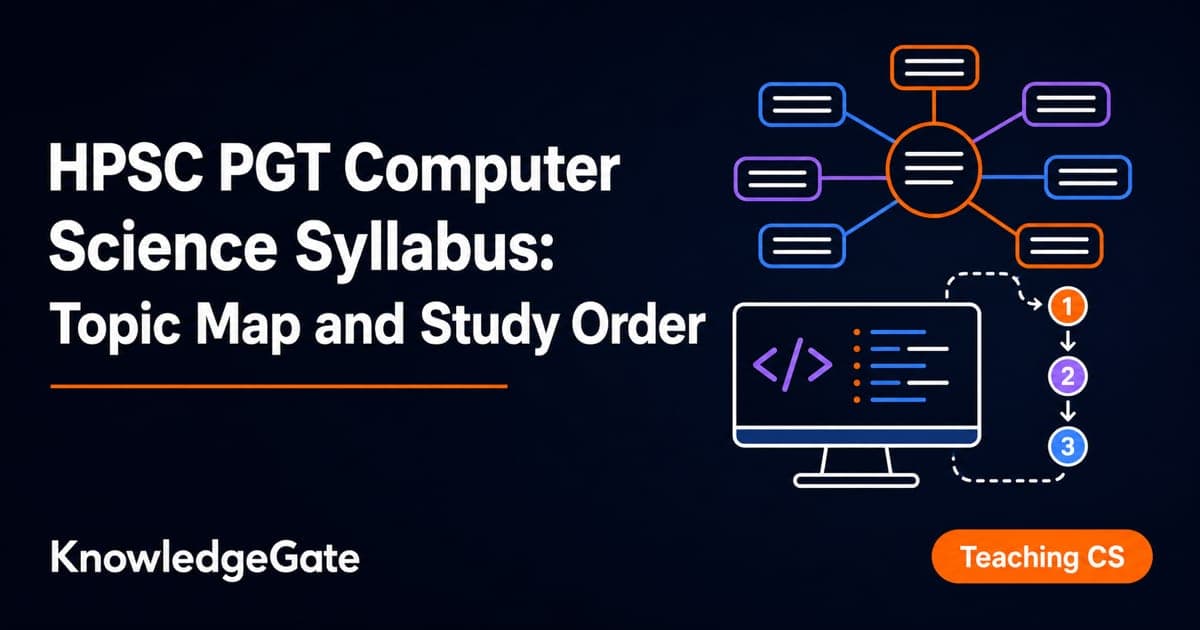
HPSC PGT Computer Science Syllabus: Topic Map and Study Order
Turn a flat HPSC PGT Computer Science checklist into six connected preparation lanes. Use the worked school-lab case and balanced diagnostic to decide what to repair next.
Updated 29 Jul 20266 min read76 viewsHPSC Teaching
HPSC Teaching Computer Science: 14-Week Study Plan for Working Aspirants
Use a repeatable 12-hour week to map the official syllabus, diagnose six CS lanes, practise retrieval, review timed sets and finish with focused revision.
Updated 27 Jul 20266 min readHPSC Teaching