HPSC Teaching CS Weightage: Rank Topics with Four Evidence Signals
Build a defensible HPSC Computer Science revision order without invented percentages. Score syllabus gaps, verified recurrence, prerequisite reach and fresh weakness, then turn the result into a ten-hour week.
KnowledgeGate Team
Exam prep & CS education
Updated 1 Aug 20265 min read
A wide HPSC Computer Science syllabus and ten revision hours in the week force one hard choice: what goes first? The weightage tables circulating for this recruitment quote tidy percentages without naming the syllabus document or the papers behind them, so you cannot check a single figure in them. A ranking you build yourself is checkable: score every syllabus area on unfinished breadth, source-verified paper recurrence, prerequisite reach and fresh-question performance, then let the arithmetic set the order. What comes out is your own revision priority, not an official HPSC marks share. The HPSC PGT Computer Science Exam Prep page holds the exam-scoped material, and the Commission's notification stays the source for every official number.
1. Define what weightage can and cannot mean
An applicable, already-issued HPSC syllabus sets the outer boundary. Verified papers show only the sample you have actually audited. Your own gaps decide what deserves the hours. Neither heading order nor module length proves an official marks share unless HPSC states one, so the score below ranks revision and nothing else: it does not predict the next paper, and it never drops a listed topic just because no verified paper has hit it yet.
Marks, stage counts, question counts, dates and negative-marking rules come from the applicable notification on the Haryana Public Service Commission portal. Get the listed syllabus into workable groupings before you score anything; HPSC PGT Computer Science Syllabus: Topic Map and Study Order works through that grouping lane by lane.
2. Build a syllabus map and a paper ledger
The syllabus map needs these columns:
Official unit, spelled the way the syllabus spells it
Source document and page number
Unfinished listed lines, counted
Downstream topic groups it unlocks
Date last revised
Fresh score out of 10
Count distinct visible lines or subunits, including listed items with no paper appearance.
The paper ledger needs:
Paper ID
Post applied for, and the paper name
Source URL or file
Source status, official or unofficial
Question number
Primary topic
Secondary dependency
Answer-key status
Duplicate check
A paper adds to recurrence only after its identity checks out against an HPSC publication. Label third-party scans unofficial, give memory-based recalls zero, and count a repost once. Practice sets and mocks diagnose ability, but they never enter official-paper recurrence.
3. Score four signals on bounded scales
S, official-syllabus gap breadth: 0 for no unfinished line, 1 for one, 2 for two, 3 for three, and 4 for four or more.
R, verified recurrence: 0 to 4, counting which of four distinct verified paper IDs contain a primary topic tag. Paper presence stops one paper dominating.
P, prerequisite reach: 0 unlocks none, 1 unlocks one later topic group, 2 unlocks two, and 3 unlocks three or more.
W, personal weakness: in a fresh ten-question diagnostic, 9 to 10 correct gives 0, 7 to 8 gives 1, 5 to 6 gives 2, 3 to 4 gives 3, and 0 to 2 gives 4.
The score is Priority = 3S + 2R + 2P + 3W, so the maximum is 3(4) + 2(4) + 2(3) + 3(4) = 38. Gaps and weakness carry the strongest coefficients. Recurrence informs the order but cannot control it. Protect every listed unfinished topic, even at R=0.
4. Worked example: rank five HPSC CS areas
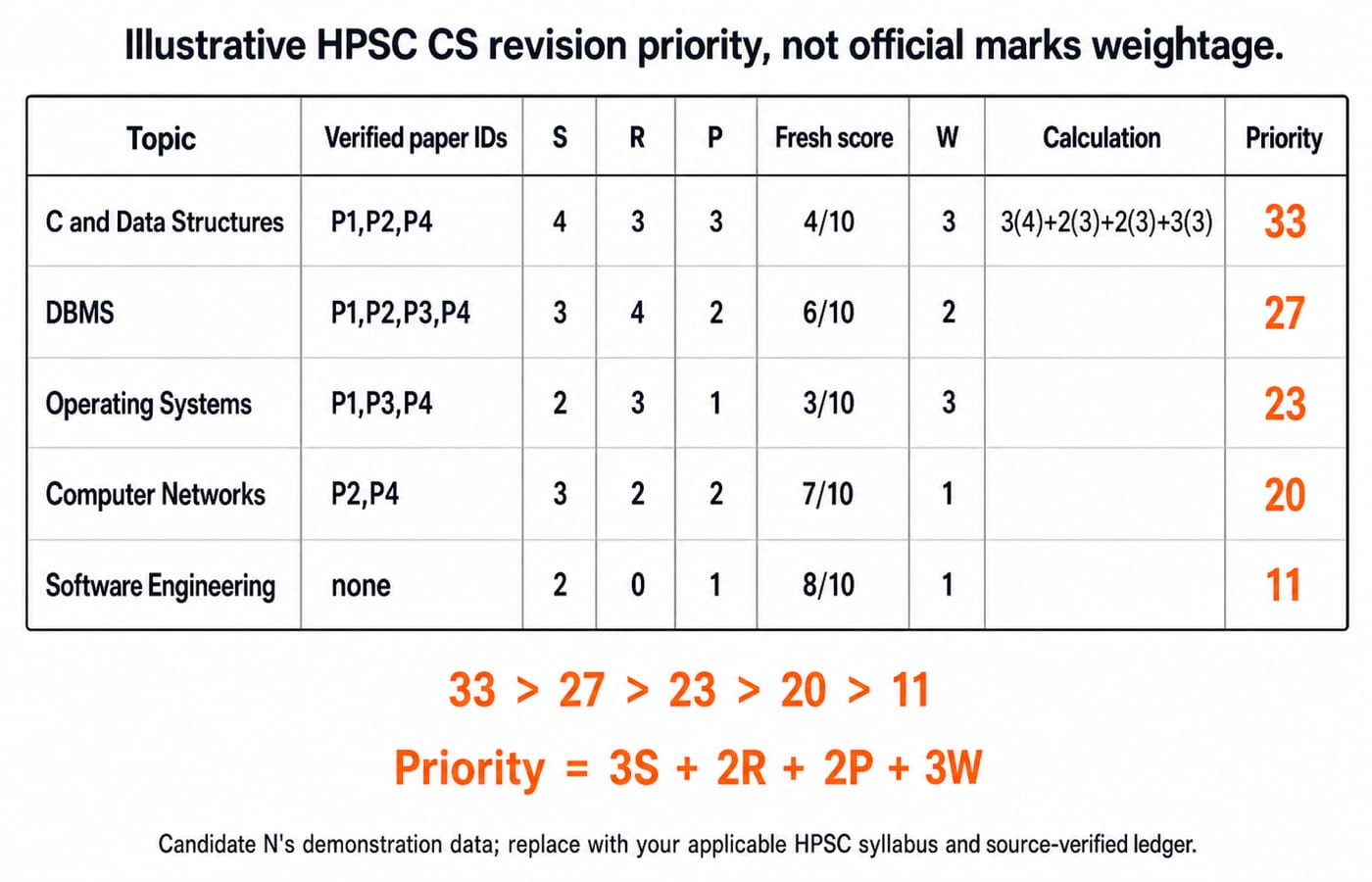
The five rows are Candidate N's demonstration data, not HPSC paper history. P1 to P4 stand for four papers she had already identity-checked against a Commission publication.
Topic | Verified paper IDs | S | R | P | Fresh score | W | Calculation | Priority |
|---|---|---|---|---|---|---|---|---|
C and Data Structures | P1, P2, P4 | 4 | 3 | 3 | 4/10 | 3 | 12 + 6 + 6 + 9 | 33 |
DBMS | P1, P2, P3, P4 | 3 | 4 | 2 | 6/10 | 2 | 9 + 8 + 4 + 6 | 27 |
Operating Systems | P1, P3, P4 | 2 | 3 | 1 | 3/10 | 3 | 6 + 6 + 2 + 9 | 23 |
Computer Networks | P2, P4 | 3 | 2 | 2 | 7/10 | 1 | 9 + 4 + 4 + 3 | 20 |
Software Engineering | none | 2 | 0 | 1 | 8/10 | 1 | 6 + 0 + 2 + 3 | 11 |
The order is 1 C and Data Structures 33, 2 DBMS 27, 3 Operating Systems 23, 4 Computer Networks 20, 5 Software Engineering 11. DBMS has the highest recurrence, but C and Data Structures wins through breadth, prerequisite reach and weakness. Software Engineering keeps protected time because it remains listed despite zero hits.
5. Convert the scores into a ten-hour HPSC revision week
The scores total 33 + 27 + 23 + 20 + 11 = 114, and 600 minutes divides into twenty 30-minute blocks. Proportional shares are 5.79, 4.74, 4.04, 3.51 and 1.93 blocks. Take the whole parts, 5 + 4 + 4 + 3 + 1 = 17, then hand the three spare blocks to the largest fractions: Software Engineering at 0.93, C and Data Structures at 0.79 and DBMS at 0.74. Final blocks are 6, 5, 4, 3 and 2, so C and Data Structures gets 180 minutes, DBMS 150, Operating Systems 120, Computer Networks 90 and Software Engineering 60. Check: 180 + 150 + 120 + 90 + 60 = 600.
Inside the top slot, split 180 minutes into 90 for concept repair, 60 for fresh questions and 30 for error-log review. Software Engineering's 60 splits equally across closed-book recall, fresh questions and review. If concept repair is where you keep stalling, the HPSC PGT Computer Science 2026 complete course carries that teaching already sequenced.
6. Re-rank from fresh evidence
After one week, C and Data Structures improves from 4/10 to 8/10. Its W falls from 3 to 1, making priority 12 + 6 + 6 + 3 = 27. DBMS returns 5/10, so W=2 and priority stays 27. Break the tie by lower fresh score: DBMS at 5/10 moves ahead of C and Data Structures at 8/10.
Change R only when a distinct, source-verified HPSC paper enters the ledger, never after a quiz or a mock. Keep S tied to unfinished syllabus lines and P tied to the dependency map. For the solve, review and repair loop that produces the fresh scores, HPSC PGT Computer Science PYQs: Build an Error-Driven Practice Loop sets out the tagging, and the HPSC PGT (CS) Test Series supplies timed sets to score against.
7. Audit the ranking and take the next 60 minutes
Run four checks:
Replace invented percentages with the visible four-signal score.
Collapse duplicate paper uploads into one paper ID.
Keep guessed-correct answers in the weakness log.
Protect time for every officially listed zero-hit topic.
Mark any unsourced paper, syllabus line or answer key unknown.
Spend the next hour as follows: 15 minutes saving and page-labelling the applicable syllabus, 20 creating the paper ledger, 20 attempting ten fresh questions in the weakest mapped area, and 5 calculating the first score. Check: 15 + 20 + 20 + 5 = 60.
The short version: official scope decides what stays on the list, verified papers show limited recurrence, prerequisites reveal leverage, and fresh performance sets urgency. Send concept gaps to the complete course and timed-application gaps to the test series. Then re-score from evidence rather than from a percentage someone else invented.
Keep learning
HPSC PGT Computer Science: Algorithms and Computer Architecture Problems
Learn a two-lane method for Algorithms and Computer Architecture practice, with verified Dijkstra, direct-mapped cache, and pipeline examples.
Updated 6 Aug 20265 min readHPSC Teaching
HPSC PGT vs DSSSB TGT Computer Science: Choose Haryana or Delhi
Use a qualification gate, syllabus-overlap calculation and weighted fit score to decide whether HPSC PGT or DSSSB TGT Computer Science deserves your next study block.
Updated 4 Aug 20266 min readHPSC Teaching
HPSC PGT Computer Science Syllabus: Topic Map and Study Order
Turn a flat HPSC PGT Computer Science checklist into six connected preparation lanes. Use the worked school-lab case and balanced diagnostic to decide what to repair next.
Updated 29 Jul 20266 min read75 viewsHPSC Teaching
HPSC Teaching Computer Science: 14-Week Study Plan for Working Aspirants
Use a repeatable 12-hour week to map the official syllabus, diagnose six CS lanes, practise retrieval, review timed sets and finish with focused revision.
Updated 27 Jul 20266 min readHPSC Teaching