HPSC Teaching Computer Science: 14-Week Study Plan for Working Aspirants
Use a repeatable 12-hour week to map the official syllabus, diagnose six CS lanes, practise retrieval, review timed sets and finish with focused revision.
KnowledgeGate Team
Exam prep & CS education
Updated 27 Jul 20266 min read

Fourteen weeks can support serious HPSC Computer Science preparation, but only if a working aspirant protects short weekday sessions and gives weekends distinct jobs. Passive watching will not finish a large syllabus. This plan uses exactly 12 hours each week for concepts, retrieval, past-question review, timed home sets and cumulative revision. Use HPSC PGT Computer Science Exam Prep for the lane-by-lane Computer Science material, and the already-issued HPSC notice for the unit list the plan has to fit inside.
1. Protect a 12-hour week before assigning subjects
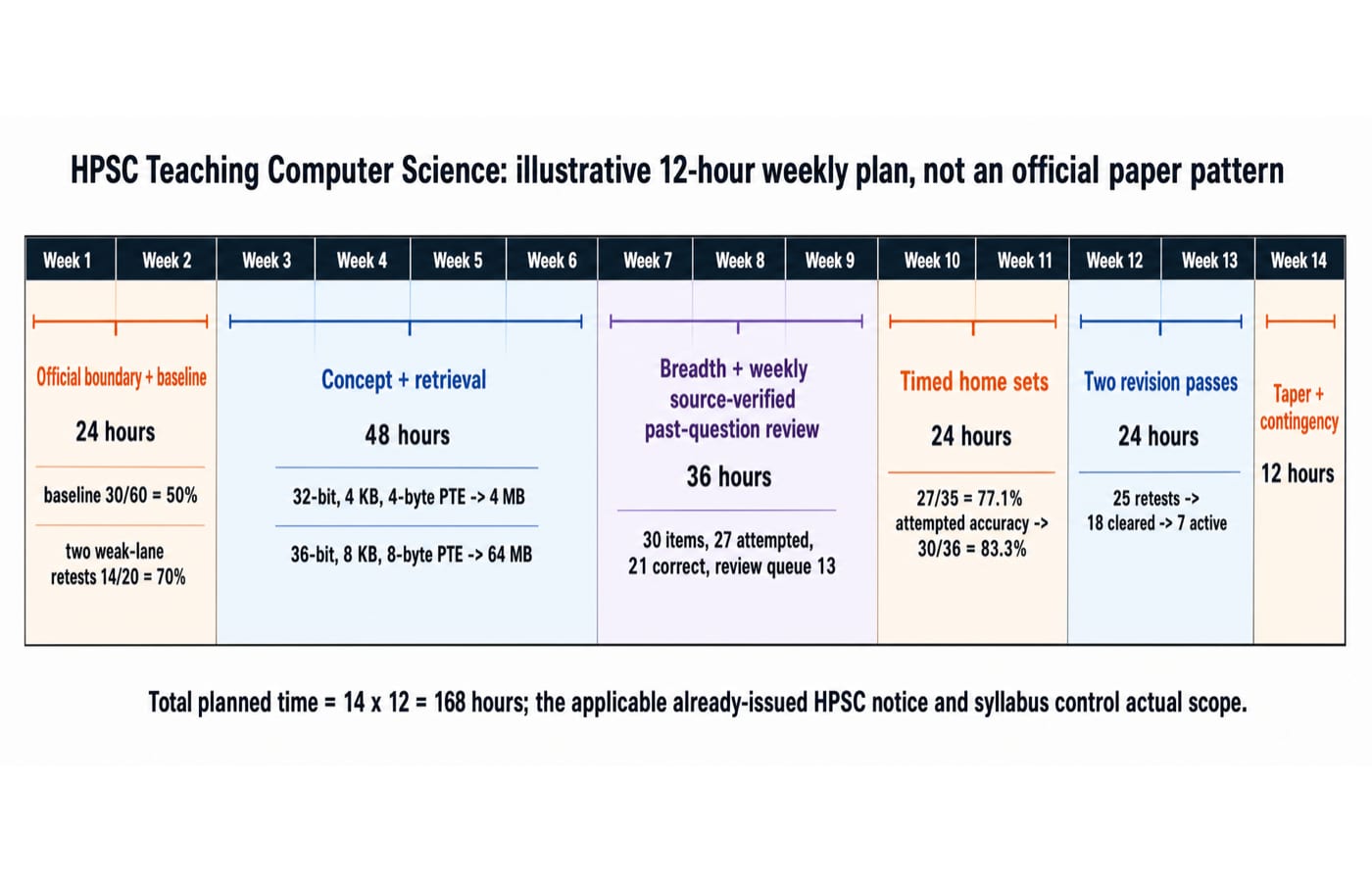
Set Monday to Thursday at 75 minutes each, Friday at 60, Saturday at 210 and Sunday at 150. (4 x 75) + 60 + 210 + 150 = 300 + 60 + 210 + 150 = 720 minutes = 12 hours. Breaks are extra.
Allocate concept learning 240, retrieval 100, questions 210, review and error logging 120, planning and official checks 30, and buffer 20. Check: 240 + 100 + 210 + 120 + 30 + 20 = 720.
Weekdays use 40 concept + 20 retrieval + 15 fresh questions = 75. Friday is 30 past questions + 30 review; Saturday is 80 concept + 60 timed set + 50 review + 20 retrieval; Sunday is 60 mixed set + 40 review + 30 planning or official check + 20 buffer. Fix those blocks in the calendar before assigning subjects to them. A plan built the other way round, subjects first and time hunted afterwards, sheds the weekday sessions first, and the weekday sessions carry the concept work.
2. Weeks 1-2: fix the boundary and establish a baseline
In Week 1, save and date-label the applicable advertisement, syllabus and corrigenda from the official HPSC portal. Build the unit checklist from that document alone: it decides what you study. Every minute count, lane split and set size in this plan is a home-study model shaped to fit inside it.
Run a 60-question, 90-minute home baseline with ten questions per lane: Programming and Data Structures 6/10, DBMS 5/10, Operating Systems and Networks 4/10, Organisation and Digital Logic 7/10, Theory and Compiler Design 3/10, and Software Engineering plus other confirmed CS units 5/10. Thus 6 + 5 + 4 + 7 + 3 + 5 = 30/60 = 50%. Ten per lane is enough to separate a weak lane from a bad morning, and 90 minutes fits the diagnostic inside one Saturday block.
Week 2 repairs Theory and Compiler at 3/10 and Systems at 4/10. Fresh retests of 7/10 each give 14/20 = 70%. Release a lane only at 6/10 on fresh questions with written reasons.
3. Weeks 3-6: pair concept blocks with retrieval
Sequence Week 3 as Programming and Data Structures; Week 4 as Operating Systems and Networks; Week 5 as DBMS plus Organisation and Digital Logic; and Week 6 as Theory, Compiler Design and Software Engineering. Keep only confirmed units. Each weekday remains 40 minutes concept reconstruction, 20 closed-book retrieval and 15 fresh application.
In Week 4, take a 32-bit byte-addressable system with 4 KB = 2^12 pages and 4-byte page-table entries. The page number has 32 - 12 = 20 bits, so the table has 2^20 entries and occupies 2^20 x 4 = 2^22 bytes = 4 MB.
Forty-eight hours later, use a 36-bit address, 8 KB = 2^13 pages and 8-byte entries: 2^(36-13) x 8 = 2^23 x 2^3 = 2^26 bytes = 64 MB. Rebuilding that chain on values you have never seen is what proves retrieval; re-reading the Week 4 note proves only that you can read.
4. Weeks 7-9: widen coverage and review past questions
Week 7 adds the listed secondary material you have not touched yet. Include general, Haryana-specific, language or pedagogy only if listed. Week 8 rotates all confirmed lanes and keeps one 20-minute retrieval block for the weakest topic. Week 9 runs a cumulative checkpoint and closes due error cards first.
Build a 30-question home set from past questions you can trace to a named paper, and label everything else practice. With 27 attempted, 21 correct, 6 wrong, 3 skipped and 4 guessed correct, attempted accuracy is 21/27 x 100 = 77.8%, completion is 27/30 x 100 = 90%, and the review queue is 6 + 3 + 4 = 13. Clear that queue of 13 before the next set: completion is a clock reading, attempted accuracy a concept reading, and the queue what is still owed.
KnowledgeGate carries over 200 HPSC Computer Science practice questions. Reach for them once the traceable past papers are worked through, and read a repeated wrong lane there exactly as you would read it in a paper. HPSC PGT Computer Science PYQs: Build an Error-Driven Practice Loop sets out the tagging and dated-retest machinery this plan assumes from Week 7 onward.
5. Weeks 10-11: use timed sets as diagnosis
Run two timed home sets in Week 10 and three in Week 11, with at least equal review time. In a 40-question, 55-minute set, 35 attempted, 27 correct, 8 wrong, 5 skipped and 4 risky correct give 27/35 x 100 = 77.1% attempted accuracy, 35/40 x 100 = 87.5% completion, and 8 + 5 + 4 = 17 review items.
After repairs, a fresh set gives 36 attempted, 30 correct, 6 wrong, 4 skipped and 3 risky correct. Attempted accuracy is 30/36 x 100 = 83.3%, completion 36/40 x 100 = 90%, total correct rate 30/40 x 100 = 75%, and queue 6 + 4 + 3 = 13. Read the fall in repeated causes rather than the rise in percentage: eight wrong answers with four different causes behind them are four separate repairs, not one. Teaching Exam Mock Strategy for CS Papers sets out the review half of that loop.
6. Weeks 12-13: revise breadth, then errors
Week 12 is the breadth pass: write 60 closed-book prompts, ten per lane. With 48 full, 8 partial and 4 blank, 8 + 4 = 12 enter repair. Allocate 300 recall + 180 fresh questions + 180 review + 60 buffer = 720 minutes.
Week 13 is error-only. Combine those 12 prompts with 13 unresolved Week 11 items: 12 + 13 = 25 retests. Clear 18 after a fresh correct answer and explanation, leaving 25 - 18 = 7. Allocate 240 retest + 180 mixed set + 240 review and repair + 60 official check = 720 minutes.
Do not add a chapter merely to feel productive. Guessed correct answers stay active until reproduced from a fresh stem or fresh values.
7. Week 14: taper honestly and choose the next action
Week 14 stays at 720 minutes: 240 recall, 180 for seven active items, 180 final mixed work, 60 official and practical checks, and 60 contingency. Check: 240 + 180 + 180 + 60 + 60 = 720. If the exam is not close, begin another targeted cycle.
If one 75-minute weekday disappears, use the 20-minute buffer and replace 55 minutes of lower-priority weekend work. After two lost sessions, preserve retrieval, past-question review and repairs, then carry coverage forward. After a lost week, extend the calendar when possible. Never compress 12 + 12 = 24 hours into one week.
For the next 60 minutes, spend 15 saving the syllabus, 30 attempting 20 baseline questions, and 15 creating the error log. Use the HPSC PGT Computer Science 2026 complete course for structured coverage or the HPSC PGT (CS) Test Series for timed application.
Keep learning

HPSC PGT Computer Science: Algorithms and Computer Architecture Problems
Learn a two-lane method for Algorithms and Computer Architecture practice, with verified Dijkstra, direct-mapped cache, and pipeline examples.
Updated 6 Aug 20265 min readHPSC Teaching
HPSC PGT vs DSSSB TGT Computer Science: Choose Haryana or Delhi
Use a qualification gate, syllabus-overlap calculation and weighted fit score to decide whether HPSC PGT or DSSSB TGT Computer Science deserves your next study block.
Updated 4 Aug 20266 min readHPSC Teaching
HPSC Teaching CS Weightage: Rank Topics with Four Evidence Signals
Build a defensible HPSC Computer Science revision order without invented percentages. Score syllabus gaps, verified recurrence, prerequisite reach and fresh weakness, then turn the result into a ten-hour week.
Updated 1 Aug 20265 min readHPSC Teaching
HPSC PGT Computer Science Syllabus: Topic Map and Study Order
Turn a flat HPSC PGT Computer Science checklist into six connected preparation lanes. Use the worked school-lab case and balanced diagnostic to decide what to repair next.
Updated 29 Jul 20266 min read75 viewsHPSC Teaching