Emerging Technologies in Web Technology: Cloud, IoT, Edge and Blockchain with Worked Examples
Follow 200 factory sensors from MQTT messages to edge decisions, cloud functions, a live dashboard and a toy blockchain. The worked numbers make each role concrete.
KnowledgeGate Team
Exam prep & CS education
Updated 27 Oct 20265 min read
Cloud, IoT, edge computing, serverless and blockchain are often memorised as separate buzzwords. That makes architecture and comparison questions harder because the learner cannot see where each technology belongs. A smart factory links them through MQTT events, WebSocket updates, edge aggregation, serverless processing and a hash-linked record. For GATE CS preparation, reason from this comparison without assuming any official topic weightage.
1. What Makes a Technology "Emerging" in a Web System?
An emerging web technology changes where computation happens, how devices exchange data, how infrastructure scales or how trust is established. Each label has a different job:
IoT produces physical-world data and acts on commands.
Edge or fog processes near the source.
Cloud supplies pooled remote infrastructure.
Serverless runs event-triggered code.
Blockchain maintains a shared, tamper-evident record.
Model | Resource location | Best-fit workload | Latency expectation | Central trade-off |
|---|---|---|---|---|
Grid | Distributed machines | A large job split across nodes | Not proximity-led | Coordination overhead |
Cloud | Provider data centres | Elastic apps, storage and analytics | Network-dependent | Remote dependency |
Edge | Near the data source | Fast filtering and local control | Proximity-led | Limited local capacity |
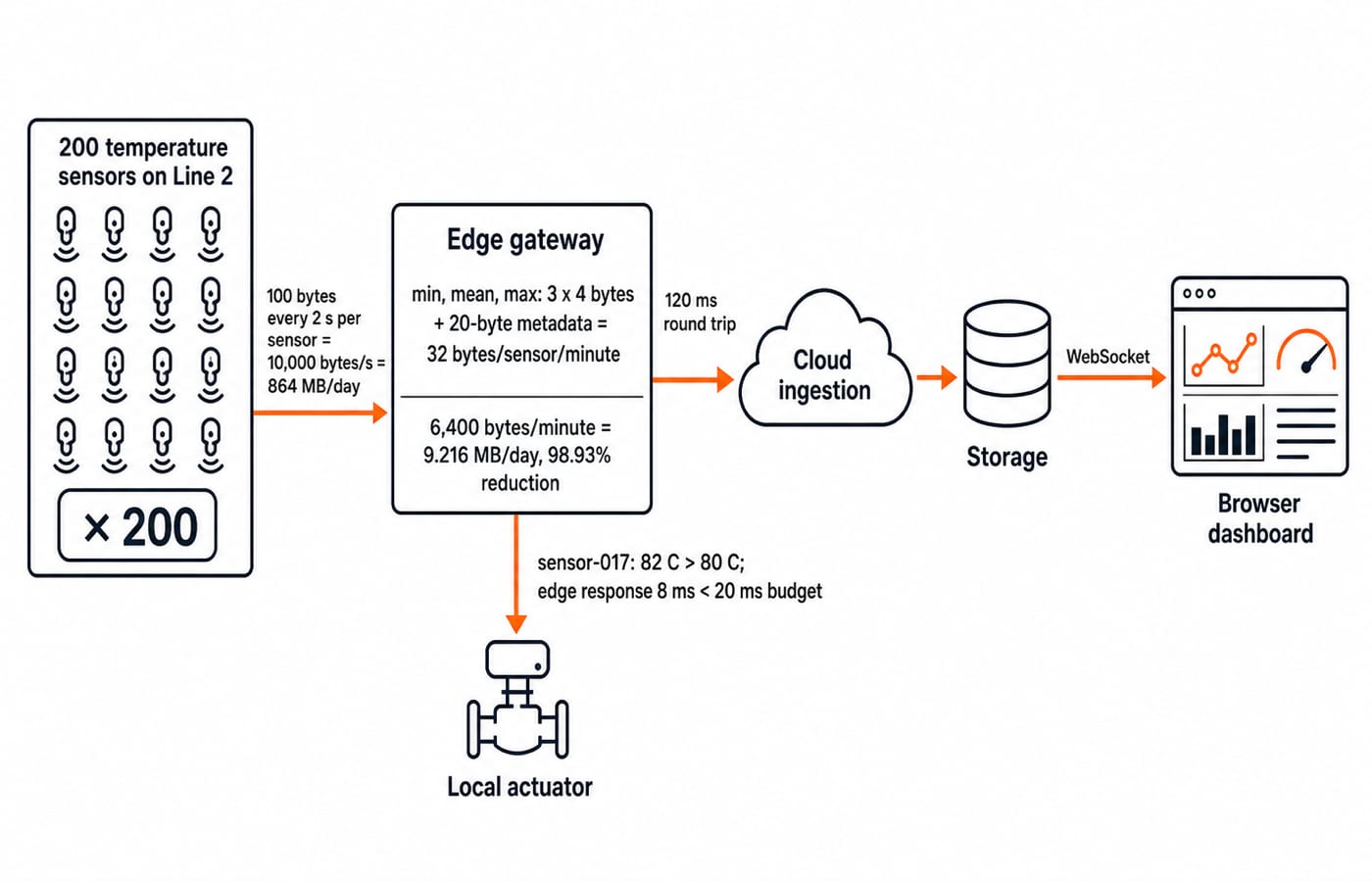
Our system has 200 temperature sensors on factory Line 2, one edge gateway, a cloud function, storage and a browser dashboard. CS Fundamentals for Placements by Sanchit Sir covers Networks, Mobile Technology, Cloud, IoT and Emerging Tech Trends.
2. IoT Devices, Messaging and the Web Dashboard
The path is sensor or actuator, edge gateway, IP network, broker or API, cloud service, then browser. HTTP is request-response, MQTT is broker-based publish-subscribe, and WebSocket carries full-duplex updates. Here MQTT carries device events and WebSocket updates the dashboard. MQTT is not a web-page protocol.
At 14:00:00, sensor-017 publishes 78 C to factory/line-2/temperature/sensor-017. It sends 82 C at 14:00:02 and 85 C at 14:00:04, all at QoS 1. Rule temperature > 80 C makes the 82 C event trigger fan=ON and a dashboard alert. QoS 1 is at-least-once delivery, so consumers must tolerate duplicates.
Practise protocol roles with Computer Networks Application Layer MCQs. Revise addressing through Computer Networks Subnetting and IP Addressing MCQs.
3. Worked Example: How Edge Aggregation Changes Data and Latency
Each of 200 sensors emits one 100-byte reading every 2 seconds. The raw rate is:
200 x 100 bytes / 2 s = 10,000 bytes/s = 10 KB/s
Over 24 hours, using decimal units:
10,000 bytes/s x 86,400 s = 864,000,000 bytes = 864 MB/day
Each per-minute sensor summary contains three 4-byte values, minimum, mean and maximum, plus 20 bytes of metadata:
3 x 4 bytes + 20 bytes = 32 bytes/sensor/minute
200 sensors x 32 bytes = 6,400 bytes/minute
6,400 / 60 = 106.7 bytes/s
6,400 x 1,440 minutes = 9,216,000 bytes = 9.216 MB/day
The reduction is:
(864 - 9.216) / 864 x 100 = 98.93%
Summaries save bandwidth but discard detail, so threshold breaches must bypass aggregation.
Suppose edge decision time is 8 ms, cloud round trip 120 ms, and the safety budget 20 ms. Edge meets it because 8 < 20; cloud-only fails because 120 > 20. These are example values, not benchmarks.
4. Cloud Service Models and Serverless Execution
In IaaS, you manage the app and operating system. In PaaS, the provider manages the runtime too. In SaaS, you consume the finished app. Serverless is an execution model, not a fourth service layer. Servers still exist, but the provider manages them.
If every sensor's one-minute summary triggers a separate function, daily invocations are:
200 x 1,440 = 288,000 invocations/day
If the gateway batches all 200 summaries into one request each minute:
1 x 1,440 = 1,440 invocations/day
The reduction is (288,000 - 1,440) / 288,000 x 100 = 99.5%. Batching reduces overhead, but couples records and may delay one failed item's retry.
The function should be stateless, durable readings belong in storage, and retry-safe processing needs an event ID such as line2-s017-140002.
5. Blockchain in Web Systems: What a Hash Chain Proves
A blockchain is an append-oriented, hash-linked sequence, with consensus deciding the accepted shared state. A replicated database does not require this model. Web3 concerns decentralised ownership, not the whole Web.
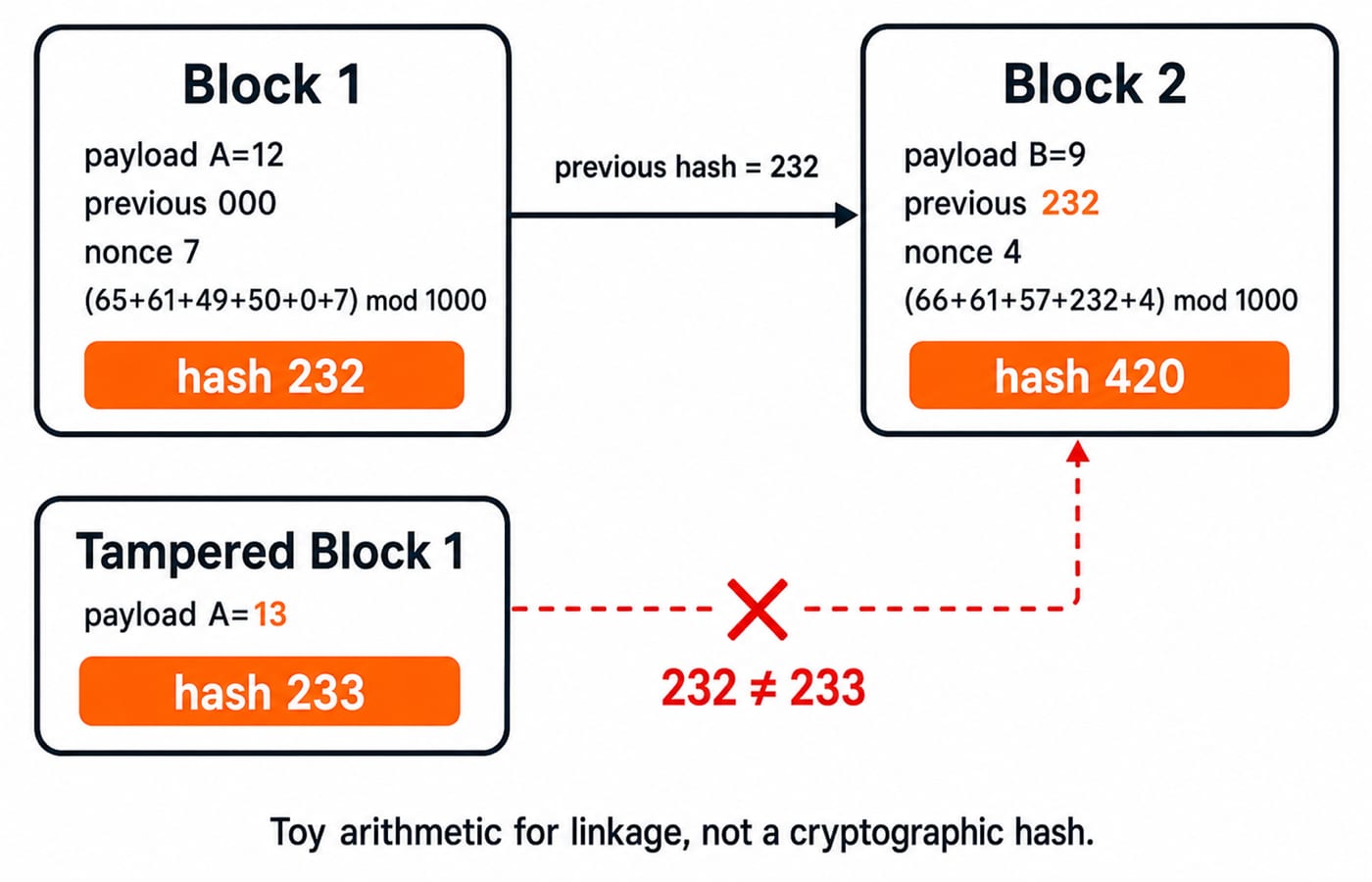
This deliberately non-cryptographic function shows the dependency:
H = (sum of ASCII codes in payload + previous hash as an integer + nonce) mod 1000
Block 1 has payload A=12, previous hash 000 and nonce 7:
(65 + 61 + 49 + 50 + 0 + 7) mod 1000 = 232
Block 2 has payload B=9, previous hash 232 and nonce 4:
(66 + 61 + 57 + 232 + 4) mod 1000 = 420
Changing Block 1 from A=12 to A=13 changes ASCII 50 to 51, so its hash becomes 233. Block 2 still stores 232, exposing the break. Real chains use cryptographic hashes plus consensus. This function shows linkage only and provides no security.
6. Common Traps and the Correct Replacement
Wrong shortcut | Why it fails | Use instead |
|---|---|---|
IoT is any sensor | A sensor may be disconnected | A connected, identified device |
Edge removes the cloud | Local work does not replace coordination | Local decisions plus central services |
Serverless has no servers | Infrastructure still runs code | Provider-managed servers |
Blockchain makes data true | Inputs may be false | History that is harder to alter unnoticed |
More raw data is always better | Retention, privacy and bandwidth matter | Keep data for a defined need |
Keep units on every line. Decimal KB and MB differ from binary KiB and MiB. Convert before comparing bytes/s with bytes/minute.
QoS 1 may duplicate sensor-017. Idempotent fan=ON processing uses event ID line2-s017-140002, making a retry the same logical action.
7. How Exams and Interviews Can Test These Concepts
Questions may test service models, edge versus cloud, aggregated bandwidth, protocol choice, hash pointers and duplicate delivery.
Try this: if sensors double from 200 to 400 while every other value stays fixed, what happens to raw daily volume?
2 x 864 MB = 1,728 MB/day
The 8 ms decision time is not automatically doubled. Volume and latency are different quantities.
Defend why 20 ms decisions stay at the edge while summaries go to cloud storage. For each path, give a failure and mitigation: gateway outage with safe fallback; cloud retry with idempotent handling. GATE aspirants should confirm the current syllabus on the organising institute's official portal. Do not assume "Emerging Technologies" is named or weighted unless that syllabus says so.
8. The Short Version and the Next Step
Use five questions to choose the component:
Where is data created? This identifies IoT.
What is the response deadline? A tight deadline points to edge.
What can be aggregated? This separates filtering from cloud storage.
Who manages the runtime? This separates service models and serverless.
Is shared, tamper-evident history needed? This points to blockchain.
For wider context, continue with CS Fundamentals above. For exam-focused study, use GATE Guidance by Sanchit Sir. Redraw the diagram and reproduce 864 MB/day, 9.216 MB/day, 98.93%, 288,000, 1,440, 232 and 420 from memory.
Keep learning
Electronic Data Interchange (EDI) and E-Commerce: Layers, X12 Segments and Legal Validity Explained
Learn EDI from the business document to the X12 envelope, then follow it through a VAN, a 997 acknowledgment, signature verification and Indian cyber law.
Updated 26 Oct 20265 min readGATE Strategy & Roadmap
Cyber Threats and Malware Attacks: Types, Attack Vectors, and Worked Security Problems
Learn to distinguish malware classes, map attacks to the CIA triad, and solve password, cipher, and key-count numericals. The guide also covers common attack vectors and a safe way to study Indian cyber law.
Updated 24 Oct 20266 min readGATE Strategy & Roadmap
Cyber Safety and Security: Information Security and Cyber Law with Worked Examples
Learn information security as an applied subject. Classify security failures, work Caesar and RSA examples, separate common attacks, and revise India's cyber-law framework.
Updated 22 Oct 20266 min readGATE Strategy & Roadmap
Internet & Web Technology for GATE: Syllabus Boundary, Weightage Method and Prep Order
Treat Internet and Web Technology as an overlap area, not a promised standalone subject. Build scope, paper-audit, URL-tracing and subnetting skills in a 12-session plan.
Updated 18 Oct 20265 min readGATE Strategy & Roadmap