

Emerging Technology Trends in ICT: AI, Cloud, IoT and Blockchain with Worked Examples
Learn what AI, cloud, IoT, blockchain and related ICT technologies actually do. One smart-classroom case connects the definitions to two worked calculations.
KnowledgeGate Team
Exam prep & CS education
Updated 10 Nov 20265 min read
You may recognise AI, cloud, IoT and blockchain yet still lose marks when a question asks which technology is performing which job. This Knowledge of ICT topic appears in teaching-recruitment preparation, where questions test what each technology does rather than how to build it. A smart-classroom data flow runs from sensors to an AI alert, and the technologies that questions often mix up have distinct roles.
Emerging technology trends in ICT: organise them by the job they do
An emerging technology is developing rapidly in capability, adoption or application. The label changes over time. ICT collects, processes, stores and communicates information.
Technology | Defining job |
|---|---|
IoT | Sense or act in the physical world through connected devices |
Networks | Move data between devices and services |
Edge and cloud | Supply nearby or remote processing and storage |
Big-data systems | Handle scale, speed, variety and data quality |
AI and ML | Infer patterns or decisions from data |
NLP | Process human language |
Computer vision | Process images and video |
Blockchain | Maintain a shared, tamper-evident record |
AR and VR | Overlay digital content or create an immersive simulation |
Robotics | Combine sensing, control and physical action |
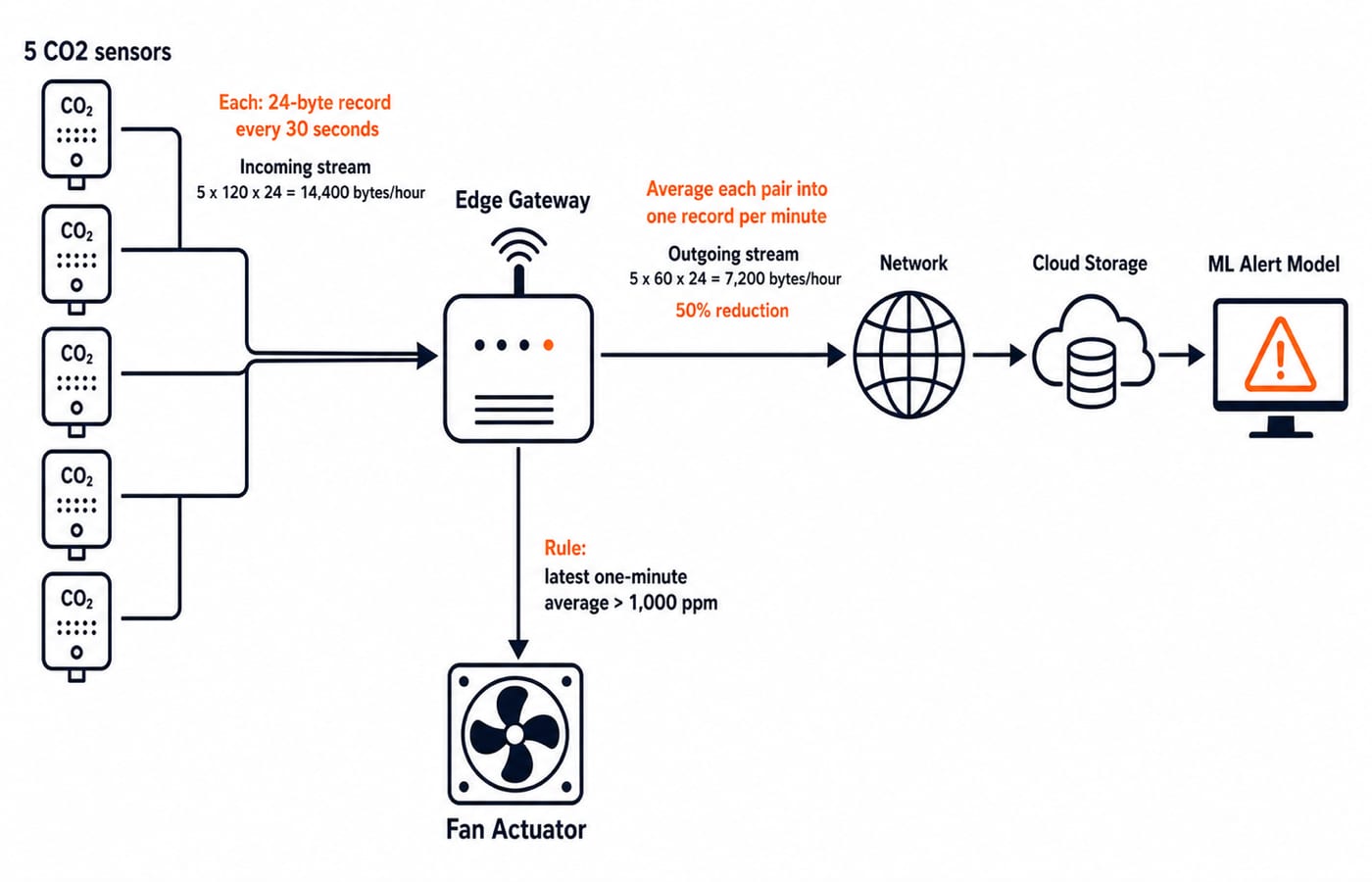
Five classrooms each have one CO2 sensor. An edge gateway reduces their data, cloud storage keeps it, and a binary ML model flags ventilation needs.
IoT, edge and cloud: follow one smart-classroom data pipeline
An IoT chain can include a sensor, controller, network, gateway, edge processing, cloud platform, application and actuator. Each sensor creates one 24-byte record every 30 seconds, or 120 readings per hour:
5 sensors x 120 readings x 24 bytes = 14,400 bytes per hour
The edge gateway averages each pair of consecutive readings. It now sends one 24-byte record per sensor per minute:
5 x 60 x 24 = 7,200 bytes per hour
The reduction is 14,400 - 7,200 = 7,200 bytes, and 7,200 / 14,400 x 100 = 50%. Edge computing works close to the source. Cloud computing supplies remote shared compute, storage and services. Neither means the internet.
If the latest one-minute average exceeds 1,000 ppm, a local controller turns on a fan. This deterministic rule is not the ML model and works during a cloud outage. The cloud keeps the reduced history for model evaluation.
AI, machine learning, NLP and computer vision: separate the family from its tasks
AI covers systems performing tasks associated with intelligent behaviour. ML learns patterns from data. Supervised learning uses labels, unsupervised learning finds patterns without them, and reinforcement learning improves actions through rewards. A fixed threshold is not automatically ML.
NLP handles human language, such as written teacher feedback. Computer vision handles images or video, such as counting students. Our CO2 model uses structured values, so it is neither. Robotics may use AI, vision and sensors, but is not their synonym.
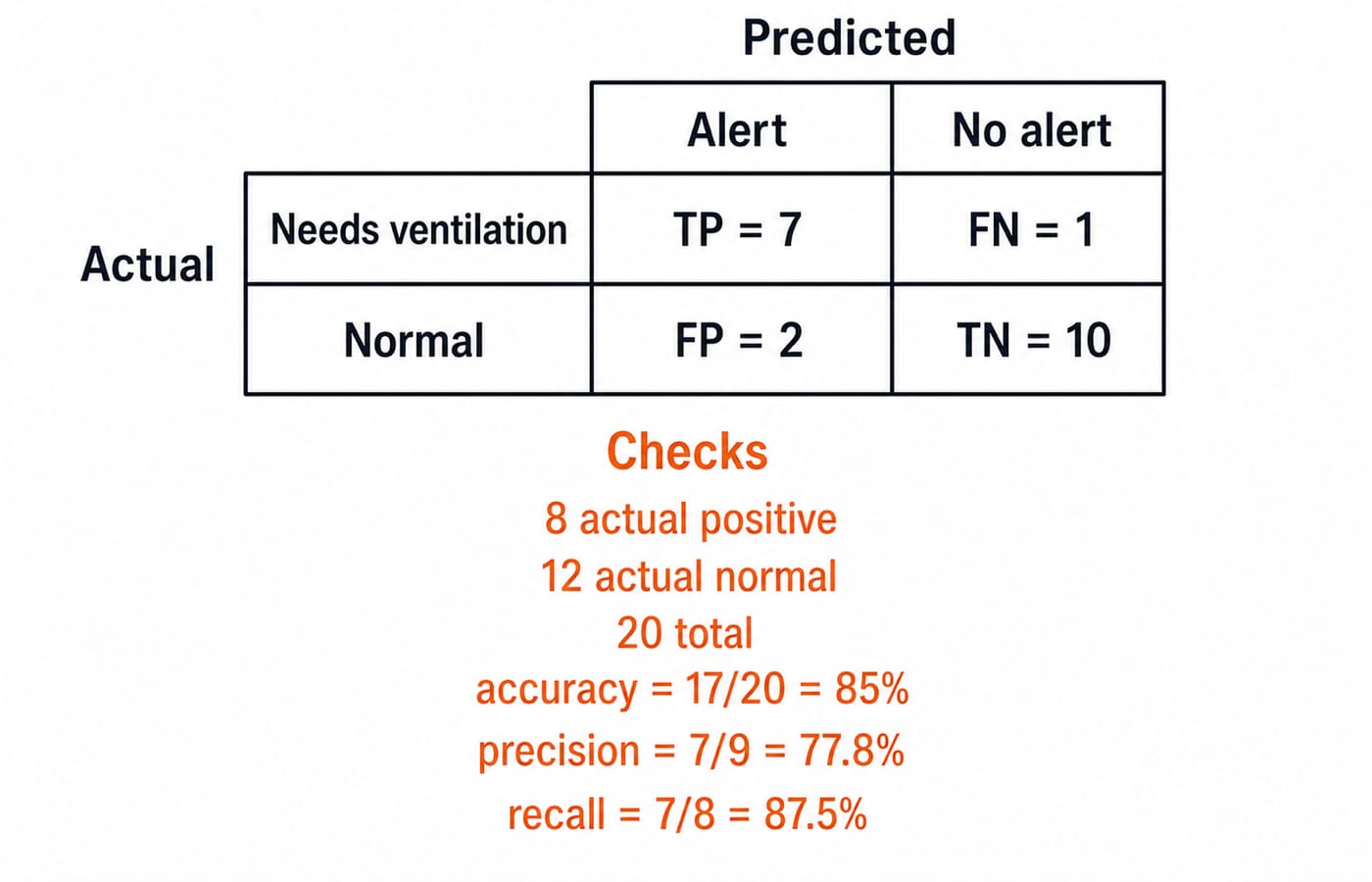
Evaluate the alert model on 20 labelled classroom periods. Eight need ventilation and 12 do not. It correctly flags 7, misses 1, falsely flags 2 normal periods and correctly leaves 10 normal. Therefore TP=7, FN=1, FP=2, and TN=10.
Accuracy =
(TP + TN) / total = (7 + 10) / 20 = 17/20 = 85%Precision =
TP / (TP + FP) = 7 / (7 + 2) = 7/9 = 77.8%Recall =
TP / (TP + FN) = 7 / (7 + 1) = 7/8 = 87.5%
Accuracy alone does not show the cost of the missed alert. The confusion matrix exposes each kind of result.
Cloud, big data and grid computing: related ideas with different boundaries
Cloud service models describe responsibility. IaaS offers virtualised infrastructure, PaaS a managed application platform, and SaaS a finished application. Public, private and hybrid are deployment models, not service models.
Big data involves volume, velocity, variety, veracity and value. Our stream has velocity and needs quality checks, but 14,400 bytes per hour is not big just because sensors produced it. Many schools could raise the scale, but no universal byte threshold defines big data.
Grid computing coordinates distributed resources for a large task, while cloud computing exposes pooled resources as elastic services. Four equal workers dividing 1,000 archived files receive 1,000 / 4 = 250 files each. Equal allocation does not guarantee equal completion time.
Blockchain, AR, VR and robotics: choose by mechanism
A blockchain is an append-oriented shared ledger with hash-linked blocks and consensus. A maintenance certificate's hash could reveal alteration. Putting every CO2 reading on-chain would not make faulty input truthful, private or secret, so it is not the sensible default.
AR keeps the real-world view and overlays digital content, such as a labelled 3D processor diagram over a real motherboard. VR replaces that view with an immersive simulated environment, such as a virtual network lab.
A robot is a programmable physical system that senses, follows control logic or decides, and acts. A line-following robot can use two sensors and motor rules without ML. The cloud CO2 classifier is AI and ML but not robotics because it has no body or motion.
Common traps in emerging technology questions
Cloud, internet and web are not synonyms. The internet is network infrastructure, the web is one service using it, and cloud computing delivers pooled resources remotely. IoT needs physical sensing or actuation and a connected data flow, not merely an online laptop.
AI, ML, NLP and robotics are not at one taxonomic level. Blockchain is not an ordinary database and cannot guarantee correct input. Identify the input, transformation and output, then match the mechanism. Sensor-to-fan is IoT plus control, text sentiment is NLP, and labels over a real object are AR.
How teaching-recruitment exams test emerging ICT trends
Questions commonly ask you to match a definition, classify a classroom scenario, separate adjacent concepts, expand an abbreviation, choose a data flow, or calculate a metric from figures given in the question. The smart-classroom example reduces 14,400 to 7,200 bytes per hour, and the model's recall is 7/8 = 87.5%.
Apply those distinctions to more than 140 Emerging Tech Trends practice questions. Use the current recruiting-body notification for any cycle-specific syllabus, date or exam pattern.
Use Teaching CS Exams Compared: DSSSB, KVS, RSSB to identify the relevant recruiting route. Computer Science Pedagogy for Teacher Exams connects technology definitions to classroom application, while Govt Teaching Job Exam Preparation is the broader preparation hub.
Emerging technology trends in ICT: the short version and next step
Remember sense -> connect -> process -> learn -> present or act -> record. IoT senses, networks connect, edge or cloud processes, ML learns, AR or VR presents, a robot acts, and blockchain preserves a shared tamper-evident record when needed.
Redraw both diagrams from memory. Check that edge averaging cuts 14,400 to 7,200 bytes per hour, while the model gives 85% accuracy, 77.8% precision and 87.5% recall. Then solve mixed identification questions.
The Teaching Recruitment Exams Bundle is the broad next step if you are preparing across teaching recruitments. If DSSSB TGT Computer Science is your specific route, use the DSSSB TGT Computer Science 2026 Bundle instead.
Go deeper with the full courseGATE Guidance by Sanchit Sir
Keep learning
Emerging Technologies in Web Technology: Cloud, IoT, Edge and Blockchain with Worked Examples
Follow 200 factory sensors from MQTT messages to edge decisions, cloud functions, a live dashboard and a toy blockchain. The worked numbers make each role concrete.
Updated 27 Oct 20265 min readGATE Strategy & Roadmap
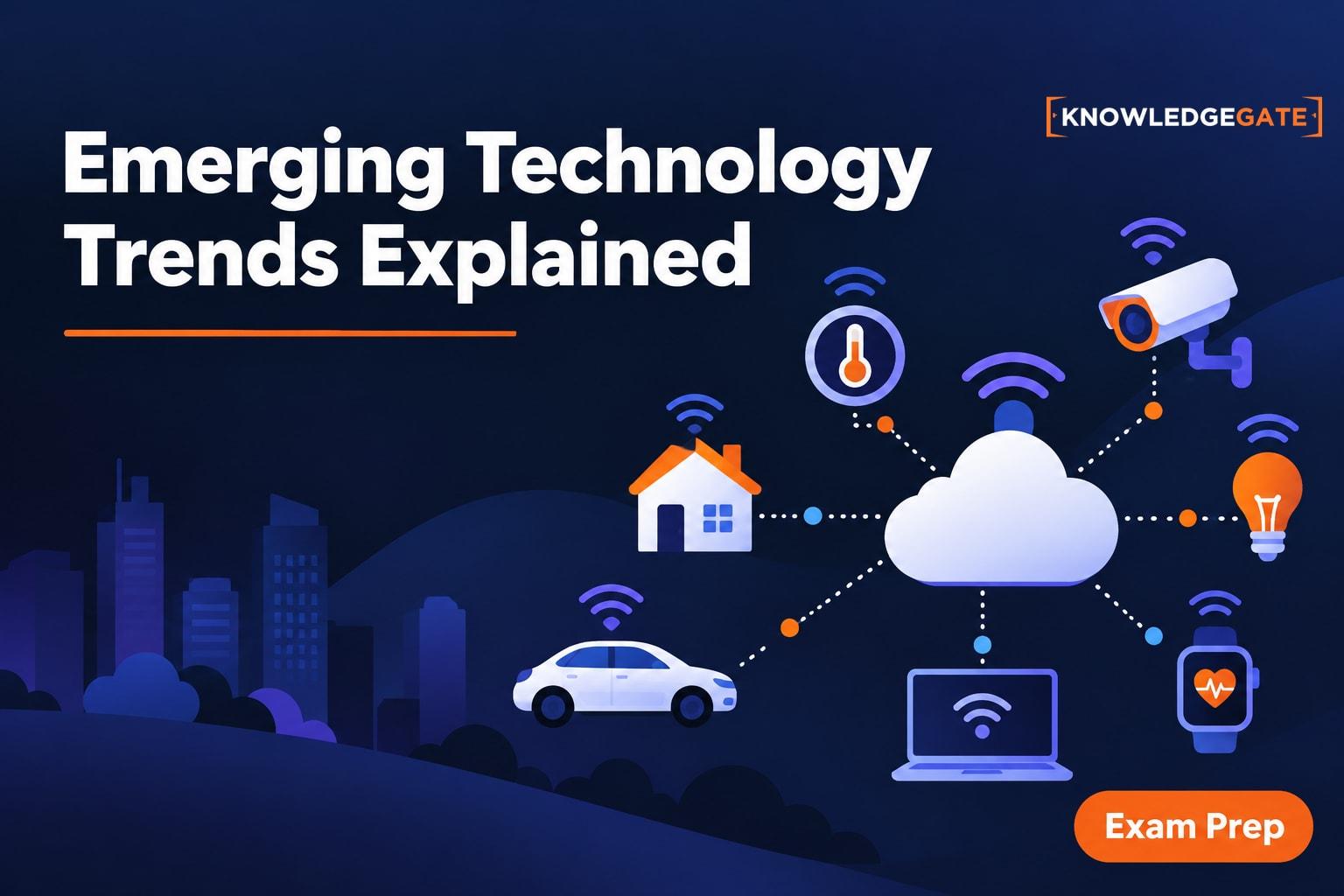
Emerging Technology Trends Explained: Concepts and a Worked IoT Example
Separate IoT, edge, cloud, AI, blockchain, 5G, big data and AR/VR by the job each performs. Then follow a smart-irrigation stack and verify its 75% payload reduction.
Updated 29 Oct 20265 min readTeaching Recruitment (Computer Science)
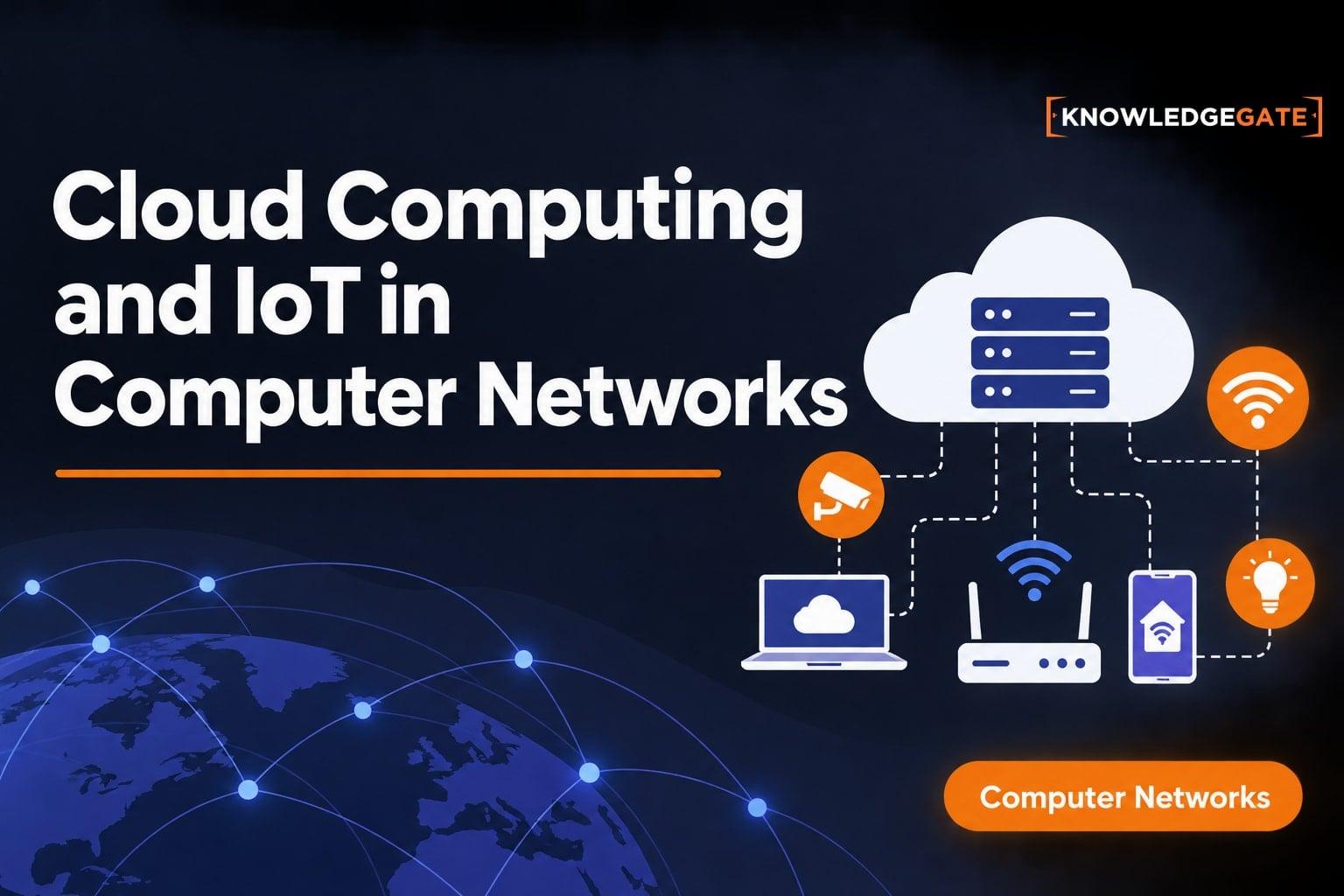
Cloud Computing and IoT in Computer Networks: Complete Guide with Worked Examples
Learn how cloud models, IoT protocols, network throughput, messaging overhead, and edge latency fit together through three solved examples.
Updated 30 Oct 20265 min readComputer Networks
Society, Law and Ethics in ICT: Concepts, Cases and Exam Traps
Learn to separate social impact, legal rules, ethical duties and cyber safety in ICT, then apply the framework to a fully worked campus-portal case.
Updated 18 Nov 20266 min readGATE Strategy & Roadmap