

GATE 2015 C Programming Questions: Topic Map and Worked Traces
Knowing a C rule is only the start. Trace pointer updates, recursion and persistent state in GATE 2015 questions, then use the topic map to plan revision.
KnowledgeGate Team
Exam prep & CS education
Updated 24 Nov 20264 min read
You may remember how pointers and recursion work, yet lose track when an unfamiliar C program combines several rules. The solution is to record each state change instead of guessing the output from a familiar pattern. A state table for each trace keeps the changed object and the resulting output visible.
What the published 2015 sample covers
The 14-question sample and its year/set labels come from KnowledgeGate's published GATE CS 2015 records; confirm set labels against the official GATE 2015 CS question papers archived by IIT Kanpur.
The table groups the 14 questions by the C rule each one exercises: arrays and pointers dominate, while functions, control flow, and storage examples supply the remaining traces.
Topic group | Questions |
|---|---|
Arrays & Pointers | 7 |
Functions | 3 |
Control Flow | 2 |
Storage Classes, Structures & Enums | 2 |
Total | 14 |
Arrays and pointers test which object an expression reaches and changes. Functions test parameter passing, recursive return values and call counts. Control flow tests integer arithmetic and switch fall-through. The storage examples test local, global and static state across calls.
Use the map alongside the GATE, PSU, Engineering & Technical Exams to choose practice themes.
Value parameters versus pointer parameters
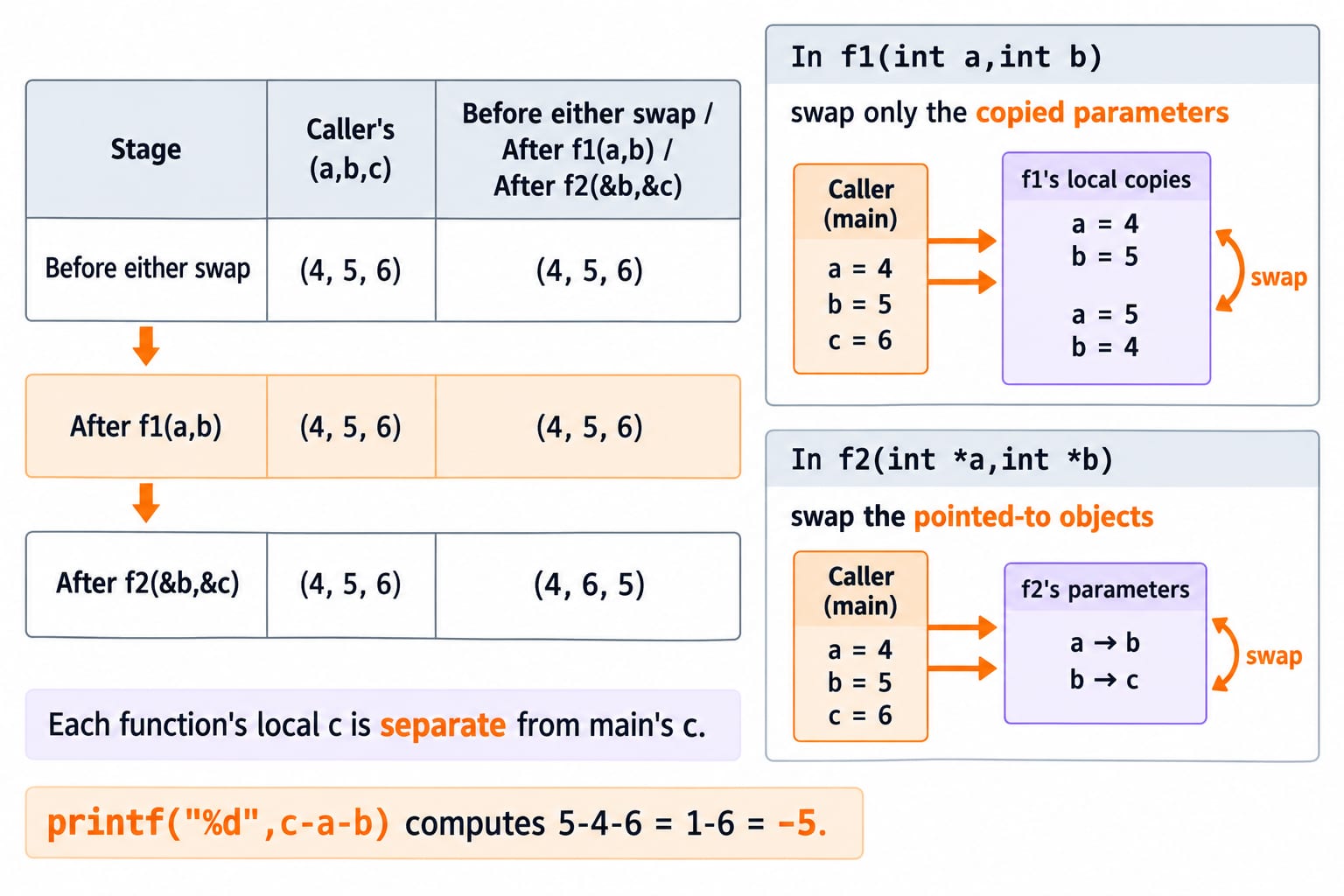
Consider the two-swap-functions question. (GATE 2015 Set 1, see the solved page)
The caller starts with a=4, b=5, c=6. In f1(int a,int b), the statements c=a; a=b; b=c; use a local int c and swap only the copied parameters. In f2(int *a,int *b), the statements c=*a; *a=*b; *b=c; swap the pointed-to objects.
Stage | Caller's |
|---|---|
Before either swap |
|
After |
|
After |
|
Each function's local c is separate from main's c. Only dereferencing the pointers in f2 reaches main's b and c. Therefore, printf("%d",c-a-b) computes 5-4-6 = 1-6 = -5.
C passes every argument by value. A copied pointer still identifies a caller object. Keep local and caller variables in separate rows, even in this short trace, to avoid swapping the wrong objects.
Pointer movement and exact printed output
Now trace this pointer-array question. (GATE 2015 Set 3, see the solved page)
static int a[]={10,20,30,40,50};
static int *p[]={a,a+3,a+4,a+1,a+2};
int **ptr=p;
ptr++;
printf("%d%d",ptr-p,**ptr);
ptr++ advances by one element of p, whose elements are pointers. Track the levels separately:
Expression after increment | Value |
|---|---|
|
|
|
|
|
|
|
|
The intended exam output is 140, because the format contains no space between the conversions. Writing 1 40 changes the output.
There is also a type issue: pointer subtraction produces ptrdiff_t. The portable format here is %td%d; %d is not correct for ptrdiff_t on every platform. Separate the intended arithmetic answer from the original format's portability problem.
Recursion: returned values and invocation counts
The Set 2 return-value question uses this function:
int fun(int n){
    int x=1,k;
    if(n==1)return x;
    for(k=1;k<n;++k) x=x+fun(k)*fun(n-k);
    return x;
}
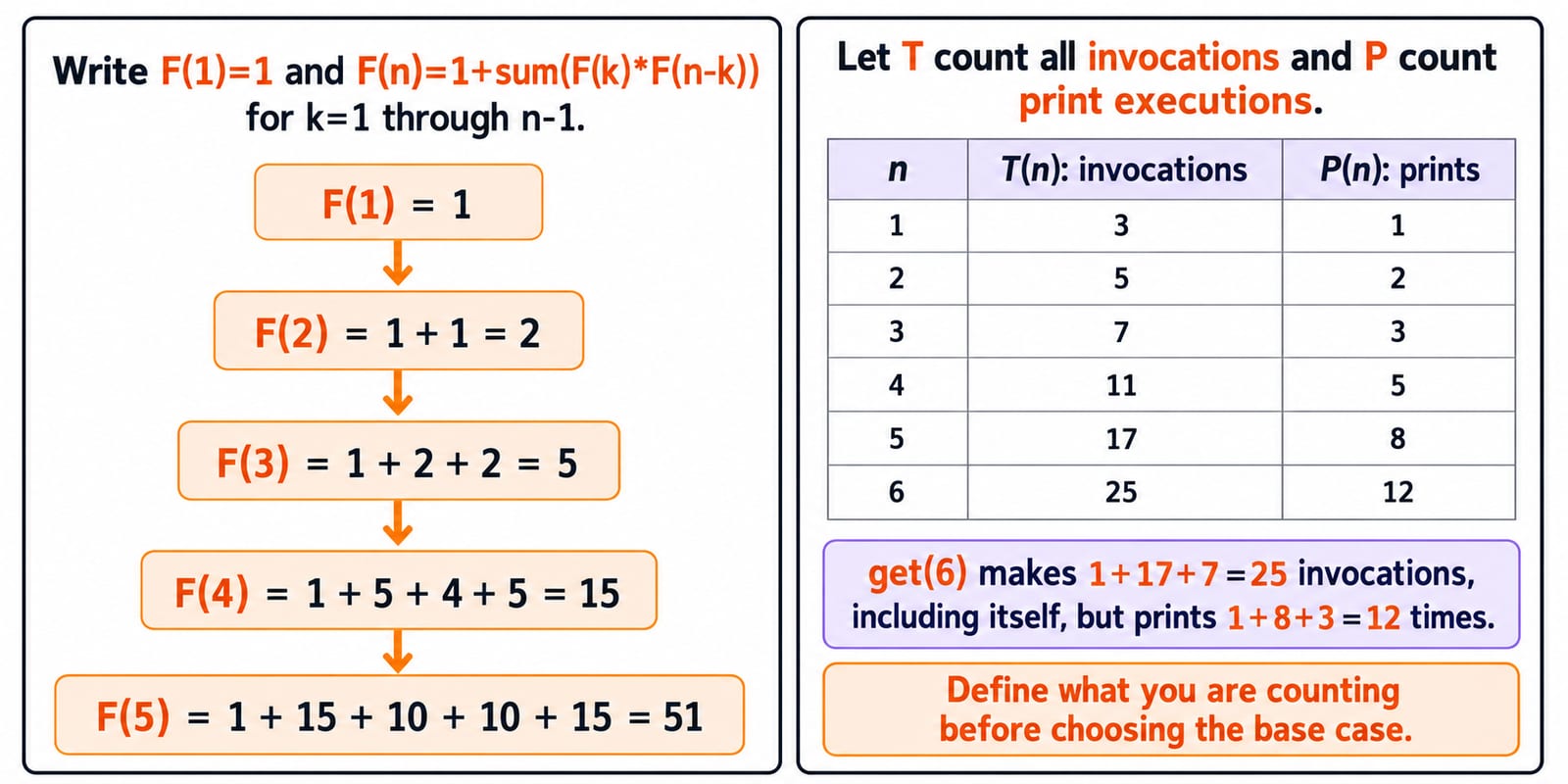
Write F(1)=1 and F(n)=1+sum(F(k)*F(n-k)) for k=1 through n-1. Then:
F(2)=1+1=2.F(3)=1+2+2=5.F(4)=1+5+4+5=15.F(5)=1+15+10+10+15=51.
The initial 1 belongs to every non-base call, not just the outermost call.
The Set 3 invocation-count question asks something different:
void get(int n){
    if(n<1)return;
    get(n-1);
    get(n-3);
    printf("%d",n);
}
Let T count all invocations and P count print executions. For n<1, T(n)=1 but P(n)=0. Otherwise, each satisfies Q(n)=1+Q(n-1)+Q(n-3).
n | T(n): invocations | P(n): prints |
|---|---|---|
1 | 3 | 1 |
2 | 5 | 2 |
3 | 7 | 3 |
4 | 11 | 5 |
5 | 17 | 8 |
6 | 25 | 12 |
Thus get(6) makes 1+17+7=25 invocations, including itself, but prints 1+8+3=12 times. Define what you are counting before choosing the base case.
Control flow and persistent state need separate ledgers
In the Set 3 control-flow question, j=2*3/4+2.0/5+8/5 gives 1+0.4+1=2.4: both 6/4 and 8/5 use integer division. Assignment to integer j gives 2. Next, k=0; k-=--j; leaves j=1, k=-1.
For i=0..4, the switch receives -1,0,1,2,3. Cases 1 and 2 share a print, followed by a case-3 print and a default print, with no breaks.
Switch value | Prints executed |
|---|---|
-1 | 1 |
0 | 1 |
1 | 3 |
2 | 3 |
3 | 2 |
Total: 1+1+3+3+2=10.
For the Set 3 storage question, keep separate objects: main's local x=1; f1's local x goes from 25 to 26; f2's static x contributes 51 and 52; f3 changes global x from 10 to 100. The sum is 1+26+51+100+52=230. This does not require left-to-right evaluation of +: the static-call contributions total 103 whichever executes first.
Turn the topic map into a revision session
Start with the swap trace and the pointer-array trace. On paper, give every variable or pointer its own row, then write one line for each recursive return and each switch value. Finish by explaining one wrong transition aloud before checking the result. This order keeps object identity, call count, and persistent state as separate error categories.
For pointers, track object identity and type; for recursion, write a recurrence; for storage, keep separate state ledgers. Use the C Programming for GATE: A 6-Week Topic-by-Topic Plan to spread that revision across topics.
What to carry into your next practice set
Identify which object changes, write the recursion quantity being counted, and reproduce the exact format string. If errors keep returning, use the C Language course to rebuild the rules behind them, then solve the traces again without looking at the answers.
Keep learning
GATE 2012 Algorithm Questions: Topic Map and Worked PYQs
Turn the five currently tagged GATE 2012 Algorithm items into a revision plan, with worked concepts and the official Code A outcomes kept separate.
Updated 12 Nov 20265 min readDSA & Algorithms

IBPS PO Previous Year Paper Analysis: Build Your Own Topic-wise Weightage Tally
IBPS does not publish a topic-wise weightage table, so build one you can defend: one column per shift, one label per question, and every column totalling its section's question count.
Updated 29 Oct 20267 min read481 viewsBanking Exams
SSC CGL Previous Year Paper Analysis: Topic-wise Question Distribution in Tier 1
We counted topic recurrence across our question bank built from SSC CGL previous year papers. Section by section, here is which Tier 1 topics repeat the most in quant, reasoning, English and General Awareness, and the study order that follows from the data.
Updated 29 Oct 20265 min read278 viewsSSC CGL
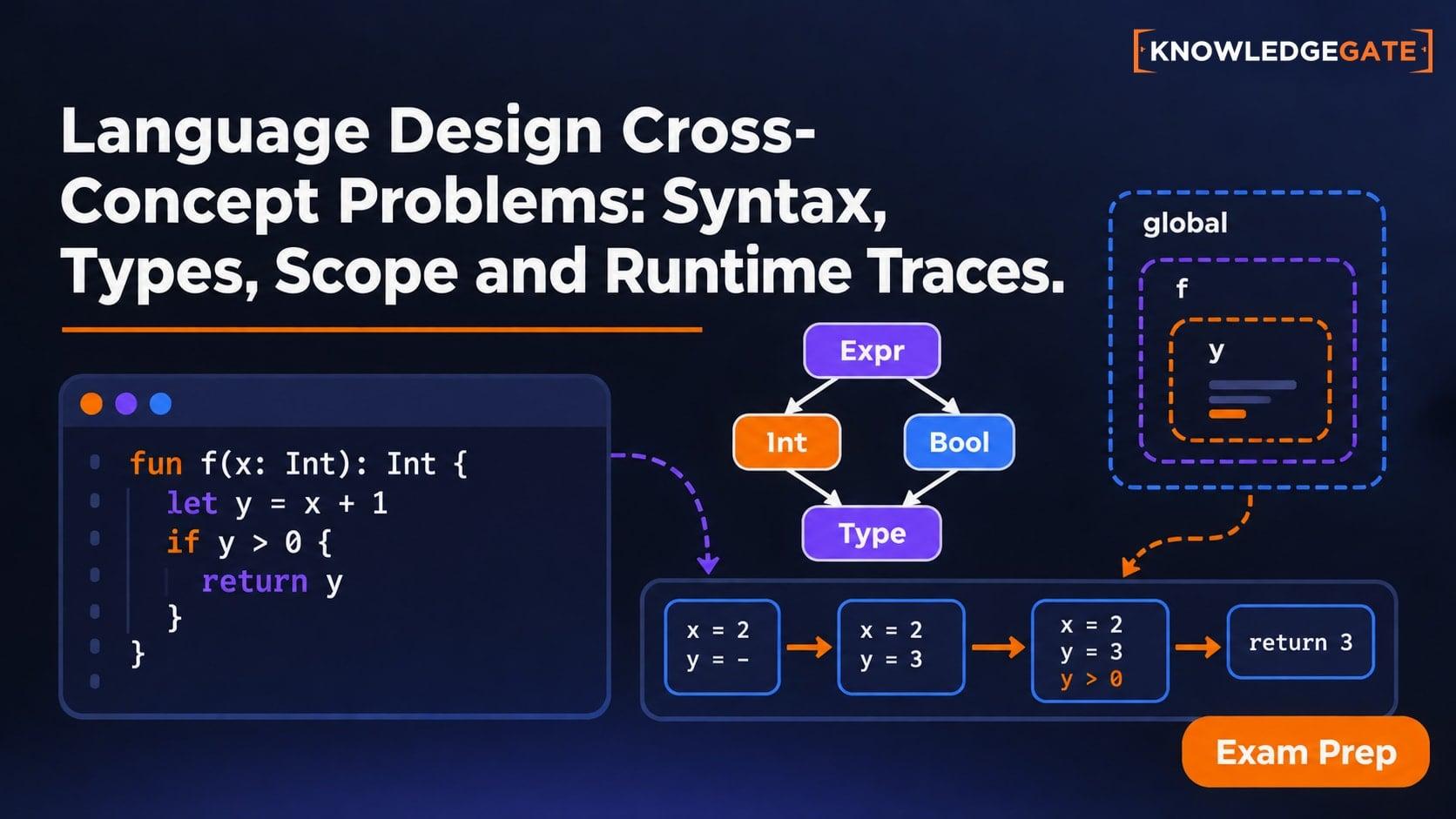
Language Design Cross-Concept Problems: Syntax, Types, Scope and Runtime Traces
Trace a small toy-language program from parse tree to type proof, closure bindings and the printed value 12. The method also shows where mixed-concept variants fail.
Updated 24 Nov 20267 min readProgramming Languages Survey