

Language Design Cross-Concept Problems: Syntax, Types, Scope and Runtime Traces
Trace a small toy-language program from parse tree to type proof, closure bindings and the printed value 12. The method also shows where mixed-concept variants fail.
KnowledgeGate Team
Exam prep & CS education
Updated 24 Nov 20267 min read
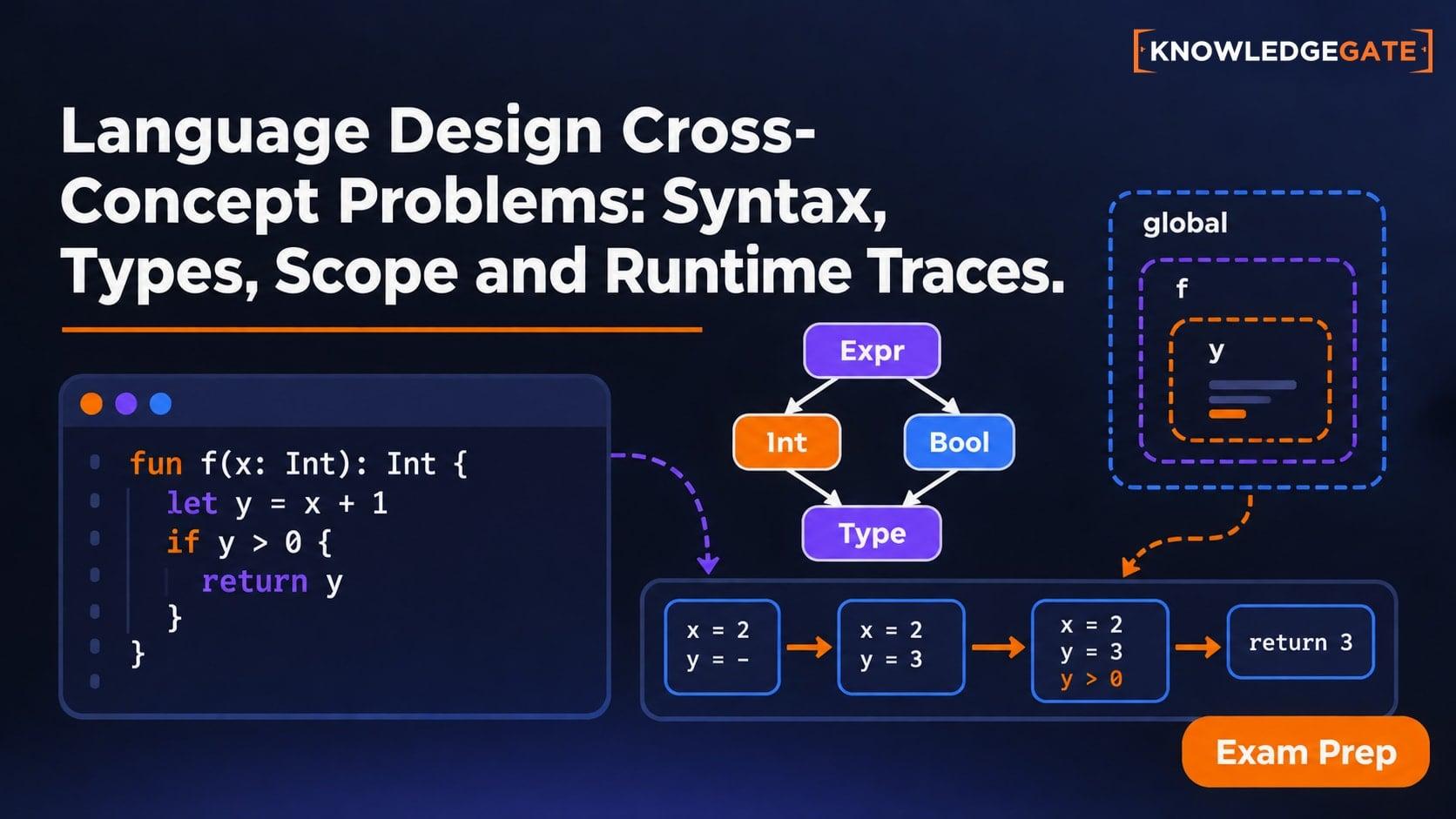
A mixed language-design question may show only seven or eight lines of code, yet solving it requires you to keep grammar, type rules, lexical scope, closure capture and evaluation order separate. Multi-topic content is not one extra language feature. It is a problem in which several language rules constrain the same program. Using the broader Learn area as context, the worked trace moves mechanically from source text to the exact printed value 12.
What a cross-concept language-design problem is really asking
Use four layers. Syntax decides whether the source has a valid structure and produces an abstract syntax tree (AST). Static semantics checks declarations and types. Binding rules connect each name use to a declaration. Dynamic semantics evaluates the accepted program to values and effects.
layer | question | artifact |
|---|---|---|
syntax | how is |
|
typing | may an | yes, because |
binding | which | the |
evaluation | what value is printed? |
|
These layers cooperate, but they are not interchangeable. A valid parse can fail type checking. A well-typed call can still be traced wrongly if you choose the wrong environment. Language Design: Syntax, Types, Scope, Worked Example explains each layer separately and contrasts two scope outcomes (15 versus 25). The MiniMix trace combines AST, type checking, closure capture and shadowing in one program.
Freeze the MiniMix rules before tracing the program
MiniMix is a toy teaching language, not Python, C, Java or an official exam language. Integer and Boolean literals exist. + and * accept two Int values and return Int. Function types use A -> B, calls bind arguments by value, and arguments evaluate before the function body. Declarations use lexical scope, an inner block may shadow an outer name, and a returned nested function retains its definition environment as a closure. Multiplication binds more tightly than addition, while addition associates left to right.
let x: Int = 4;

fun makeAdder(delta: Int): Int -> Int {
    fun add(n: Int): Int {
        return n + delta + x;
    }
    return add;
}

let f: Int -> Int = makeAdder(2);

{
    let x: Int = 10;
    print(f(3 * 2));
}
Do not calculate yet. Record the AST first, then types, declaration links, runtime environments and values. That order prevents a familiar value from smuggling in an unstated language rule.
Phase one: parse the call and prove that the program is well typed
The print expression has this AST:
Print(Call(Name(f), Multiply(Int(3), Int(2))))It is not Multiply(Call(f, 3), 2). The returned function body is Add(Add(Name(n), Name(delta)), Name(x)) because n + delta + x associates left to right. The final block declares a new x; it does not rewrite the earlier function body.
expression | input types | result type |
|---|---|---|
|
|
|
|
| function |
| argument |
|
|
| function |
| function |
|
|
|
|
|
|
|
The parser establishes the tree. The type checker uses declarations and operator signatures to accept that tree, so print receives an Int. Types constrain the result category, but they do not calculate its value.
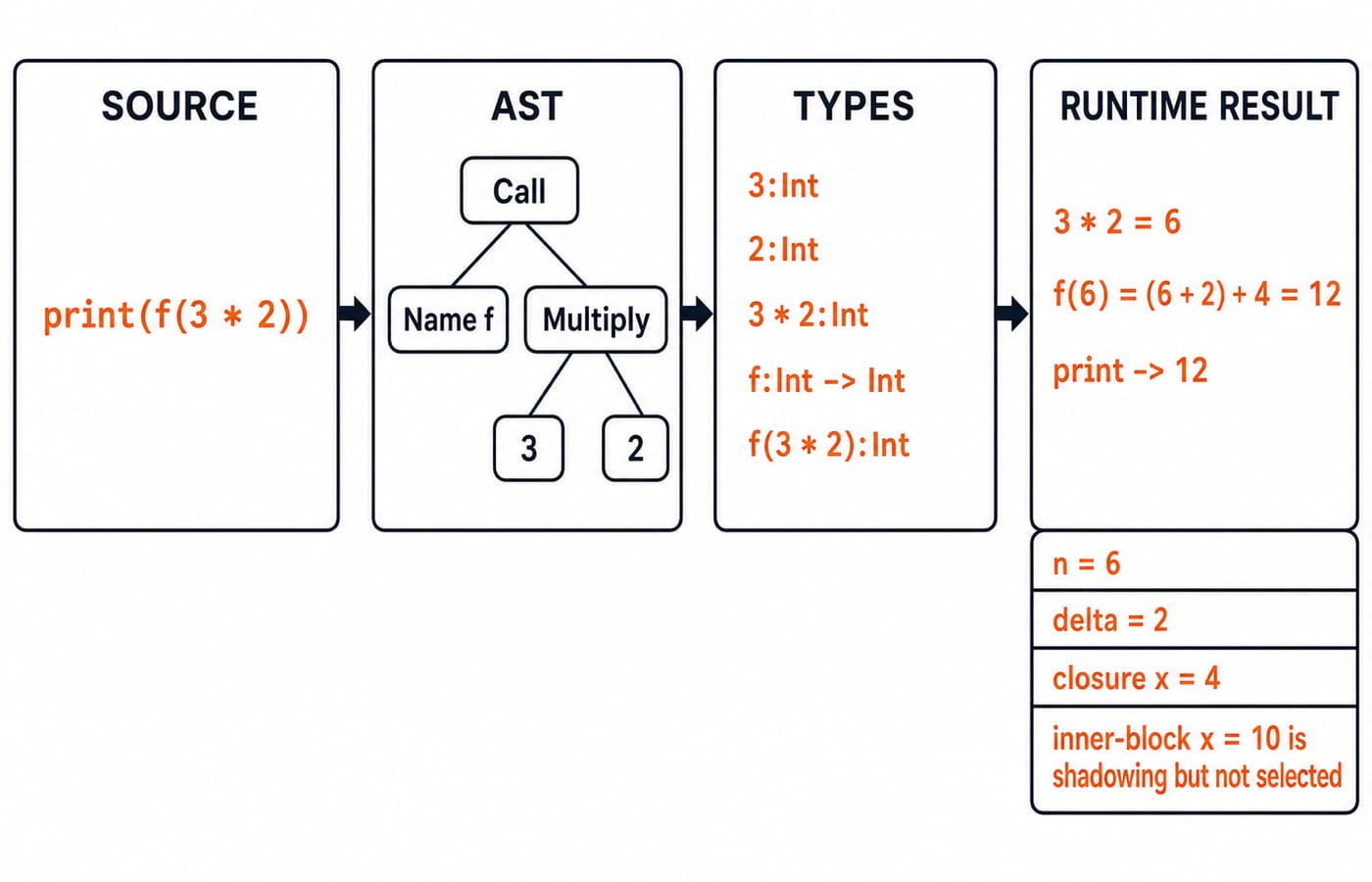
Phase two: resolve names and build the closure environment
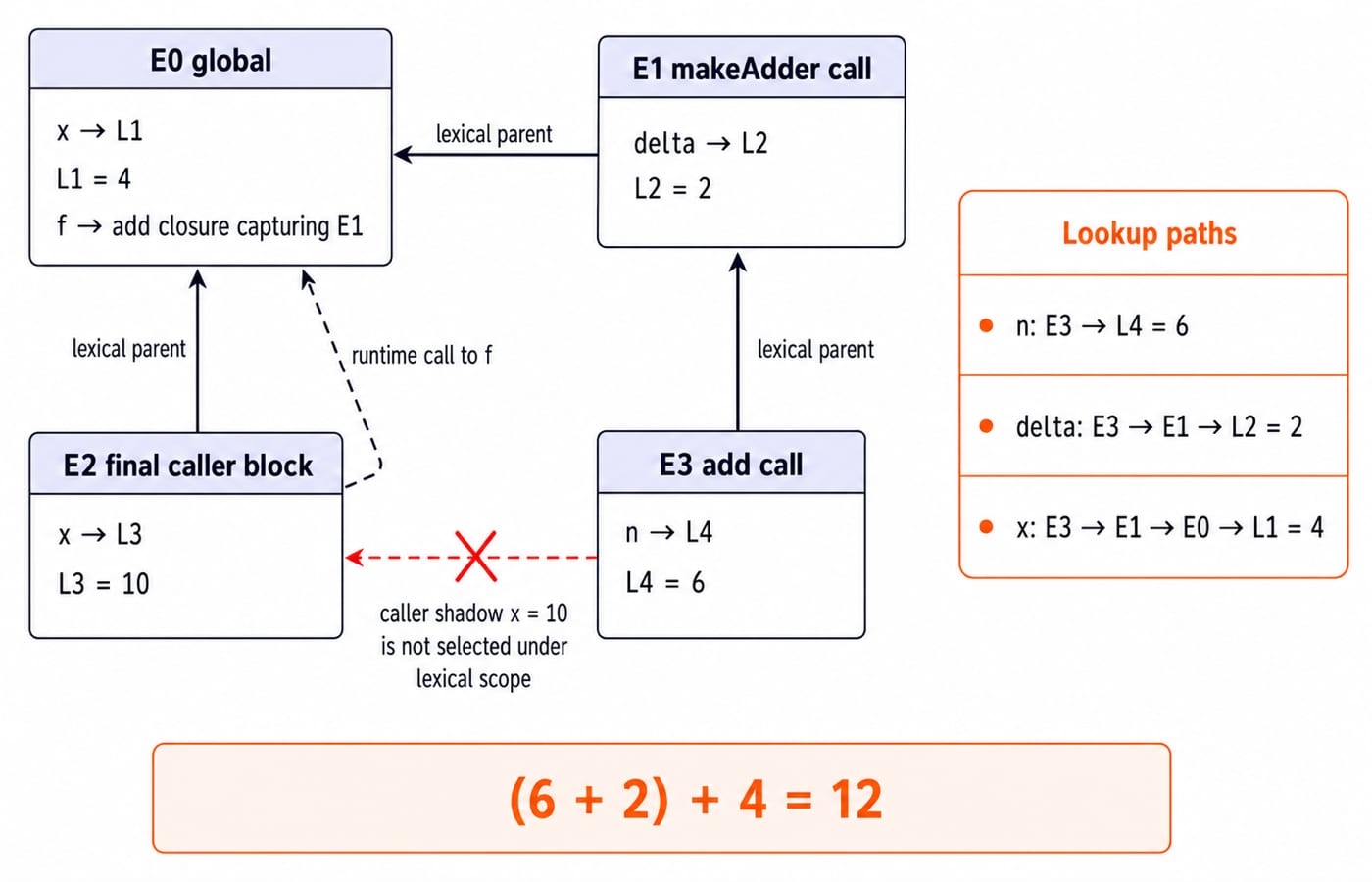
Start with global environment E0. It binds x -> L1, where store cell L1 = 4, and binds makeAdder to its function closure. Calling makeAdder(2) creates E1 with lexical parent E0. It binds delta -> L2, where L2 = 2. The nested add closure captures E1, and global name f is bound to that returned closure.
The final block creates caller environment E2, whose parent is E0. Its x -> L3, with L3 = 10, shadows the global x only for code lexically inside that block. The argument is evaluated to 6 before the call. Calling f(6) creates E3, whose lexical parent is captured environment E1, not caller environment E2. It binds n -> L4, with L4 = 6.
Lookup is now mechanical. n resolves in E3 to L4 = 6. delta follows E3 -> E1 to L2 = 2. x follows E3 -> E1 -> E0 to L1 = 4. The caller's E2/L3 = 10 is not on the closure's lexical chain. For a wider treatment of stack frames and access links, continue with Run-Time Environment: Activation Records and GATE Examples.
Phase three: execute in order and obtain the exact output
step | operation | result | reason |
|---|---|---|---|
1 | evaluate |
| call by value |
2 | return | closure captures | nested function escapes safely |
3 | bind |
| function value |
4 | enter final block | local | shadows only along |
5 | evaluate |
| argument before call |
6 | call |
|
|
7 | evaluate |
| left addition |
8 | add closure's |
|
|
9 | print result |
| only visible output |
The exact output is:
12The tempting answer 18 is wrong. It substitutes caller-block x = 10 for closure x = 4, silently changing lexical scoping into dynamic scoping. MiniMix does not say that closures copy every value. Its closure retains the definition environment and resolves the binding specified by the language rules.
Cross-concept traps: identify the layer that changes first
change | first affected layer | outcome |
|---|---|---|
delete the final right parenthesis in | syntax | parse error, so no typing or execution |
replace | static types | rejected because MiniMix |
delete the global | binding/static semantics |
|
rename the inner | binding only in | output remains |
change | AST and evaluation |
|
Counterfactual: if the question replaced lexical scope with dynamic scope, x would be found in caller environment E2 as 10. The arithmetic would then be (6 + 2) + 10 = 18. That is not the result under the stated MiniMix rules.
Stop at the first failing layer. A parse error has no accepted AST, and a type error has no valid run in this exercise. When you later study binding and dispatch in a real object oriented language, use that language's rules rather than carrying MiniMix assumptions across automatically.
How assessments test mixed programming-language concepts
Mixed questions can ask you to choose an AST, complete a type judgment, draw a lexical-link chain, predict closure output, identify the phase where a bad variant fails, or compare lexical scope with an explicitly stated dynamic-scope rule.
Use these rapid checks on the worked program:
Check A: The root of
f(3 * 2)isCall, notMultiply.Check B: The type of
makeAdder(2)isInt -> Int.Check C: The argument value placed in
nis6.Check D: The
xinsideaddresolves to global4, not block-local10.Check E: The output is
12; under the separate dynamic-scope counterfactual it would be18.
On paper, make four columns headed AST | type | declaration/environment | value. Give every disputed subexpression one entry. This small discipline exposes the exact layer where two proposed answers diverge. If you want optional timed practice after learning the method, use GATE Test Series: Mocks and Topic-wise Tests. This link is a practice route, not a claim that it contains this MiniMix question.
Language-design cross-concept problems: the short version and next step
Freeze the language rules. Parse once, type-check the AST, connect each name use to a declaration, draw closure parents separately from caller links, and only then evaluate values. Here 3 * 2 gives 6; lexical lookup supplies delta = 2 and global x = 4, so (6 + 2) + 4 prints 12.
As an exit exercise, rename final-block x to x2, set x2 = 100, and change nothing else. The answer remains 12 because x2 is never referenced and the closure still resolves x through E1 to E0/L1 = 4. For cross-language syntax and problem practice, continue with Coding for Placements: C, C++, Java, Python.
Keep learning
C++ Cross-Concept Questions Explained: Scope, Dispatch and Object Lifetime
Trace one well-defined C++ program from construction to destruction, then change one line at a time to see which language rule controls each output token.
Updated 16 Nov 20266 min readC++

Language Design in Programming Languages: Syntax, Types, Scope and a Worked Evaluation
Trace one expression from source text to a value, then compare the design rules that make scope, typing, evaluation and mutation behave differently.
Updated 31 Jul 20266 min readProgramming Languages Survey
Programming Language Design: Syntax, Semantics, Types, Scope and a Worked Mini-Language
Design MiniCalc from tokens to runtime, then trace how precedence, typing, environments, scope and parameter passing change what a program means.
Updated 23 Aug 20267 min read98 viewsGATE Strategy & Roadmap

Pipelining Cross-Concept Problems: CPI, Hazards and Cache Stalls
Build one reliable cycle ledger for a five-stage pipeline, then use it to combine load-use stalls, branch penalties and cache misses without mixing units.
Updated 3 Nov 20265 min readComputer Organization & Architecture