Fuzzy-set notation looks close to ordinary set notation, but every element carries a membership grade, and an answer can change when a question switches operator families. That combination makes simple-looking calculations surprisingly easy to mix up. Calculate each result from membership grades using standard max-min operations, alpha-cuts and cardinality, then check the common traps.
Fuzzy set definitions: universe, membership function and notation
In a crisp set, an element's indicator is 0 or 1: it is outside or inside the set. For a fuzzy set A on a universe U, the membership function is mu_A: U -> [0,1]. A statement such as mu_A(2)=0.7 means that element 2 belongs to A to degree 0.7. It is not the probability that element 2 exists.
Fix U={1,2,3,4} and write A={0.2/1, 0.7/2, 1.0/3, 0.4/4}. Here, 0.7/2 attaches grade 0.7 to element 2; it is not division. In the fixed universe order, the same set has vector form mu_A=[0.2,0.7,1.0,0.4].
Fuzzy Sets in Artificial Intelligence: Membership Functions, Operations, and Worked Examples extends the foundations to membership-function shapes, fuzzy relations and max-min composition. For one fixed four-element pair, complement, difference, cuts, cardinality and standard-versus-algebraic operators remain in a single trace.
Fuzzy set operations: complement, union, intersection and difference
The standard Zadeh operations are applied pointwise for every x in U:
Complement:
mu_(A^c)(x)=1-mu_A(x)Union:
mu_(A union B)(x)=max(mu_A(x),mu_B(x))Intersection:
mu_(A intersection B)(x)=min(mu_A(x),mu_B(x))Difference:
A\B=A intersection B^c, somu_(A\B)(x)=min(mu_A(x),1-mu_B(x))
Pointwise means that you calculate each element independently while keeping the universe order fixed. The complement formula assumes grades normalised to [0,1]; subtract the membership grade from 1, not the universe element.
For this standard max-min family, union and intersection are commutative, associative and idempotent. Absorption also holds. De Morgan's laws give (A union B)^c=A^c intersection B^c and (A intersection B)^c=A^c union B^c. These properties do not mean that every question uses max and min: the words union and intersection may refer to another stated operator family.
Fuzzy set worked example: calculate every membership grade
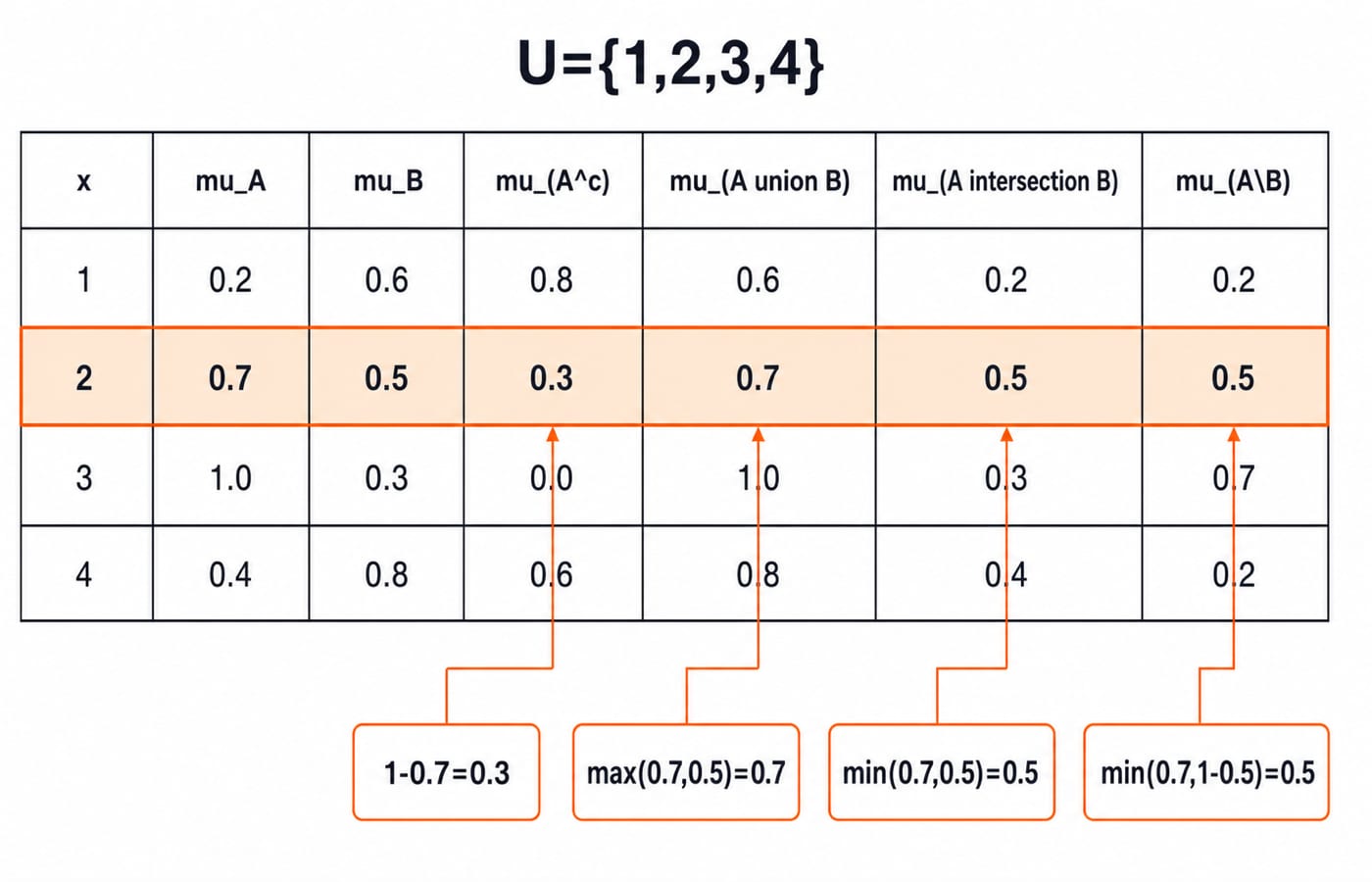
Take mu_A=[0.2,0.7,1.0,0.4] and mu_B=[0.6,0.5,0.3,0.8] on U={1,2,3,4}. Calculate each operation for one position before checking all positions. At x=2, the complement of A is 1-0.7=0.3; the union is max(0.7,0.5)=0.7; the intersection is min(0.7,0.5)=0.5; and A\B is min(0.7,1-0.5)=0.5.
|
|
|
|
|
|
|
|
|---|---|---|---|---|---|---|---|
1 | 0.2 | 0.6 | 0.8 | 0.4 | 0.6 | 0.2 | 0.2 |
2 | 0.7 | 0.5 | 0.3 | 0.5 | 0.7 | 0.5 | 0.5 |
3 | 1.0 | 0.3 | 0.0 | 0.7 | 1.0 | 0.3 | 0.7 |
4 | 0.4 | 0.8 | 0.6 | 0.2 | 0.8 | 0.4 | 0.2 |
Thus mu_(A^c)=[0.8,0.3,0.0,0.6], mu_(B^c)=[0.4,0.5,0.7,0.2], mu_(A union B)=[0.6,0.7,1.0,0.8], mu_(A intersection B)=[0.2,0.5,0.3,0.4], and mu_(A\B)=[0.2,0.5,0.7,0.2].
In fuzzy-set notation, the results are A^c={0.8/1,0.3/2,0.0/3,0.6/4}, B^c={0.4/1,0.5/2,0.7/3,0.2/4}, A union B={0.6/1,0.7/2,1.0/3,0.8/4}, A intersection B={0.2/1,0.5/2,0.3/3,0.4/4}, and A\B={0.2/1,0.5/2,0.7/3,0.2/4}.
Now verify De Morgan. (A union B)^c=[0.4,0.3,0.0,0.2]. Taking min between A^c=[0.8,0.3,0.0,0.6] and B^c=[0.4,0.5,0.7,0.2] also gives [0.4,0.3,0.0,0.2]. Matching all four positions verifies this instance of De Morgan's law.
Fuzzy alpha-cuts, support, core and cardinality
Fundamentals of Fuzzy Sets: Membership Functions, Operations and a Worked Example builds support, core and alpha-cuts from a triangular membership function and verifies the pointwise laws. For the fixed vector A, support(A)={1,2,3,4}, core(A)={3}, and height(A)=1.0. Therefore, A is normal. A fuzzy set whose maximum grade is below 1 is subnormal.
The ordinary alpha-cut is A_alpha={x | mu_A(x)>=alpha}; the strong alpha-cut is A_alpha+={x | mu_A(x)>alpha}. Here, A_0.5={2,3}, A_0.8={3}, and A_0.4={2,3,4}. In contrast, A_0.4+={2,3}. Element 4 lies exactly on the 0.4 boundary, so >= includes it while > excludes it.
For a finite fuzzy set, sigma cardinality is the sum of its grades: |A|=0.2+0.7+1.0+0.4=2.3. If relative cardinality is requested, divide by the universe size: 2.3/4=0.575.
Alternative fuzzy operators: algebraic product and algebraic sum
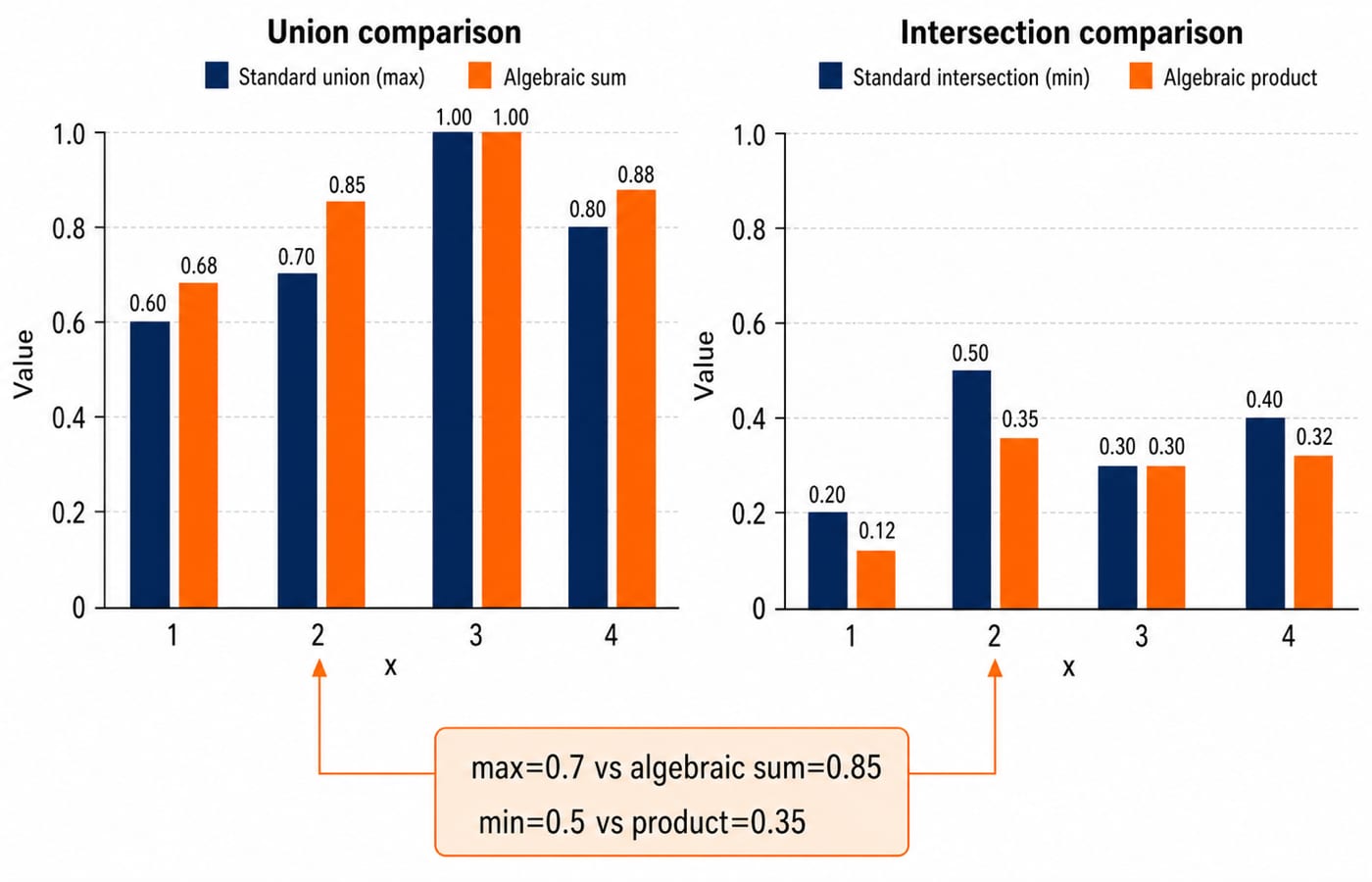
Fuzzy Arithmetic and Membership Functions: Alpha-Cuts, Worked Examples and Exam Traps continues from grade-by-grade operations to interval arithmetic and the extension principle. For paired grades, algebraic product uses mu_A*mu_B and algebraic sum uses mu_A+mu_B-mu_A*mu_B, rather than the standard min and max formulas.
For the same pair, the algebraic product is [0.12,0.35,0.30,0.32]. The algebraic sum is [0.68,0.85,1.00,0.88], calculated as 0.2+0.6-0.12=0.68, 0.7+0.5-0.35=0.85, 1.0+0.3-0.30=1.00, and 0.4+0.8-0.32=0.88.
Value at | Standard max-min | Algebraic operator |
|---|---|---|
Union or sum | 0.7 | 0.85 |
Intersection or product | 0.5 | 0.35 |
Write the chosen formula before substituting. Mixing operator families often produces a plausible number, but it is still the wrong answer.
Fuzzy set exam patterns: direct, reverse and operator-choice questions
Questions test the definitions from several directions:
Compute a grade at
x=2.Reverse a complement: if
mu_(A^c)(x)=0.25, thenmu_A(x)=1-0.25=0.75.Test a fuzzy subset.
Ais not a fuzzy subset ofBbecausemu_A(2)=0.7>0.5andmu_A(3)=1.0>0.3.Apply a cut:
2is excluded fromA_0.8because0.7<0.8.
Other forms ask for a union or intersection entry, a De Morgan check at one element, recognition that 0.7/2 is notation rather than division, or the operator family named in the question. Fuzzy grades connect with logic but do not automatically follow Boolean truth tables.
In a numerical-answer question, report the exact grade produced by the stated operator. In a multiple-select question, test every option under the same operator family because standard and algebraic results can both appear as distractors.
Fuzzy set mistakes: why plausible calculations go wrong
Mistake | What goes wrong | Correction |
|---|---|---|
Treating a grade as probability | Misreads belonging | Use degree of membership |
Using | Can exceed | Use the named operator |
Subtracting the universe element | Wrong complement | Calculate |
Using | Computes intersection | Use |
Changing vector order | Grades move to wrong elements | Fix the universe order |
Confusing alpha-cuts | Boundary answer changes | Check |
Switching operator families | Uses the wrong rule | Write the formula first |
At x=4, raw addition gives 0.4+0.8=1.2, which cannot be a membership grade. Standard union is max(0.4,0.8)=0.8, while algebraic sum is 0.4+0.8-0.32=0.88. For A_0.4, element 4 is included by >=0.4 but excluded from the strong cut by >0.4.
Practise these operators on a fresh pair of sets, writing the chosen formula before each substitution, until the whole table comes out without hesitation.
Fuzzy set operations: the short version and your next step
Use these rules for your first few calculations:
Complement means
1-a.Standard union means
max.Standard intersection means
min.Difference means
min(a,1-b)under the stated standard definition.Alpha-cut means compare every grade with the threshold.
At x=2, the check is A^c=0.3, union 0.7, intersection 0.5, and difference 0.5. For a structured route through Artificial Intelligence and Fuzzy Sets, use ZERO TO HERO. The Semester & College Exam Courses catalogue is the broader route for foundational CS study.