Ordinary sets feel simple until an element belongs only partly. Triangular fuzzy-number shortcuts are easy to memorise without knowing when they fail. A membership grade lies in [0,1], but it is not a probability. Alpha-cuts turn those grades into nested intervals; addition, subtraction, multiplication and division then follow from interval rules, including sign and zero checks.
Fuzzy sets and membership functions: what a membership grade means
A fuzzy set A on universe X is defined by mu_A: X -> [0,1]. A crisp characteristic function permits only 0 and 1; fuzzy membership also permits intermediate grades. Fuzzy Sets in AI: Membership Functions and Worked Examples develops the broader foundation of shapes, standard operations, relations and max-min composition. Exact alpha-cut sums, differences, products, quotients and extension-principle memberships instead require interval arithmetic.
For X={1,2,3,4,5}, let A={0.2/1, 0.7/2, 1.0/3, 0.6/4, 0.1/5}. Here 0.7/2 means mu_A(2)=0.7. The slash is notation, not division, and this does not mean a 70 per cent chance.
Support: points with
mu_A(x)>0, sosupport(A)={1,2,3,4,5}.Core: points with
mu_A(x)=1, socore(A)={3}.Height:
sup mu_A(x)=1, makingAnormal.Crossover point: a point with grade
0.5. None of these five sampled points is one.
Membership-function shapes and alpha-cuts: compute a triangle exactly
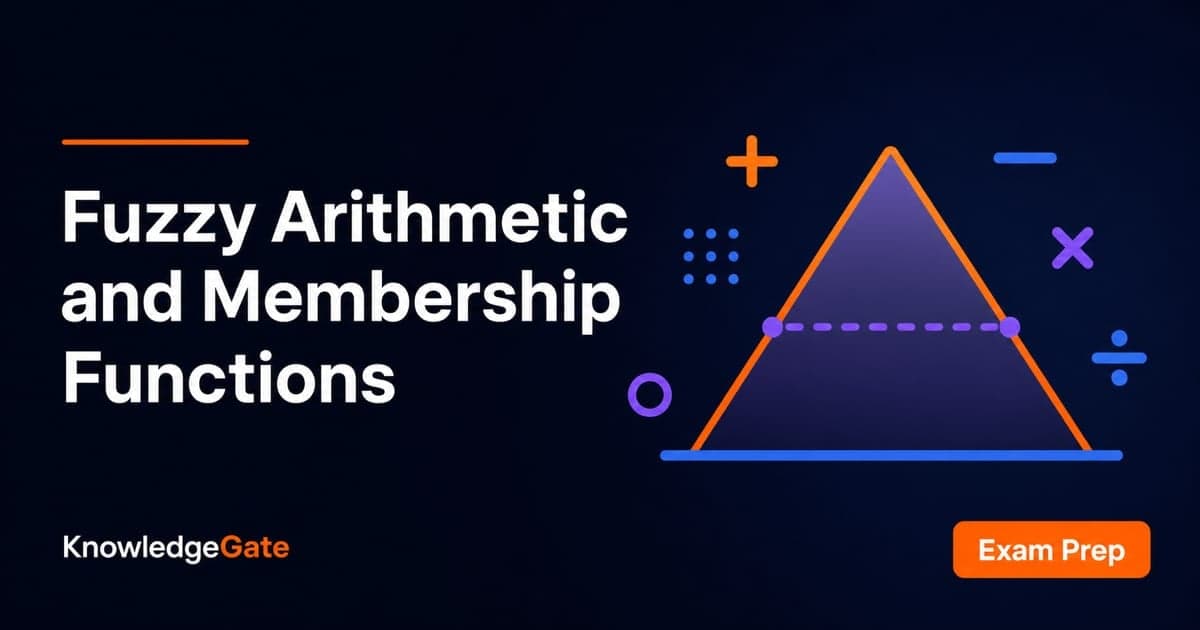
A triangular fuzzy number T=(a,m,b) has membership 0 outside [a,b], (x-a)/(m-a) for a <= x <= m, and (b-x)/(b-m) for m <= x <= b. A trapezoid (a,b,c,d) instead has core [b,c]; a singleton has one non-zero point.
For Warm=(20,25,30):
mu_Warm(20)=0mu_Warm(23)=(23-20)/(25-20)=3/5=0.6mu_Warm(25)=1mu_Warm(28)=(30-28)/(30-25)=2/5=0.4mu_Warm(30)=0
Thus support(Warm)=(20,30), core(Warm)={25}, and height(Warm)=1.
For 0 < alpha <= 1, the ordinary alpha-cut is T_alpha={x: mu_T(x) >= alpha}. Solving each slope gives [a+alpha(m-a), b-alpha(b-m)]. Therefore Warm_0.6=[20+0.6(5), 30-0.6(5)]=[23,27]. Under the standard fuzzy-number convention, T_0=closure(support(T))=[a,b]; the literal condition mu >= 0 over the whole universe would include every point. A strong alpha-cut uses T_alpha^+={x: mu_T(x) > alpha}. For this triangle, its endpoints are excluded, so the strong 0.6-cut is (23,27).
![Triangular membership plot of Warm=(20,25,30) with the alpha=0.6 cut projecting to Warm_0.6=[23,27].](https://cdn.knowledgegate.ai/blog-assets/blog_asset_1784247082116_q08d2n.jpg)
Fuzzy union, intersection and complement: do not confuse them with arithmetic
Keep A=[0.2,0.7,1.0,0.6,0.1] and take B=[0.1,0.5,0.8,1.0,0.4]. With the standard Zadeh operators, union is pointwise max, intersection is pointwise min, and complement is 1-mu.
x | A | B | A union B | A intersection B | A complement |
|---|---|---|---|---|---|
1 | 0.2 | 0.1 | 0.2 | 0.1 | 0.8 |
2 | 0.7 | 0.5 | 0.7 | 0.5 | 0.3 |
3 | 1.0 | 0.8 | 1.0 | 0.8 | 0 |
4 | 0.6 | 1.0 | 1.0 | 0.6 | 0.4 |
5 | 0.1 | 0.4 | 0.4 | 0.1 | 0.9 |
The output vectors are [0.2,0.7,1.0,1.0,0.4], [0.1,0.5,0.8,0.6,0.1], and [0.8,0.3,0,0.4,0.9]. At x=4, these operations give max(0.6,1.0)=1.0, min(0.6,1.0)=0.6, and 1-0.6=0.4. Min and max extend the 0/1 AND/OR boundary discussed in Propositional and Predicate Logic: Truth Tables, Quantifiers. Adding the grades gives 1.6, which is neither standard union nor a valid membership grade.
Fuzzy arithmetic with alpha-cuts: one complete worked example
Let positive triangular fuzzy numbers be P=(1,2,3) and Q=(2,4,6). Their cuts are P_alpha=[1+alpha,3-alpha] and Q_alpha=[2+2alpha,6-2alpha].
For intervals P=[pL,pU] and Q=[qL,qU], sum is [pL+qL,pU+qU]; difference is [pL-qU,pU-qL]. Product and quotient use the minimum and maximum of all four endpoint results, with division allowed only when Q excludes zero. Here both intervals are positive, so product becomes [pL*qL,pU*qU] and quotient [pL/qU,pU/qL].
alpha | P | Q | P+Q | P-Q | P*Q | P/Q |
|---|---|---|---|---|---|---|
0 |
|
|
|
|
|
|
0.5 |
|
|
|
|
|
|
1 |
|
|
|
|
|
|
The alpha=0 row uses the closed-support convention. Also, 5/6=0.8333..., not 0.8.
The full sum cut is [3+3alpha,9-3alpha], hence P+Q=(3,6,9). The difference is [-5+3alpha,1-3alpha], hence P-Q=(-5,-2,1). Its lower endpoint must be lower P minus upper Q, not lower minus lower.
Multiplication and division remain the exact cut families [(1+alpha)(2+2alpha),(3-alpha)(6-2alpha)] and [(1+alpha)/(6-2alpha),(3-alpha)/(2+2alpha)]. Their boundaries are generally curved, so triangular inputs do not produce exact triangular products or quotients. Division is undefined through any alpha-cut of Q containing 0.
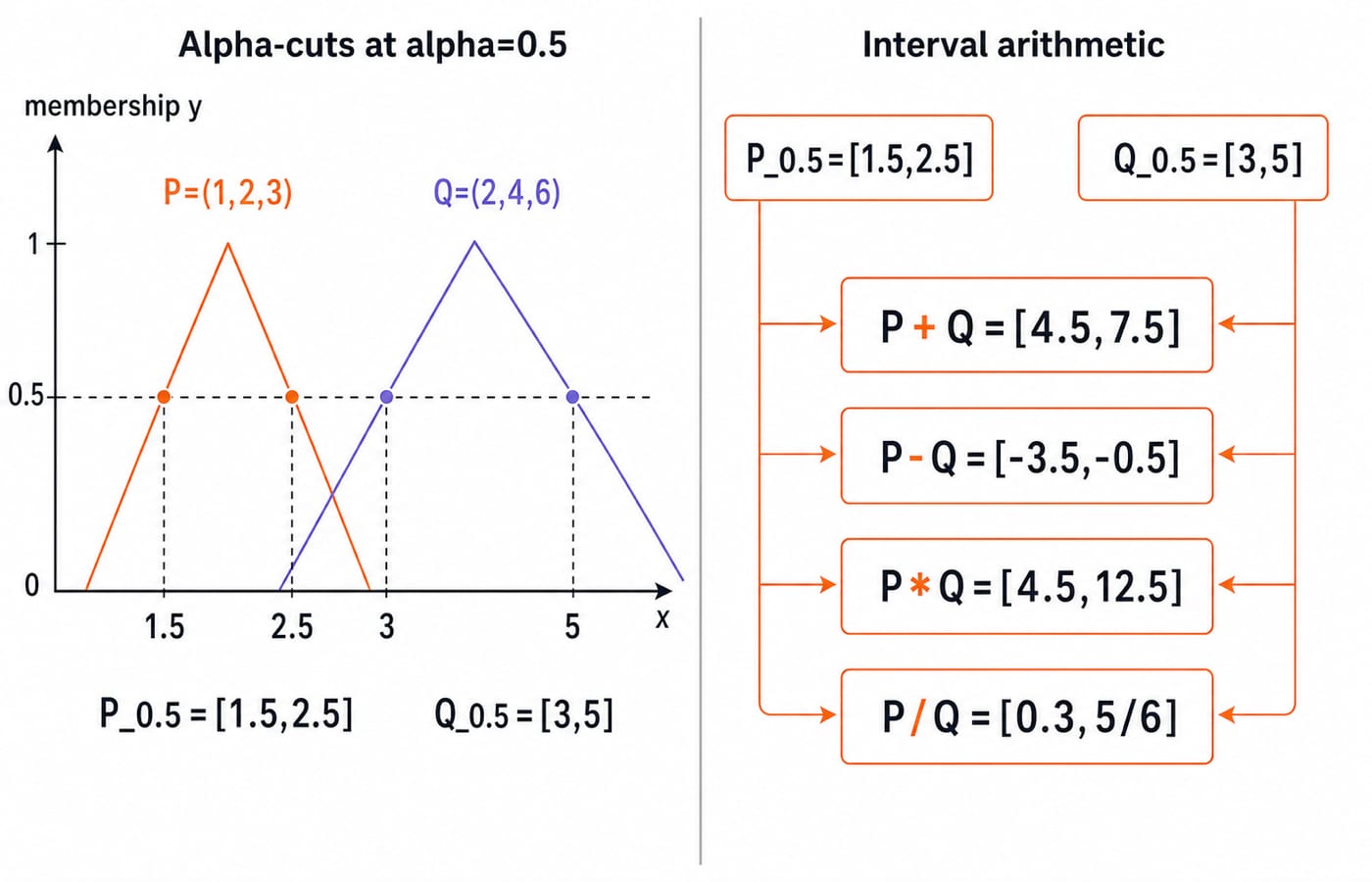
Extension principle: why alpha-cut arithmetic works
For addition, the extension principle is mu_(P+Q)(z)=sup_(x+y=z) min(mu_P(x),mu_Q(y)). It examines every input pair producing z. Alpha-cuts turn that search into interval arithmetic when the operation and domain conditions are valid.
At z=6, (x,y)=(2,4) gives min(1,1)=1. At z=4.5, (1.5,3) gives min(0.5,0.5)=0.5; correspondingly, the alpha=0.5 sum cut runs from 1.5+3=4.5 to 2.5+5=7.5.
This agrees with P+Q=(3,6,9): mu_(P+Q)(5)=(5-3)/(6-3)=2/3, mu_(P+Q)(6)=1, and mu_(P+Q)(7.5)=(9-7.5)/(9-6)=0.5.
Fuzzy arithmetic mistakes and a numerical self-check
Tempting move | Why it fails | Replacement check |
|---|---|---|
Treat membership as probability | A grade expresses membership | Read |
Add grades for union | It can exceed 1 | At |
Use | Standard complement is | For |
Replace | That changes ordinary to strong cut | State the chosen definition |
Subtract matching endpoints | Difference reverses |
|
Multiply matching endpoints across signs | Extremes may be cross-products | Calculate all four products |
Divide through zero | A quotient endpoint becomes undefined | Confirm the denominator cut excludes 0 |
Assume a triangular product | Exact product boundaries can curve | Keep the alpha-cut family |
For [-2,3]*[-4,5], the candidates are 8,-10,-12,15, so the interval is [-12,15], not [8,15]. For positive cuts, P_0.5*Q_0.5=[4.5,12.5].
Use this four-step self-check: write the membership or cut definition, state the interval rule, calculate every candidate endpoint, then confirm that each higher-alpha result cut nests inside its lower-alpha cut.
How questions test membership functions and fuzzy arithmetic
Cue | Action |
|---|---|
Given | Select the correct membership-function branch |
Given | Solve |
Union or intersection | Use the stated operator, or standard max/min if none is specified |
| Cross the interval endpoints |
Multiply or divide | Inspect signs and zero before choosing bounds |
Find | Use the extension principle or derived membership function |
Rapid checks: mu_Warm(28)=0.4; Warm_0.6=[23,27]; at x=4, mu_(A intersection B)=0.6; the modal value of P+Q is 6; P_0.5-Q_0.5=[-3.5,-0.5]; and [-2,3]*[-4,5]=[-12,15].
For mixed practice beyond this worked example, use the GATE CS Exam Preparation category.
Fuzzy arithmetic and membership functions: the short version and next step
Recall the chain: interpret mu, select the function branch, form the correct alpha-cut, apply the valid interval rule, inspect signs and zero, then verify nested cuts. The anchors are Warm_0.6=[23,27], P+Q=(3,6,9), and P-Q=(-5,-2,1).
Try this transfer exercise: for R=(0,2,4) and S=(1,3,5), find their alpha=0.5 cuts, sum, and difference.
Answer: R_0.5=[1,3], S_0.5=[2,4], R_0.5+S_0.5=[3,7], and R_0.5-S_0.5=[-3,1].
For a structured preparation route, use GATE Guidance by Sanchit Sir. For broader applied-AI preparation, AI & ML for Placements develops placement-oriented AI and machine-learning skills.