Fuzzy-set notation looks like ordinary set notation, but every element carries a membership grade. Crisp-set instincts produce wrong unions, complements and cardinalities. The broader Fuzzy Sets in AI: Membership Functions and Worked Examples covers membership-function shapes, fuzzy relations and max-min composition. A single finite universe keeps every alpha-cut, cardinality, operation and law directly checkable, one coordinate at a time.
Fuzzy set fundamentals: membership by degree
A crisp subset C of universe U uses the characteristic function chi_C(x) in {0,1}. An element is either outside or inside. A fuzzy subset A instead uses mu_A: U -> [0,1]: grade 0 means no membership, grade 1 means full membership, and a value between them means partial membership under the chosen concept.
Take U = {p,q,r,s} for four project proposals and
A = Ready = {0.0/p, 0.4/q, 1.0/r, 0.7/s}.
The term 0.4/q says, "proposal q has membership grade 0.4 in Ready." It is not a 40 per cent probability, and the slash is notation, not division. By contrast, the crisp threshold set C = {q,r,s} has vector [0,1,1,1] in the fixed universe order. Set Theory and Relations Explained for GATE provides the crisp-set foundation that fuzzy membership generalises. The GATE CS Exam category is the broader preparation route.
Fuzzy set vocabulary: support, core and alpha-cuts
Keep A = [0.0,0.4,1.0,0.7] in the order [p,q,r,s].
support(A) = {q,r,s}because support requiresmu_A(x) > 0.core(A) = {r}because the core requiresmu_A(x) = 1.height(A) = 1.0, soAis normal.|A| = 0.0 + 0.4 + 1.0 + 0.7 = 2.1. This fuzzy cardinality is not the three-element support count.
An ordinary alpha-cut is A_alpha = {x in U : mu_A(x) >= alpha}. A strong alpha-cut is A_alpha+ = {x in U : mu_A(x) > alpha}. At alpha = 0.4, A_0.4 = {q,r,s}, while A_0.4+ = {r,s}. Proposal q is the boundary case because its grade equals 0.4.
For the subnormal set S = [0.2,0.6,0.9,0.6], the height is 0.9, the core is empty, and the support contains all four elements. Also, S_0.6 = {q,r,s}, S_0.6+ = {r}, and |S| = 2.3. A non-empty fuzzy set need not reach grade 1.
Fuzzy membership functions: a triangular worked example
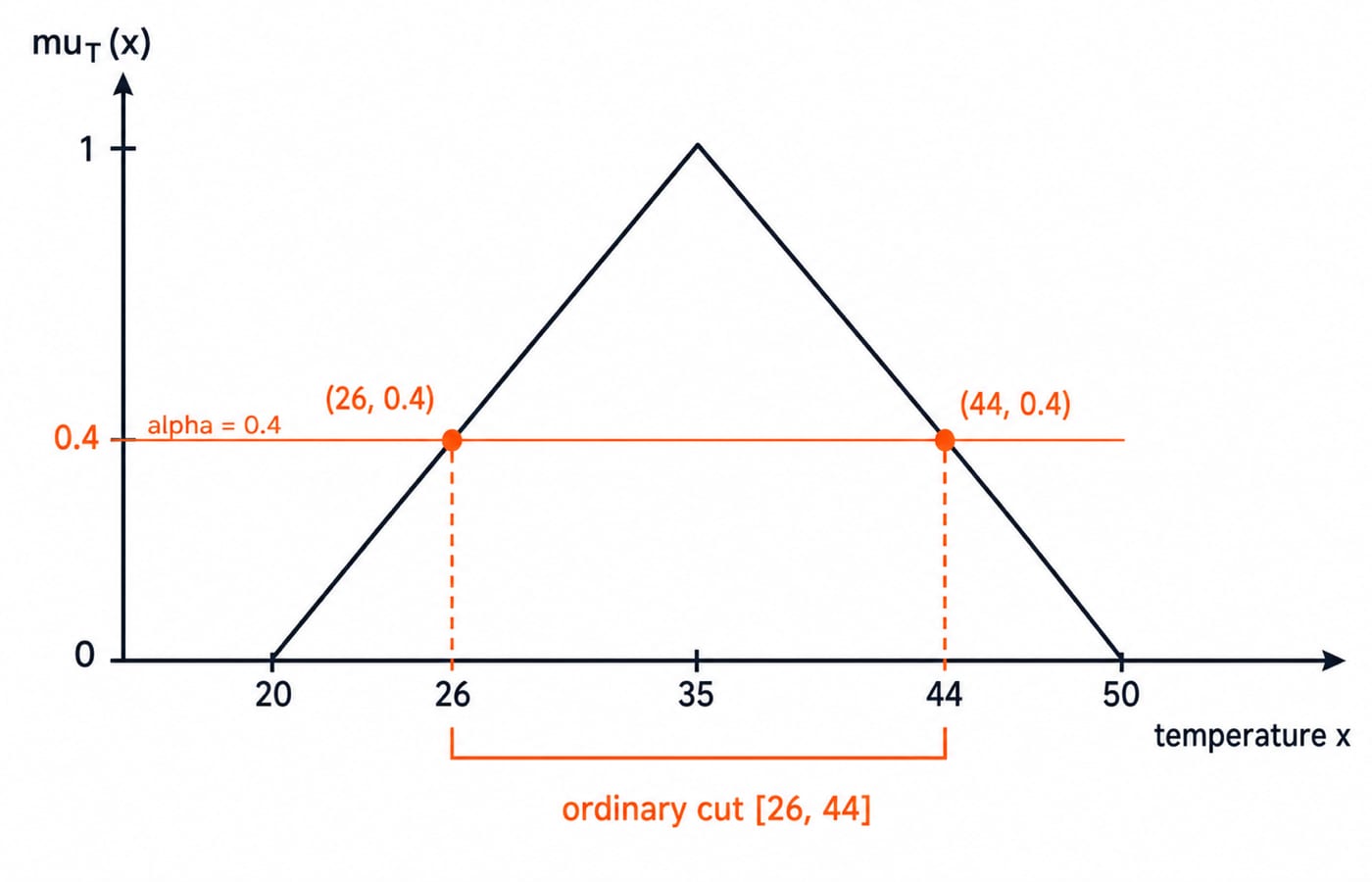
The triangular fuzzy number T = (20,35,50) has left foot 20, peak 35 and right foot 50. Its membership function is
mu_T(x) = 0forx <= 20orx >= 50;mu_T(x) = (x-20)/15for20 < x <= 35;mu_T(x) = (50-x)/15for35 < x < 50.
Now evaluate it coordinate by coordinate:
mu_T(26) = (26-20)/15 = 6/15 = 0.4.mu_T(35) = 1.mu_T(44) = (50-44)/15 = 6/15 = 0.4.mu_T(55) = 0.
For the ordinary 0.4-cut, the rising side gives (x-20)/15 >= 0.4, so x >= 26. The falling side gives (50-x)/15 >= 0.4, so x <= 44. Therefore the cut is [26,44]; the strong cut is (26,44). A trapezoidal function replaces the peak with a flat interval. The formula, not the application label, fixes parameters that may differ by application.
Fuzzy set operations: complement, union and intersection
Introduce B = Urgent = {0.5/p, 0.8/q, 0.6/r, 0.3/s}, represented by [0.5,0.8,0.6,0.3]. The standard Zadeh operators are: mu_(A complement)(x) = 1-mu_A(x), mu_(A union B)(x) = max(mu_A(x),mu_B(x)), and mu_(A intersection B)(x) = min(mu_A(x),mu_B(x)).
x | mu_A | mu_B | 1-mu_A | max(A,B) | min(A,B) |
|---|---|---|---|---|---|
p | 0.0 | 0.5 | 1.0 | 0.5 | 0.0 |
q | 0.4 | 0.8 | 0.6 | 0.8 | 0.4 |
r | 1.0 | 0.6 | 0.0 | 1.0 | 0.6 |
s | 0.7 | 0.3 | 0.3 | 0.7 | 0.3 |
At x=q, the complement is 1-0.4=0.6, the union is max(0.4,0.8)=0.8, and the intersection is min(0.4,0.8)=0.4. At x=r, the results are 0.0, 1.0 and 0.6.
Thus A complement = [1.0,0.6,0.0,0.3], A union B = [0.5,0.8,1.0,0.7], and A intersection B = [0.0,0.4,0.6,0.3]. Their relevant cardinalities are |A union B| = 0.5+0.8+1.0+0.7 = 3.0 and |A intersection B| = 0.0+0.4+0.6+0.3 = 1.3. Do not add grades to form a union unless another operator family has been defined.
Fuzzy set laws: verify them pointwise
From the union vector, (A union B) complement = [0.5,0.2,0.0,0.3]. Separately, B complement = [0.5,0.2,0.4,0.7]. Taking the elementwise minimum of A complement and B complement gives [0.5,0.2,0.0,0.3]. Both sides match, confirming (A union B) complement = A complement intersection B complement for these operators.
Fuzzy inclusion is pointwise: A subseteq B only when mu_A(x) <= mu_B(x) for every x. Here A is not a subset of B because mu_A(r)=1.0 > 0.6=mu_B(r). Likewise, B is not a subset of A because mu_B(p)=0.5 > 0.0=mu_A(p). One counterexample rejects inclusion.
Crisp laws can become traps. For the same A, A union A complement = [1.0,0.6,1.0,0.7], not the all-ones set. Also, A intersection A complement = [0.0,0.4,0.0,0.3], not the all-zero set. Compare this boundary with the two-valued reasoning in the Boolean Algebra and K-map Minimization Guide.
Fuzzy sets exam-style questions: traps and solving order
A typical question gives a universe and membership grades, then asks you to interpret mu_A(x), read the discrete set, find support or core, calculate an alpha-cut, apply an operator, or test an identity.
Use this order:
Freeze the universe order.
Write every set as a membership vector.
Copy the exact operator definition.
Calculate one coordinate at a time.
Check that every result remains in
[0,1].
For an alpha-cut, first circle whether the condition is >= alpha or > alpha.
Tempting move | Why it fails | Correction |
|---|---|---|
Read membership as probability | A grade expresses membership under a model | Interpret it through |
Count positive grades for cardinality | That counts support elements | Sum the membership grades |
Add grades for union | Standard union here uses max | Apply max coordinate by coordinate |
Drop a grade equal to alpha | Ordinary cuts include equality | Use |
Call every non-empty set normal | Normality requires height | Find the maximum grade |
Prove subset from one element | Inclusion must hold everywhere | Test all coordinates |
Fuzzy set fundamentals: the short version and next step
Remember the recall chain:
A fuzzy set maps
Uto[0,1].Support uses
>0.Core uses
=1.Ordinary alpha-cuts use
>=.Standard union and intersection use elementwise max and min.
Finite fuzzy cardinality sums the grades.
The results are A complement=[1.0,0.6,0.0,0.3], A union B=[0.5,0.8,1.0,0.7], and A intersection B=[0.0,0.4,0.6,0.3].
Try one transfer exercise on U={1,2,3,4}. Let P=[0.2,0.5,0.9,1.0] and Q=[0.7,0.5,0.4,0.1]. Find P complement, P union Q, P intersection Q, P_0.5, and decide whether P subseteq Q.
Answer key: [0.8,0.5,0.1,0.0]; [0.7,0.5,0.9,1.0]; [0.2,0.5,0.4,0.1]; {2,3,4}; no, because at x=3, 0.9 > 0.4.
For a route through the subject sequence and problem practice, use GATE Guidance by Sanchit Sir. Keep the operator definition and work pointwise.