

Fundamentals of System MCQs: 11 Solved Questions Explained
Solve 11 Fundamentals of System MCQs with clear explanations and worked examples on analysis, feasibility, simulation, DFDs, flowcharts and entropy.
KnowledgeGate Team
Exam prep & CS education
Updated 24 Nov 20267 min read
Fundamentals of System MCQs often place a lifecycle activity, a feasibility test and a diagram type in the same-looking option set. The reliable method is to identify the question's axis before reading the distractors. The 11 questions have fresh explanations. Answer first, circle the decisive word, and then test why each nearby term fails.
KnowledgeGate has more than 10 Fundamentals of System practice questions for teaching and recruitment exams. Eight questions below link to individual solution pages. Questions 1, 4 and 10 link to the Fundamentals of System practice hub because stable individual pages are not available. The Govt Teaching Job Exam Preparation page provides the wider exam route.
Build the four-axis map before solving the MCQs
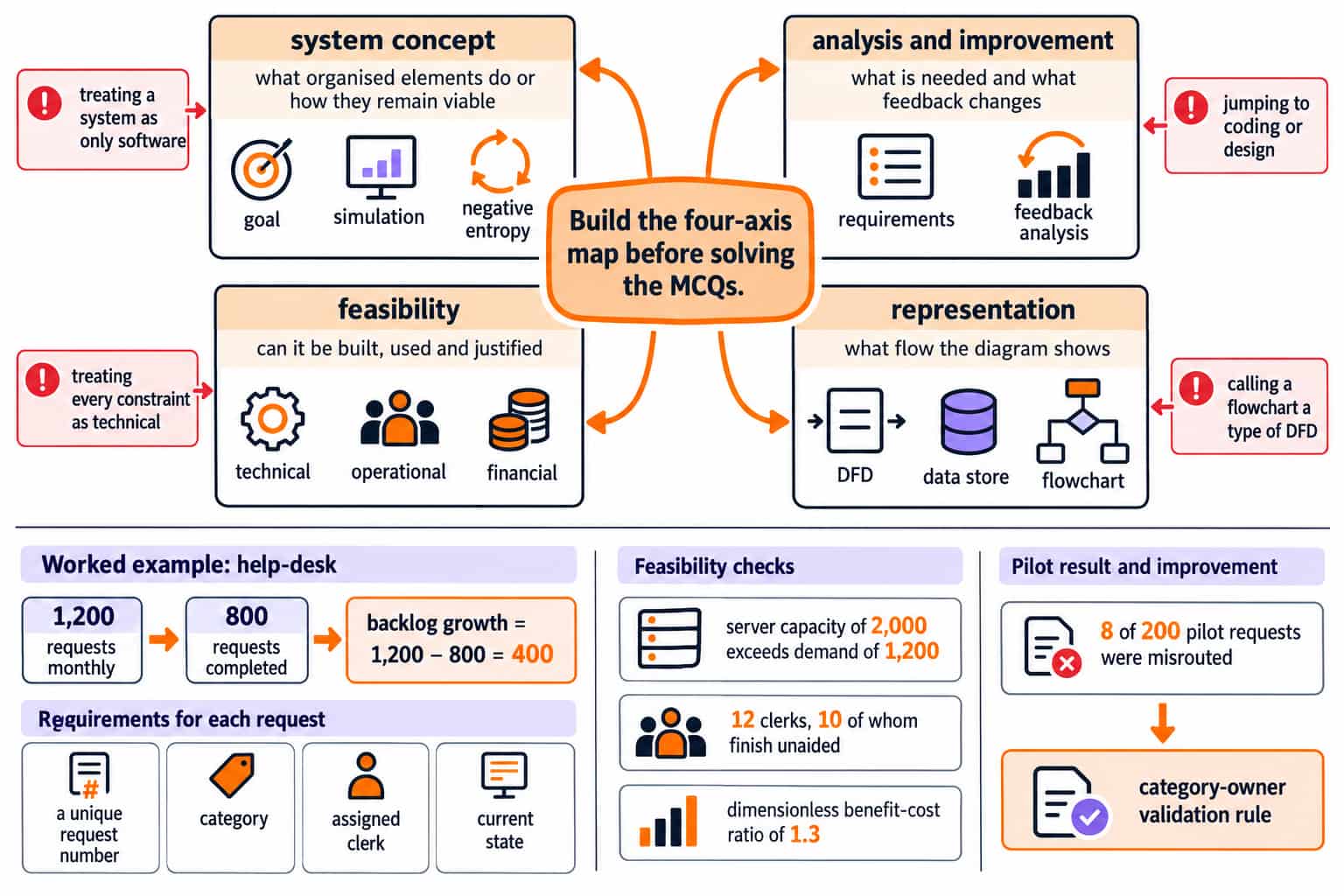
Axis | Decisive question | Examples in this set | Common mix-up |
|---|---|---|---|
system concept | what organised elements do or how they remain viable | goal, simulation, negative entropy | treating a system as only software |
analysis and improvement | what is needed and what feedback changes | requirements, feedback analysis | jumping to coding or design |
feasibility | can it be built, used and justified | technical, operational, financial | treating every constraint as technical |
representation | what flow the diagram shows | DFD, data store, flowchart | calling a flowchart a type of DFD |
A college help-desk receives 1,200 requests monthly but closes 800, so backlog growth is 1,200 - 800 = 400. Analysis identifies four tracking requirements: a unique request number, category, assigned clerk and current state. Design later decides how to store and display them. The earlier Software Engineering for CS Teaching Exams guide connects this boundary to the wider SDLC, process models and testing. For the help-desk case, analysis identifies needs while design chooses the implementation.
Technical feasibility checks whether server capacity of 2,000 requests exceeds demand of 1,200. Operational feasibility pilots the workflow with 12 clerks, 10 of whom finish unaided. Financial feasibility checks available funds and cost-effectiveness, here with a dimensionless benefit-cost ratio of 1.3. After 8 of 200 pilot requests are misrouted, feedback analysis specifies a category-owner validation rule.
Fundamentals of System MCQs 1-2: definition and simulation
Question 1
A collection of activities and elements organized to accomplish a goal. This is the definition of ______.
----------------------------------------
किसी लक्ष्य को प्राप्त करने के लिए व्यवस्थित की गई गतिविधियों और तत्वों का समूह ______ की परिभाषा है।
A. Information / सूचना
B. An organization / एक संगठन
C. Programming / प्रोग्रामिंग
D. A system / एक प्रणाली
Correct answer: D. A system / एक प्रणाली.
The clues are activities and elements, organized and goal. At the help-desk, clerks, forms, server and rules work towards resolving 1,200 monthly requests, so they form a system. Information is a resource or output, programming is an activity, and an organisation is only one possible system.
Question 2
_____ is an imitation of the dynamics of a real world process or system over time.
A. Designing
B. Cryptography
C. Simulation
D. Copying
Correct answer: C. Simulation.
Simulation models behaviour over time. With hourly arrivals of 10, 14 and 8 and capacity of 9, backlog becomes 10 - 9 = 1, then 1 + 14 - 9 = 6, then 6 + 8 - 9 = 5. Copying is static, designing specifies structure, and cryptography protects information. Open the Fundamentals of System module hub (question page unavailable) after committing to an answer.
Fundamentals of System MCQs 3-4: analysis and feedback
Question 3
Which general problem-solving step is equivalent to system analysis in the software development process?
A. Design the chosen solution
B. Implement the chosen solution
C. Identify the solution requirements and expectations
D. Identify the problem
Correct answer: C. Identify the solution requirements and expectations.
Problem identification comes first. Analysis defines requirements and constraints; design chooses how; implementation builds. Here, the problem is the 1,200 - 800 = 400 backlog. Analysis requires four fields and capacity of at least 1,200 requests. See DSSSB TGT Computer Science 2026 Section B and the solved page.
Question 4
Which activity directly links system evaluation with future improvements?
A. Coding
B. Documentation
C. Feedback analysis
D. Data modelling
Correct answer: C. Feedback analysis.
Evaluation produces observations; feedback analysis converts them into change. Here, 8 / 200 x 100 = 4% of requests are misrouted, so a category-owner validation rule is specified. Coding implements, documentation records, and data modelling structures, but none independently closes the evaluation loop.
Fundamentals of System MCQs 5-7: technical, operational and financial feasibility
Technical asks whether capability exists, operational asks whether people can use it, and financial asks whether funding and cost-effectiveness support it.
Question 5
Technical Feasibility is carried out by the System Analysts to evaluate __________.
A. that the needed technology is available.
B. that there will be no resistance for the implementation of the new system.
C. the cost of converting and preparing data files and the cost of preparing new or expanded computer facilities.
D. the time within which the new system will become operational.
Correct answer: A. that the needed technology is available.
The server supports 2,000 monthly requests against demand of 1,200, leaving 2,000 - 1,200 = 800 capacity. Resistance is operational, cost is financial, and completion time is schedule feasibility. Solved page.
Question 6
Conducting study to find out if the proposed system can be used by the employees or not is covered under the __________ feasibility.
A. Technical
B. Schedule
C. Economic
D. Operational
Correct answer: D. Operational.
Used by the employees means operational feasibility. Here, 10 of 12 clerks finish unaided while 2 need training. That is adoption, not hardware, time or economics. Solved page.
Question 7
Financial Feasibility Study is carried out by the System Analysts to evaluate that __________.
A. it will be profitable to implement the system.
B. the proposed system will result in improved operations.
C. finances are available to implement the proposed system and it will be cost-effective.
D. implementation will lead to low operating cost.
Correct answer: C. finances are available to implement the proposed system and it will be cost-effective.
Financial feasibility needs affordability and cost-effectiveness. Profit alone is narrow, operational improvement is not a funding test, and low operating cost omits lifecycle costs. Here, funds and a dimensionless benefit-cost ratio of 1.3 are checked. See NTA-UGC-NET Paper - 2 and the solved page.
Fundamentals of System MCQs 8-10: DFDs, data stores and flowcharts
A DFD tracks data movement; a flowchart traces control steps. Here, Student sends request R-104, category Network, to 1.0 Log Request, which writes R-104, Network, Open to D1 Request Store. A separate flowchart asks Details complete?: Yes goes to Save, while No goes to Return form.
Question 8
__________ is a visual representation that depicts the information flow and the transformation that are applied to data as data moves from input to output.
A. Data Flow Diagram
B. System Flow Chart
C. Layout Form
D. Hierarchy Chart
Correct answer: A. Data Flow Diagram.
Information flow, transformation and movement from input to output point to a DFD: Student -> 1.0 Log Request -> D1 Request Store. A system flowchart shows processing sequence, a layout form concerns presentation, and a hierarchy chart shows levels. Solved page.
Question 9
Which of the following Symbol in Data Flow Diagrams represents Data Store?
A. Arrow
B. Parallel lines (data store)
C. Rectangle
D. Oval
Correct answer: B. Parallel lines (data store).
The option names the notation: D1 Request Store is drawn as parallel lines. An arrow carries data flow, a rectangle commonly represents an external entity, and an oval belongs to other conventions. Solved page.
Question 10
Which statement is wrong related with flowchart?
A. It is the graphical form of an algorithm.
B. It uses diamond-shaped symbols for decisions or conditions.
C. It is a type of Data Flow Diagram (DFD).
D. It represents the sequence of algorithm execution.
Correct answer: C. It is a type of Data Flow Diagram (DFD).
The negative wording means select the wrong statement. A flowchart graphs an algorithm, uses a diamond for decisions, and shows execution sequence. It is not a DFD subtype. The DFD moves R-104 into D1; the flowchart branches Yes/No after Details complete?. The same contrast supports elimination when diagram terms appear together.
Fundamentals of System MCQ 11: negative entropy and system maintenance
Question 11
The maintenance input of matter and energy required to repair, replenish and maintain the system is termed as __________.
A. System Maintenance
B. Debugging
C. Positive Entropy
D. Negative Entropy
Correct answer: D. Negative Entropy.
Entropy is the tendency towards disorder; negative entropy is replenishing input that counters it. If error rate rises from 1% to 6% across four months, a rules update, refreshed category list and 4 staff-hours of retraining that reduce it to 1.5% are restorative inputs. System maintenance is the broad activity, debugging targets software faults, and positive entropy means increasing disorder. Solved page.
A 60-second elimination routine and the next practice step
Use this decision routine before looking at the options:
goal and organised elements -> system
model evolving over time -> simulation
technology / employees / funding -> technical / operational / financial feasibility
data movement -> DFD
algorithm sequence and decisions -> flowchart
restorative input against deterioration -> negative entropy
Test a mixed case: 1,200 monthly requests, server capacity of 2,000, 10 of 12 clerks finishing unaided, a benefit-cost ratio of 1.3, and a 4% error rate prompting validation. The answers are technical feasibility for capacity, operational feasibility for clerk use, financial feasibility for available funding plus cost-effectiveness, and feedback analysis for the validation change.
Answer all 11 again without explanations, then revisit only the options whose axis you misidentified. Continue through the teaching-CS and wider-coverage study routes linked above. Two passes reveal whether your gap is recall or classification.
Go deeper with the full courseMP SET Computer Science (Paper 1 + Paper 2)
Keep learning

Cache Coherence and Write Policy MCQs: 11 Solved Questions with Explanations
Solve 11 cache coherence and write policy questions, then use concrete traces to check dirty bits, allocation, eviction, inclusion, snooping and directories.
Updated 31 Oct 20267 min readComputer Organization MCQs

C Fundamentals Mistakes: Fix 11 Data-Type, Operator and Flowchart Errors
Short C expressions can hide strict rules. Diagnose and repair 11 common errors involving initialisation, conversions, operators, increments and flowcharts.
Updated 18 Nov 20265 min readC Programming & Data Structures
Distributed System Basics MCQs: 11 Solved Questions with Explanations
Practise 11 distributed-system MCQs from UGC NET, DSSSB, KVS and Accenture papers, then learn why each answer wins. The set covers local clocks, scalability, clusters, OS coupling and cloud service models.
Updated 22 Aug 20267 min read74 viewsOperating System MCQs
Subnetting and FLSM Design MCQs: 12 Solved Questions on Masks, Hosts and Ranges
Solve 12 FLSM questions on default masks, borrowed bits, subnet and host counts, usable ranges, gateway selection and a complete 512-subnet design.
Updated 30 Oct 20267 min readComputer Networks MCQs