Subnetting and FLSM Design MCQs: 12 Solved Questions on Masks, Hosts and Ranges
Solve 12 FLSM questions on default masks, borrowed bits, subnet and host counts, usable ranges, gateway selection and a complete 512-subnet design.
KnowledgeGate Team
Exam prep & CS education
Updated 17 Sep 20267 min read
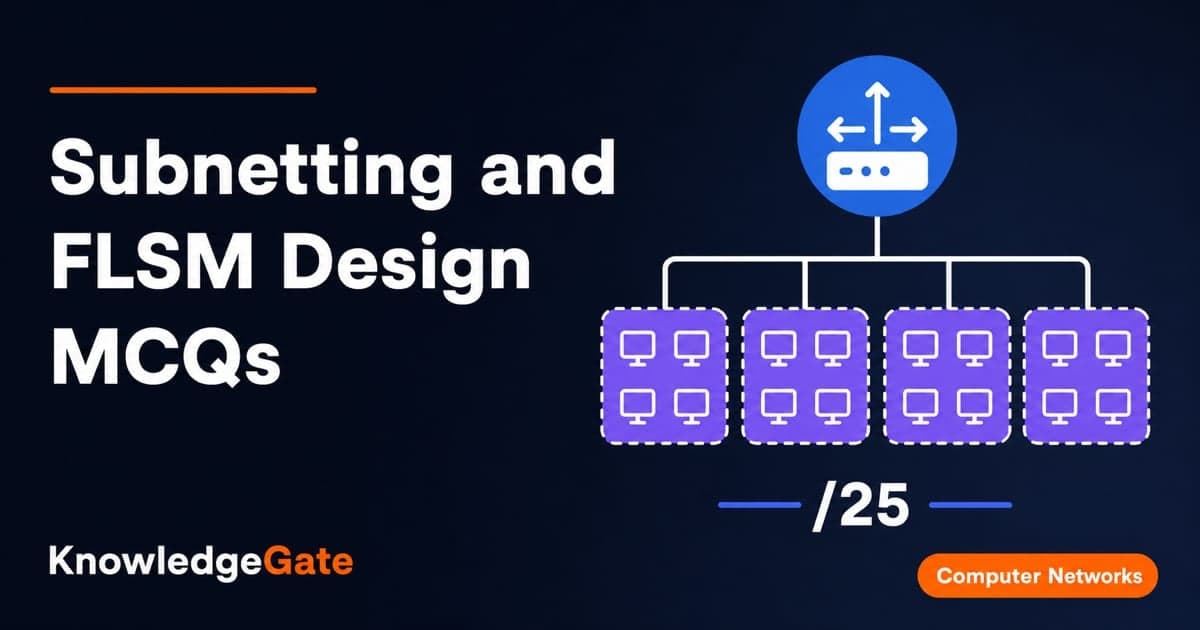
FLSM errors usually begin when borrowed bits are confused with host bits or when network and broadcast addresses are counted as usable hosts. Start from the parent prefix, derive the new prefix, and use the block size to confirm every network, host and broadcast boundary.
For mixed IP-class, address-size and CIDR practice, use Subnetting MCQs: 12 Solved IP Addressing Questions. Classful recall and CIDR ranges belong in that broader survey. FLSM design keeps child subnets equal and therefore centres on borrowed bits, gateway membership and a complete /16-to-/25 allocation. Older PYQs may use the historical 2^s - 2 subnet count, while modern subnetting permits subnet zero. Question 4 uses the historical convention explicitly.
Subnetting and FLSM formulas to use in all 12 MCQs
Fixed Length Subnet Masking, or FLSM, borrows the same number of host bits for every subnet. Every resulting subnet therefore has the same prefix and address capacity. VLSM instead allows different subnet sizes and assigns the largest address requirement first.
Use these rules throughout:
Borrowed bits:
s = new prefix - parent prefixModern subnet count:
2^sHost bits:
h = 32 - new prefixUsable hosts per subnet:
2^h - 2Block size in the changing octet:
256 - mask octet
Prefix | Subnet mask | Host bits | Usable hosts |
|---|---|---|---|
|
| 12 | 4094 |
|
| 10 | 1022 |
|
| 6 | 62 |
|
| 5 | 30 |
Use GATE CS Exam Preparation to place mask and range calculations inside the wider Computer Networks syllabus.
FLSM default masks and borrowed bits: Questions 1-3
Question 1: default Class A mask, UP Police 2016
Default subnet mask of class A IP address is _________
A.
255.255.0.0B.
0.0.0.255C.
255.0.0.0D.
255.255.255.0
Answer: C, 255.0.0.0. A Class A network has the historical default prefix /8. Its mask contains eight network 1s followed by 24 host 0s, which converts to 255.0.0.0.
Question 2: mask for 60 equal departments, Coal India 2017
An organization has a Class B Network and wishes to form subnets for 60 departments. The subnet mask would be:
A.
255.255.64.0B.
255.255.0.0C.
255.255.252.0D.
255.255.255.0
Answer: C, 255.255.252.0. The Class B parent is /16. The smallest s satisfying 2^s >= 60 is 6, so the new prefix is /22; its third mask octet is 11111100₂ = 252, and it creates 64 equal subnets.
Question 3: modern subnet count from /16 to /20, IBPS 2023
A Class B network with default mask /16 is subnetted using the mask /20. Assuming modern subnetting rules where subnet-zero is allowed, how many subnets are created?
A.
8B.
16C.
32D.
64E.
256
Answer: B, 16. The prefix moves from /16 to /20, so four bits are borrowed. Modern rules count all bit patterns, including the all-zero and all-one patterns, giving 2^4 = 16 subnets.
FLSM subnet counts, host counts and usable ranges: Questions 4-6
Question 4: six subnet bits under the historical convention, GATE 2007
The address of a class B host is to be split into subnets with a 6-bit subnet number. What is the maximum number of subnets and the maximum number of hosts in each subnet?
A.
62 subnets and 262142 hosts.B.
64 subnets and 262142 hosts.C.
62 subnets and 1022 hosts.D.
64 subnets and 1024 hosts.
Answer: C, 62 subnets and 1022 hosts. This older PYQ follows the historical convention, so six subnet bits give 2^6 - 2 = 62 subnets. A Class B address begins with 16 host bits; borrowing six leaves ten, and 2^10 - 2 = 1022 usable hosts. Question 3, by contrast, explicitly uses the modern rule.
Question 5: /27 subnet and host capacity, TPSC 2024
If a network uses IPv4 addresses and has a subnet mask of 255.255.255.224, how many subnets can be created, and how many hosts are possible in each subnet?
A.
8 subnets, 30 hosts per subnetB.
16 subnets, 16 hosts per subnetC.
64 subnets, 6 hosts per subnetD.
128 subnets, 2 hosts per subnet
Answer: A, 8 subnets, 30 hosts per subnet. The stem does not name a parent prefix, so the subnet count is not uniquely determined. Option A assumes a /24 parent. Relative to that parent, the mask is /27, so three borrowed bits create 2^3 = 8 subnets, while five remaining host bits provide 2^5 - 2 = 30 usable addresses per subnet.
Question 6: valid host range for 192.168.168.188/26, Accenture 2023
Which option gives the valid host range for IP address 192.168.168.188 with mask 255.255.255.192?
A.
192.168.168.129-190B.
192.168.168.129-191C.
192.168.168.128-190D.
192.168.168.128-192
Answer: A, 192.168.168.129-190. A /26 mask gives a block size of 256 - 192 = 64. Address 188 lies in the 128-191 block, where .128 is the network address, .191 is broadcast, and .129-.190 is the usable host range.
Subnet IDs and same-network masks: Questions 7-8
For more practice on Questions 7 and 12, use the Subnetting & FLSM Design learn module.
Question 7: subnet ID under /18
Consider address 141.14.196.46 with subnet mask 255.255.192.0. What is the subnet ID?
A.
141.14.192.0B.
141.14.1.46C.
25.255.192.0D.
None of these
Answer: A, 141.14.192.0. The mask is /18, so the third-octet block size is 256 - 192 = 64. The value 196 falls in the 192-255 block, making 141.14.192.0 the subnet ID.
Question 8: the mask that separates two hosts, GATE 2010
Suppose computers A and B have IP addresses 10.105.1.113 and 10.105.1.91 respectively and they both use the same net mask N. Which of the values of N given below should not be used if A and B should belong to the same network?
A.
255.255.255.0B.
255.255.255.128C.
255.255.255.192D.
255.255.255.224
Answer: D, 255.255.255.224. With /24, /25, or /26, last octets 91 and 113 remain in the same block. With /27, 91 belongs to 64-95 while 113 belongs to 96-127, so this mask separates A and B.
Gateway choice and subnet membership: Questions 9-11
Question 9: choose Host X's gateway, GATE 2008
Host X has IP address 192.168.1.97 and is connected through routers R1 and R2 to host Y at 192.168.1.80. Router R1 has interfaces 192.168.1.135 and 192.168.1.110. Router R2 has interfaces 192.168.1.67 and 192.168.1.155. The netmask is 255.255.255.224. Which IP address should X configure as its gateway?
A.
192.168.1.67B.
192.168.1.110C.
192.168.1.135D.
192.168.1.155
Answer: B, 192.168.1.110. A /27 has blocks of 32. Host X at .97 lies in 192.168.1.96/27, whose usable range is .97-.126; only R1's .110 interface is in that local subnet, so X must use it as the gateway.
Question 10: three machines under /30, GATE 2019
Consider three machines M, N, and P with IP addresses 100.10.5.2, 100.10.5.5, and 100.10.5.6 respectively. The subnet mask is set to 255.255.255.252 for all the three machines. Which one of the following is true?
A.
M, N, and P all belong to the same subnetB.
Only M and N belong to the same subnetC.
Only N and P belong to the same subnetD.
M, N, and P belong to three different subnets
Answer: C, Only N and P belong to the same subnet. A /30 block contains four addresses. M at .2 belongs to 100.10.5.0/30, while N at .5 and P at .6 are the two usable hosts in 100.10.5.4/30.
Question 11: count the guaranteed /27 subnets, GATE 2008
Host X has IP address 192.168.1.97 and is connected through routers R1 and R2 to host Y at 192.168.1.80. Router R1 has interfaces 192.168.1.135 and 192.168.1.110. Router R2 has interfaces 192.168.1.67 and 192.168.1.155. The netmask is 255.255.255.224. How many distinct subnets are guaranteed to exist?
A.
6B.
3C.
2D.
1
Answer: B, 3. With /27, .67 and .80 map to 192.168.1.64/27, .97 and .110 map to 192.168.1.96/27, and .135 and .155 map to 192.168.1.128/27. These three address pairs prove that three distinct subnets exist.
Full FLSM design from a /16: Question 12 worked end to end
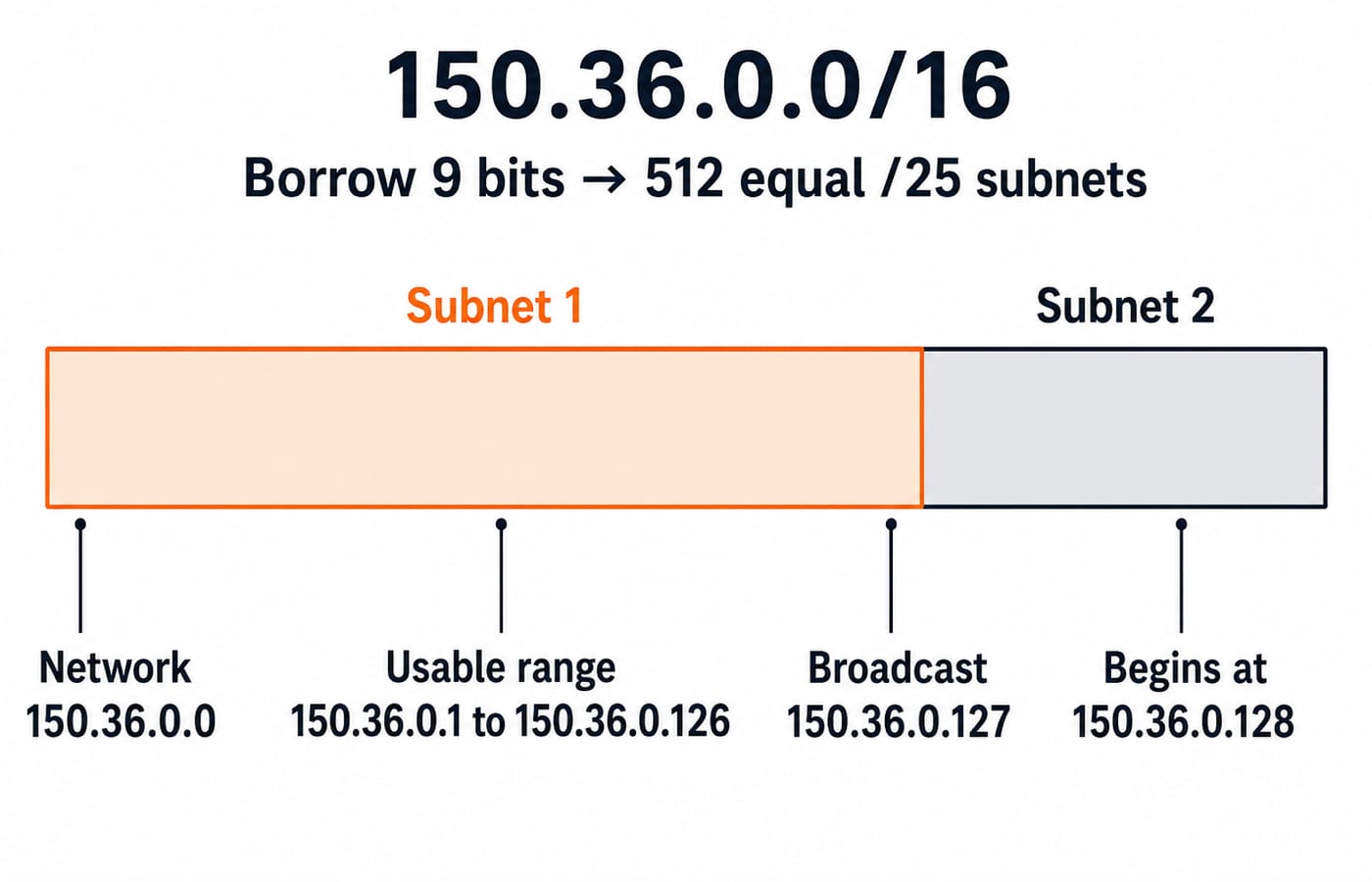
Question 12: create 512 equal subnets
Split 150.36.0.0/16 into 512 equal subnets. Find the usable hosts per subnet and the first and last usable hosts in the first subnet.
A.
128, 150.36.0.1 and 150.36.0.127B.
128, 150.36.0.129 and 150.36.0.255C.
126, 150.36.0.1 and 150.36.0.126D.
126, 150.36.0.129 and 150.36.0.254
Answer: C, 126, 150.36.0.1 and 150.36.0.126. Work it in four steps:
512 = 2^9, so borrow nine bits from the/16parent.The new prefix is
/16 + 9 = /25.Seven host bits remain, giving
2^7 - 2 = 126usable hosts per subnet.The first subnet is
150.36.0.0/25: network.0, first host.1, last host.126, and broadcast.127. The next subnet begins at.128.
FLSM traps to check before the next MCQ set
Before accepting an answer, identify the parent prefix, count borrowed bits separately from host bits, subtract network and broadcast only from host capacity, and use the changing-octet block size to locate the network and broadcast boundaries.
Keep the convention visible too. Question 3 explicitly allows subnet zero, so it uses 2^s. Question 4 uses the historical convention, so it gives 2^s - 2. Never switch between those rules silently.
For a mixed drill on subnetting, classful addressing and CIDR, use the broader collection. For subject-wide practice, use Computer Networks MCQs. If you need Computer Networks sequenced with the wider GATE CS syllabus, continue with GATE Guidance by Sanchit Sir. If only FLSM is weak, redo Questions 6, 8, 9 and 12 by hand before moving on.
Keep learning
Computer Networks Basics & Criteria MCQs: 12 Solved Questions with Explanations
Solve 12 Computer Networks questions, then use clear explanations and worked criteria checks to separate similar terms confidently.
3 Oct 20268 min readComputer Networks MCQs
TCP Timers, RTT Estimation & SWS: 10 Solved MCQs and NATs
Solve 10 TCP exam questions covering timer roles, Silly Window Syndrome, recursive RTT estimates, Jacobson/Karels RTO and Karn's rule.
Updated 28 Sep 20267 min readComputer Networks MCQs
RSA Algorithm MCQs: 12 Solved Questions with Step-by-Step Explanations
Practise RSA key generation, modular inverses, encryption, signatures and defining equations, with concise working for conceptual and numerical answers.
25 Sep 20268 min readComputer Networks MCQs
Firewall, VPN, IDS and IPS MCQs: 11 Network Security Questions Solved
Solve 11 previous-year questions on firewalls, VPNs, IDS and IPS. Learn rule filtering, connection state, DMZ design, IPsec modes, tunnels and signatures.
Updated 24 Sep 20267 min readComputer Networks MCQs