

C Fundamentals Mistakes: Fix 11 Data-Type, Operator and Flowchart Errors
Short C expressions can hide strict rules. Diagnose and repair 11 common errors involving initialisation, conversions, operators, increments and flowcharts.
KnowledgeGate Team
Exam prep & CS education
Updated 18 Nov 20265 min read

C fundamentals errors often come from answering from visual instinct: a local is assumed to be zero, integer division is treated as floating point, and a flowchart update is moved past the operation. Read each trap by establishing the first value, operand types, grouping, side effects and control-flow state. Use CS Fundamentals for Exams & Placements for the wider subject route.
Mistake 1: treating every declared C variable as zero
Why it happens: Beginners transfer the zero-initialisation rule for static-storage objects to an ordinary automatic local variable. Inside a function, consider int total; total += 5; printf("%d", total);.
What goes wrong: total += 5 must first read total, but that automatic int has an indeterminate value. The program therefore has undefined behaviour, not an output of 5 or a predictable “garbage” value. By contrast, static int total; is zero-initialised.
Do instead: Write int total = 0; total += 5;. The defined value is now 5. Beside every declaration, mark where its first value comes from. If this distinction feels unfamiliar, C Programming is a useful syntax reset.
Mistakes 2 and 3: doing arithmetic before checking operand types
Mistake 2, integer division. Why: A float destination makes the division look floating point. Wrong: In int correct = 17, attempted = 20; float accuracy = (correct / attempted) * 100.0f;, C computes 17 / 20 = 0 first, then 0 * 100.0f = 0.0f. Fix: Guard against attempted == 0, then force floating arithmetic before division: 100.0f * correct / attempted = 85.0f.
Mistake 3, signed and unsigned comparison. Why: -1 < 3 appears obvious. Wrong: On a model with 32-bit int and unsigned int, int delta = -1; unsigned int limit = 3U; delta < limit converts delta to 4294967295U, so the comparison is false. Fix: Validate delta >= 0 before comparing as unsigned, or keep both values signed when negatives matter. For full expression-tree parsing, compare C Operators and Expressions: Precedence and Worked Traces and C Operators Explained: Types, Precedence and Worked Expressions; those earlier posts own longer mixed-expression walkthroughs, while this section isolates conversion and comparison traps.
Mistakes 4 to 6: reading C expressions like ordinary algebra
Mistake 4, precedence. Why: The eye reads left to right. Wrong: 2 + 3 * 4 is 14, not 20, because multiplication binds first. Fix: Mark 2 + (3 * 4) before calculating, and use clarifying parentheses in your code.
Mistake 5, assignment in a condition. Why: = and == differ by one character. Wrong: In int x = 7; if (x = 0), assignment makes x zero and the condition false. Fix: Test with if (x == 0), read the condition aloud and enable compiler warnings.
Mistake 6, chained comparisons. Why: Mathematics permits 0 < x < 10. Wrong: For x = 25, C evaluates (0 < 25) < 10, then 1 < 10, producing true. Fix: Write 0 < x && x < 10, which is false for 25.
Source expression | Actual grouping | Exact value |
|---|---|---|
|
|
|
|
|
|
|
|
|
Mistakes 7 and 8: separating logical, bitwise and short-circuit rules
Mistake 7, swapping operator families. Why: && resembles &, while || resembles |. Wrong: For int a = 2, b = 1, with bit patterns 10 and 01, a && b = 1 but a & b = 0; a || b = 1 but a | b = 3. Fix: Decide whether you are combining truth values or bits.
Mistake 8, expecting every operand to run. Why: Both sides get traced automatically. Wrong: int p = 0, q = 5; int r = p && q++; leaves q = 5, r = 0. Likewise, int s = 1, t = 5; int u = s || t++; leaves t = 5, u = 1. Fix: Mark short-circuiting before any right-side effect, and separate essential updates.
Mistakes 9 and 10: refusing forced answers for increment expressions
Mistake 9, prefix versus postfix. Why: Both leave the variable one larger. Wrong: With separate starting values of 4, int a = i++; gives a = 4, i = 5, while int b = ++j; gives b = 5, j = 5. Fix: Record the yielded and stored values.
Mistake 10, tracing undefined behaviour. Why: You assume left-to-right evaluation. Wrong: From k = 4, k++ + ++k modifies k twice without sequencing, so C defines no answer. Fix: Stop. In new, explicitly sequenced code, left = k gives 4; k++ makes 5; ++k makes 6; right = k gives 6; and z = left + right gives 10. Final k = 6. Keep the defined replacement separate from the original expression; it does not recover the original expression's meaning.
Mistake 11: moving a flowchart update across the process step
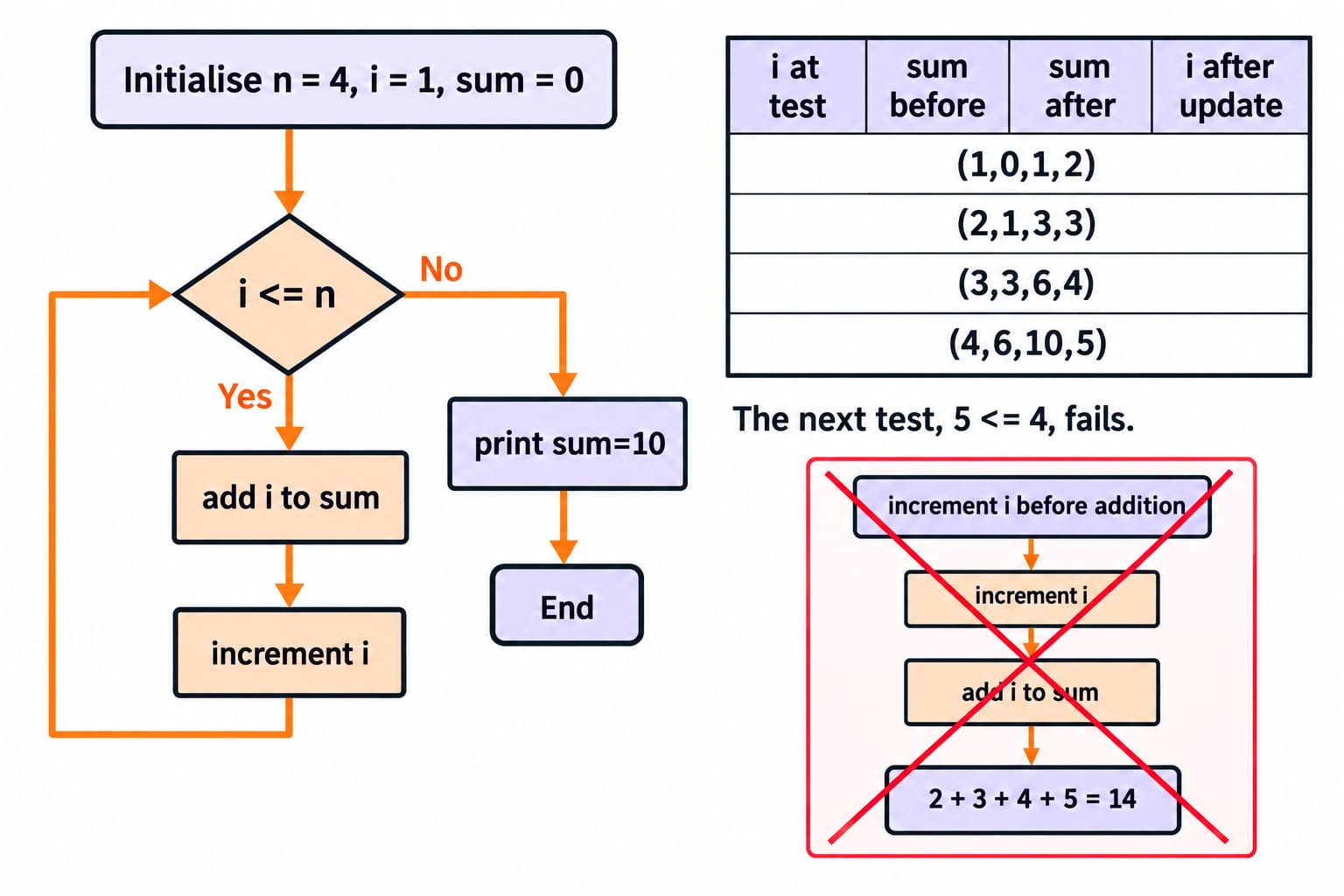
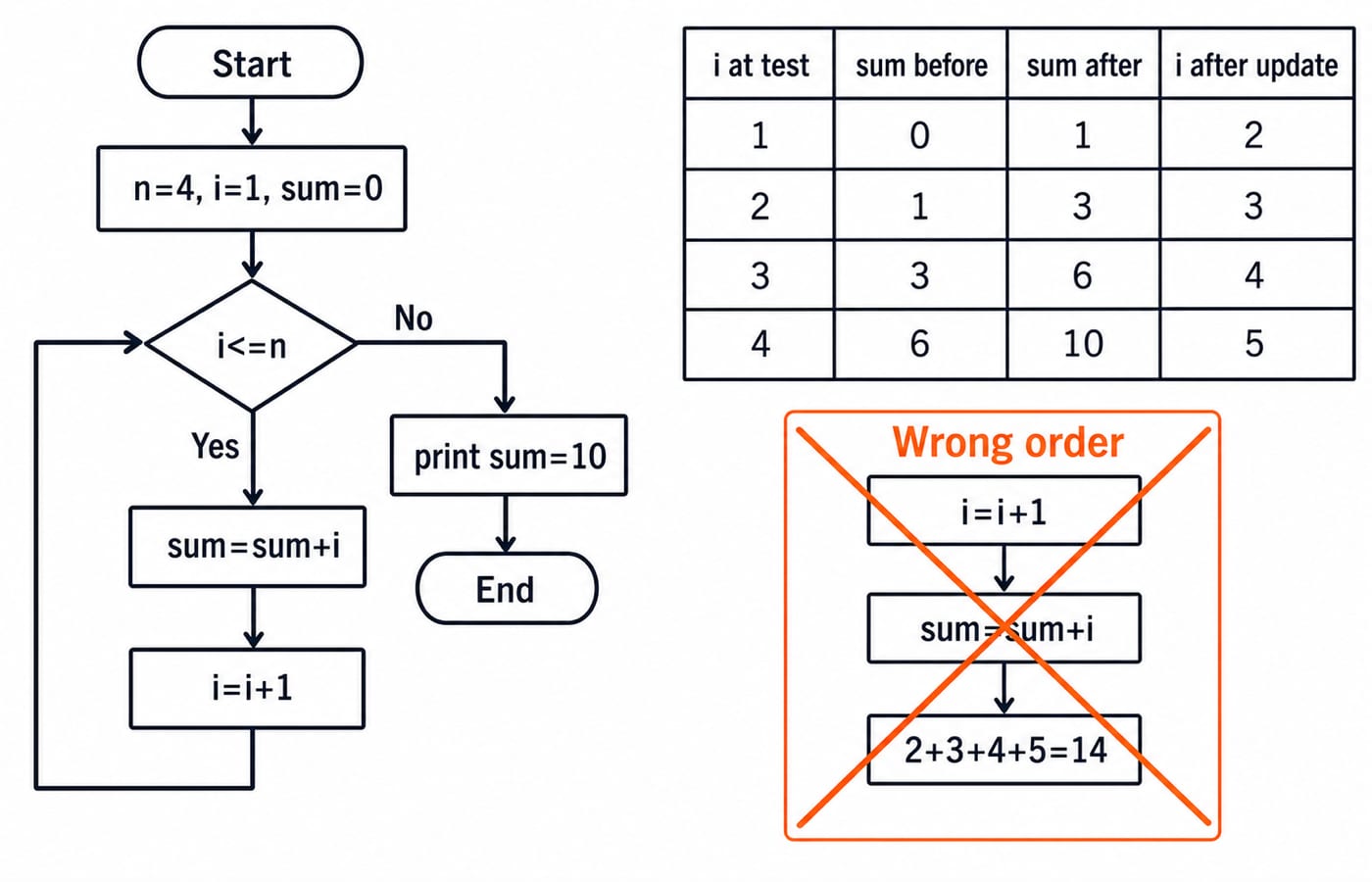
Why it happens: The boxes look unchanged, so moving one arrow seems harmless. It changes the state reaching every later box.
What goes wrong: Initialise n = 4, i = 1, sum = 0; test i <= n; add i to sum; increment i; and return to the test. The sums are 1, 3, 6, 10, with exit at i = 5. Move the increment before addition and the chart adds 2 + 3 + 4 + 5 = 14.
Do instead: Trace one complete row per loop.
Test value of |
|
|
|
|---|---|---|---|
1 | 0 | 1 | 2 |
2 | 1 | 3 | 3 |
3 | 3 | 6 | 4 |
4 | 6 | 10 | 5 |
The next test, 5 <= 4, fails.
C fundamentals: the rule-first answer check
Before choosing an answer, put the evidence on the page:
Question to ask | Evidence to write |
|---|---|
What value enters the statement? | The declared type and first defined value. |
What operation happens first? | Parentheses, conversions and any short-circuit decision. |
Can the trace continue? | Defined sequencing and the next control-flow state. |
Recheck: 17 / 20 becomes 0 before conversion, 0 < 25 < 10 becomes true for the wrong reason, and the flowchart sum is 10, not 14. Use C Language: Concepts, MCQs, Coding Questions for structured concept, MCQ and coding practice.
Keep learning
Grammar and CFG Mistakes for GATE: 7 Traps and How to Fix Them
Seven small grammars expose the errors that make CFG answers go wrong, with reproducible checks for classification, ambiguity, FIRST sets and CNF.
Updated 24 Oct 20265 min readCompiler Design

Bottom-Up Parsing Mistakes for GATE: Fix Errors That Cost Marks
Prevent the small LR parsing errors that spoil an otherwise correct solution. Trace two examples and use a final check for handles, states, GOTO, closure and acceptance.
Updated 1 Nov 20266 min readCompiler Design
Lexical Analysis Mistakes for GATE: 7 Mark-Losing Errors and Exact Fixes
These seven repairs show exactly where lexical analysis answers go wrong. Trace one shared source, separate token counts from lexemes and categories, and keep each compiler phase in its lane.
Updated 30 Oct 20265 min readCompiler Design
Control Flow in C: 7 Mark-Losing Mistakes and Precise Fixes
Trace seven common C control-flow mistakes step by step, see exactly where execution changes course, and learn a short routine for checking every branch and loop.
Updated 14 Nov 20265 min readC Programming & Data Structures