

Information Systems Concepts MCQs: 10 Solved Questions Explained
Solve ten Information Systems Concepts MCQs on system roles, TPS, ERP, knowledge management, MIS resources, requirements and implementation methods.
KnowledgeGate Team
Exam prep & CS education
Updated 25 Nov 20267 min read
Information Systems Concepts MCQs often mix three axes in one option set: a person's role, a functional information-system type, and a processing or implementation method, so the safe routine is to label the axis before choosing.
Answer each question first, underline its decisive phrase, compare every distractor, and then read the explanation. More practice on Information Systems Concepts sits inside the broader Govt Teaching Job Exam Preparation category.
Separate roles, system types, resources and implementation methods
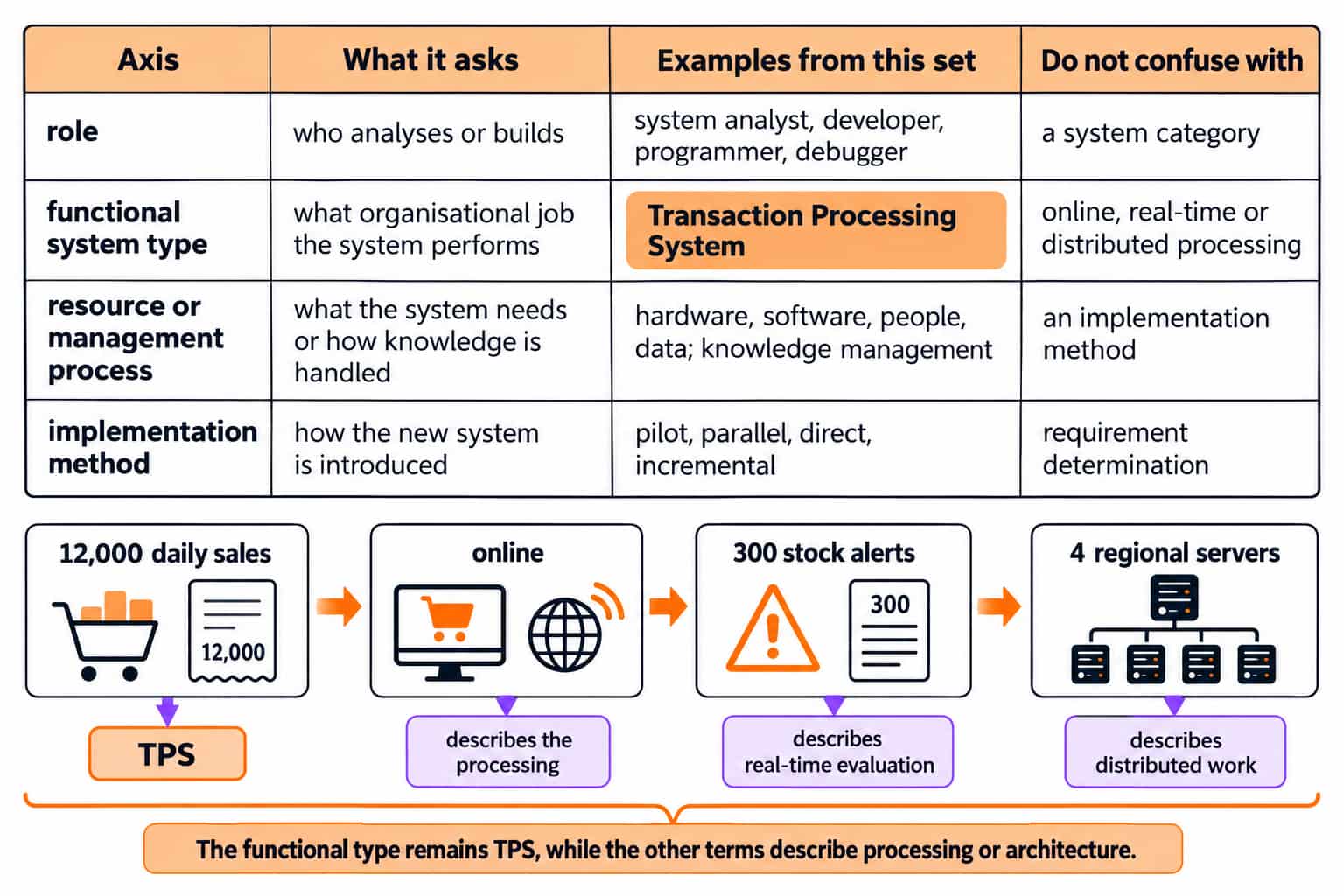
Axis | What it asks | Examples from this set | Do not confuse with |
|---|---|---|---|
role | who analyses or builds | system analyst, developer, programmer, debugger | a system category |
functional system type | what organisational job the system performs | Transaction Processing System | online, real-time or distributed processing |
resource or management process | what the system needs or how knowledge is handled | hardware, software, people, data; knowledge management | an implementation method |
implementation method | how the new system is introduced | pilot, parallel, direct, incremental | requirement determination |
Consider a retailer recording 12,000 daily sales through a TPS. Data arrives online, 300 stock alerts need real-time evaluation, and 4 regional servers distribute the work. Its functional type remains TPS. Online and real-time describe processing; distributed describes architecture.
A system analyst interviews 6 department heads, identifies 8 required reports, and gives the design to 3 programmers. The analyst owns problem analysis and design; the programmers implement the specification. Software Engineering for CS Teaching Exams: SDLC to Testing develops this distinction.
Now check capacity. 4 clerks at 500 records each process 4 × 500 = 2,000 daily. Against 12,000 incoming records, backlog grows by 12,000 - 2,000 = 10,000 per day. This illustrates why volume and timely decisions drive computer-based information systems.
Information Systems Concepts MCQs 1-3: roles, system types and ERP integration
The exact practice pages are linked for Questions 1-6. For Questions 7-10, use the Information Systems Concepts question hub because those items do not have reliable question-specific URLs.
Question 1
HTET Computer Science, 2024.
.......... analyzes the business situation, identifies opportunities for improvements and designs an information system to implement the improvement.
A. System Analyst
B. Developer
C. Programmer
D. Debugger
Correct answer: A. System Analyst.
Analyzes, identifies and designs point to a system analyst. Developers and programmers implement the design; debuggers isolate faults. Information Systems Concepts question hub (question page unavailable), then see DSSSB TGT CS 2026 Section B Course for a broader teaching-CS route.
Question 2
DSSSB Computer Science, 2021.
Which of the following is a type of information system?
निम्नलिखित में से कौन सूचना प्रणाली (Information System) का एक प्रकार है?
A. Transaction Processing System
ट्रांज़ेक्शन प्रोसैसिंग सिस्टम
B. Online Processing System
ऑनलाइन प्रोसैसिंग सिस्टम
C. Real-time Processing System
रियल-टाइम प्रोसैसिंग सिस्टम
D. Distributed Processing System
डिस्ट्रीब्युटिड प्रोसैसिंग सिस्टम
Correct answer: A. Transaction Processing System / ट्रांज़ेक्शन प्रोसैसिंग सिस्टम.
The axis is functional type. A TPS handles routine organisational transactions. Online and real-time describe timing; distributed describes arrangement. It can process 12,000 online sales, evaluate 300 alerts in real time, and span 4 servers while remaining a TPS. Information Systems Concepts question hub (question page unavailable).
Question 3
UGC NET Computer Science Paper 2, 2011.
Enterprise Resource Planning (ERP) is best described as a system that ______
A. has existed for over a decade.
B. does not integrate well with the functional areas other than operations.
C. is inexpensive to implement.
D. automates and integrates the majority of business processes.
Correct answer: D. automates and integrates the majority of business processes.
ERP joins finance, human resources, procurement, operations and sales through a shared suite and database. Its defining property is cross-functional integration, not age, low cost or isolation around operations. Therefore D completes the definition. Practise this UGC NET 2011 question.
Information Systems Concepts MCQs 4-6: knowledge management and MIS resources
Question 4
DSSSB Computer Science, 2021.
______ is the process of identifying, organizing, storing and disseminating information within an organization.
A. Knowledge management
B. Human resource management
C. Financial management
D. Management information system
Correct answer: A. Knowledge management.
Identify, organise, store and disseminate define knowledge management. HR management concerns employment, financial management concerns funds, and an MIS may support the process without being its name. Information Systems Concepts question hub (question page unavailable).
Question 5
DSSSB Computer Science, 2021.
Which of the following factors is taken into account when we develop a Knowledge Management System (KMS)?
A. It requires a knowledge contract.
B. It is a cheap management system.
C. It is a definite process.
D. It has no human implications.
Correct answer: A. It requires a knowledge contract.
A knowledge contract sets rules for ownership, permitted reuse and recognition of contributions. Cost is not necessarily low, tacit knowledge follows no fixed mechanical process, and trust and incentives make human factors central. Information Systems Concepts question hub (question page unavailable).
Question 6
DSSSB Computer Science, 2023.
Which of the following are management information system resources?
Resources:
i) Hardware ii) Software iii) People iv) Data
A. i, ii, iii and iv
B. ii, iii and iv only
C. iii and iv only
D. i and ii only
Correct answer: A. i, ii, iii and iv.
Here, 20 scanners and 2 servers are hardware, the inventory application is software, 35 employees are people, and 12,000 daily records are data. Remove one category and the MIS is incomplete. Information Systems Concepts question hub (question page unavailable).
Information Systems Concepts MCQs 7-8: prioritising and determining requirements
Question 7
It is necessary to prioritize information requirements because
A. it is always good practice
B. there are conflicting user demands
C. there are constraints on budget, time, and resources
D. all organizations do it
Correct answer: C. there are constraints on budget, time, and resources.
Demand is 8 × 4 = 32 developer-days. 2 developers across 10 days provide 2 × 10 = 20 developer-days. Only 20 ÷ 4 = 5 reports fit, leaving 8 - 5 = 3 for later. Conflicts may exist, but capacity is decisive.
Question 8
The major goal of requirement determination phase of information system development is
A. determine whether information is needed by an organization
B. determine what information is needed by an organization
C. determine how information needed by an organization can be provided
D. determine when information is to be given
Correct answer: B. determine what information is needed by an organization.
Requirement determination asks what information is needed: the 8 reports, users, fields and purpose. Design decides how to provide it; scheduling decides when. Option A is too broad.
Information Systems Concepts MCQs 9-10: implementation continuity and organisational need
Question 9
In a high-risk, mission-critical information system, which combination best balances reliability and continuity during implementation?
A. Direct implementation with stress testing
B. Parallel implementation with limited user training
C. Pilot implementation followed by parallel implementation
D. Incremental development with direct cutover
Correct answer: C. Pilot implementation followed by parallel implementation.
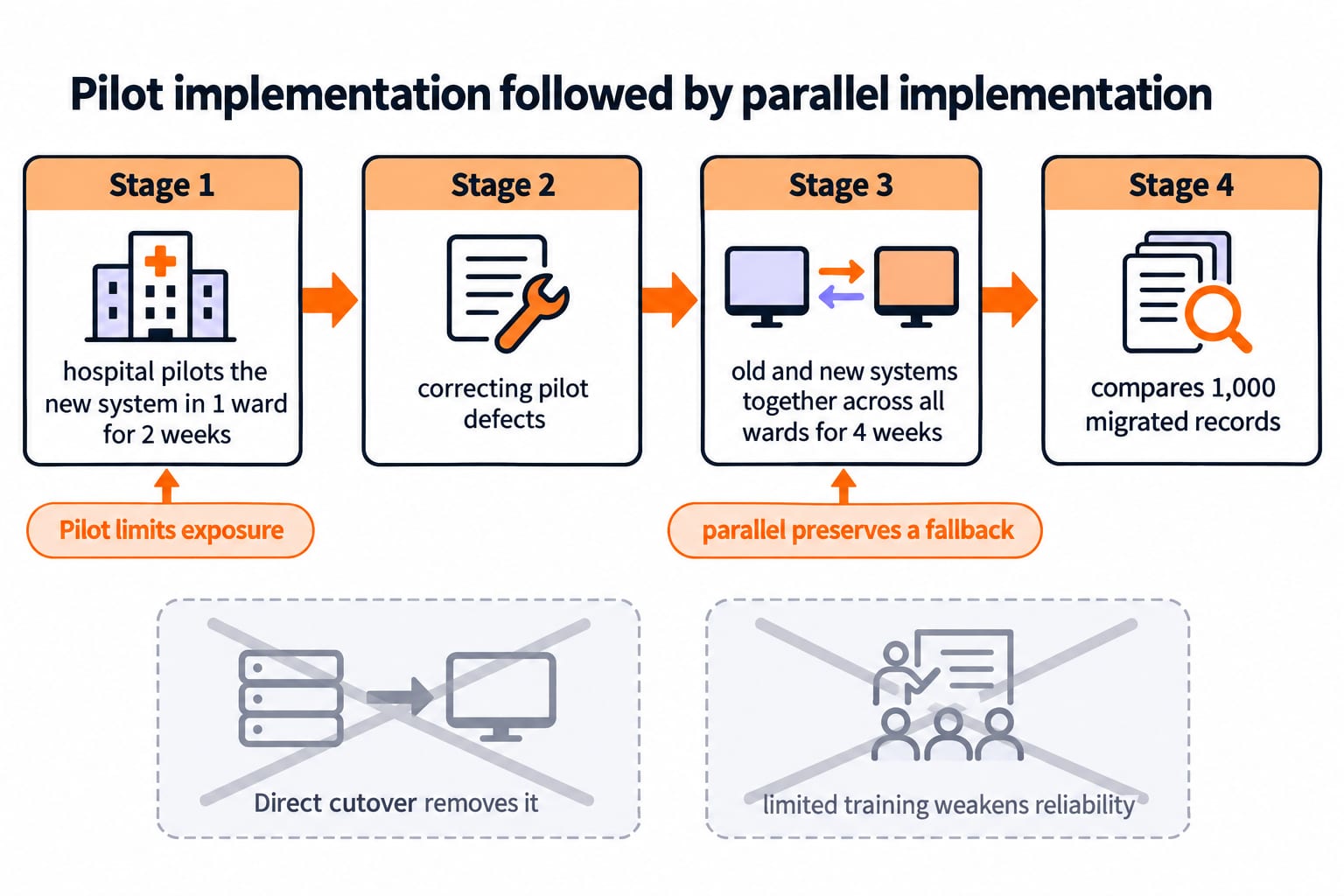
In an illustrative scenario, a hospital pilots the new system in 1 ward for 2 weeks. After correcting pilot defects, it runs old and new systems together across all wards for 4 weeks and compares 1,000 migrated records. Pilot limits exposure; parallel preserves a fallback. Direct cutover removes it, while limited training weakens reliability.
Question 10
A computer based information system is needed :
I. as it is difficult for administrative staff to process data.
II. due to rapid growth of information and communication technology.
III. due to growing size of organizations which need to process large volume of data.
IV. as timely and accurate decisions are to be taken.
Which of the above statement(s) is/are true ?
A. I and II
B. III and IV
C. II and III
D. II and IV
Correct answer: B. III and IV.
III and IV name direct needs: larger data volumes and timely, accurate decisions. I is unspecific; ICT growth in II enables systems but does not create the business need. The check confirms it: 12,000 - 2,000 = 10,000 records remain unprocessed each day.
Classify six mixed clues without seeing the options
For each clue, write one label before checking the sequence: role, functional system type, management process, resource set, requirement activity or implementation method.
analyses six department interviews and designs the solution
handles 12,000 routine sales while running online across four servers
identifies, stores and shares organisational know-how
combines 20 scanners, an application, 35 employees and transaction records
asks which eight reports users need before design begins
starts in one ward, then keeps the old and new systems running together
Answer sequence: system analyst; TPS; knowledge management; hardware, software, people and data; requirement determination; pilot followed by parallel implementation.
A wrong first label exposes the exact confusion. If you wrote a technology term for clue 1, revise roles. If you wrote real-time for clue 2, separate function from processing mode. If you wrote design for clue 5, separate what users need from how the solution will provide it.
Build a five-axis error log from your first attempt
Record every miss under one of five axes. Each row needs the question number, the decisive phrase, the nearest distractor and the correct axis, so the next attempt repairs a distinction rather than memorising an answer letter.
role: Question 1
functional system or enterprise suite: Questions 2-3
management process and MIS resources: Questions 4-6
requirement priority and determination: Questions 7-8
implementation continuity and organisational need: Questions 9-10
Retake all ten items after 24 hours. Explain why every rejected option belongs to the wrong axis, then redo the six-clue classification without looking at the answer sequence.
For a structured Paper 2 sequence, use NTA-UGC-NET Paper - 2. If you need only this concept, repeat the ten questions and keep the five-axis error log instead of taking a full course.
Go deeper with the full courseMP SET Computer Science (Paper 1 + Paper 2)
Keep learning
Fundamentals of Systems and Information Systems: Types, Components and a Worked Inventory Model
Learn the system vocabulary, compare classifications and TPS, MIS, DSS and ESS, then follow one warehouse case from raw transactions to a 480-unit order.
Updated 15 Nov 20266 min readGATE Strategy & Roadmap
Intrusion Detection Systems (IDS): Types, Detection Methods and a Worked Metrics Example
Understand where an IDS collects evidence, how it detects suspicious activity, and why recall, precision and false-positive rate matter more than accuracy alone.
Updated 2 Nov 20266 min readGATE Strategy & Roadmap

Abstraction, Modularity and Information Hiding MCQs: 12 Solved Design Questions
Use 12 solved design-concept MCQs to separate abstraction, ownership, refinement, CRC roles and UML modelling choices.
Updated 15 Nov 20267 min readUGC NET Computer Science
Information Security & Cyber Laws for GATE: A 6-Week Topic Plan
Build an adaptable six-week plan for security and cyber law topics, with a diagnostic hour budget, worked exercises, timed practice and a missed-day rule.
Updated 20 Nov 20265 min readGATE Strategy & Roadmap