

Design Description Tools and Techniques: 12 Solved MCQs and Design Questions
Practise six objective MCQs and six applied design questions, with fresh answers that show how to choose and use the right system design tool.
KnowledgeGate Team
Exam prep & CS education
Updated 23 Nov 20268 min read

Six objective MCQs and six applied questions test whether you can match a design problem to the right representation. DFDs trace data, decision tables encode rules, dictionaries define data, and behavioural or inheritance diagrams show change and reuse. Use UGC NET CS Exam Preparation for the broader syllabus. Questions 1 and 5 have direct links; use the Design Description Tools question page for Questions 2-4 and 6.
Design description tools: a compact recognition map
DFDs move data; decision tables map rules; dictionaries define data; dynamic diagrams show change; inheritance enables reuse.
Example: Gold = Yes, order > 5000 = Yes and Weekend = Yes trigger 20% off. For 6200 on Saturday, discount = 6200 x 0.20 = 1240; payable = 6200 - 1240 = 4960. Weekend = No prevents the action. A trade-off matrix ranks alternatives instead.
Design description MCQs 1-3: DFD black holes, decisions and data flow
Question 1
A black hole in a DFD is
A. A data store with no in bound flows
B. A data store with only in bound flows
C. A data store with more than one in bound flow
D. None of these
Correct answer: B. A data store with only in bound flows.
Bank attribution: UP LT Grade 2022. A black hole consumes an incoming data flow but produces no outgoing flow, so B is correct. Review the full bank question.
Question 2
Which of the following is used to show the rules that apply to a decision when one or more conditions apply?
निम्नलिखित में से किसका उपयोग किसी निर्णय पर लागू होने वाले नियमों को दिखाने के लिए किया जाता है, जब एक या अधिक शर्तें लागू होती हैं?
A. System flowchart / सिस्टम फ्लोचार्ट
B. Decision table / डिसीजन टेबल
C. Grid chart / ग्रिड चार्ट
D. Checklist / चेकलिस्ट
Correct answer: B. Decision table / डिसीजन टेबल.
A decision table maps each condition combination to its action. Flowcharts show sequence; grid charts and checklists do not map complete condition-action rules.
Question 3
Which of the following tools present data or information flow within an information system?
निम्नलिखित में से कौन-सा टूल सूचना प्रणाली (Information System) के भीतर डेटा या सूचना के प्रवाह को दर्शाता है?
A. Grid chart / ग्रिड चार्ट
B. Decision table / डिसीजन टेबल
C. System flowchart / सिस्टम फ्लोचार्ट
D. Data flow diagram / डेटा फ्लो डायग्राम
Correct answer: D. Data flow diagram / डेटा फ्लो डायग्राम.
A DFD shows information moving among entities, processes and data stores. A system flowchart emphasizes processing sequence and physical flow.
Design description MCQs 4-6: structured models, design timing and CASE tools
Question 4
In information systems development, the structured approach used to model system processes and data flow is ______.
सूचना प्रणाली विकास (Information Systems Development) में सिस्टम की प्रक्रियाओं और डेटा के प्रवाह को मॉडल करने के लिए प्रयुक्त संरचित तरीका ______ है।
A. Decision tree / डिसीजन ट्री
B. Data flow diagram / डेटा फ्लो डायग्राम
C. Grid chart / ग्रिड चार्ट
D. Checklist / चेकलिस्ट
Correct answer: B. Data flow diagram / डेटा फ्लो डायग्राम.
The paired clues “processes” and “data flow” identify a DFD. A decision tree models branching choices, while a DFD models transformations, stores and named flows.
Question 5
System Design is carried out ______.
A. as soon as system requirements are determined.
B. whenever the System Analyst feels it to be urgent.
C. after the final system specifications are approved by the management.
D. whenever the management feels it to be urgent.
Correct answer: C. after the final system specifications are approved by the management.
Bank attribution: UP LT Grade 2024. Approved final specifications establish the design baseline, so C is correct; urgency alone does not define a valid design start. Review the full bank question.
Question 6
These tools are also called computer-aided software engineering (CASE) tools. They are used in system analysis to evaluate alternative hardware and software solutions.
A. Project management tools
B. Automated design tools
C. Spreadsheets
D. Report generators
Correct answer: B. Automated design tools.
CASE tools model or compare system alternatives. Project-management tools schedule work, spreadsheets tabulate data, and report generators format outputs.
Applied design questions 7-8: the toolset, dictionaries and decision logic
Question 7
What are the tools used for describing system design? Explain the concept and significance of a Data Dictionary in the System Design Specification (SDS).
Answer: DFDs show movement; tables/trees show rules; state/interaction diagrams show behaviour; inheritance shows class relationships; dictionaries define metadata. Example: Customer_Status, alias Cust_State, type ENUM, values {Active, Suspended, Closed}, owner Customer Service, consumers CRM UI, billing API, monthly report. Shared definitions support validation and impact analysis.
Question 8
A Database Administrator (DBA) argues that a Data Dictionary is redundant because "the SQL schema itself contains all table definitions and constraints." Meanwhile, a Developer is struggling to understand when a specific 'Order' status transitions from 'Pending' to 'Shipped' and how complex discount logic is applied.
a) Critique the DBA’s claim by explaining the specific components of a 'Description of Data Element' that are missing in a raw SQL schema.
b) The Developer is confused by the 'Order' status flow. Identify whether a 'Timing Diagram' or a 'State Machine Diagram' would better resolve this confusion, and why.
c) If the company has a complex policy (e.g., "If customer is Gold AND order > 5000 AND it's a Weekend, give 20% discount"), explain why a 'Decision Table' is superior to a 'Trade-off Matrix' for this specific requirement.
Answer: (a) SQL covers columns, types and constraints but often omits aliases, meaning, owner, source, consumers and process use; a dictionary adds them.
(b) Use a state machine: events and guards move Pending to Shipped; timing diagrams emphasize exact timing.
(c) Gold = Yes, order > 5000 = Yes, Weekend = Yes matches Y/Y/Y. For 6200 on Saturday: 6200 x 20 / 100 = 1240; 6200 - 1240 = 4960. Weekend = No blocks it. Decision tables execute rules; trade-off matrices rank alternatives.
Applied design questions 9-10: object interaction and inheritance
Question 9
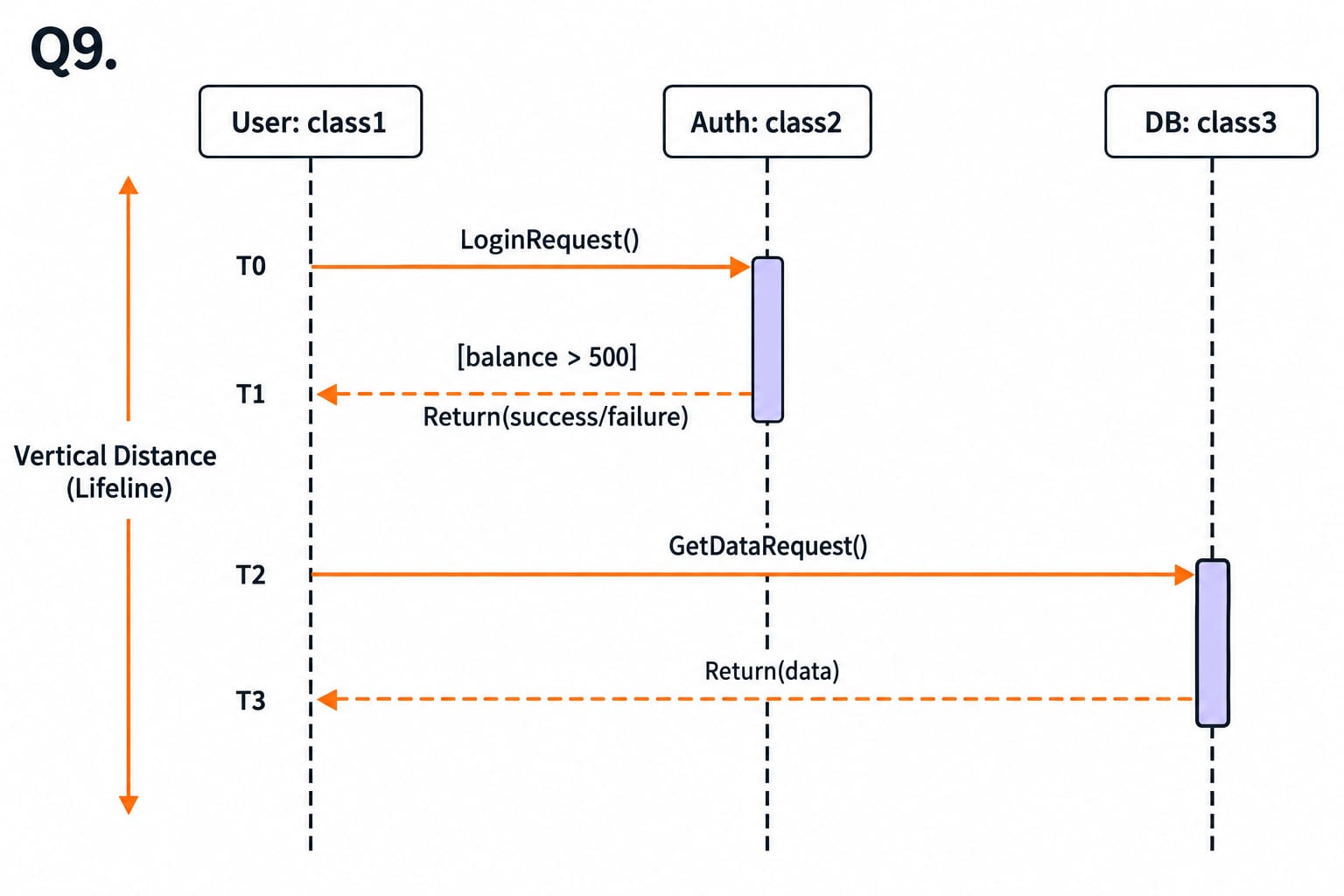
A Senior Developer is reviewing a new module's design. The Junior Developer has provided a static class diagram, but the Senior is frustrated, saying, "I see the objects, but I don't see the temporal (time-based) logic or how these objects actually talk to each other to fulfill a request."
a) Critique why a static class diagram is insufficient in this case and how an 'Object Interaction Diagram' solves the Senior Developer's concern regarding the 'Life of an Object'.
b) Explain the technical significance of 'Vertical Distance' and 'Directed Lines' as shown in the provided interaction diagram.
c) If a message is only sent when a specific condition is met (e.g., "if balance > 500"), discuss how this is represented in an Interaction Diagram compared to a simple flowchart.
Answer: (a) A class diagram is static; an interaction diagram shows an object's life through named-object messages ordered from T0 to T3 below.
(b) Vertical distance shows sequence/time; arrows show sender, receiver and direction.
(c) Put [balance > 500] on the arrow; flowcharts lack object-to-object emphasis.
Question 10
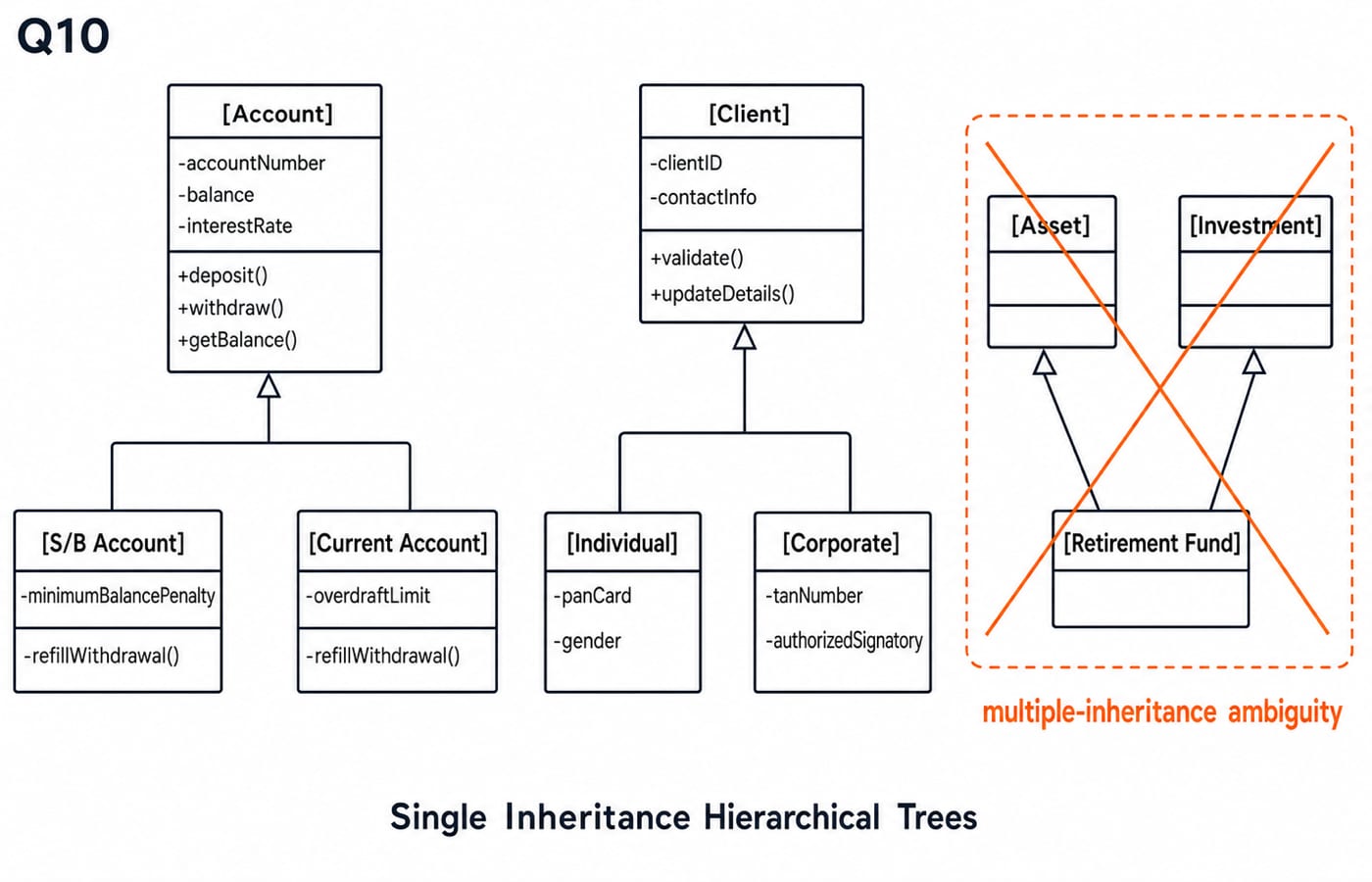
An Analyst is reviewing the following Inheritance Diagram for a new Banking Module. He argues that using Inheritance creates too much dependency between classes.
a) Critique why this claim is short-sighted regarding 'Operations' reuse and 'Attributes' consistency.
b) Based on this 'Hierarchical Tree', identify which specific attributes would be shared from 'Account' to 'S/B Account'.
c) Explain why adding a 'Retirement Fund' inheriting from two classes creates a 'Multiple Inheritance' problem for this notation.
Answer: (a) Inheritance couples classes but centralizes reusable attributes and operations, preventing inconsistent duplication.
(b) S/B Account inherits accountNumber, balance, interestRate; minimumBalancePenalty and refillWithdrawal() are specific.
(c) Asset and Investment may conflict; this single-parent notation cannot resolve multiple-inheritance ambiguity.
Applied design questions 11-12: data dictionary entries that remove ambiguity
Question 11
A Banking Application is being developed to handle millions of transactions daily. During the design phase, the development team is confused about the naming conventions and data types for fields like Account_Balance, Transaction_ID, and Customer_Status. To resolve this ambiguity and ensure consistency across the database and user interface, you are asked to implement a Data Dictionary.
(a) Define a Data Dictionary in the context of System Design. Why is it often called the "Metadata" of a system?
(b) Create a sample Data Dictionary entry for the field Account_Balance. Include at least five essential elements (e.g., Data Name, Aliases, Range, etc.) that must be present in this entry.
(c) Discuss how a well-maintained Data Dictionary helps in "Impact Analysis" when a system needs an upgrade or a bug fix in the future.
Answer: (a) A data dictionary is metadata: definitions, not values.
(b) Entry: name Account_Balance; aliases Curr_Bal, Available_Funds; type DECIMAL(15,2); range -1,000.00 to 9,99,99,99,999.99; meaning withdrawable funds; owner Accounts Service; consumers ledger, API, UI, statement; validation two decimals.
(c) If scale changes from 2 to 3, it identifies every database, API, UI and report to update/test.
Question 12
"A software development team is building a complex 'Hospital Management System.' During the design phase, the database administrator uses the term Patient_ID, while the UI designer uses PID for the same element. Additionally, there is confusion regarding which data elements are 'control elements' and how they should be structured within the various tables of the subsystem."
(a) According to the provided text, which specific tool should be used in the System Design Specification to define these data and control elements?
(b) How does this tool resolve the conflict between the terms Patient_ID and PID?
(c) Apart from individual data items, what other structural information can this tool contain?
Answer: (a) Use a data dictionary.
(b) Set canonical Patient_ID with alias PID, type VARCHAR(12), sample PAT-000042, uniqueness, owner and consumers.
(c) It can define control elements, table structures, keys and relationships.
The traps these 12 design-description questions expose
Five clue patterns account for most wrong choices:
Inbound data without an output is a DFD black hole; data without an input is a miracle.
Conditions mapped to actions need a decision table, not an alternative-ranking matrix.
Event-driven object states need a state machine; time-ordered object messages need an interaction diagram.
Aliases, ownership, meaning and consumers belong in a data dictionary even when SQL defines columns and constraints.
Inheritance centralizes shared features, but multiple parents can introduce conflicts.
For architecture, cohesion, coupling and change containment, use Software Design in Software Engineering; this set stays on selecting and applying description tools.
Design description tools: the next practice step
Redo Questions 1-6, then outline 8, 9 and 11. Continue with NTA-UGC-NET Paper - 2 and the UGC NET CS Test Series.
Go deeper with the full courseMP SET Computer Science (Paper 1 + Paper 2)
Keep learning

Common Software & Tools MCQs: 12 Solved ICT Questions Explained
Attempt 12 previous-year ICT MCQs before reading concise explanations that separate applications, hardware, web tools, abbreviations, malware and operating systems.
Updated 29 Oct 20268 min read59 viewsUGC NET Computer Science

ICT in Education MCQs: 12 Solved Questions on Digital Learning Tools
Solve 12 ICT in Education MCQs, then use clear explanations and a five-layer model to separate files, tools, platforms and public initiatives.
Updated 30 Oct 20268 min readUGC NET Computer Science

Resume Tailoring for a Job Description: Match Evidence Without Keyword Stuffing
Use one evidence ledger to create honest developer, testing and support resumes. Follow a worked matrix, three bullet rewrites and a 40-minute cycle.
Updated 30 Oct 20265 min readInterview Corner

Switching Techniques MCQs: 12 Solved Questions on Circuit, Packet and Message Switching
Practise 12 switching-techniques questions on circuit, packet and message switching, packet-header arithmetic and legacy WAN standards.
Updated 29 Oct 20267 min read122 viewsComputer Networks MCQs