Distributed System Basics MCQs: 11 Solved Questions with Explanations
Practise 11 distributed-system MCQs from UGC NET, DSSSB, KVS and Accenture papers, then learn why each answer wins. The set covers local clocks, scalability, clusters, OS coupling and cloud service models.
KnowledgeGate Team
Exam prep & CS education
Updated 22 Aug 20267 min read
Basic distributed-system questions look definitional, but their distractors mix distributed operating systems, multiprocessing, clusters, scalability and cloud service models. Ten of these eleven are previous-year questions from UGC NET, DSSSB, UPPSC Polytechnic Lecturer, KVS and Accenture papers, set between 2014 and 2025. For each question, choose an answer before opening the explanation. Then state the rule that eliminated the other three choices. Do not stop at recognising a familiar word. This extra step turns recognition into recall and exposes a weak definition quickly. If a term is unfamiliar, use the CS Fundamentals for Exams and Placements map to place it within the wider subject.
Distributed system basics to know before solving
A distributed system coordinates independent networked computers to provide one service. Each machine has its own local memory and hardware clock. Adding machines can increase capacity and flexibility, but each machine also creates another communication, failure and diagnostic surface.
Keep four terms separate. A distributed OS coordinates loosely coupled machines as one system. A multiprocessing OS coordinates processors inside one tightly coupled computer. A cluster joins independent machines for availability or high-performance work. Parallel computing means simultaneous execution, which one shared-memory machine can also provide, so parallel does not automatically mean distributed.
Now take a service with two servers, each handling 120 requests/second:
Initial capacity =
2 x 120 = 240 requests/second.Incoming load =
300 requests/second, so the excess is300 - 240 = 60 requests/second.A third identical server gives
3 x 120 = 360 requests/second.Utilisation is
300 / 360 x 100 = 83.33%.
That is scalability in action, with one more network path and machine to diagnose.
Distributed computing and processor independence: MCQs 1-3
Question 1
DSSSB 2021, Computer Science
_____ computing is a model in which components of a software system are shared among multiple computers.
A. Distributed
B. Abstraction
C. Private
D. Simulation
Correct answer: A. Distributed.
"Components" shared among "multiple computers" defines distributed computing. Abstraction hides detail, private describes access or deployment, and simulation imitates a system without distributing its components. See the full Q1 solution.
Question 2
Which type of operating system shares processing across multiple computers?
A. Multiprogramming OS
B. Real-Time OS
C. Distributed OS
D. Multiprocessing OS
Correct answer: C. Distributed OS.
The physical boundary decides it: "multiple computers" identifies a distributed OS. Multiprocessing uses processors within one computer, multiprogramming keeps several programs ready for a CPU, and real-time describes deadline behaviour. See the full Q2 solution.
Question 3
UPPSC Polytechnic Lecturer 2022, Computer Science
In distributed system each processor has its own ______.
A. local memory
B. clock
C. both local memory and clock
D. None of the above
Correct answer: C. both local memory and clock.
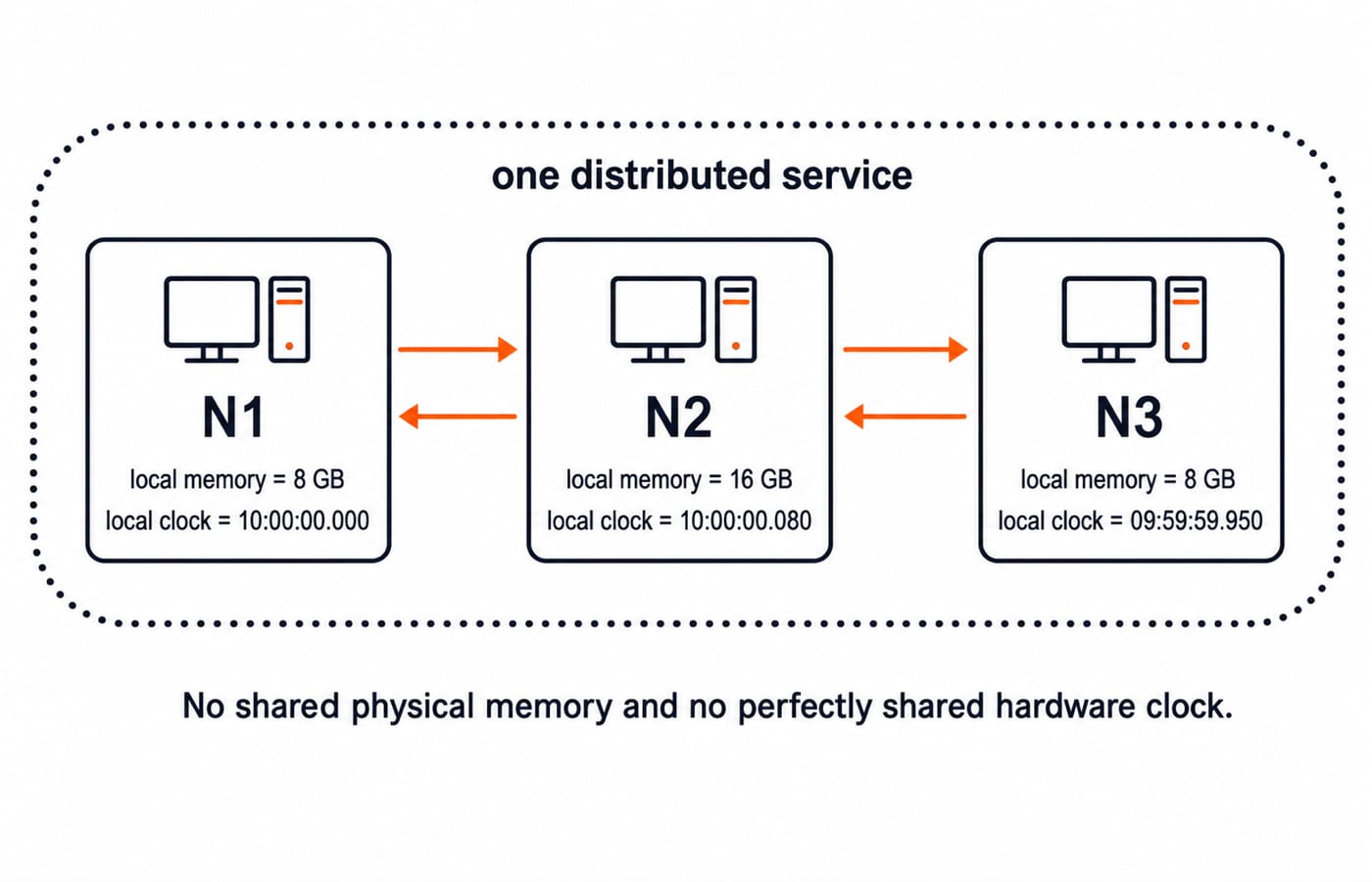
Independent nodes share neither physical memory nor a perfect hardware clock. N1 has 8 GB at 10:00:00.000; N2 has 16 GB at 10:00:00.080; N3 has 8 GB at 09:59:59.950. They coordinate by messages and clock-synchronisation protocols. See the full Q3 solution.
Scalability, flexibility and the cost of distribution: MCQs 4-6
Question 4
DSSSB 2022, Computer Science
Which of the following is/are a feature of distributed operating system? (i) Scalability (ii) Flexibility
A. Only (i)
B. Only (ii)
C. Both (i) and (ii)
D. Neither (i) nor (ii)
Correct answer: C. Both (i) and (ii).
Test each statement separately. Scalability grows capacity by adding resources; flexibility lets workloads or services move across machines. Both apply. The increase from 240 to 360 requests/second demonstrates scalability. See the full Q4 solution.
Question 5
UGC NET Paper 2 (November) 2017, Computer Science
In Distributed system, the capacity of a system to adapt the increased service load is called __________ .
A. Tolerance
B. Scalability
C. Capability
D. Loading
Correct answer: B. Scalability.
"Adapt" to an "increased service load" defines scalability. Fault tolerance concerns service after failure, capability is too general, and loading names the demand rather than the response. See the full Q5 solution.
Question 6
DSSSB 2022, Computer Science
Which of the following statements is/are FALSE? (i) In distributed computing, you may add multiple machines as required. (ii) Because of the distribution across multiple servers, troubleshooting and diagnostics are more challenging in distributed computing.
A. Only (i)
B. Only (ii)
C. Both (i) and (ii)
D. Neither (i) nor (ii)
Correct answer: D. Neither (i) nor (ii).
Both statements are true. Horizontal scaling adds machines. A distributed trace reaches N1 at 10:00:00.000, N2 at 10:00:00.080, then fails on N3 at 09:59:59.950. Diagnosis must reconcile its network path and clock offsets. The question asks which are false, so answer neither. See the full Q6 solution.
Distributed, parallel and clustered models: MCQs 7-8
Question 7
UGC NET Paper 2 (December) 2014, Computer Science
Which of the following computing models is not an example of distributed computing environment ?
A. Cloud computing
B. Parallel computing
C. Cluster computing
D. Peer-to-peer computing
Correct answer: B. Parallel computing.
Cloud, cluster and peer-to-peer models use networked machines. Parallel computing only requires simultaneous operations, which can occur inside one shared-memory machine. The two ideas can overlap, but parallelism alone is not distributed. See the full Q7 solution.
Question 8
KVS 2018, Computer Science
Which of the following is correct?
A. In asymmetric multiprocessing, the processors are peers.
B. In symmetric multiprocessing, the processors are placed symmetrically on the motherboard.
C. Clustered systems are used for high performance computing.
D. All multiprocessor systems are multicore systems.
Correct answer: C. Clustered systems are used for high performance computing.
Four nodes with 8 CPU cores and 32 GB local memory each provide 4 x 8 = 32 cores and 4 x 32 = 128 GB for divisible work, before coordination and data-transfer overhead.
Asymmetric processors use master-subordinate roles, so A fails. In B, symmetry means peer access and scheduling, not motherboard geometry. D fails because processors can occupy separate packages. See the full Q8 solution.
Hardware and software coupling in a distributed OS: MCQ 9
Question 9
UGC NET Paper 2 (January) 2017, Computer Science
Distributed operating systems consist of :
A. Loosely coupled O.S. software on a loosely coupled hardware.
B. Loosely coupled O.S. software on a tightly coupled hardware.
C. Tightly coupled O.S. software on a loosely coupled hardware.
D. Tightly coupled O.S. software on a tightly coupled hardware.
Correct answer: C. Tightly coupled O.S. software on a loosely coupled hardware.
Split the layers. Independent N1, N2 and N3 machines have local memory and clocks, so their hardware is loosely coupled. Tightly coordinated OS software presents one coherent system. See the full Q9 solution.
SaaS, PaaS and IaaS boundaries: MCQs 10-11
Question 10
Accenture 2025
When you add a software stack, such as an operating system and applications to the service, the model shifts to _____ model.
A. SaaS
B. PaaS
C. IaaS
D. All of the mentioned
Correct answer: A. SaaS.
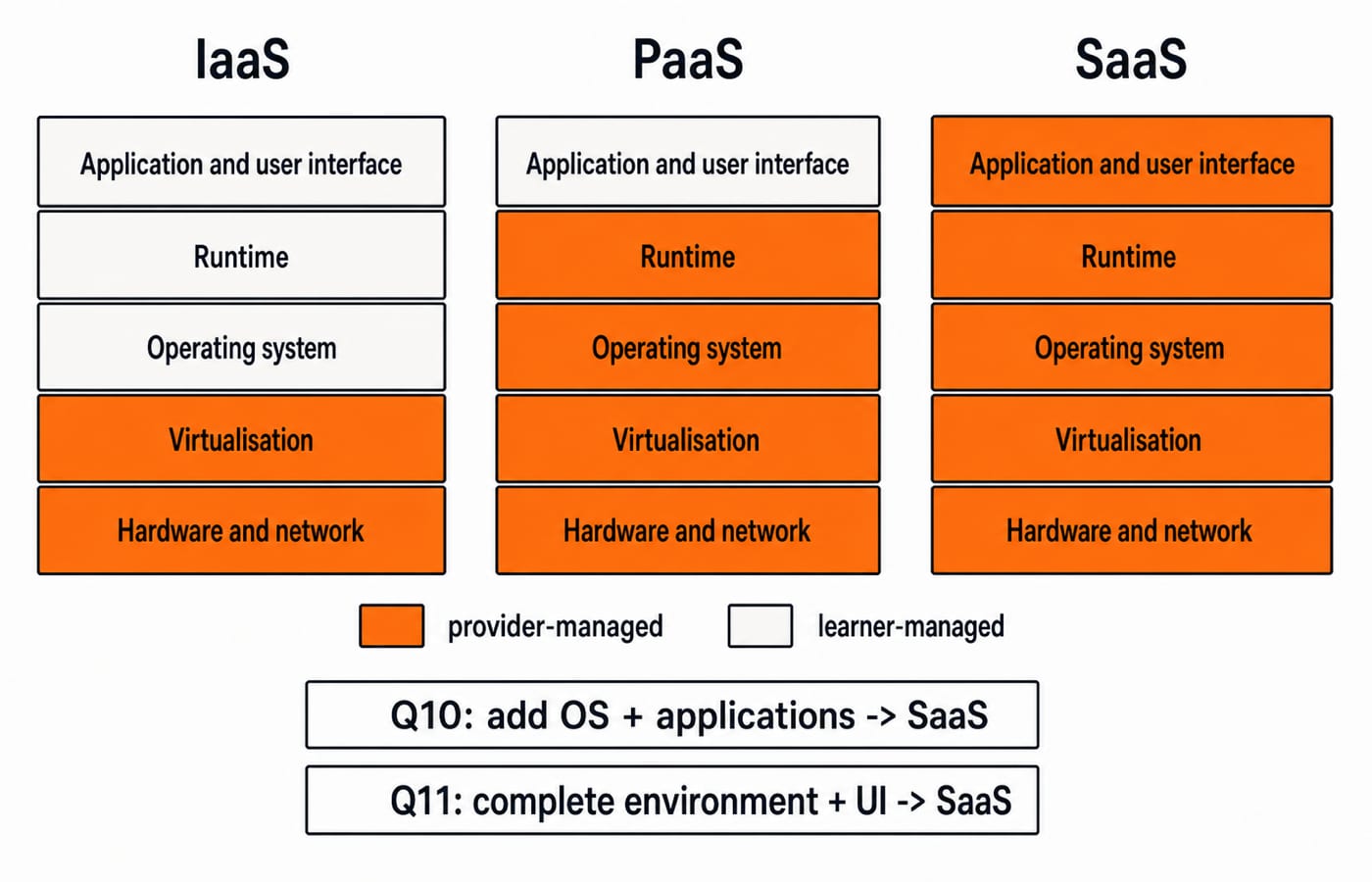
Test provider responsibility. IaaS leaves the OS and applications to the customer; PaaS manages the runtime for the customer's application. A service including the OS and application stack for an end user is SaaS, so "all" fails. See the full Q10 solution.
Question 11
Accenture 2024
_______ is a complete operating environment with applications, management, and the user interface.
A. IaaS
B. SaaS
C. PaaS
D. All of the mentioned
Correct answer: B. SaaS.
"Complete operating environment", "applications" and "user interface" identify SaaS. A PaaS developer still supplies the application; an IaaS customer manages more of the stack. Questions 10 and 11 test the same boundary with different option orders. See the full Q11 solution.
Answer key, recurring traps and the next practice step
Question | Answer | Deciding clue |
|---|---|---|
1 | A | components shared across computers |
2 | C | processing across multiple computers |
3 | C | own local memory and clock |
4 | C | scalability and flexibility |
5 | B | adapts to increased load |
6 | D | both statements are true |
7 | B | parallelism alone need not be distributed |
8 | C | clusters support high-performance computing |
9 | C | tightly coordinated software, loosely coupled hardware |
10 | A | OS plus applications |
11 | B | complete environment and UI |
Four traps recur across the set:
Check whether the question asks for true or false statements.
Distinguish multiple computers from multiple processors.
Separate hardware coupling from software coordination.
Decide IaaS, PaaS or SaaS from who manages each layer, not from the word "cloud" alone.
Next, solve OS Basics MCQs: 12 Solved (GATE/NET). Use Operating Systems for GATE: Deadlocks, Scheduling, Memory for the wider map and OS Interview Questions for Freshers: Top 50 with Answers for verbal recall.
Continue with CS Fundamentals for Placements by Sanchit Sir. Zero to Hero: Complete CS Course is the broader foundations route.
Keep learning
Process Basics and PCB MCQs: 12 Solved Questions with Explanations
Solve 12 Process Basics and PCB questions, then use each explanation to repair the exact concept boundary behind the correct option.
Updated 20 Oct 20268 min readOperating System MCQs

Critical Section MCQs: 12 Solved Questions on Race Conditions and Mutual Exclusion
Practise critical-section MCQs on race conditions, mutual exclusion, Bakery ordering, stale writes and priority inversion, with explanations and two complete traces.
Updated 16 Oct 20268 min readOperating System MCQs

Hardware Synchronization MCQs: 10 Solved Test-and-Set, Spinlock and Barrier Questions
Attempt 10 hardware synchronization questions, then check concise explanations of atomic instructions, busy waiting, lock failures and barrier races.
Updated 12 Oct 20267 min readOperating System MCQs
SJF and SRTF Scheduling MCQs: 11 Solved Questions with Step-by-Step Explanations
Solve 11 SJF and SRTF questions with ready-queue decisions, Gantt traces, waiting-time calculations and checked explanations.
Updated 7 Oct 20267 min read82 viewsOperating System MCQs