

Fundamentals of AI MCQs: 12 Solved Questions with Explanations
Solve 12 Fundamentals of AI questions covering core definitions, domains, the AI project cycle and ethics. Each answer explains both the right choice and the distractors.
KnowledgeGate Team
Exam prep & CS education
Updated 9 Nov 20267 min read

Elementary AI questions mix definitions, domains, the project cycle and ethics. Familiar words such as automation, autonomy, fairness and evaluation can therefore lead to different answers. Choose an option and write one reason before opening each explanation. Use the cue, your choice and your reason to prepare for timed practice. The Fundamentals of AI learn module is the bank-level follow-up because these questions do not have individual solved pages.
Fundamentals of AI in one worked project
Keep four buckets separate. AI is the broad goal of performing tasks associated with human intelligence. Natural Language Processing works with language, while computer vision works with images or video. The AI project cycle moves from a defined problem through data and modelling to evaluation. AI ethics asks whether a system is fair, private, explainable and accountable.
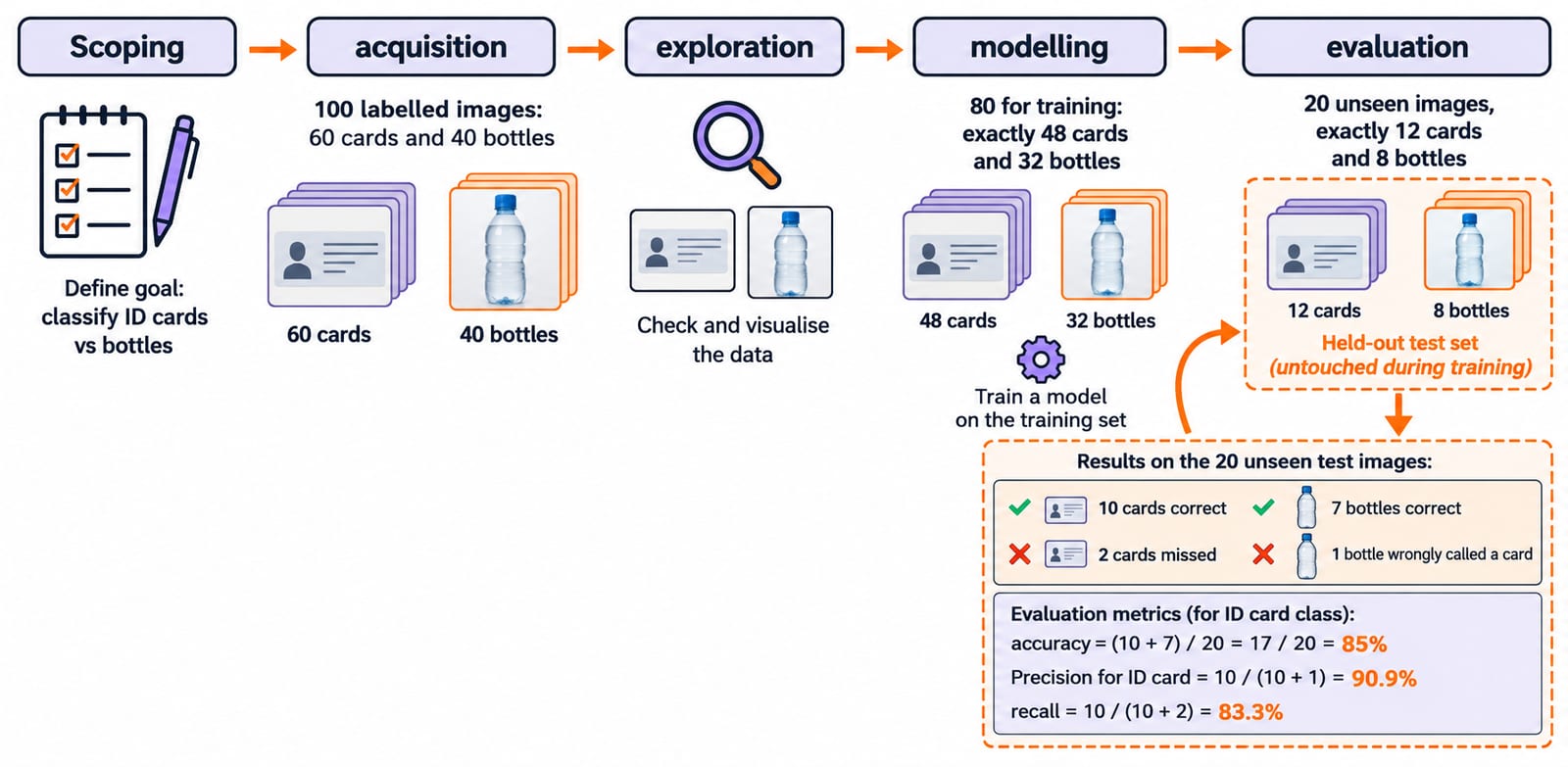
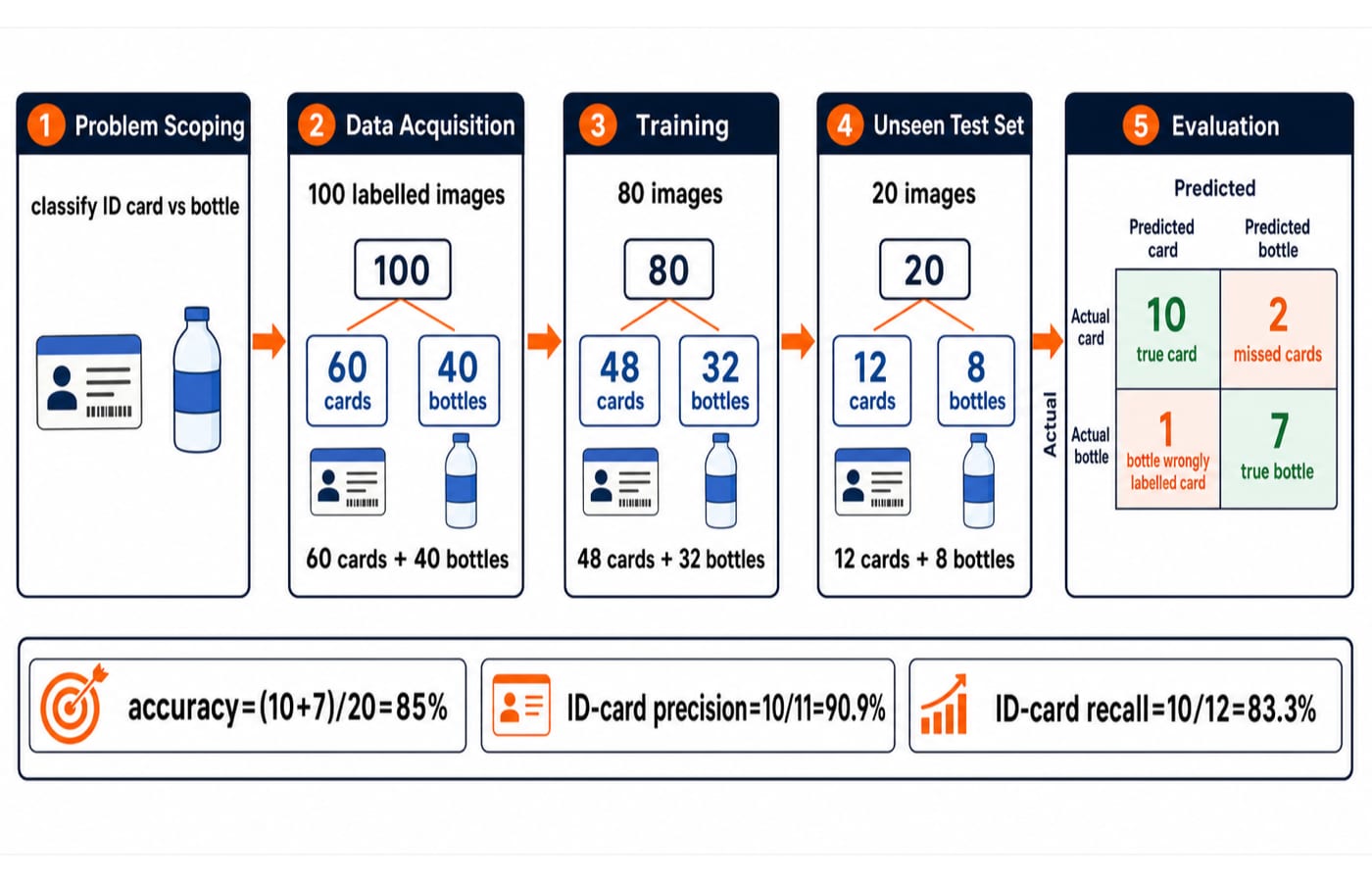
Suppose a campus lost-and-found team wants to classify each uploaded image as ID card or bottle. It collects 100 labelled images: 60 cards and 40 bottles. It uses 80 for training, exactly 48 cards and 32 bottles, then holds out 20 unseen images, exactly 12 cards and 8 bottles.
On the held-out set, the model gets 10 cards and 7 bottles correct. It misses 2 cards and wrongly calls 1 bottle a card. Therefore, accuracy is (10 + 7) / 20 = 17 / 20 = 85%. Precision for ID card is 10 / (10 + 1) = 90.9%, while recall is 10 / (10 + 2) = 83.3%.
Scoping defines the task, acquisition gathers the images, exploration inspects them, modelling learns from the training set, and evaluation uses the untouched test set. The four approaches to AI, with worked examples provide a theory-first follow-up.
Fundamentals of AI MCQs 1-2: intelligence, automation and autonomy
Question 1: what Artificial Intelligence actually refers to
Artificial Intelligence mainly refers to:
A. Machines that can perform tasks requiring human intelligence
B. Only hardware devices
C. Computer networking systems
D. Data storage systems
Answer: A. Machines that can perform tasks requiring human intelligence.
An email classifier gives a message a spam score of 0.82 and labels it spam because the threshold is 0.70. It recognises a pattern and makes a classification associated with human judgement. Storing or routing the message does not. Hardware can run the model, but hardware alone is not AI.
Question 2: automated systems versus autonomous systems
What is the main difference between automated systems and autonomous systems?
A. Autonomous systems can make decisions independently
B. Automated systems learn from data
C. Autonomous systems require human control for every action
D. Automated systems have higher intelligence than autonomous systems
Answer: A. Autonomous systems can make decisions independently.
A conveyor repeating a fixed 30-minute sequence is automated. A delivery rover that detects an obstacle 0.8 m ahead and chooses a clear 145 m route instead of the blocked 120 m route acts autonomously. The distinction is selecting an action from current conditions. Automation may use AI, while autonomy need not involve learning during every action.
Fundamentals of AI MCQs 3-4: the Turing test and language
Question 3: CAPTCHAs and the Turing test (UGC NET 2025, Paper I, June)
The process of typing CAPTCHAs is a variation on:
A. Turing test
B. Turner's test
C. F-test
D. t-test
Answer: A. Turing test.
The shared idea is a task intended to distinguish human performance from machine performance. A user may read five distorted characters, while a bot must infer the same sequence from pixels. A CAPTCHA is a variation on this human-versus-machine idea, not a complete conversational Turing test. It checks a short visual challenge, not whether a machine can sustain humanlike dialogue. The F-test and t-test are statistical tests, while Turner's test is the distractor here.
Question 4: which field counts as a major AI domain
Which of the following is considered a major domain of Artificial Intelligence?
A. Natural Language Processing (NLP)
B. Database Normalization
C. Compiler Design
D. Network Routing
Answer: A. Natural Language Processing (NLP).
For Book a train to Pune, NLP can identify the intent book travel and destination Pune. Database normalisation organises relational tables, compiler design translates programs, and network routing selects packet paths. These are computer-science areas, but not the AI domain named by the answer.
Fundamentals of AI MCQs 5-6: computer vision and language models
Question 5: spotting a computer vision scenario
Which of the following scenarios best represents the Computer Vision domain of AI?
A. Converting speech to text in a smartphone assistant
B. Detecting pedestrians in images for autonomous driving
C. Translating English text to Hindi automatically
D. Recommending movies based on past viewing history
Answer: B. Detecting pedestrians in images for autonomous driving.
In a 1920 x 1080 road frame, a detector returns a pedestrian box from (620,240) to (780,680). Its input and output are visual, so this is computer vision. Speech-to-text and translation are language tasks, while movie recommendation uses user-item behaviour. Autonomous driving can combine vision with other sensors and methods.
Question 6: what large language models mainly operate on
Large Language Models (LLMs) mainly operate on:
A. Numerical sensor data
B. Large text datasets
C. Satellite imagery
D. Audio signals only
Answer: B. Large text datasets.
Compare 50 million text tokens with 2,000 satellite images or an audio-only collection. An LLM learns statistical relationships among language tokens, so the text corpus matches its central task. A modern multimodal product may connect a language model to image or audio components, but its core training material is still large-scale text.
Fundamentals of AI MCQs 7-9: scoping, acquisition and exploration
Question 7: the stage that defines the problem and objectives
Which stage of the AI project cycle involves defining the problem and objectives?
A. Problem Scoping (समस्या निर्धारण)
B. Modeling (मॉडलिंग)
C. Evaluation (मूल्यांकन)
D. Deployment (परिनियोजन)
Answer: A. Problem Scoping.
Before collecting an image, define the objective: classify an upload into exactly one of two labels, ID card or bottle. This fixes the users, labels and success measure. Modelling fits the system, evaluation checks it, and deployment exposes the selected model to users.
Question 8: the phase that collects and prepares data
Which phase of the AI Project Cycle involves collecting and preparing data?
A. Deployment
B. Data Acquisition
C. Evaluation
D. Visualization
Answer: B. Data Acquisition.
This phase collects the 100 labelled images and prepares the 60:40 class split. Acquisition means obtaining and organising usable data. Deployment follows modelling, evaluation uses held-out examples, and visualisation can support exploration without becoming the acquisition phase.
Question 9: analysing patterns before a model is built
During the AI Project Cycle, a team analyzes patterns, relationships, distributions, and anomalies in the dataset before building a model. This activity belongs to which phase?
A. Problem Scoping
B. Data Acquisition
C. Data Exploration
D. Modeling
Answer: C. Data Exploration.
Inspect the acquired 100-image set. It contains 60% cards and 40% bottles, and suppose 6 images are blurred. Measuring the distribution and locating anomalies is exploration. Collection alone does not reveal this quality issue; exploration makes it visible before fitting. No parameters have been fitted, so modelling is premature. Scoping and acquisition have already occurred.
Fundamentals of AI MCQs 10-12: evaluation, fairness and explainability
Question 10: testing performance on unseen data
Which stage of the AI project cycle involves testing model performance on unseen data?
A. Data Acquisition
B. Modeling
C. Evaluation
D. Deployment
Answer: C. Evaluation.
On the untouched 20-image test set, the model is correct on 17 and wrong on 3, so accuracy is 17 / 20 = 85%. The key is that these examples were unseen during fitting. Testing on the same 80 training images would not reliably measure new-input performance.
Question 11: biased hiring and the ethics principle at stake
An AI system used for automatic hiring decisions tends to reject candidates from a particular demographic group due to biased training data. Which AI Ethics principle is primarily violated?
A. Transparency
B. Fairness
C. Privacy
D. Accountability
Answer: B. Fairness.
Consider 100 equally qualified applicants in Group A and 100 in Group B. If biased historical labels make the system advance 80 from A but 20 from B, the rates are 80 / 100 = 80% and 20 / 100 = 20%. The gap is 80% - 20% = 60 percentage points. Unequal treatment makes fairness the primary violation. Transparency, privacy and accountability concern different questions.
Question 12: a medical prediction that cannot be explained
A medical AI system predicts diseases but cannot explain how it arrived at the diagnosis. According to AI ethics principles, which issue is most relevant?
A. Lack of Transparency (Explainability)
B. Violation of Privacy
C. Data Acquisition Error
D. Poor Model Training
Answer: A. Lack of Transparency (Explainability).
Contrast a bare score of 0.82 with an explanation identifying which features influenced it and how strongly. The system cannot explain its path, so transparency and explainability are the direct issue. The score alone does not prove a privacy breach, collection error or poor training.
Revision map and the next practice step
Exact cue | Answer |
|---|---|
task requiring human intelligence | AI |
human versus machine challenge | Turing test |
language | NLP |
images or video | computer vision |
define objective | problem scoping |
collect and prepare | data acquisition |
inspect distributions and anomalies | data exploration |
unseen data | evaluation |
discriminatory outcome | fairness |
cannot explain decision | transparency/explainability |
Redo all 12 questions without viewing the answers. For each mistake, explain every wrong option in one line. This forces you to distinguish a related term from the exact answer.
If you need the complete learning sequence, continue with NTA-UGC-NET Paper 1. When you are ready to work under time pressure, use the UGC NET Paper 1 Test Series. Then extend the same answer-first method to Artificial Neural Networks MCQs: 10 Solved Questions with Explanations.
Keep learning
Fundamentals of Planning in AI: STRIPS, State-Space Search and a Worked Blocks World Plan
Build a planning problem from facts, actions and goals, then follow every add and delete effect through a complete six-step Blocks World solution.
Updated 11 Oct 20266 min read64 viewsML & Data Science

AI Technologies and Applications MCQs: 12 Solved Questions with Explanations
Solve 12 published-bank AI MCQs, then use concise explanations and worked examples to separate closely related concepts without memorising isolated answers.
Updated 29 Oct 20267 min readMCQ Practice

Philosophical and Theoretical Approaches to AI MCQs: 12 Solved Questions with Explanations
Solve 12 UGC NET, MPPSC, HTET and GATE MCQs on cognitive science, the Turing Test, rational agents, reinforcement learning and linear separability.
Updated 11 Aug 20268 min readMCQ Practice

Foundations and Evolution of AI MCQs: 12 Solved Questions with Explanations
Solve 12 foundations of AI MCQs from DSSSB, HTET, UGC NET and state PSC papers. Each answer explains the definition, founder, test or subfield being examined.
Updated 30 Oct 20267 min read93 viewsMCQ Practice