

AI & ML MCQs: 11 Solved Questions with Explanations
Solve 11 AI and machine learning MCQs, then check the reasoning behind each answer. AI categories, learning methods, overfitting, GANs and sensing each use a different clue.
KnowledgeGate Team
Exam prep & CS education
Updated 8 Nov 20267 min read

AI and ML options often mix a broad field, a learning method, a sensor, a model architecture and a training technique as if they were interchangeable. Supervised learning, clustering, generalisation, generative models and sensing require different clues; broad AI-purpose questions establish only the hierarchy. Before reading each explanation, choose an answer and write a one-line reason for it, because that small commitment makes every vague definition easier to test, correct and remember. Mean and evaluation metrics use arithmetic and short-answer practice in Data and Statistics Basics MCQs and Short Answers: Mean, Data Literacy and AI, while labels, clustering, dropout, GANs and sensing turn on model-choice distinctions. The Skill Development Courses page supplies a wider subject mix.
Build one AI-to-ML map before solving the questions
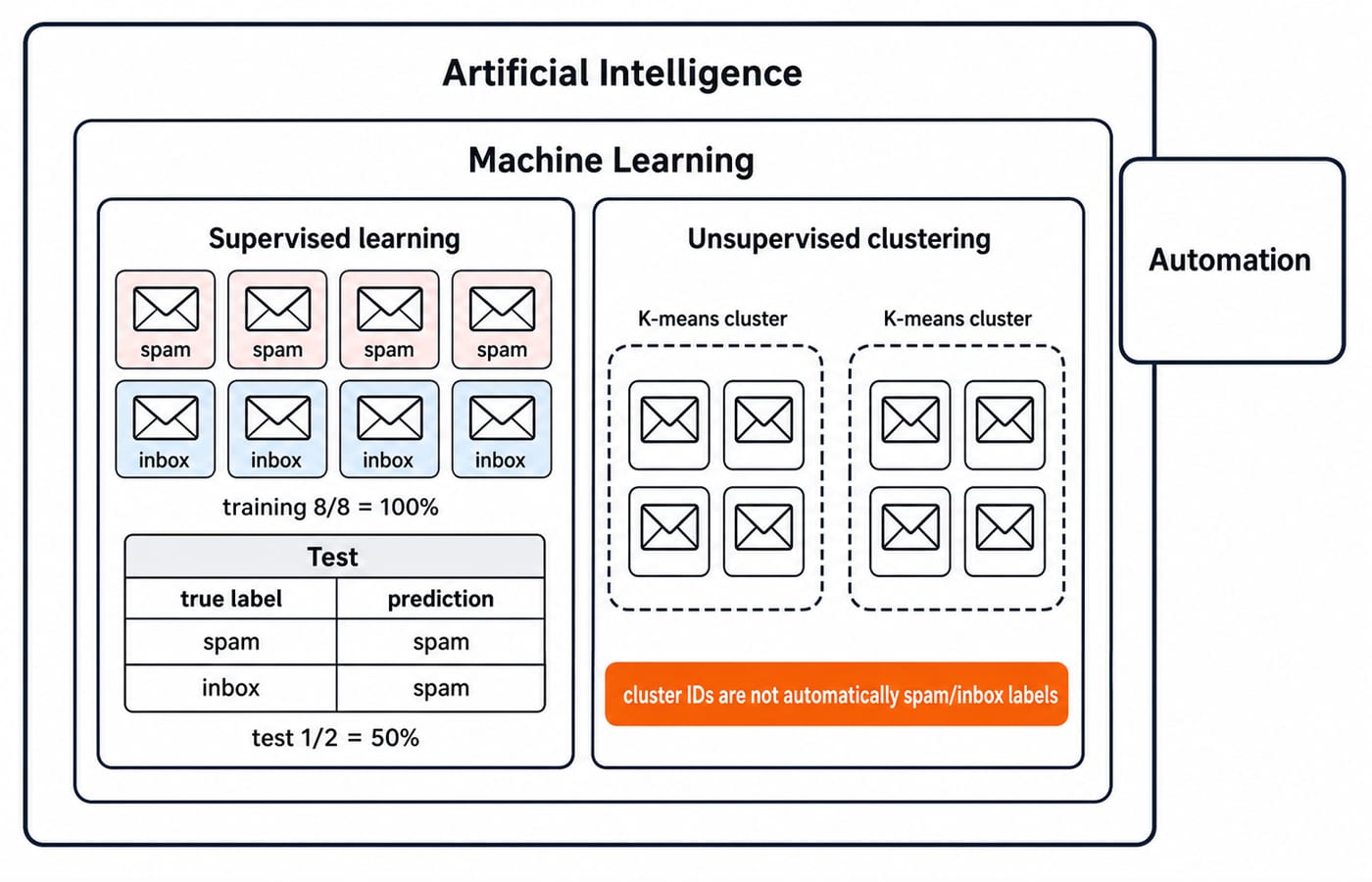
Artificial intelligence is the broad goal of building systems that perform tasks associated with intelligence. Machine learning is one way to learn patterns from data. Supervised learning uses labelled examples, while clustering is an unsupervised task. Deep learning uses multi-layer neural networks, and generative models learn to create outputs. Automation overlaps with AI, but a fixed automated rule is not automatically AI.
Consider an email filter with 10 messages. Its eight labelled training messages are spam, spam, spam, spam, inbox, inbox, inbox, inbox. A decision tree learns from those labels and scores 8/8 = 100% on training. The two unseen test messages are spam, inbox, but it predicts spam, spam. Only the first prediction is correct, so test accuracy is 1/2 = 50%. That gap is evidence of overfitting: excellent training performance has not carried to unseen data.
Remove the labels, and K-means could group the same messages by word-frequency features. The clusters would not inherently be named spam and inbox. If this hierarchy is unfamiliar, review Approaches to AI: Four Approaches and a Worked Example before solving.
AI & ML MCQs 1-2: intelligent tasks and office automation
Question 1
Which of the following is a key feature of Artificial Intelligence (AI) ?
A. Automation of tasks requiring human intelligence
B. Predicting future events with absolute certainty
C. Enhancing hardware performance
D. Storing and managing large data sets
Correct answer: A. Automation of tasks requiring human intelligence.
Focus on the kind of task. A help-desk model could classify 40 incoming tickets and rank the 6 it estimates as urgent, work that otherwise needs human judgement. AI cannot guarantee future events. Faster hardware and large-data storage may support it, but neither defines it. Open the full question page.
Question 2
Which of the following most clearly reflects the need for automation in modern offices?
A. Preference for physical files
B. Use of typewriters
C. Increasing digital workload
D. Overstaffing in departments
Correct answer: C. Increasing digital workload.
A growing digital workload creates repeated, high-volume operations. In a hypothetical queue of 1,200 online forms, fixed validation rules could reject 75 incomplete submissions and route 1,200 - 75 = 1,125 complete ones. Physical files and typewriters are manual processes. Overstaffing is an organisational condition, not the clearest technical need. This example is automation without learning from data. Review the full question page.
AI & ML MCQs 3-4: AI categories and learning from experience
Question 3
Match the categories of AI with its correct description.
Categories of AI | Description | ||
|---|---|---|---|
I | Artificial Narrow Intelligence | 1 | Level of general and strong AI that is smarter than humans if that's possible. |
II | Artificial General Intelligence | 2 | Such system seems to act intelligently but they don't have any awareness of what they are doing. |
III | Super Intelligence | 3 | Acting like a smart human and thinking like one with a conscious. |
A. I-2, II-3, III-1
B. I-2, II-1, III-3
C. I-1, II-2, III-3
D. I-1, II-3, III-2
Correct answer: A. I-2, II-3, III-1.
Match by scope. The question describes Artificial Narrow Intelligence as task-specific behaviour without awareness, so I -> 2. General human-like capability gives II -> 3, while capability beyond humans gives III -> 1. These are the categories used in the question, not a claim that every named category is currently deployed. Review the full question page.
Question 4
Machine learning is a field of artificial intelligence consisting of learning algorithms that:
A. Improve their performance
B. At executing some task
C. Over time with experience
D. All of the above
Correct answer: D. All of the above.
Read A, B and C as one sentence: learning algorithms improve their performance at a task over time with experience. In the email example, the data provides experience, classification is the task, and unseen-message accuracy measures performance. All three fragments complete the intended definition. Review the full question page.
AI & ML MCQs 5-6: supervised learning versus clustering
Question 5
Which of the following is a supervised learning algorithm?
A. Decision Tree
B. K-means Clustering
C. Reinforcement Learning
D. More than one of the above
E. None of the above
Correct answer: A. Decision Tree.
A decision tree can learn from labelled rows such as (contains_link=1, sender_known=0) -> spam. K-means groups points without target labels. Reinforcement learning instead uses rewards from interaction. Only the decision tree fits the labelled-example setup, so “More than one of the above” is false. Review the full question page.
Question 6
Which of the following is not a supervised machine learning algorithm?
A. Decision Tree
B. K-Nearest Neighbors
C. Linear Regression
D. K-Means Clustering
E. Support Vector Machine
Correct answer: D. K-Means Clustering.
Decision trees, K-nearest neighbours, linear regression and support vector machines learn mappings from inputs to supplied targets. K-means receives feature vectors without targets. Given (8,1), (7,1), (1,7), (2,8) and k=2, it may form two groups by distance, but it is never told that a group means spam or inbox. Review the full question page.
AI & ML MCQs 7-8: black boxes, overfitting and dropout
Question 7
In AI biases many AI models are _____.
I. deepfakes
II. Black boxes
III. K-anonymity
A. Only II
B. Only I
C. I, II and III
D. Only I and III
Correct answer: A. Only II.
A black-box model has internal reasoning that is difficult to interpret, which can make bias harder to detect or explain. A deepfake is synthetic or manipulated media, not a general model property. K-anonymity is a data-privacy technique. Only statement II fits. A stable direct page is not available for this item; use the UPPSC Polytechnic Lecturer AI and ML question hub for related practice.
Question 8
Which method is commonly used to enhance a deep learning model's ability to generalize while minimizing overfitting?
A. Adding unlimited hidden layers to the network
B. Eliminating activation functions from neural network layers
C. Implementing dropout regularization during training
D. Training the model without a validation dataset
Correct answer: C. Implementing dropout regularization during training.
For eight hidden units, a dropout rate of 0.5 can produce mask [1,0,1,0,0,1,0,1], leaving units 1,3,6,8 active, exactly 4/8 = 0.5. A different mask next time discourages dependence on one path. With inverted dropout, the framework scales activations during training; evaluation uses the full network without dropout. The other options do not solve overfitting. Recall the opening gap: 8/8 in training but 1/2 in testing. Review the full question page.
AI & ML MCQs 9-11: GANs, latent space and autonomous sensing
Question 9
In a standard GAN architecture, how many neural networks are used ?
A. Two
B. One
C. Three
D. Four
Correct answer: A. Two.
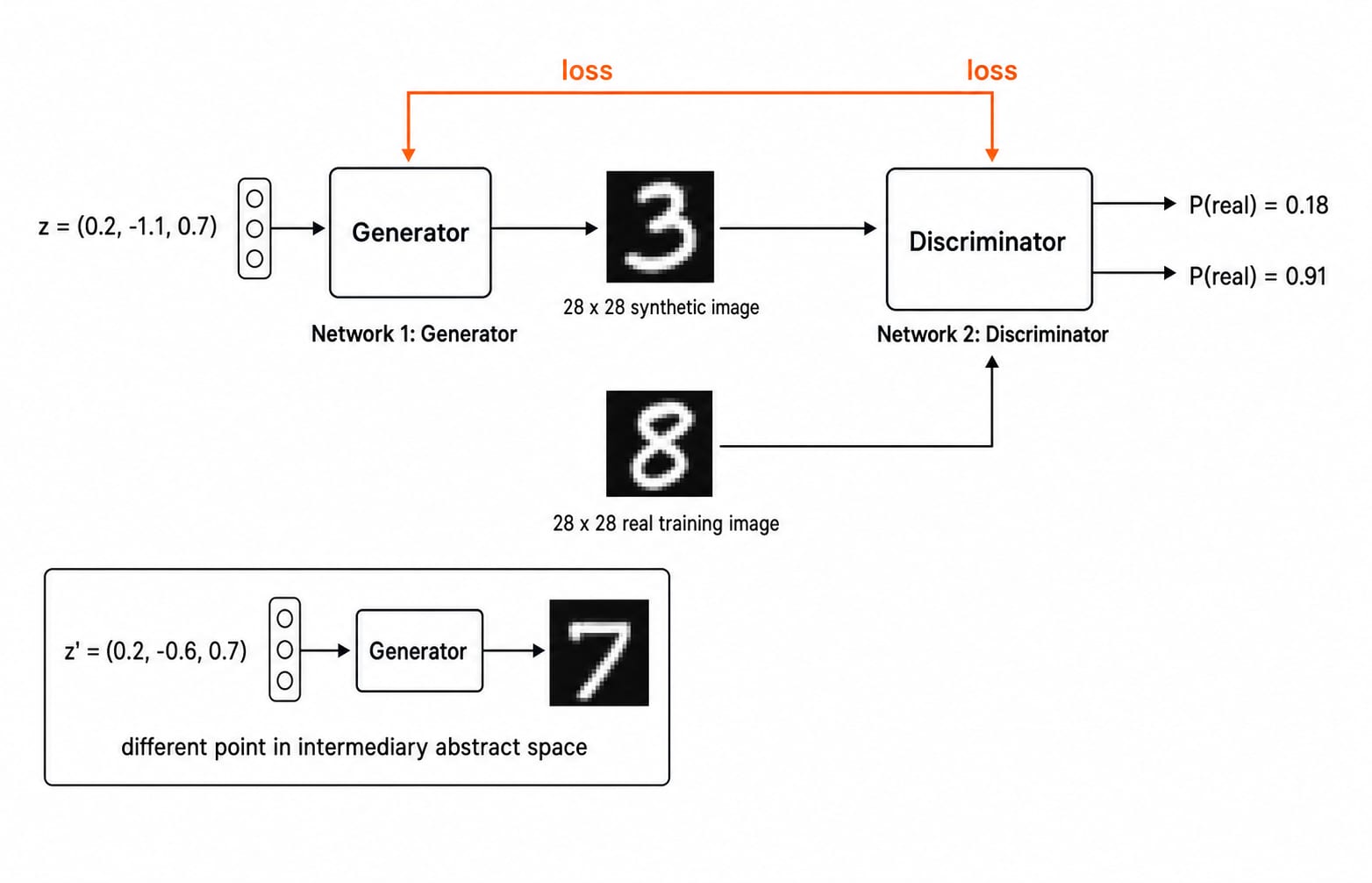
The generator converts a latent input into a synthetic sample. The discriminator estimates whether a sample is real or generated. Because these two networks train against each other, the standard GAN architecture uses two neural networks. Review the full question page.
Question 10
What is latent space in Generative AI?
A. Structured input features directly fed into the model
B. Intermediary abstract space
C. Final output space generated after decoding
D. Pre-processed training dataset
E. Hidden memory layer used for storing learned weights
Correct answer: B. Intermediary abstract space.
Latent space is an internal representation where useful patterns are encoded. Here, z = (0.2, -1.1, 0.7) is one point in a three-dimensional latent space. It is not the 28 x 28 output image, training data or weight storage. Changing it to (0.2, -0.6, 0.7) gives the generator a different position to decode, so the sample can change. Review the full question page.
Question 11
Which technology is commonly used in autonomous vehicles to detect and avoid obstacles ?
A. Quantum Computing
B. LiDAR (Light Detection and Ranging)
C. Artificial Intelligence
D. Augmented Reality
Correct answer: B. LiDAR (Light Detection and Ranging).
LiDAR emits light pulses and measures their returns to estimate surrounding distances. Hypothetical returns at 6.4 m, 3.1 m and 1.2 m can help form a local scene. AI and control logic may decide how to respond, but LiDAR is the specific listed sensing technology. Quantum computing and augmented reality do not perform this role. Review the full question page.
Answer-pattern recap and the next practice step
Pattern | What to recall | Questions |
|---|---|---|
AI purpose | Intelligent-task automation | 1-2 |
Scope | ANI, AGI, super intelligence | 3 |
Learning from experience | Machine learning | 4 |
Labels | Supervised; no labels, K-means | 5-6 |
Model risk and control | Black box, dropout | 7-8 |
Generative and sensing systems | GAN, latent space, LiDAR | 9-11 |
Do a second pass after 48 hours. Allow 45 seconds for a direct-definition item and 90 seconds for matching or elimination. For every miss, write one contrast pair, such as K-means vs decision tree, generator vs discriminator or LiDAR sensing vs AI decision-making.
Use AI & ML for Placements | Generative AI Placement Course when you need the concepts and implementation path together. Continue topic-specific practice with Artificial Neural Networks MCQs: 10 Solved Questions for layers, activation and forward-pass reasoning. Then redo all 11 questions after 48 hours before checking any answer.
Keep learning

AI Agent Architecture and Program Types MCQs: 11 Solved Questions
Eleven solved AI agent MCQs with the trap in each one named: current-percept rules, sensor versus actuator, goal versus utility scoring, and what counts as learning.
Updated 30 Oct 20268 min readML & Data Science

Fundamentals of AI MCQs: 12 Solved Questions with Explanations
Solve 12 Fundamentals of AI questions covering core definitions, domains, the AI project cycle and ethics. Each answer explains both the right choice and the distractors.
Updated 9 Nov 20267 min readML & Data Science

Data and Statistics Basics MCQs and Short Answers: Mean, Data Literacy and AI
Practise a mixed set on data and statistics basics. Check six MCQs with option-by-option reasoning, then build five short answers with definitions, purpose and worked examples.
Updated 7 Nov 20268 min readML & Data Science

AI Technologies and Applications MCQs: 12 Solved Questions with Explanations
Solve 12 published-bank AI MCQs, then use concise explanations and worked examples to separate closely related concepts without memorising isolated answers.
Updated 29 Oct 20267 min readMCQ Practice