FCFS and SSTF Scheduling MCQs: 12 Solved Disk Questions with Explanations
Solve 12 FCFS and SSTF disk-scheduling questions with complete routes, movement totals, seek-time conversions and fresh explanations for every answer.
KnowledgeGate Team
Exam prep & CS education
Updated 19 Sep 20268 min read

FCFS arithmetic can zig-zag across the disk. With SSTF, recompute after every move instead of using the original head.
Choose first, then verify the rule, route and arithmetic. GATE CS Exam Preparation places disk scheduling in its wider Operating Systems path.
Keep the starting head separate from the pending queue.
FCFS and SSTF rules to write before solving
Use this method card:
FCFS follows arrival order without reordering.
SSTF chooses the pending request with the smallest absolute distance from the current head, then recomputes after every service.
Total head movement is
sum of |next cylinder - current cylinder|.With a given rate, seek time is
total movement x time per cylinder.
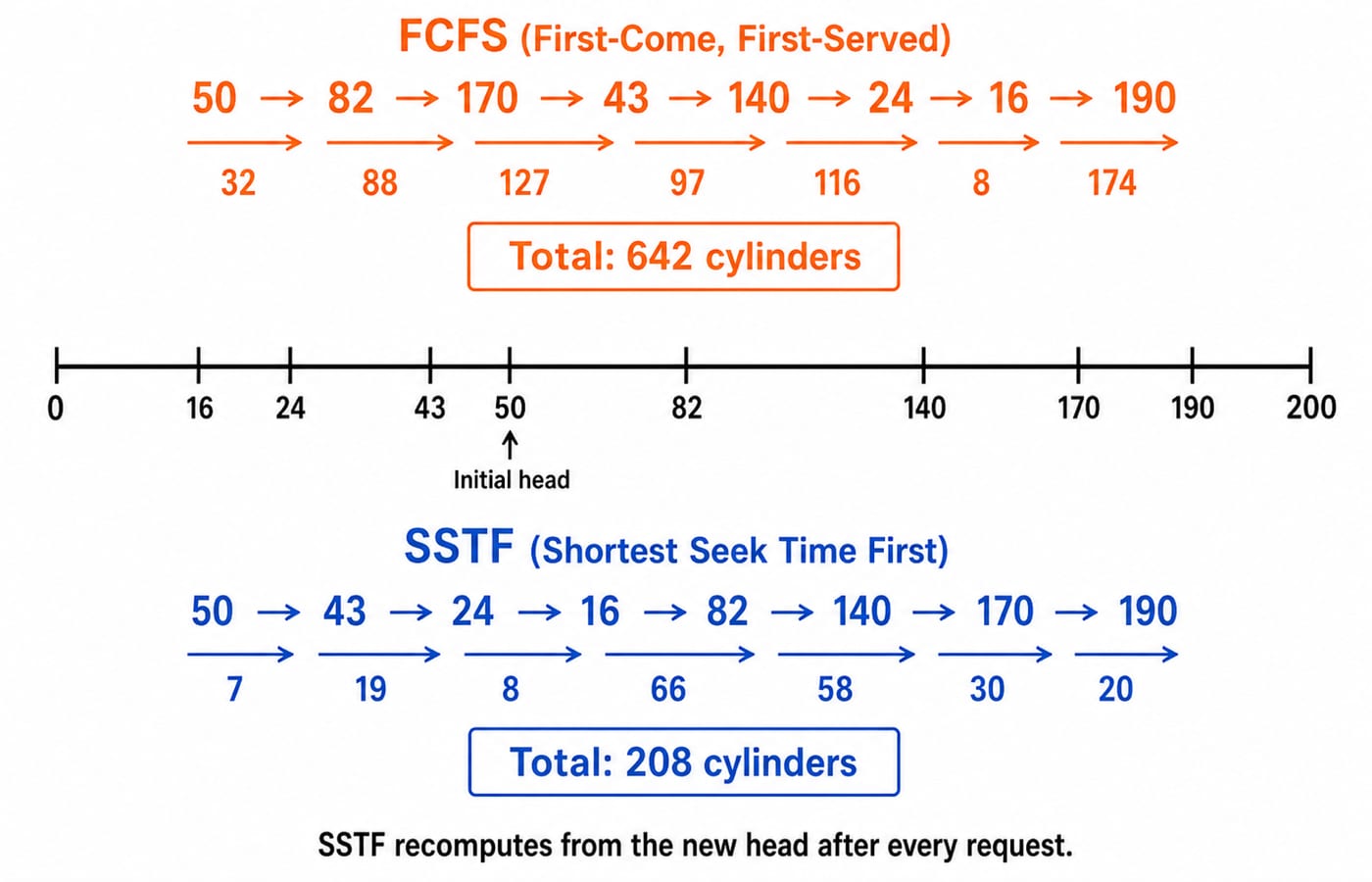
Calibrate with head 50 and queue 82, 170, 43, 140, 24, 16, 190.
FCFS route:
50 -> 82 -> 170 -> 43 -> 140 -> 24 -> 16 -> 190FCFS movement:
32 + 88 + 127 + 97 + 116 + 8 + 174 = 642cylindersSSTF route:
50 -> 43 -> 24 -> 16 -> 82 -> 140 -> 170 -> 190SSTF movement:
7 + 19 + 8 + 66 + 58 + 30 + 20 = 208cylinders
SSTF travels less here but may starve distant requests. Use Disk Scheduling MCQs: FCFS, SSTF, SCAN for a mixed survey; use this set for full FCFS/SSTF routes, totals and time conversions.
MCQs 1-3: seek time, throughput and when SSTF cannot help
Question 1
Move the read/write head of disk in or out to position on a correct track is known as ______.
A. Waiting time
B. Access time
C. Seek time
D. Latency time
Correct answer: C. Seek time.
Seek time covers head movement to the required track. Rotational latency waits for the sector to rotate under it. Access time can include both; transfer follows positioning. Question 1 worked solution.
Question 2
Which of the following disk strategies is likely to give the best throughput?
A. Farthest cylinder next
B. Nearest cylinder next
C. First come first served
D. Elevator algorithm
Correct answer: B. Nearest cylinder next.
Nearest-cylinder-next is SSTF. It greedily reduces the next seek distance, making B correct. Throughput is not fairness; distant requests may starve. The mixed-algorithm set uses this question for identification; here it tests throughput against fairness. Question 2 worked solution.
Question 3
Consider an operating system capable of loading and executing a single sequential user process at a time. The disk head scheduling algorithm used is First Come First Served (FCFS). If FCFS is replaced by Shortest Seek Time First (SSTF), claimed by the vendor to give 50% better benchmark results, what is the expected improvement in the I/O performance of user programs?
A. 50%
B. 40%
C. 25%
D. 0%
Correct answer: D. 0%.
A sequential process has no competing queue. With one outstanding request, both algorithms select it, so the benchmark gain does not apply. The mixed set asks the same question; here the key is the single outstanding request. Question 3 worked solution.
MCQs 4-6: FCFS head-movement totals
For FCFS, prepend the starting head, mark each absolute difference and add without sorting.
Question 4
If the Disk head is located initially at track 32, find the number of disk moves required with FCFS scheduling criteria if the disk queue of I/O blocks requests are :
98, 37, 14, 124, 65, 67
A. 320
B. 322
C. 321
D. 319
Correct answer: C. 321.
The route is 32 -> 98 -> 37 -> 14 -> 124 -> 65 -> 67. Movement is 66 + 61 + 23 + 110 + 59 + 2 = 321. Track 32 is the start, not a request. Question 4 worked solution.
Question 5
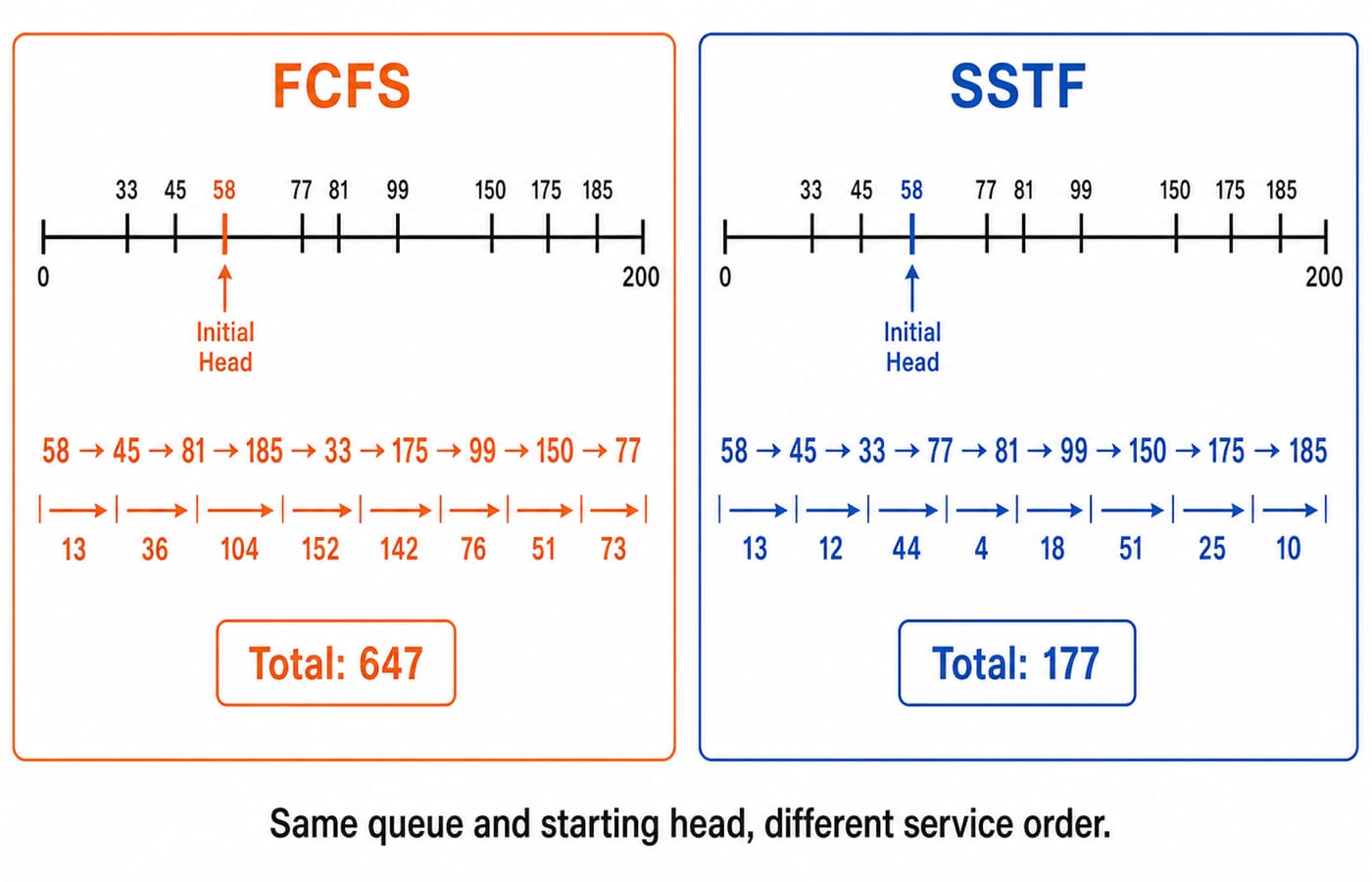
Consider the following disc Queue with requests for I/O to block on cylinders: 45, 81, 185, 33, 175, 99, 150, 77
(Consider that the head starts from location 58)
What shall be the total head movement of cylinders if the FCFS disc scheduling method is used?
A. 536
B. 594
C. 647
D. 700
Correct answer: C. 647.
Preserve arrival order: 58 -> 45 -> 81 -> 185 -> 33 -> 175 -> 99 -> 150 -> 77. Thus, 13 + 36 + 104 + 152 + 142 + 76 + 51 + 73 = 647. Question 11 uses SSTF on this queue. Question 5 worked solution.
Question 6
Consider a disk queue with requests for I/O to blocks on cylinders. 98 183 37 122 14 124 65 67. Considering FCFS (first cum first served) scheduling, the total number of head movements is, if the disk head is initially at 53 is?
A. 600
B. 620
C. 640
D. 650
Correct answer: C. 640.
Using FCFS, the route is 53 -> 98 -> 183 -> 37 -> 122 -> 14 -> 124 -> 65 -> 67. The total is 45 + 85 + 146 + 85 + 108 + 110 + 59 + 2 = 640. Question 6 worked solution.
MCQs 7-8: build the SSTF service order before adding
Question 7
Consider the following five disk five disk access requests of the form (request id, cylinder number) that are present in the disk scheduler queue at a given time.
(P, 155), (Q, 85), (R, 110), (S, 30), (T, 115)
Assume the head is positioned at cylinder 100. The scheduler follows Shortest Seek Time First scheduling to service the requests.
Which one of the following statements is FALSE ?
A. T is serviced before P
B. Q is serviced after S, but before T
C. The head reverses its direction of movement between servicing of Q and P
D. R is serviced before P
Correct answer: B. Q is serviced after S, but before T.
Recomputing gives 100 -> R(110) -> T(115) -> Q(85) -> S(30) -> P(155). B is false because Q follows T and precedes S; the other statements match. The mixed set shares this question; here the full route exposes both reversals. Question 7 worked solution.
Question 8
Consider a disk queue with requests for I/O to blocks on cylinders 98, 183, 37, 122, 14, 124, 65, 67. Suppose SSTF disk scheduling algorithm implemented to meet the requests then the total number of head movements are __________ if the disk head is initially at 53.
A. 224
B. 248
C. 236
D. 240
Correct answer: C. 236.
SSTF gives 53 -> 65 -> 67 -> 37 -> 14 -> 98 -> 122 -> 124 -> 183. Movement is 12 + 2 + 30 + 23 + 84 + 24 + 2 + 59 = 236. FCFS needed 640 on the same requests. Question 8 worked solution.
MCQs 9-11: convert SSTF movement into time and compare algorithms
Question 9
Consider a disk system having 60 cylinders. Disk requests are received by a disk drive for cylinders 10,22,20,2,40,6 and 38, in that order. Assuming the disk head is currently at cylinder 20, what is the time taken to satisfy all the requests if it takes 2 milliseconds to move from one cylinder to adjacent one and Shortest Seek Time First (SSTF) algorithm is used?
A. 240 milliseconds
B. 96 milliseconds
C. 120 milliseconds
D. 112 milliseconds
Correct answer: C. 120 milliseconds.
A request at 20 costs zero movement. The route 20 -> 20 -> 22 -> 10 -> 6 -> 2 -> 38 -> 40 costs 0 + 2 + 12 + 4 + 4 + 36 + 2 = 60 cylinders. Therefore, 60 x 2 ms = 120 ms. Question 9 worked solution.
Question 10
A disk drive has 100 cylinders, numbered 0 to 99. Disk requests come to the disk driver for cylinders 12,26,24,4,42,8 and 50 in that order. The driver is currently serving a request at a cylinder 24. A seek takes 6 msec per cylinder moved. How much seek time is needed for shortest seek time first (SSTF) algorithm ?
A. 0.984 sec
B. 0.396 sec
C. 0.738 sec
D. 0.42 sec
Correct answer: D. 0.42 sec.
Serve the zero-distance request first: 24 -> 24 -> 26 -> 12 -> 8 -> 4 -> 42 -> 50. Movement is 0 + 2 + 14 + 4 + 4 + 38 + 8 = 70 cylinders. Time is 70 x 6 ms = 420 ms = 0.42 sec. Question 10 worked solution.
Question 11
Consider the following disc Queue with requests for I/O to block on cylinders:
45, 81, 185, 33, 175, 99, 150, 77
(Consider that the head starts from location 58)
What will be the total head movement of cylinders for the SSTF disc Scheduling technique?
A. 160
B. 124
C. 177
D. 240
Correct answer: C. 177.
SSTF orders the queue as 58 -> 45 -> 33 -> 77 -> 81 -> 99 -> 150 -> 175 -> 185. Add 13 + 12 + 44 + 4 + 18 + 51 + 25 + 10 = 177. FCFS retained arrival order and used 647. Question 11 worked solution.
MCQ 12: count direction changes using the previous head
Question 12
A disk has 200 tracks (numbered 0 through 199). At a given time, it was servicing the request of reading data from track 120, and at the previous request, service was for track 90. The pending requests (in order of their arrival) are for track numbers. 30 70 115 130 110 80 20 25. How many times will the head change its direction for the disk scheduling policies SSTF(Shortest Seek Time First) and FCFS (First Come Fist Serve)
A. 2 and 3
B. 3 and 3
C. 3 and 4
D. 4 and 4
Correct answer: C. 3 and 4.
The move 90 -> 120 was upward. SSTF follows 120 -> 115 -> 110 -> 130 -> 80 -> 70 -> 30 -> 25 -> 20; reversals at 120 -> 115, 110 -> 130 and 130 -> 80 make three. FCFS follows 120 -> 30 -> 70 -> 115 -> 130 -> 110 -> 80 -> 20 -> 25 and makes four. Count the initial reversal. The mixed set shares this question; here the paths locate every reversal. Question 12 worked solution.
FCFS and SSTF review sheet and next step
For Questions 4-6, practise differences without sorting. For Questions 7-11, recompute after every hop. For Question 12, include the previous head and mark reversals.
Use Operating Systems for GATE to place disk scheduling beside CPU scheduling, memory management and deadlocks.
Redo Questions 5 and 11 and explain why one queue gives 647 under FCFS but 177 under SSTF. Continue with GATE Guidance by Sanchit Sir for structured Operating Systems study, then use the GATE Test Series for timed practice.
Keep learning

Segmentation and Hybrid MCQs: 10 Solved OS Questions with Explanations
Solve ten memory-management MCQs, then check the keyed answers, short reasoning paths, distractor traps, and worked address calculations.
Updated 3 Oct 20267 min readOperating System MCQs

Paging and TLB MCQs: 12 Solved Questions with Step-by-Step Explanations
Solve 12 Paging and TLB MCQs in a sequence that builds from page-table basics to address splits, TLB coverage, timing and fragmentation.
Updated 28 Sep 20268 min readOperating System MCQs

OS Types & Evolution MCQs: 12 Solved Questions with Explanations
Solve 12 published OS Types & Evolution questions. Each answer identifies the clue that separates batch, multiprogramming, time sharing and other OS models.
Updated 25 Sep 20268 min read83 viewsOperating System MCQs

Multilevel Paging MCQs: 12 Solved Questions with Explanations
Solve 10 MCQs and two NATs on multilevel paging. Each answer works through the address bits, table capacity or access-time path that decides the result.
Updated 24 Sep 20268 min readOperating System MCQs