SCAN and C-SCAN Disk Scheduling MCQs: 12 Solved Questions with Head-Movement Traces
Practise 12 SCAN and C-SCAN disk scheduling questions, then check each path against worked explanations covering endpoints, reversals and circular wraps.
KnowledgeGate Team
Exam prep & CS education
Updated 12 Aug 202610 min read
SCAN and C-SCAN each take one line to define, and the marks are lost somewhere else: in the initial direction, in where the reverse sweep is allowed to stop, and in what the circular wrap costs. Get those three right and the rest is adjacent differences and careful addition. Disk scheduling is a dependable scorer across the GATE CS Exam Preparation syllabus and the UGC NET Paper 2 computer science unit. Work each question on paper before you open its answer.
SCAN versus C-SCAN: fix the path before attempting the MCQs
SCAN and C-SCAN differ in exactly one place, the return leg, and File Systems and Disk Scheduling in OS sets that difference beside FCFS and SSTF:
Algorithm | Service rule |
|---|---|
SCAN | Serve to the physical end in the current direction, then reverse and serve. |
C-SCAN | Serve to the end, wrap without service, then continue in the same direction. |
Use four steps:
Write the range.
Mark the head and direction.
Sort requests below and above the head.
Include endpoints before adding adjacent differences.
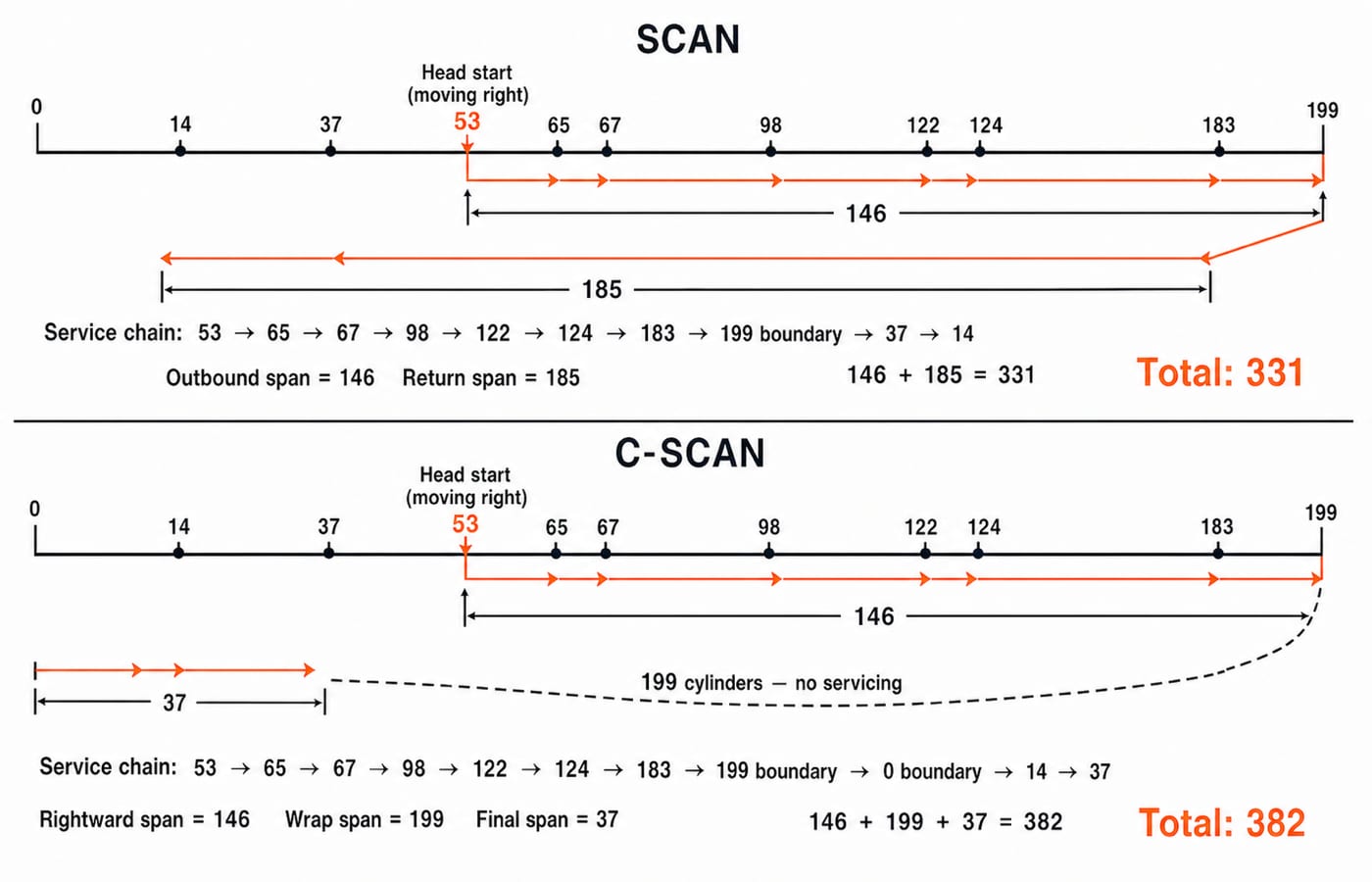
FIFO does not decide SCAN order. For cylinders 0-199, head 53, direction higher and requests {98, 183, 37, 122, 14, 124, 65, 67}, SCAN follows 53 -> 65 -> 67 -> 98 -> 122 -> 124 -> 183 -> 199 -> 37 -> 14. Its movement is (199-53) + (199-14) = 146 + 185 = 331.
C-SCAN follows 53 -> 65 -> 67 -> 98 -> 122 -> 124 -> 183 -> 199 -> 0 -> 14 -> 37. Its movement is (199-53) + (199-0) + (37-0) = 146 + 199 + 37 = 382.
One convention still has to be pinned down. After the head turns at the boundary, does the count stop at the last pending request or run on to the far boundary? Exam keys split on it, and the options tell you which the setter wanted. Question 6 offers 169, the total when the reverse sweep stops at track 86, and the both-boundaries value 255 is absent from that paper. Question 8 runs the same test in reverse, and there the options reward the sweep that does reach the boundary. Read all four options before you commit to a reverse leg.
SCAN and C-SCAN MCQs 1-4: names, paths and characteristics
Question 1. C-SCAN expansion
What does the C-SCAN disk scheduling algorithm stand for?
(a)
Complete SCAN(b)
Circular SCAN(c)
Cyclic SCAN(d)
Continuous SCAN
Answer: (b) Circular SCAN. At an endpoint, the head wraps and continues in the same service direction. The wrap still costs movement.
Question 2. Recognising SCAN
Which disk scheduling algorithm works by moving the head from one end of the disk to the other, servicing requests along the way?
(a)
FCFS(b)
C-SCAN(c)
LOOK(d)
SCAN
Answer: (d) SCAN. SCAN serves during each sweep. C-SCAN wraps without serving, while LOOK reverses at the last pending request.
Question 3. Recognising the C-SCAN wrap
In C-SCAN (Circular SCAN) scheduling, how does the head move?
(a)
From the outer edge to the inner edge, then jumps to the outer edge(b)
In a continuous circular loop(c)
From one end of the disk to the other, then jumps to the beginning(d)
In a zig-zag pattern
Answer: (c) From one end of the disk to the other, then jumps to the beginning. The jump returns without service, but still costs movement. Option (b) omits both the endpoint and the no-service rule.
Question 4. The statement that is not a SCAN characteristic, MPPSC 2025
In the context of disk scheduling algorithms, which of the following is not a characteristic of SCAN algorithm ?
(a)
Also known as elevator algorithm(b)
Moves the disk arm towards an end, servicing requests until it reaches the end then reverse direction(c)
May cause starvation of requests at the end of the disk(d)
Provides more uniform wait times compared to FCFS
Answer: (c) May cause starvation of requests at the end of the disk. Every sweep runs to a boundary, so a request at cylinder 0 or 199 is picked up on the very next pass. The other three are genuine SCAN properties: the elevator nickname, the run-to-the-end-then-reverse rule, and wait times far more even than FCFS. SCAN does carry a real cost, but a different one. A request landing just behind the head waits a full sweep plus the return, which is a long wait, not starvation.
SCAN direction MCQ 5: find the service order before doing arithmetic
Question 5. Second request under SCAN (LEFT), UGC NET June 2025
Consider the following disc Queue with requests for I/O to block on cylinders:
45, 81, 185, 33, 175, 99, 150, 77
(Consider that the head starts from location 58)
What shall be the 2nd request being processed by SCAN (LEFT) disc Scheduling technique for the already given request queue?
(a)
81(b)
45(c)
33(d)
175
Answer: (c) 33. Left of 58, SCAN serves 45 then 33. The full path is 58 -> 45 -> 33 -> 0 -> 77 -> 81 -> 99 -> 150 -> 175 -> 185; endpoints count for movement, not request order.
SCAN numerical MCQs 6-8: endpoint, reversal and total movement
Question 6. Infer direction from the previous head position, UGC NET December 2023
The head of moving head disk with 200 tracks, numbered 0 to 199, has just finished a request at track 125, and currently serving a request at track 143. The queue of requests is given in the FIFO order as 86,147,91,177,94,150,102,175,130. What will be the total number of head movements required to satisfy these requests for SCAN algorithm ?
(a)
259 cylinders(b)
169 cylinders(c)
154 cylinders(d)
264 cylinders
Answer: (b) 169 cylinders. The move 125 -> 143 fixes the increasing path: 143 -> 147 -> 150 -> 175 -> 177 -> 199 -> 130 -> 102 -> 94 -> 91 -> 86. Its spans give 56 + 113 = 169 cylinders.
Question 7. SCAN numerical answer on tracks 0-199, NAT
Consider a system with 0 -199 track. Suppose there are seven requests: 18, 27, 50, 85, 130, 150, and 195. The disk arm is supposed to travel using scan algorithm while the read/write arm is at 60 currently moving from lower index to higher index track. What is the total seek time?
No options.
Answer: 320. On 0-199, from 60 moving higher, use 60 -> 85 -> 130 -> 150 -> 195 -> 199 -> 50 -> 27 -> 18. Its legs give 139 + 181 = 320 tracks; without per-track time, “seek time” means movement.
Question 8. SCAN on a 150-cylinder disk moving toward 0, UGC NET January 2017
Consider a disk queue with I/O requests on the following cylinders in their arriving order : 6, 10, 12, 54, 97, 73, 128, 15, 44, 110, 34, 45 The disk head is assumed to be at cylinder 23 and moving in the direction of decreasing number of cylinders. Total number of cylinders in the disk is 150. The disk head movement using SCAN-scheduling algorithm is :
(a)
172(b)
173(c)
227(d)
228
Answer: (a) 172. 150 cylinders means the range is 0-149. Going down, 23 -> 15 -> 12 -> 10 -> 6 -> 0 costs 23. Reversing and running to the far boundary through 34 -> 44 -> 45 -> 54 -> 73 -> 97 -> 110 -> 128 -> 149 adds 149, so 23 + 149 = 172. Stopping at the last request 128 would give 151, which is not offered.
SSTF versus SCAN MCQs 9-10: what the boundary run costs
Question 9. SSTF versus SCAN distance, GATE 2015, Set 1, NAT
Suppose the following disk request sequence (track numbers) for a disk with 100 tracks is given: 45, 20, 90, 10, 50, 60, 80, 25, 70. Assume that the initial position of the R/W head is on track 50. The additional distance that will be traversed by the R/W head when the Shortest Seek Time First (SSTF) algorithm is used compared to the SCAN (Elevator) algorithm (assuming that SCAN algorithm moves towards 100 when it starts execution) is _________ tracks
No options.
Answer: 10. Track 50 is already under the head, so serving it costs nothing. SSTF then takes 50 -> 45 -> 60 -> 70 -> 80 -> 90 -> 25 -> 20 -> 10, totalling 130. SCAN runs out to the boundary first: 50 -> 60 -> 70 -> 80 -> 90 -> 100 -> 45 -> 25 -> 20 -> 10, totalling 140. The paths differ by 10. The key treats track 100 as the boundary; turning at 99 instead gives 138 and a difference of 8.
Question 10. SSTF and SCAN totals on the same queue, UGC NET December 2013
Consider a disk queue with requests for input/output to blocks on cylinders 98, 183, 37, 122, 14, 124, 65, and 67 in that order. Assume that the disk has cylinders numbered 0 to 199, and the disk head is initially positioned at cylinder 53 and moving towards cylinder number 0. The total number of head movements using Shortest Seek Time First (SSTF) and SCAN algorithms are respectively:
(a)
236 and 252 cylinders(b)
640 and 236 cylinders(c)
235 and 640 cylinders(d)
235 and 252 cylinders
Answer: (a) 236 and 252 cylinders. SSTF takes the nearest pending request each time: 53 -> 65 -> 67 -> 37 -> 14 -> 98 -> 122 -> 124 -> 183, giving 12 + 2 + 30 + 23 + 84 + 24 + 2 + 59 = 236. The step that catches most attempts is at 67, where 37 sits 30 away against 98 at 31. SCAN reaches 0 after 53 cylinders, reverses and runs to 199, so 53 + 199 = 252. Same queue as the trace above, opposite direction, different total.
C-SCAN numerical MCQs 11-12: count the circular wrap
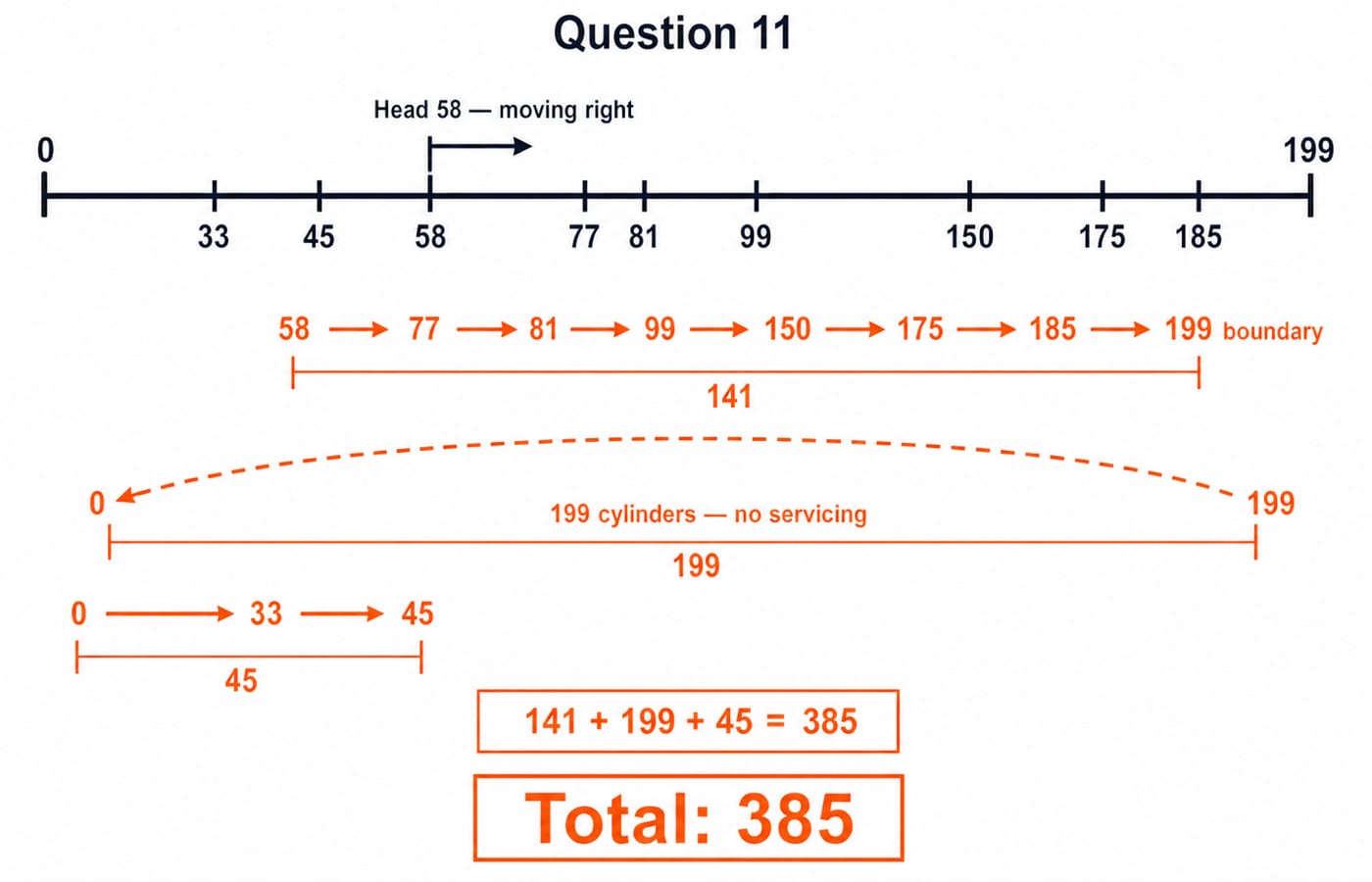
Question 11. C-SCAN total from head 58 moving right, UGC NET June 2025
Consider the following disc Queue with requests for I/O to block on cylinders:
45, 81, 185, 33, 175, 99, 150, 77
(Consider that the head starts from location 58)
What shall be the total head movement of cylinders for the C-SCAN disc Scheduling technique if the head starts moving in the right direction from initial position?
(a)
327(b)
307(c)
525(d)
385
Answer: (d) 385. On 0-199, from 58 moving right, use 58 -> 77 -> 81 -> 99 -> 150 -> 175 -> 185 -> 199 -> 0 -> 33 -> 45. Its three spans give 141 + 199 + 45 = 385 cylinders.
Question 12. C-SCAN on 5000 cylinders
Suppose that a disk drive has 5000 cylinders, numbered 0 to 4999. The drive is currently serving a request at cylinder 2150, and the previous request was at cylinder 1805. The queue of pending requests, in FIFO order, is 2069, 1212, 2296, 2800, 544, 1618, 356, 1523, 4965, 3681. Starting from the current head position, what is the total distance (in cylinders) that the disk arm moves to satisfy all the pending requests, using C-SCAN disk scheduling?
(a)
9900(b)
900(c)
9917(d)
9797
Answer: (c) 9917. The move 1805 -> 2150 fixes increasing direction: 2150 -> 2296 -> 2800 -> 3681 -> 4965 -> 4999 -> 0 -> 356 -> 544 -> 1212 -> 1523 -> 1618 -> 2069. Its spans total 2849 + 4999 + 2069 = 9917 cylinders.
SCAN and C-SCAN answer audit and the next practice step
Question | Answer | What decides it |
|---|---|---|
Q1 | B | Circular means service continues in one direction |
Q2 | D | SCAN serves on every sweep, C-SCAN does not serve on the return |
Q3 | C | The wrap carries no service, but it is not free |
Q4 | C | Every sweep reaches a boundary, so a long wait is not starvation |
Q5 | C | Boundaries are movement, not serviced requests |
Q6 | B | The move from 125 to 143 fixes the direction |
Q7 | 320 | Seek time here means track movement |
Q8 | A | The reverse leg runs to the far boundary, so 151 is not offered |
Q9 | 10 | SCAN's run out to track 100 is what separates the paths |
Q10 | A | Nearest-first against boundary-to-boundary, two totals in one option |
Q11 | D | The 199 to 0 wrap is physical movement |
Q12 | C | The move from 1805 to 2150 fixes the direction |
Recompute Questions 8, 10 and 12 on blank axes. Every SCAN chain should show exactly one reversal, and every C-SCAN chain an endpoint wrap that carries no service.
Next, compare algorithms with Disk Scheduling MCQs: 12 Solved (FCFS, SSTF, SCAN). Use GATE Guidance by Sanchit Sir for GATE or NTA-UGC-NET Paper - 2 for NET.
Keep learning
Segmentation and Hybrid MCQs: 10 Solved OS Questions with Explanations
Solve ten memory-management MCQs, then check the keyed answers, short reasoning paths, distractor traps, and worked address calculations.
Updated 3 Oct 20267 min readOperating System MCQs
Paging and TLB MCQs: 12 Solved Questions with Step-by-Step Explanations
Solve 12 Paging and TLB MCQs in a sequence that builds from page-table basics to address splits, TLB coverage, timing and fragmentation.
Updated 28 Sep 20268 min readOperating System MCQs
OS Types & Evolution MCQs: 12 Solved Questions with Explanations
Solve 12 published OS Types & Evolution questions. Each answer identifies the clue that separates batch, multiprogramming, time sharing and other OS models.
Updated 25 Sep 20268 min read83 viewsOperating System MCQs
Multilevel Paging MCQs: 12 Solved Questions with Explanations
Solve 10 MCQs and two NATs on multilevel paging. Each answer works through the address bits, table capacity or access-time path that decides the result.
Updated 24 Sep 20268 min readOperating System MCQs