FCFS Scheduling MCQs: 12 Solved Questions with Step-by-Step Explanations
Solve 12 FCFS scheduling questions with ready-queue order, Gantt charts and checked calculations. Learn how to separate response, waiting and turnaround time.
KnowledgeGate Team
Exam prep & CS education
Updated 5 Aug 20267 min read100 views
FCFS looks like simple arrival-order execution, but questions switch among response, waiting and turnaround time. Equal arrivals and convoy-effect wording create extra traps.
Ten of the twelve are multiple choice and two ask for a numerical answer. Draw the ready-queue order and Gantt chart before checking each explanation. Treat every stated arrival order as data, not as a suggestion. More questions on this topic wait in the practice set inside GATE CS Exam Preparation. Revise CPU scheduling: FCFS, SJF, Round Robin with Gantt charts first if you want the algorithms side by side.
FCFS rules and formulas to put beside the ready queue
Sort by arrival. Preserve stated order for a tie unless another tie-break is given. FCFS does not pre-empt a running process. If the queue is empty, advance to the next arrival.
CT = finish timeTAT = CT - ATWT = TAT - BTRT = first start time - AT
Warm-up: P1(AT 0, BT 4), P2(AT 1, BT 2), P3(AT 5, BT 3) gives P1 0-4, P2 4-6, P3 6-9. Waiting times are 0, 3, 1, averaging 4/3 = 1.33. Turnaround times are 4, 5, 4, averaging 13/3 = 4.33. Response equals waiting time because each process starts once.
Do not average completion times, reorder equal arrivals by burst, or let a later short job pre-empt FCFS.
FCFS questions 1-3: FIFO meaning and arrival-order selection
Question 1
When a user initiates multiple process to the computer then the computer follows FIFO method. The expansion of FIFO is
A. Formula In Formula Out
B. First In First Out
C. Figure In Figure Out
D. Flash In Flash Out
Correct answer: B. First In First Out.
“First in” entered the ready queue first, and “first out” is selected first. FIFO states order, not whether the wait is short.
Question 2
What does the acronym ‘FIFO’ stand for in process scheduling ?
A. First Input, First Output
B. First In, First Out
C. First Inside, First Out
D. Fast Input, Fast Output
Correct answer: B. First In, First Out.
The standard queue phrase is First In, First Out. The input/output expansions sound plausible but do not name the scheduling order.
Question 3
Which of the following scheduling algorithms selects the process that has been waiting the longest?
A. Shortest Job First (SJF)
B. Round Robin (RR)
C. First-Come, First-Served (FCFS)
D. Priority Scheduling
Correct answer: C. First-Come, First-Served (FCFS).
The ready process waiting longest has the earliest arrival. SJF chooses a shortest burst, Round Robin rotates by quantum, and Priority Scheduling uses priority.
FCFS questions 4-6: response time, waiting time and turnaround time
Question 4
Assume that 3 processes all with requirements of 1 second of CPU time each and no I/O arrive at the same time. What will be the average response time for the processes under FCFS scheduling?
Correct answer: 1 sec.
In listed tie order, the jobs start at 0, 1 and 2. All arrive at 0, so their response times are 0, 1 and 2. The average is (0 + 1 + 2) / 3 = 1 second. Response time ends at first start, not completion.
Question 5
For the following set of processes scheduled using FCFS policy, determine the average waiting time. Assume that the processes arrived in the order P1, P2, P3, P4.
Process | Burst Time (ms) |
|---|---|
P1 | 8 |
P2 | 15 |
P3 | 10 |
P4 | 7 |
A. 8
B. 16
C. 32
D. 48
Correct answer: B. 16.
The timeline is P1 0-8, P2 8-23, P3 23-33, P4 33-40. Waiting times are 0, 8, 23, 33; their sum is 64, and 64 / 4 = 16 ms. Averaging the burst times gives 10 ms and averaging the completion times gives 26 ms, so both shortcuts miss every option; only the waiting-time average lands on 16.
Question 6
Consider the following set of processes with the arrival time and length of CPU Burst time given in milli-seconds (ms):
Process | Arrival Time | Burst Time |
|---|---|---|
P₁ | 0 | 5 |
P₂ | 2 | 3 |
P₃ | 2 | 2 |
P₄ | 5 | 3 |
P₅ | 6 | 1 |
What is the average turnaround time for these Processes with First Come First Serve (FCFS) scheduling Algorithm?
A. 5.3 ms
B. 6.4 ms
C. 7.0 ms
D. 8.2 ms
Correct answer: C. 7.0 ms.
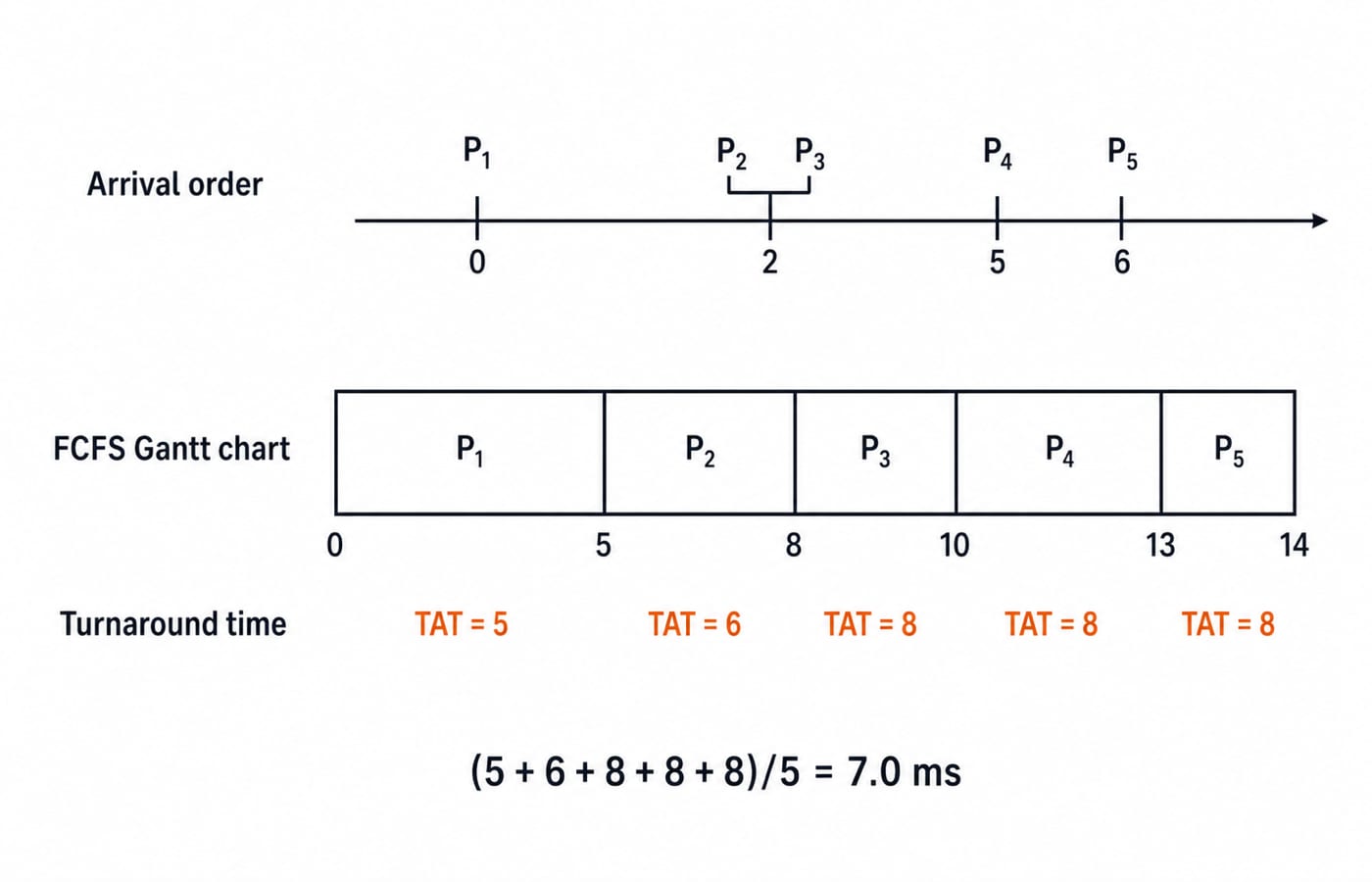
Keep P₂ before P₃ for the tie. Run P₁ 0-5, P₂ 5-8, P₃ 8-10, P₄ 10-13, P₅ 13-14. Completion times are 5, 8, 10, 13, 14. Subtract arrivals for turnaround times 5, 6, 8, 8, 8; hence (5 + 6 + 8 + 8 + 8) / 5 = 7.0 ms.
FCFS questions 7-8: idle boundaries and a ten-process queue
Question 7
For the following list of processes, the average turnaround time and average waiting time using FCFS algorithm is:
Process | Arrival Time (ms) | Execution Time (ms) |
|---|---|---|
P1 | 6 | 24 |
P2 | 0 | 3 |
P3 | 3 | 3 |
A. Average Turnaround time 30 ms and Average Waiting Time 4.5 ms
B. Average Turnaround time 13 ms and Average Waiting Time 3 ms
C. Average Turnaround time 10 ms and Average Waiting Time 0 ms
D. Average Turnaround time 24 ms and Average Waiting Time 0 ms
Correct answer: C. Average Turnaround time 10 ms and Average Waiting Time 0 ms.
Sort by arrival: P2 0-3, P3 3-6, P1 6-30. Each starts at arrival, so every wait is 0. Turnaround times are 3, 3, 24, and (3 + 3 + 24) / 3 = 10 ms. No idle gap exists at the boundaries.
Question 8
Consider a CPU that has to execute two types of processes. The first type, Actuators (A), requires a CPU burst of 6 seconds. The second type, Controllers (C), requires a CPU burst of 8 seconds. A new process of type A arrives at time t = 10, 20, 30, 40, and 50 (in seconds). Similarly, a new process of type C arrives at time t = 11, 22, 33, 44, and 55 (in seconds). The CPU scheduling policy is First Come First Serve (FCFS). The first process of type A starts running at t = 10 seconds. The average waiting time (in seconds) for the 10 processes is ___________. (rounded off to one decimal place)
Correct answer: 9.5.
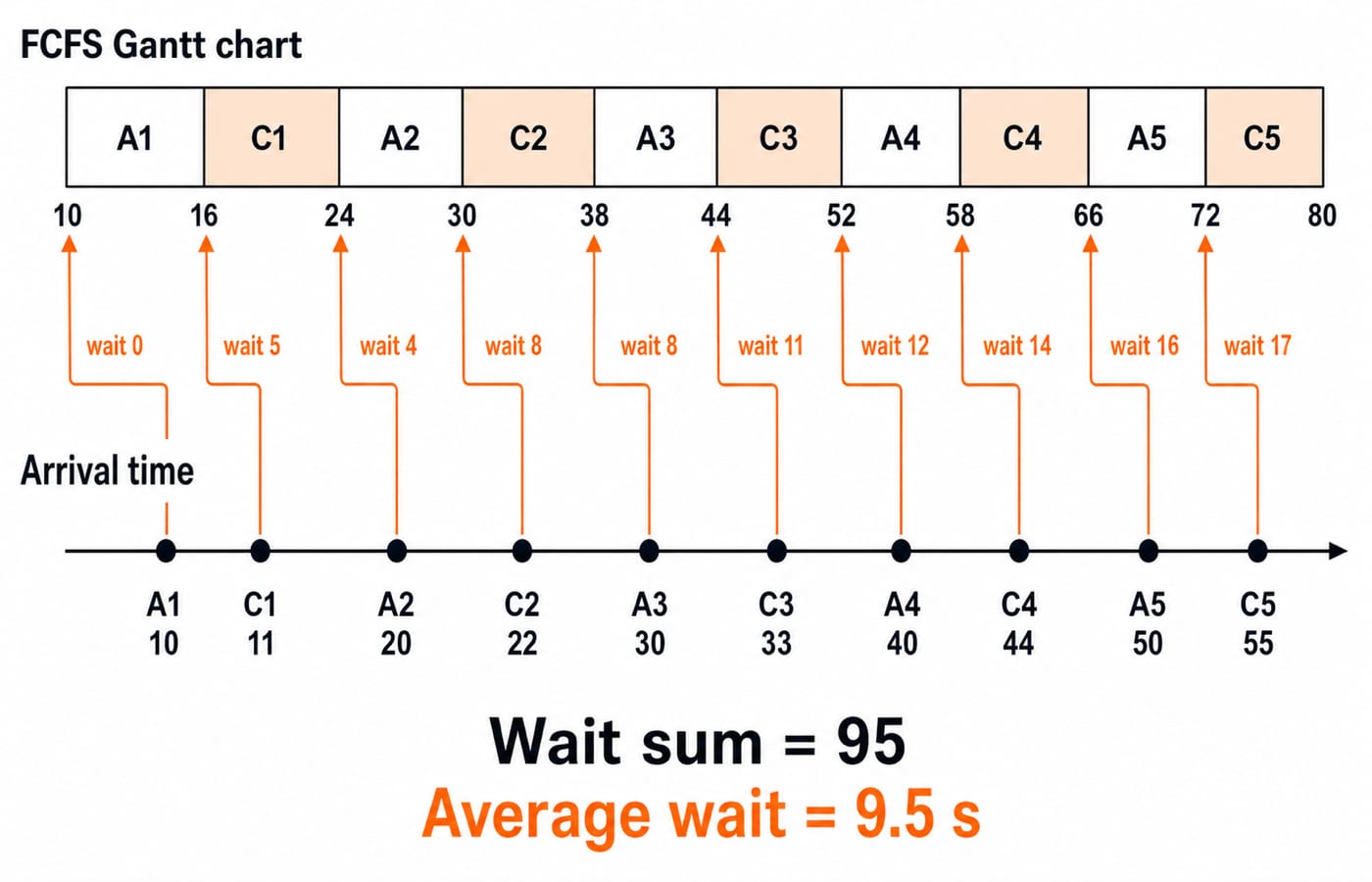
Run A1 10-16, C1 16-24, A2 24-30, C2 30-38, A3 38-44, C3 44-52, A4 52-58, C4 58-66, A5 66-72, C5 72-80. WT = start - arrival gives 0, 5, 4, 8, 8, 11, 12, 14, 16, 17. Their sum is 95, so 95 / 10 = 9.5 seconds. Ignore initial idle time because the first start is given as t=10.
FCFS questions 9-12: non-pre-emption and the convoy effect
Question 9
Which one of the following CPU scheduling algorithms cannot be preemptive?
A. Shortest Remaining Time First (SRTF) Scheduling
B. First Come First Serve (FCFS) Scheduling
C. Round Robin Scheduling
D. Priority Scheduling
Correct answer: B. First Come First Serve (FCFS) Scheduling.
FCFS keeps the first ready process until it completes or blocks. A later arrival cannot displace it. SRTF and Round Robin are pre-emptive, while Priority Scheduling can be.
Question 10
What is the Convoy Effect observed in the FCFS scheduling algorithm?
A. All the processes under execution finish at the same time
B. The process with the smallest burst time is made to wait by the process with the largest burst time
C. All the processes wait for the one big process to get off the CPU
D. None of the above
Correct answer: C. All the processes wait for the one big process to get off the CPU.
One long CPU-bound process at the head can make many ready processes queue behind it. Option B describes one possible small-job symptom, while C captures the whole queue.
Question 11
What causes the convoy effect in FCFS scheduling?
A. Priority inversion
B. Multiple threads competing for locks
C. Long I/O burst of initial processes
D. Long CPU-bound process blocking short I/O-bound processes
Correct answer: D. Long CPU-bound process blocking short I/O-bound processes.
If L needs 20 ms and S1-S3 need 2 ms each, order L, S1, S2, S3 gives waits 0, 20, 22, 24. The average is 66 / 4 = 16.5 ms. The long CPU burst creates the queue; an I/O burst does not occupy the CPU.
Question 12
In First-Come-First-Served CPU scheduling algorithm when all the other processes wait for one big process to get off the CPU is known as ______.
A. Belady's Anomaly
B. Aging
C. Convoy effect
D. Starvation
Correct answer: C. Convoy effect.
The wording defines convoy effect. Belady's anomaly concerns page replacement, aging prevents starvation, and starvation means indefinite postponement. A finite head process eventually completes.
FCFS error checklist and the next practice set
The repeatable moves are FIFO order (Questions 1-3), the requested metric (4-8), non-pre-emption (9), and convoy-effect distinctions (10-12).
Sort by arrival before process label.
Keep stated order for equal arrivals.
Insert an idle gap only when no process is ready.
Find
TAT = CT - AT, thenWT = TAT - BT.Measure response time to first start.
Never let a later short process pre-empt FCFS.
Continue with Process Scheduling MCQs: 12 solved GATE questions for mixed practice or Operating System MCQs for wider revision.
The short version
FCFS is a non-pre-emptive FIFO queue. The Gantt chart supplies each metric, while one long head process creates the convoy effect.
Use GATE Guidance by Sanchit Sir for the subject sequence, then the GATE Test Series for timed practice.
Keep learning
Segmentation and Hybrid MCQs: 10 Solved OS Questions with Explanations
Solve ten memory-management MCQs, then check the keyed answers, short reasoning paths, distractor traps, and worked address calculations.
Updated 3 Oct 20267 min readOperating System MCQs
Paging and TLB MCQs: 12 Solved Questions with Step-by-Step Explanations
Solve 12 Paging and TLB MCQs in a sequence that builds from page-table basics to address splits, TLB coverage, timing and fragmentation.
Updated 28 Sep 20268 min readOperating System MCQs
OS Types & Evolution MCQs: 12 Solved Questions with Explanations
Solve 12 published OS Types & Evolution questions. Each answer identifies the clue that separates batch, multiprogramming, time sharing and other OS models.
Updated 25 Sep 20268 min read83 viewsOperating System MCQs

Multilevel Paging MCQs: 12 Solved Questions with Explanations
Solve 10 MCQs and two NATs on multilevel paging. Each answer works through the address bits, table capacity or access-time path that decides the result.
Updated 24 Sep 20268 min readOperating System MCQs