Disk Access Time and Performance MCQs: 12 Solved Questions Explained
Solve 12 disk performance MCQs with checked steps for seek time, rotational delay, transfer rate, swap time, and total access time.
KnowledgeGate Team
Exam prep & CS education
Updated 6 Sep 20268 min read

Disk-performance MCQs become manageable once every quantity is assigned to one of three components: seek time moves the head to a track, rotational latency waits for the sector, and transfer time moves the bytes. The common errors are mechanical: using RPM as revolutions per second, using a full revolution for average latency, or adding transfer time when the question asks only for preparation time. Before calculating, write the units beside every value and identify whether the question asks for a maximum, an average, or a complete access time. Attempt each option set before reading the explanation. If a problem orders several pending requests rather than timing one access, revise File systems and disk scheduling in OS; that is a scheduling problem, not an access-component calculation.
Related reading: disk access time calculations and disk structure and addressing.
1. Disk access time MCQs on the three time components
Q1. RPSC Programmer - P1 2024
Total time to access a disk block is given by the –
(a) Seek time + rotational delay
(b) Seek time + rotational delay + transfer time
(c) Seek time + transfer time
(d) Seek time
Answer: (b) Seek time + rotational delay + transfer time. These are track positioning, sector positioning, and byte movement.
Q2. DSSSB TGT - Shift 3 2021
The time required to wait until Read/Write head comes under a desired sector is known as _____.
(a) Seek time
(b) Execution time
(c) Wait time
(d) Rotational delay
Answer: (d) Rotational delay. Rotation positions the sector; seek positions the track.
View the solved question.
Q3. ISRO 2008
The total time to prepare a disk drive mechanism for a block of data to be read from it is
(a) seek time
(b) latency
(c) latency plus seek time
(d) transmission time
Answer: (c) latency plus seek time. Preparation is seek plus rotation. Transfer starts afterward.
2. Rotational latency MCQs: definition, maximum delay, and average delay
Q4. HPSC 2021
The rotational latency required in reading a block of data from a disk to memory along with seek time and transfer time is
(a) the total time required for the platter to rotate the right sector under the head
(b) the total time required for read and write head to move in the correct position over the appropriate track
(c) the total time required for the platter to complete its full rotation
(d) None of the above
Answer: (a) the total time required for the platter to rotate the right sector under the head. Option (b) is seek time; option (c) is a full revolution. Latency need not be a full turn.
Q5. UGC NET Paper 2 June 2020
Concern a disk with a sector size of 512 bytes, 2000 tracks per surface, 50 sectors per track, five double-sided platters, and average seek time of 10 milliseconds.
If the disk platters rotate at 5400 rpm (revolutions per minute), then approximately what is the maximum rotational delay?
(a) 0.011 seconds
(b) 0.11 seconds
(c) 0.0011 seconds
(d) 1.1 seconds
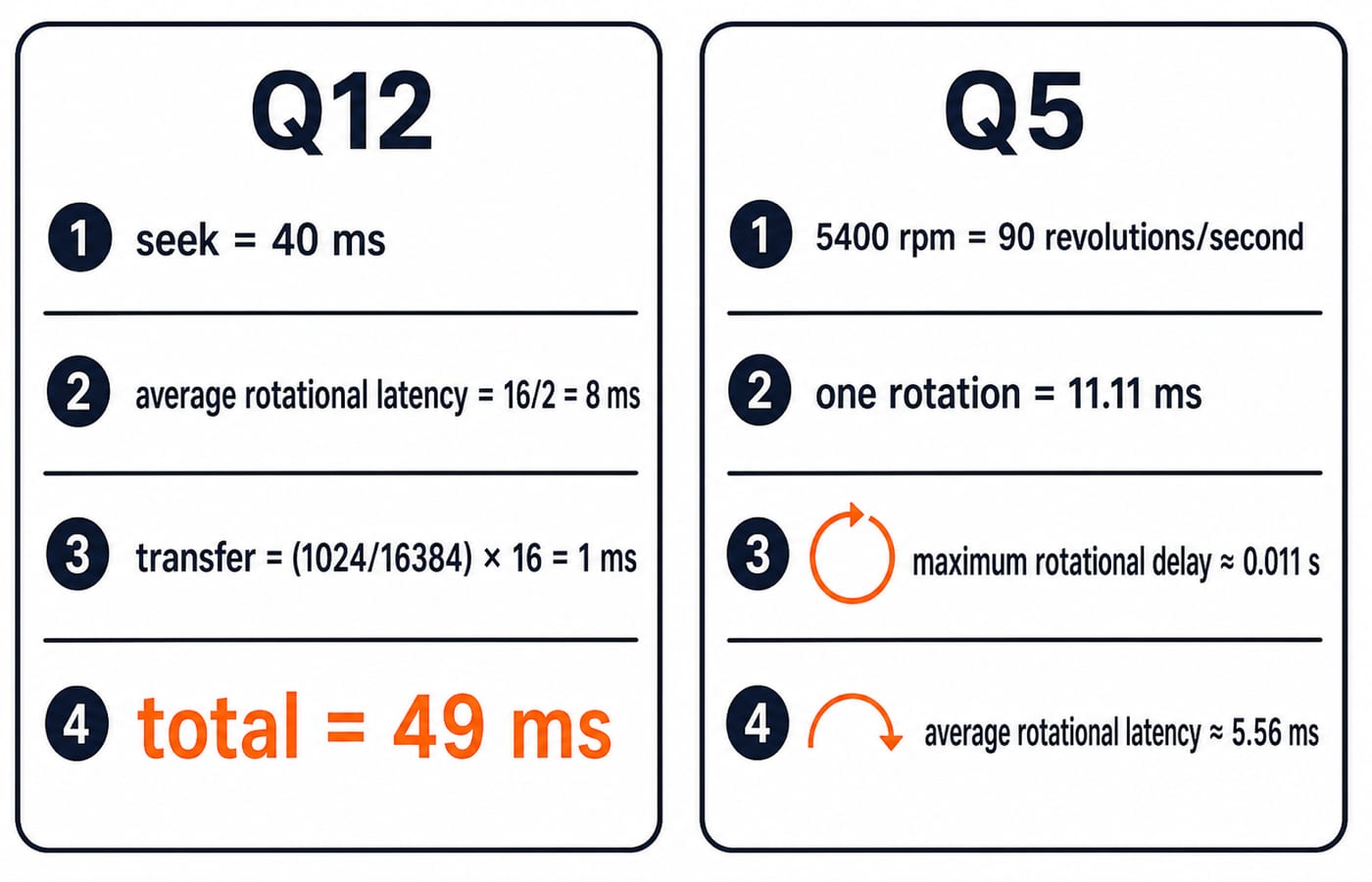
Answer: (a) 0.011 seconds. 5400 rpm / 60 = 90 revolutions/second, giving 1/90 = 0.01111... second per revolution. Maximum delay is one revolution; average is half, about 0.00556 second.
Use the topic page for the full Disk Access Time & Performance set.
3. Seek-time MCQs on arm motion and the dominant mechanical cost
Q6. GATE 2008
For a magnetic disk with concentric circular tracks, the seek latency is not linearly proportional to the seek distance due to
(a) non-uniform distribution of requests
(b) arm starting and stopping inertia
(c) higher capacity of tracks on the periphery of the platter
(d) use of unfair arm scheduling policies
Answer: (b) arm starting and stopping inertia. The arm accelerates and settles. Doubling track distance need not double seek time.
Q7. TPSC Senior Informatics Officer 2025
Which of the following is the major part of time taken when accessing data on the disk ?
(a) Settle time
(b) Rotational latency
(c) Seek time
(d) Waiting time
Answer: (c) Seek time. Arm motion dominates these magnetic-disk choices. SSDs have no mechanical seek.
4. Disk transfer-rate MCQs using RPM, sectors, and bytes per track
Q8. ISRO 2011
A fast wide SCSI-II disk drive spins at 7200 RPM, has a sector size of 512 bytes, and holds 160 sectors per track. Estimate the sustained transfer rate of this drive
(a) 576000 Kilobytes / sec
(b) 9600 Kilobytes / sec
(c) 4800 Kilobytes / sec
(d) 19200 Kilobytes / sec
Answer: (b) 9600 Kilobytes / sec. Speed is 7200/60 = 120 revolutions/second, while a track holds 160 × 512 = 81,920 bytes = 80 KB using 1 KB = 1024 bytes. Rate is 80 × 120 = 9600 KB/second.
Q9. UGC NET Paper 2 June 2020
Concern a disk with a sector size of 512 bytes, 2000 tracks per surface, 50 sectors per track, five double-sided platters, and average seek time of 10 milliseconds with rotational speed of 5400 rpm.
If one track of data can be transferred per revolution, then what is the data transfer rate?
(a) 2,850 KBytes/second
(b) 4,500 KBytes/second
(c) 5,700 KBytes/second
(d) 2,250 KBytes/second
Answer: (d) 2,250 KBytes/second. A track holds 50 × 512 = 25,600 bytes = 25 KBytes; speed is 5400/60 = 90 revolutions/second. Rate is 25 × 90 = 2250 KBytes/second; other values are irrelevant.
5. Complete disk access-time MCQs with fully worked calculations
Q10. GATE Information Technology 2005
A disk has 8 equidistant tracks. The diameters of the innermost and outermost tracks are 1 cm and 8 cm respectively. The innermost track has a storage capacity of 10 MB. If the disk has 20 sectors per track and is currently at the end of the 5th sector of the inner-most track and the head can move at a speed of 10 meters/sec and it is rotating at constant angular velocity of 6000 RPM, how much time will it take to read 1 MB contiguous data starting from the sector 4 of the outer-most track?
(a) 13.5 ms
(b) 10 ms
(c) 9.5 ms
(d) 20 ms
Answer: (a) 13.5 ms. Radii 0.5 cm and 4 cm give travel 3.5 cm = 0.035 m, so seek at 10 m/s is 0.035/10 = 0.0035 second = 3.5 ms. At 6000 rpm = 100 revolutions/second, rotation takes 10 ms and each sector 10/20 = 0.5 ms; sector 5 end to sector 4 start spans 18 intervals, giving 18 × 0.5 = 9 ms. A sector stores 10 MB/20 = 0.5 MB, so 1 MB takes two sectors, or 1 ms. Total is 3.5 + 9 + 1 = 13.5 ms.
Q11. UGC NET Paper 2 June 2025
What is the total swap time (Swap in & Swap out) in a system for a 15 MB process with a transfer rate of 30 MBps. Given that there is an average latency of 12 ms, however no head seeks involved.
(a) 1.024 sec
(b) 1.00 sec
(c) 0.512 sec
(d) 12 sec
Answer: (a) 1.024 sec. Each transfer takes 15 MB / 30 MBps = 0.5 second, so both take 1.0 second. Two latencies add 2 × 12 ms = 24 ms = 0.024 second; with no seek, total is 1.0 + 0.024 = 1.024 seconds.
Q12. UGC NET Paper 2 December 2015
Consider a disk with 16384 bytes per track having a rotation time of 16 msec and average seek time of 40 msec. What is the time in msec to read a block of 1024 bytes from this disk?
(a) 57 msec
(b) 49 msec
(c) 48 msec
(d) 17 msec
Answer: (b) 49 msec. Average rotational latency is 16/2 = 8 ms. Transfer time is (1024/16384) × 16 = 1 ms, so complete access time is 40 + 8 + 1 = 49 ms.
6. Disk access time MCQ answer map and recurring calculation traps
Question | Answer | Tested idea | Key check |
|---|---|---|---|
Q1 | (b) | Three-component access time | Seek + rotation + transfer |
Q2 | (d) | Rotational delay | Wait for sector |
Q3 | (c) | Mechanism preparation | Latency + seek |
Q4 | (a) | Latency definition | Rotate sector under head |
Q5 | (a) | Maximum rotational delay | 0.011 s |
Q6 | (b) | Arm inertia | Non-linear seek |
Q7 | (c) | Dominant mechanical cost | Seek time |
Q8 | (b) | Transfer rate | 9600 KB/s |
Q9 | (d) | Transfer rate | 2250 KBytes/s |
Q10 | (a) | Complete access time | 13.5 ms |
Q11 | (a) | Swap in and swap out | 1.024 s |
Q12 | (b) | Complete access time | 49 ms |
Write rps = rpm/60 and rotation period = 1/rps. Maximum latency uses one period; average uses half. Choose transfer rate = bytes per track × rps or transfer time = bytes requested / transfer rate, retain units, and add only requested components. For request ordering, use these Disk Scheduling MCQs.
RPM used directly -> rate is 60 times too large -> divide first.
Full revolution used for average latency -> delay doubles -> use half a period.
Half revolution used for maximum delay -> delay halves -> use one period.
Transfer added to preparation -> extra time appears -> stop after seek plus latency.
Every value used -> distractors enter the formula -> select required values.
Units mixed -> conversion errors appear -> standardise before calculating.
Magnetic seek applied to SSDs -> false delay appears -> SSDs have no moving head.
7. Disk access time MCQ practice: the short version and next step
Recall:
seek = move to trackrotational latency = wait for sectortransfer = move bytesmaximum rotational delay = one revolutionaverage rotational latency = half a revolution
Re-attempt Q5, Q8, Q9, Q10, Q11, and Q12 unaided. Exam names are only item attributions. The Disk Access Time & Performance practice set includes more than 40 questions. Use GATE Guidance by Sanchit Sir for concepts, the GATE Test Series for timed practice, or browse the GATE category.
Keep learning

Instruction Formats and Addressing Modes MCQs: 12 Solved Cross-Concept Questions
Solve 12 cross-concept COA questions that connect addressing-mode choices with PC rules, memory references, opcode fields, and byte-aligned instructions.
3 Oct 20267 min readComputer Organization MCQs

Interrupt-Driven I/O MCQs: 12 Solved Questions with Explanations
Attempt 12 previous-year interrupt-driven I/O questions, then check each answer with a concise explanation. The set covers ISR order, vectoring, priority, and CPU-time numericals.
28 Sep 20268 min readComputer Organization MCQs

Bitmap and Pixmap MCQs: 12 Solved Pixel Depth and Memory Questions
Build a reliable pixel-memory method through 12 live MCQs covering bitmaps, pixmaps, lookup tables, uncompressed storage, refresh rates, masks, and dithering.
Updated 25 Sep 20267 min readComputer Organization MCQs

Assembly & Assembler Design MCQs: 11 Solved PYQs Explained
Attempt 11 published PYQs on assembler directives, language levels, tables, register-pair instructions, debugging and fixed-width arithmetic, then check each worked explanation.
Updated 24 Sep 20267 min readComputer Organization MCQs