

FCFS and SSTF Disk Scheduling: Worked Examples and Exam Traps
Trace FCFS and SSTF on the same queue, compare 640 with 236 cylinders, and learn how to handle ties, arrivals, starvation and common traps.
KnowledgeGate Team
Exam prep & CS education
Updated 3 Nov 20265 min read
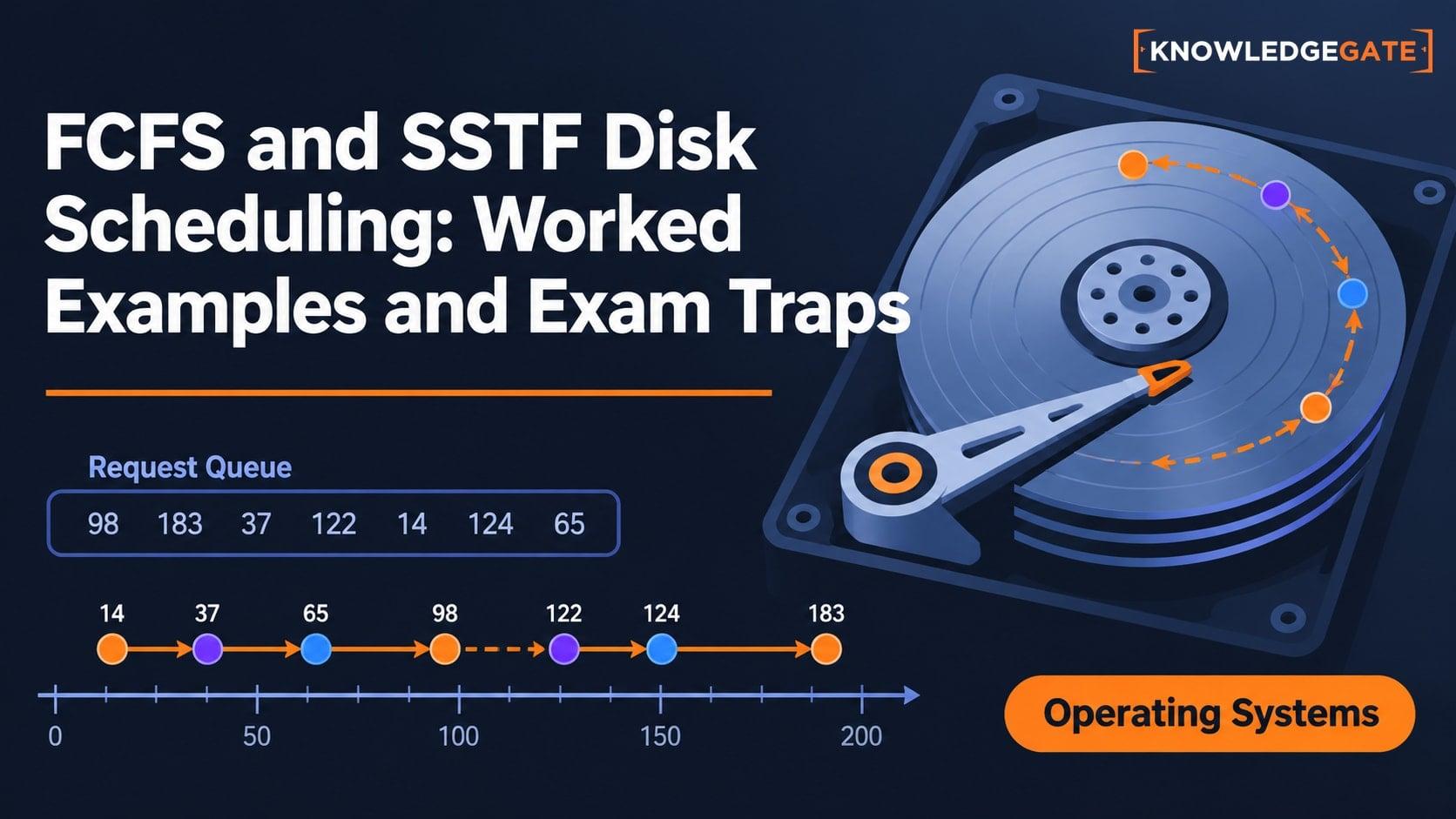
FCFS and SSTF can start from the same head position and queue but produce different service orders and totals. Learners often copy the queue into SSTF, sort it once, or add cylinder numbers instead of absolute movements. The same eight requests produce 640 cylinders under FCFS and 236 under SSTF. The earlier Disk Scheduling in Operating Systems: 6 Algorithms with Worked Examples compares all six algorithms on this queue; tie rules, dynamic arrivals, starvation, and a counterexample to SSTF optimality expose the narrower FCFS/SSTF edge cases.
FCFS and SSTF solve a disk-head ordering problem
A request identifies a cylinder. From head h to request r, movement is |r-h|; add these consecutive movements for the total. Seek time, rotational latency and transfer time are separate. Convert only under a supplied model.
FCFS, or First Come, First Served, follows queue order. It prevents later arrivals from bypassing waiting work but may cause large reversals. SSTF, or Shortest Seek Time First, selects the nearest pending request and recomputes from the new head. This greedy rule need not find the globally shortest route.
Point | FCFS | SSTF |
|---|---|---|
Selection rule | Queue order | Nearest pending request |
Recompute after service | No | Yes |
Uses arrival order | Yes | Only for a stated tie |
Needs a tie rule | No | Sometimes |
Starvation risk | No later-arrival bypass | Possible |
Needs initial direction | No | No |
Neither needs the initial direction used by SCAN-family questions. CPU FCFS instead schedules bursts and measures waiting time.
Work FCFS from the request queue without reordering it
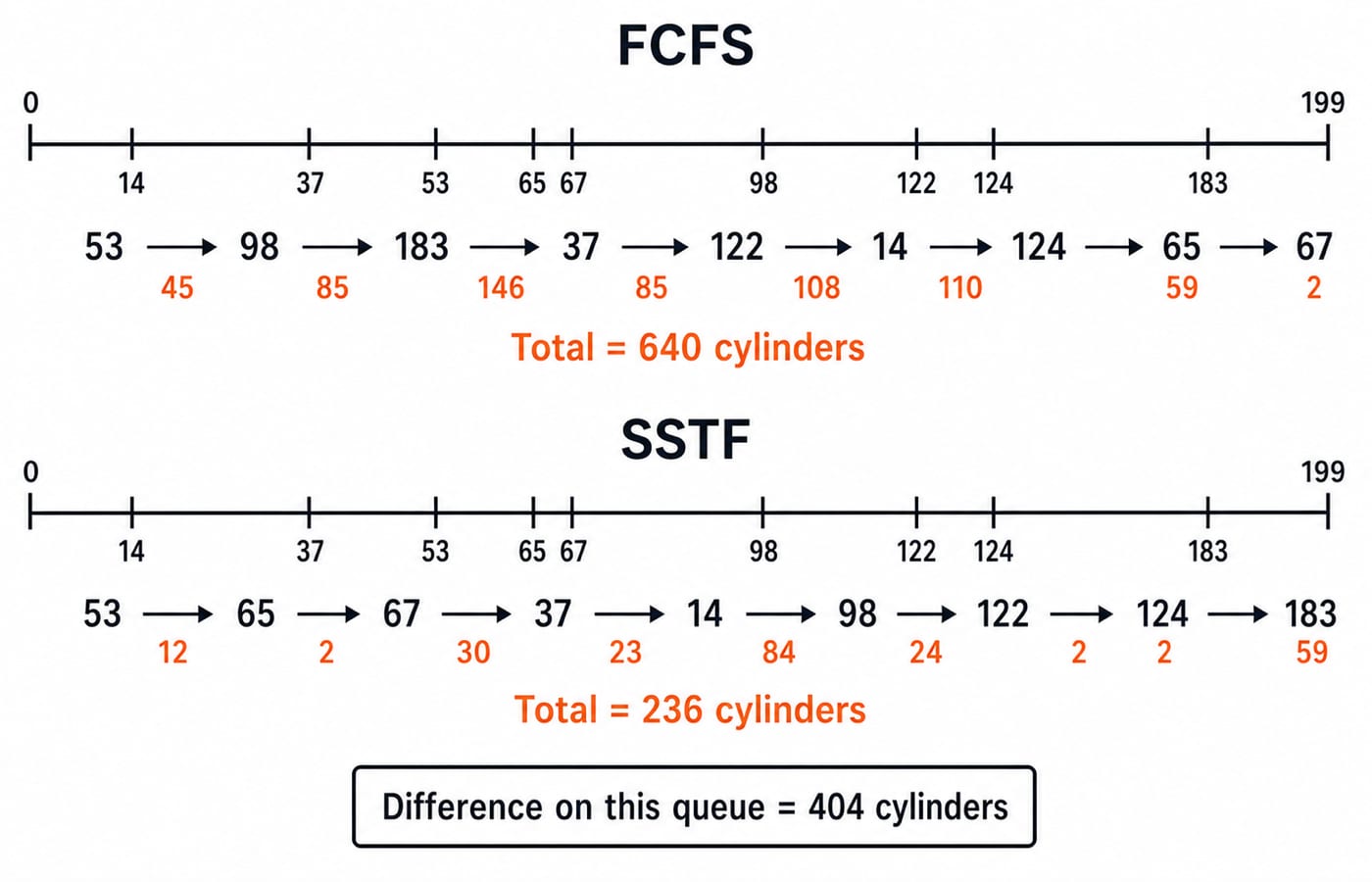
Cylinders range from 0 to 199, the head starts at 53, and all requests are pending in order 98, 183, 37, 122, 14, 124, 65, 67. The endpoints are context only and are not visited.
FCFS path: 53 -> 98 -> 183 -> 37 -> 122 -> 14 -> 124 -> 65 -> 67
Leg | Movement |
|---|---|
|
|
|
|
|
|
|
|
|
|
|
|
|
|
|
|
45+85+146+85+108+110+59+2 = 640 cylinders
Average movement is 640/8 = 80 cylinders per request, not 640 ms without a conversion.
Recompute the nearest pending request at every SSTF step
Start again at 53, measuring every distance from the current head.
Current | Choice | Movement |
|---|---|---|
|
|
|
|
|
|
|
|
|
|
|
|
|
|
|
|
|
|
|
|
|
|
|
|
At 67, the shrinking pending set puts 37 at distance 30, narrowly ahead of 98 at 31. Recomputing produces:
53 -> 65 -> 67 -> 37 -> 14 -> 98 -> 122 -> 124 -> 183
12+2+30+23+84+24+2+59 = 236 cylinders; average 236/8 = 29.5. All eight requests appear once, giving eight terms because the initial head is not a request.
Compare the answers without claiming SSTF is always best
Policy | Path | Total | Average |
|---|---|---|---|
FCFS |
|
|
|
SSTF |
|
|
|
The difference is 640-236 = 404 cylinders. FCFS reverses 183 -> 37 = 146 and 14 -> 124 = 110; SSTF first clears 65 and 67.
SSTF is not globally optimal. For head=50, queue {40,0,51,100}, it takes 50 -> 51 -> 40 -> 0 -> 100 for 1+11+40+100=152. The valid route 50 -> 40 -> 0 -> 51 -> 100 gives 10+40+51+49=150.
If a question assumes 0.2 ms per cylinder and ignores other delays, FCFS is 640 x 0.2 = 128 ms and SSTF 236 x 0.2 = 47.2 ms. This linear model is not a physical law.
Handle SSTF ties, dynamic arrivals and starvation explicitly
For head=50 with requests 40, 60, 61, both 40 and 60 are 10 away. SSTF alone cannot choose. A lower-cylinder rule gives 50 -> 40 -> 60 -> 61, totalling 10+20+1=31. If earlier arrival wins and 60 arrived first, 50 -> 60 -> 61 -> 40 totals 10+1+21=32. Follow the supplied rule, state an allowed assumption, or call the answer underdetermined.
With timed arrivals, FCFS appends behind waiting requests. SSTF considers only arrived, pending requests. A closer future request is unavailable.
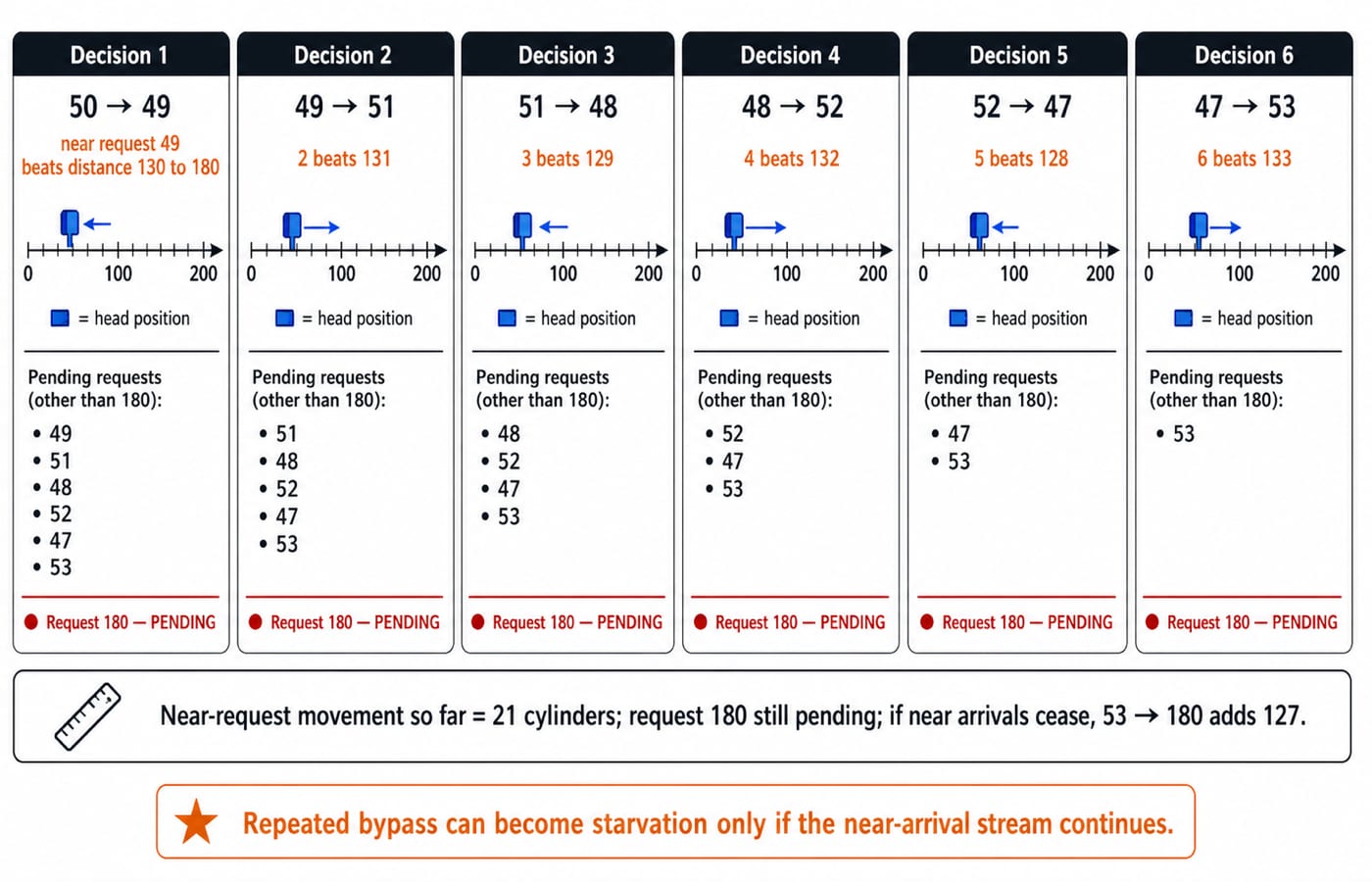
Now start at 50 with 180 and 49 pending. Before later decisions, nearby requests arrive: 51, 48, 52, 47, 53. SSTF serves 50 -> 49 -> 51 -> 48 -> 52 -> 47 -> 53 for 1+2+3+4+5+6=21; 180 remains pending through six choices. If arrivals stop, 53 -> 180=127. If nearer arrivals continue indefinitely, 180 can starve. Six choices alone do not prove infinite starvation.
How exam-style questions test FCFS and SSTF
Tasks may derive a path and total, choose the next request, compare policies, apply ties or arrivals, convert under a stated model, or judge fairness, starvation, optimality and direction.
Use this routine:
Copy the head and requests; identify a static or timed queue.
State the policy and build the sequence first.
For SSTF, shrink the pending set and recompute each time.
Add one absolute movement per request; check each appears once.
Practise with Disk Scheduling MCQs. These examples are illustrative, not official items. Check current requirements on the examination's official site.
Avoid the mistakes that change the service path
Smallest cylinder first for FCFS: Preserve queue order.
Sort once for SSTF: Recompute each time.
Measure SSTF from
53: Use the current head.Add destinations: Add consecutive absolute differences.
Choose
98from67: Choose37, distance30versus31.Drop a reversal:
183 -> 37=146;14 -> 124=110.SSTF is always optimal: The
152versus150example disproves it.Starvation is inevitable: It needs continued nearer arrivals.
Visit
0or199: Do so only under an explicit rule.Call
640 cylinderstime: Convert only when instructed.
Eight requests require eight movement terms, a quick check for incomplete paths.
FCFS and SSTF: the short version and next step
Recall: current head, pending set, policy, full path, absolute movements, fairness. FCFS begins 53 -> 98 and totals 640; SSTF begins 53 -> 65 -> 67 and totals 236.
Reverse only the queue to 67, 65, 124, 14, 122, 37, 183, 98. FCFS gives 14+2+59+110+108+85+146+85 = 609 cylinders. SSTF keeps its path and 236 total because the static pending set is unchanged. Thus order matters to FCFS, not SSTF here.
Continue at CS Fundamentals. Zero to Hero Complete CS Course is an optional broader route; CS Fundamentals for Placements by Sanchit Sir is the placement-focused option.
Go deeper with the full courseOperating System
Keep learning
FCFS and SSTF Scheduling MCQs: 12 Solved Disk Questions with Explanations
Solve 12 FCFS and SSTF disk-scheduling questions with complete routes, movement totals, seek-time conversions and fresh explanations for every answer.
Updated 19 Sep 20268 min read53 viewsOperating System MCQs
Disk Scheduling MCQs: 12 solved questions (FCFS, SSTF, SCAN)
Disk scheduling MCQs for GATE, UGC NET, DSSSB and BPSC: FCFS, SSTF, SCAN and C-SCAN head-movement numericals, seek time and direction changes, each solved.
Updated 29 Oct 20269 min read301 viewsOperating System MCQs
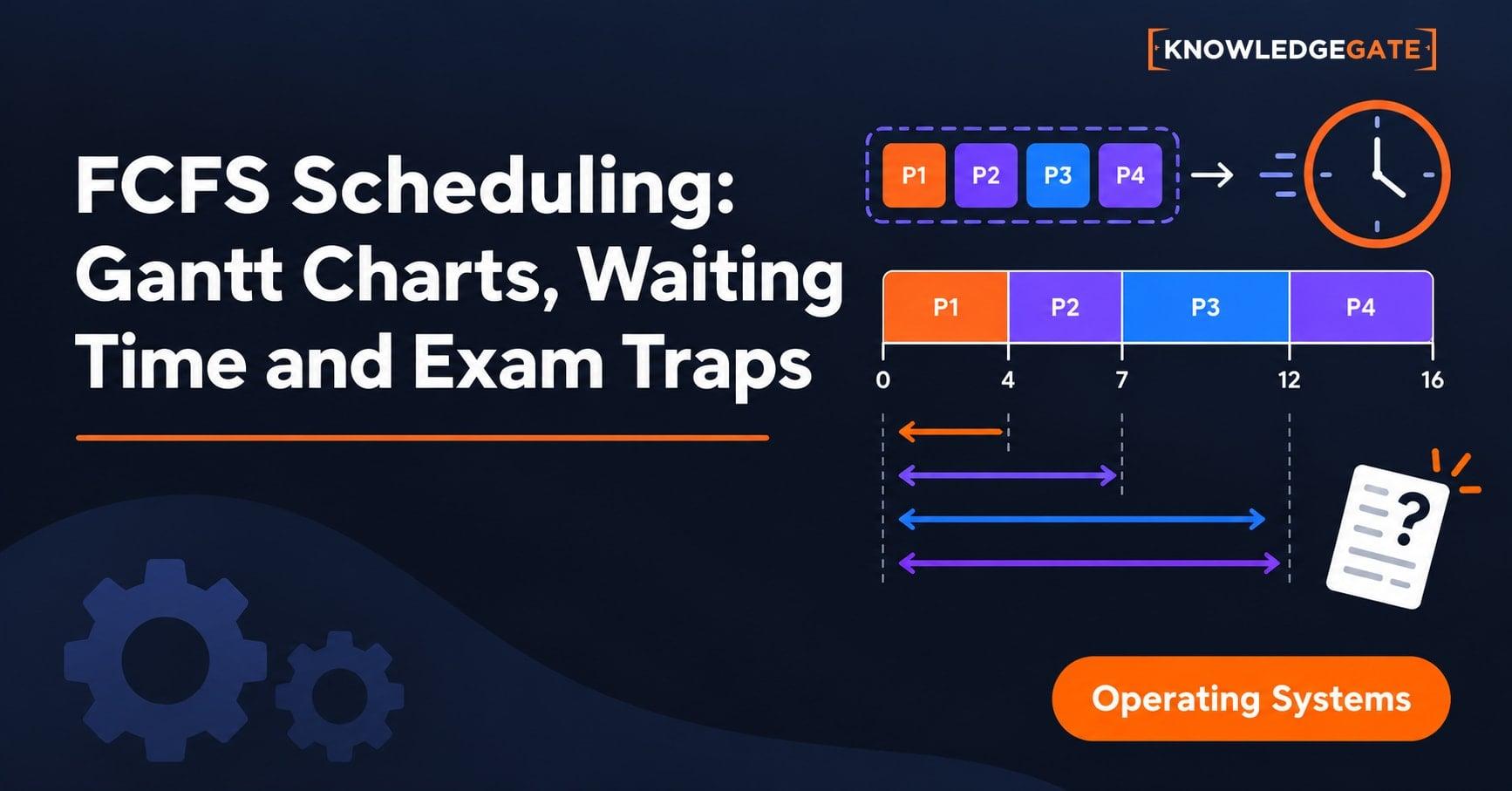
FCFS Scheduling: Gantt Charts, Waiting Time and Exam Traps
Learn FCFS scheduling through a four-process trace, a complete metric table, convoy-effect reasoning, and checks for idle time, ties and context switches.
Updated 2 Nov 20265 min readOperating Systems

CPU scheduling algorithms: FCFS, SJF, Round Robin and priority explained
When several processes are ready to run and there is one CPU, the operating system has to choose who goes next. That choice is CPU scheduling, and the algorithm it uses decides how long each process waits and how responsive the system feels. It is almost entirely mechanical: draw a Gantt chart, read off the completion times, and two subtractions give you everything an exam question asks for. Four processes, four algorithms, and the same two averages come out different every time.
Updated 29 Jul 20266 min read428 viewsOperating Systems