Process State and Lifecycle MCQs: 12 Solved OS Questions with Explanations
Attempt 12 process-state MCQs, then use concise explanations to trace CPU scheduling events, termination cases, Unix lifecycle traps, and CPU limits.
KnowledgeGate Team
Exam prep & CS education
Updated 17 Sep 20268 min read
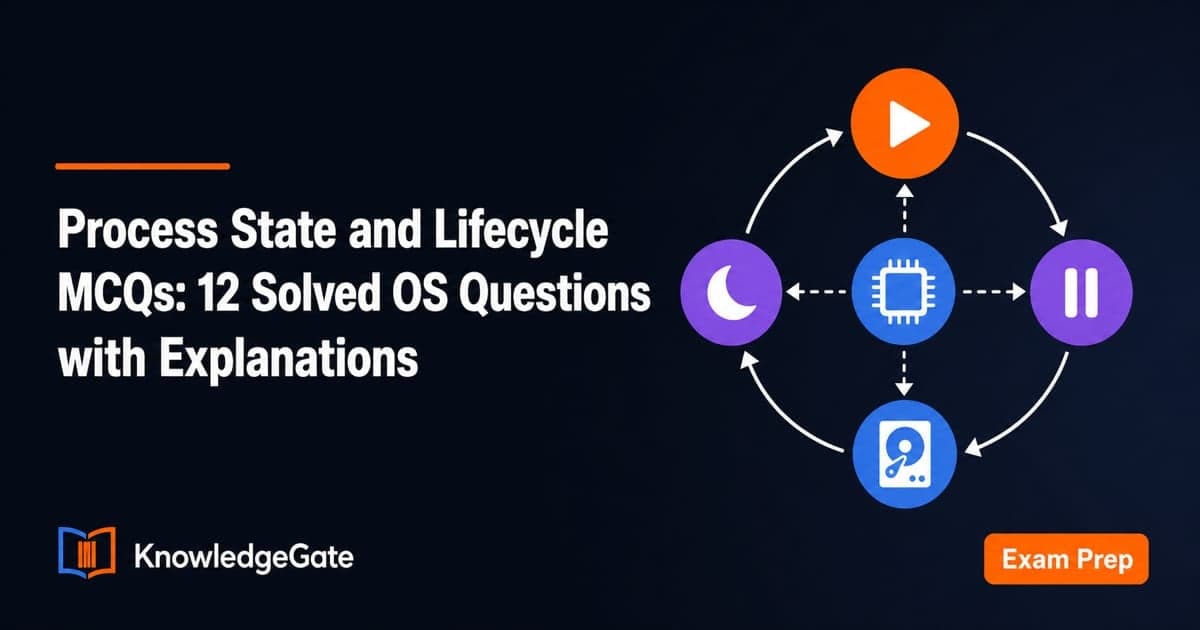
Process-state questions look like vocabulary tests, but their options ask you to follow one event through New, Ready, Running, Waiting or Blocked, and Terminated. The harder items add exit conditions, Unix lifecycle cases, interrupts and CPU limits. Attempt each item before reading its explanation.
Questions 1, 3, 4, 5, 6, 7 and 10 open their dedicated solution pages. Questions 2, 8, 9, 11 and 12 use the Process State & Lifecycle module as the broader practice route.
1. Process state basics: identify the model before choosing the label
The standard five-state model contains New, Ready, Running, Waiting or Blocked, and Terminated. An extended seven-state model adds suspended variants, so always use the model named or implied by the options.
Question 1: How many process states?
How many states can be processed in an operating system?
(A) 2
(B) 3
(C) 4
(D) 5
Answer: (D) 5. See the worked solution
Explanation: The basic model has five states: New, Ready, Running, Waiting or Blocked, and Terminated. Seven is valid in an extended model, but it is not offered here, so the options indicate the five-state model.
Question 2: Ready or Waiting?
In which state, the process will be waiting to be assigned to a processor?
(A) New
(B) Running
(C) Waiting
(D) Ready
Answer: (D) Ready.
Explanation: A Ready process has everything it needs except the CPU and can run as soon as the scheduler dispatches it. A Waiting process cannot run yet because an I/O operation or another event must finish first.
Question 3: What defines a process state?
The state of a process is defined by __________ .
(A) the final activity of the process
(B) the activity just executed by the process
(C) the activity to next be executed by the process
(D) the current activity of the process
Answer: (D) the current activity of the process. See the worked solution
Explanation: State describes the process's current activity or condition. It is not its last instruction, next instruction, or eventual completion.
2. Process state transitions: follow the event, not the arrow by memory
Use this event key: dispatch gives Ready to Running; pre-emption gives Running to Ready; an event request gives Running to Blocked; event completion gives Blocked to Ready; process completion gives Running to Terminated. Ready to Blocked and Blocked to Running are not direct transitions.
Question 4: Time quantum expiry
In a timeshare operating system, when the time slot assigned to a process is completed, the process switches from the current state to?
(A) Suspended state
(B) Blocked state
(C) Ready state
(D) More than one of the above
(E) None of the above
Answer: (C) Ready state. See the worked solution
Explanation: The process is Running when its quantum ends. Pre-emption returns it to Ready for another turn. It neither requested I/O nor got swapped out, so Blocked and Suspended are wrong.
Question 5: Match transitions to causes
Match List I (Process state transition) with List II (Reason for transition), then choose the option giving the correct match for all four pairs.
List I: Process state transition | List II: Reason for transition |
|---|---|
(a) Ready → Running | (i) Request made by the process is satisfied or an event for which it was waiting occurs |
(b) Blocked → Ready | (ii) Process wishes to wait for some action by another process |
(c) Running → Blocked | (iii) The process is dispatched |
(d) Running → Ready | (iv) The process is pre-empted |
(A) iii i ii iv
(B) iv i iii ii
(C) iv iii i ii
(D) iv iii ii i
Answer: (A) iii, i, ii, iv. See the worked solution
Explanation: Dispatch gives (a)-(iii). A satisfied request gives (b)-(i), choosing to wait gives (c)-(ii), and pre-emption gives (d)-(iv). Thus iii, i, ii, iv is option A.
Question 6: Interruption and completion
Which of the following statements is/are true about process states? (i) A running process moves to ready state when it is interrupted. (ii) A process moves to waiting state when it has completed its execution.
(A) Only (i)
(B) Only (ii)
(C) Both (i) and (ii)
(D) Neither (i) nor (ii)
Answer: (A) Only (i). See the worked solution
Explanation: Statement (i) is true because an interruption or pre-emption can return a Running process to Ready. Statement (ii) is false because completion leads to Terminated; Waiting is for an unfinished process awaiting an event.
Question 7: An impossible direct transition
Which of the following process state transitions is not possible in a typical operating system?
(A) Running → Ready
(B) Waiting → Ready
(C) Ready → Waiting
(D) Running → Waiting
Answer: (C) Ready → Waiting. See the worked solution
Explanation: A Ready process is not executing, so it cannot issue the I/O or event request that would make it wait. It must first reach Running. Each other transition has a standard trigger.
3. Process termination, abort, zombie, and orphan states
Keep four ideas separate: normal completion, abnormal abort, an unreaped zombie, and an orphan still running after its parent exits. Zombie and orphan are not extra boxes in the five-state diagram.
Question 8: Abnormal termination
When a program is terminated abnormally, it is called ______.
(A) End
(B) Stop
(C) Abort
(D) Terminate
Answer: (C) Abort.
Explanation: Abort is the conventional term for abnormal termination. The other words are generic and do not identify the abnormal-exit condition asked for here.
Question 9: Zombie process
What does a zombie process imply in Unix?
(A) The process is not running but still has an entry in the process table
(B) The process is running but not responding
(C) The process is running and responding
(D) The process has been deleted from the process table
Answer: (A) The process is not running but still has an entry in the process table.
Explanation: The child has completed, but its parent has not collected the exit status. It no longer executes, yet it keeps a process-table entry until the parent reaps it.
Question 10: Orphan versus zombie
Consider the following statement
I. A child process that remains running even after its parent process is terminated or completed, without waiting for the child process execution is called an orphan.
II. A process that has completed its task but still, it shows an entry in a process table is called a zombie process.
(A) Both are true
(B) Both are false
(C) Only I is true
(D) Only II is true
Answer: (A) Both are true. See the worked solution
Explanation: Statement I describes a running child whose parent has exited, an orphan. Statement II describes a completed child that remains in the process table until wait() or waitpid() collects its status, a zombie.
4. Process state questions with interrupts and multiple CPUs
For a systems scenario, mark the exact instant being asked about, count the CPUs that can execute processes, and only then assign Running or Ready.
Question 11: Interrupt on a single-core system
Consider a process P1 that is executing on a Linux-like OS on a single core system. When P1 is executing, a disk interrupt occurs, causing P1 to go to kernel mode to service that interrupt. The interrupt delivers all the disk blocks that unblock a process P2 (which blocked earlier on the disk read). The interrupt service routine has completed execution fully, and the OS is just about to return back to the user mode of P1. At this point in time, what are the states (ready/running/blocked) of processes P1 and P2?
(A) P1 is ready, P2 is ready
(B) P1 is running, P2 is ready
(C) P1 is ready, P2 is running
(D) P1 is running, P2 is terminate
Answer: (B) P1 is running, P2 is ready.
Explanation: There is one CPU. The interrupt ran in P1's kernel context, while completing P2's disk read only made P2 eligible. Just before return, P1 remains Running and P2 is Ready because no scheduling decision installed P2 on the CPU.
Question 12: Maximum Running and Ready processes
The maximum number of processes that can be present in the running state and in the ready state on a computer with n CPUs are, respectively:
(A) n, n²
(B) n², n
(C) independent of n, n²
(D) n, independent of n
Answer: (D) n, independent of n.
Explanation: With n CPUs, at most n processes can execute simultaneously, one on each CPU. The Ready queue may contain a system-dependent number of runnable processes, so its maximum is not fixed by n or n².
5. Process-state trap table: one event, one next state
Use the event, not the sound of the label, to choose the next state.
Event or condition | Resulting state |
|---|---|
Admitted | Ready |
Dispatched | Running |
Time quantum expires | Ready |
Blocking I/O requested | Waiting or Blocked |
I/O completes | Ready |
Execution completes | Terminated |
Abnormal termination | Abort |
Parent has not reaped a completed child | Zombie |
Your mistakes identify the revision needed. If Question 2 was wrong, revise Ready versus Waiting. If Questions 5 to 7 were wrong, trace events instead of memorising arrows. If Questions 11 or 12 were wrong, mark the exact time instant and CPU count before reasoning.
6. Process State and Lifecycle MCQs: the short version and next practice step
Process-state questions include state definitions, transition causes, completion and Unix edge cases, and scheduler reasoning with one or n CPUs.
For the whole OS sequence, continue with GATE Guidance by Sanchit Sir. Syllabus browsers can start from the GATE CS Exam category. Questions 2, 6, 7 and 8 also appear in the earlier Process Management and Process States MCQs. That set owns the broad survey of states, control blocks, schedulers and multitasking; this set uses those anchors for a narrower progression through legal transitions, zombies, orphans, interrupt context and multi-CPU limits. After the lifecycle boundary is secure, Threads and Process Creation MCQs shifts the focus to thread models and fork mechanics.
Answer key: 1-D, 2-D, 3-D, 4-C, 5-A, 6-A, 7-C, 8-C, 9-A, 10-A, 11-B, 12-D.
Keep learning

Segmentation and Hybrid MCQs: 10 Solved OS Questions with Explanations
Solve ten memory-management MCQs, then check the keyed answers, short reasoning paths, distractor traps, and worked address calculations.
Updated 3 Oct 20267 min readOperating System MCQs
Paging and TLB MCQs: 12 Solved Questions with Step-by-Step Explanations
Solve 12 Paging and TLB MCQs in a sequence that builds from page-table basics to address splits, TLB coverage, timing and fragmentation.
Updated 28 Sep 20268 min readOperating System MCQs
OS Types & Evolution MCQs: 12 Solved Questions with Explanations
Solve 12 published OS Types & Evolution questions. Each answer identifies the clue that separates batch, multiprogramming, time sharing and other OS models.
Updated 25 Sep 20268 min read83 viewsOperating System MCQs

Multilevel Paging MCQs: 12 Solved Questions with Explanations
Solve 10 MCQs and two NATs on multilevel paging. Each answer works through the address bits, table capacity or access-time path that decides the result.
Updated 24 Sep 20268 min readOperating System MCQs