Disk Scheduling in Operating Systems: 6 Algorithms with Worked Examples
Use one request queue to compare all six disk-scheduling algorithms. Every service path, endpoint rule, total movement and per-request average is worked out.
KnowledgeGate Team
Exam prep & CS education
Updated 6 Sep 20266 min read
An unstated direction or mishandled endpoint changes a disk-scheduling service order and total head movement. Compare FCFS, SSTF, SCAN, C-SCAN, LOOK and C-LOOK on one fixed queue and endpoint convention, with the full path and movement total for each. Keeping the workload fixed isolates the algorithm as the cause of different totals. This seek-distance model applies to rotating disks; SSDs have no moving head.
Related reading: FCFS and SSTF MCQs and disk access time.
Disk scheduling decides the next cylinder request
An HDD stores data on tracks, addressed here as cylinders. Pending read or write requests wait in a queue, and moving the disk head between cylinders creates seek distance. Disk scheduling chooses which pending cylinder to service next.
Head movement is the metric for these calculations; rotational latency and transfer time remain separate. For a complete head path:
total head movement = sum of |next cylinder - current cylinder|
Average head movement per request is total movement / number of requests. Do not divide by the number of distinct cylinders or by the largest cylinder number.
FCFS prioritises arrival order. SSTF prioritises the nearest request. SCAN-family methods sweep in a direction, while circular variants aim for more uniform waiting. The wider syllabus is mapped in GATE CS Exam Preparation.
Disk scheduling worked-example setup and conventions
Use the same dataset for all six algorithms:
Cylinders:
0through199Starting head:
53Queue in arrival order:
[98, 183, 37, 122, 14, 124, 65, 67]Requests:
8Initial SCAN-family direction: toward higher-numbered cylinders
Sorted once, the requests are [14, 37, 65, 67, 98, 122, 124, 183]. Around head 53, the lower side is [14, 37] and the higher side is [65, 67, 98, 122, 124, 183]. The starting head is not itself a request.
Under the endpoint convention used in these calculations, SCAN reaches physical endpoint 199, and C-SCAN travels from 199 to 0. LOOK and C-LOOK turn or wrap at the extreme pending requests instead. Both circular returns count as physical head movement. If a question states another convention, follow its wording.
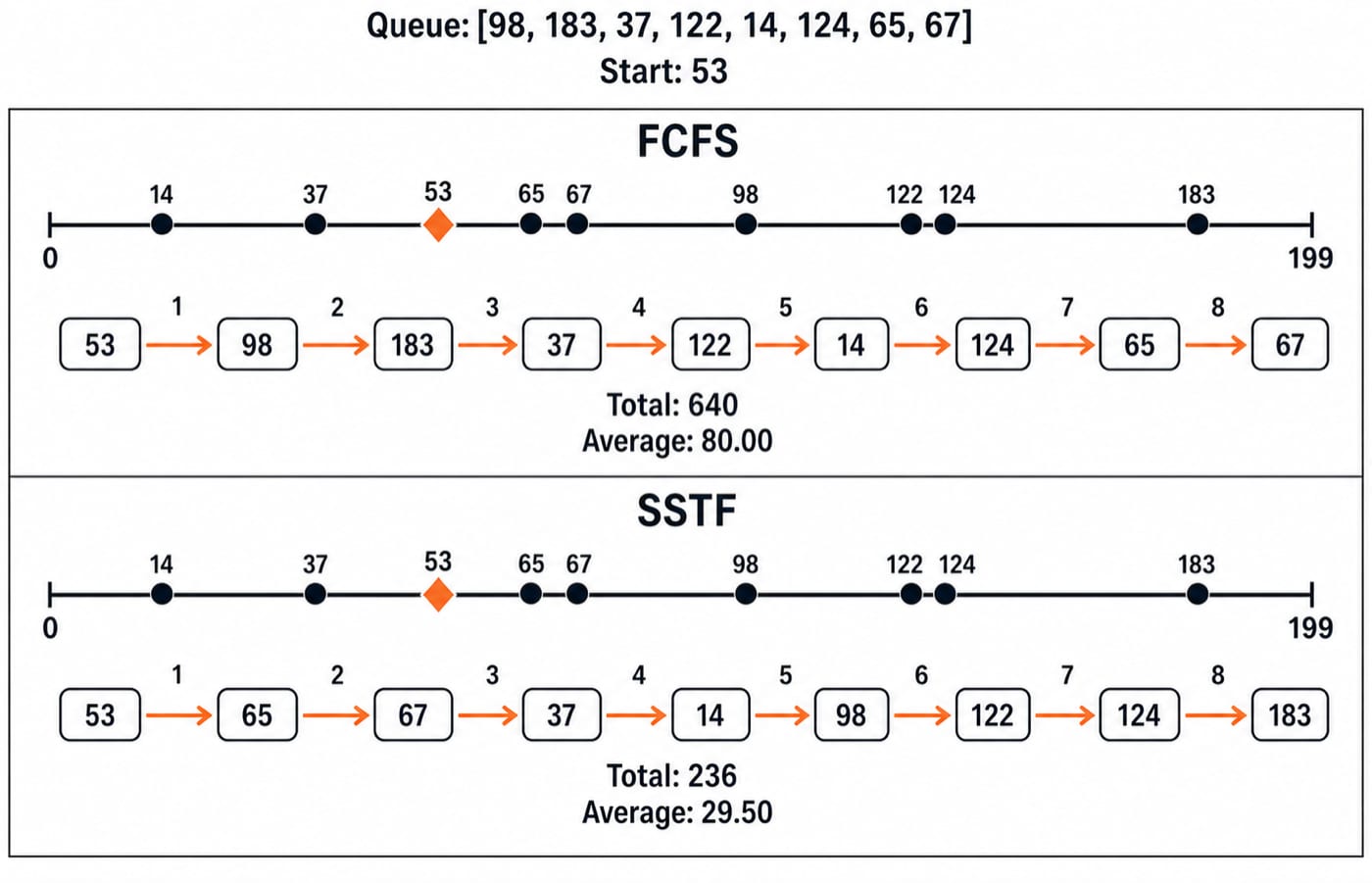
FCFS and SSTF worked paths on the same queue
FCFS preserves arrival order:
53 -> 98 -> 183 -> 37 -> 122 -> 14 -> 124 -> 65 -> 67
The movement is:
45 + 85 + 146 + 85 + 108 + 110 + 59 + 2 = 640 cylinders
Average movement is 640 / 8 = 80.00 cylinders per request. FCFS is simple and arrival-fair, but the large reversals in this queue create a high seek distance.
SSTF repeatedly chooses the pending request closest to the current head:
53 -> 65 -> 67 -> 37 -> 14 -> 98 -> 122 -> 124 -> 183
Its movement is 12 + 2 + 30 + 23 + 84 + 24 + 2 + 59 = 236 cylinders, and its average is 236 / 8 = 29.50 cylinders per request.
From 53, request 65 is only 12 cylinders away. From 65, request 67 is 2 away. The closest lower requests then come before the remaining high requests. This local rule produces a smoother trace here, although it never plans the full path in advance.
SSTF saves 640 - 236 = 404 cylinders on this workload. That does not make it universally best. A continuing stream of nearby requests can postpone a distant request, so SSTF can cause starvation.
SCAN and C-SCAN include physical endpoints
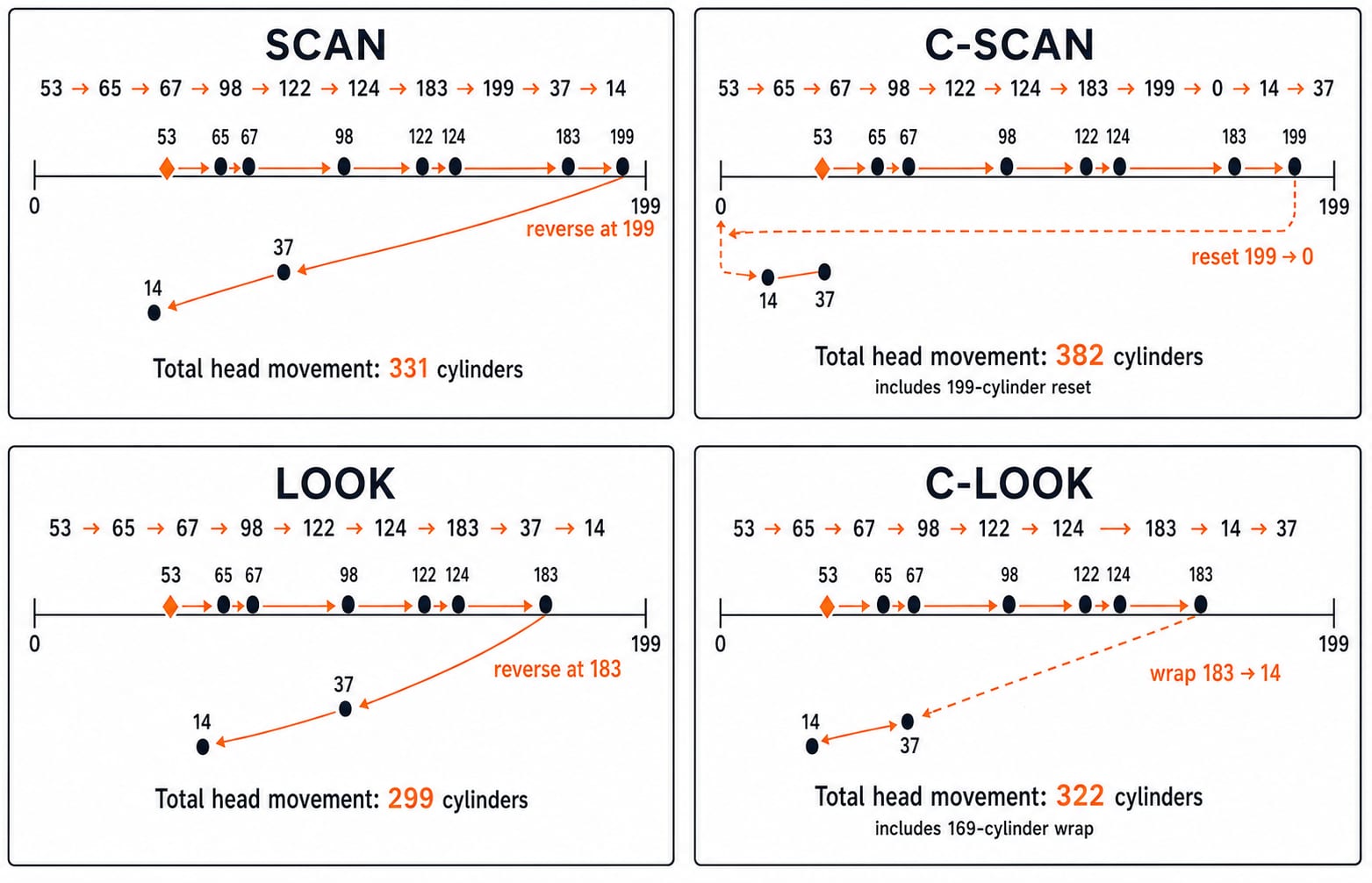
SCAN moves upward first, services the higher requests, reaches the disk end, then reverses:
53 -> 65 -> 67 -> 98 -> 122 -> 124 -> 183 -> 199 -> 37 -> 14
The movement is 12 + 2 + 31 + 24 + 2 + 59 + 16 + 162 + 23 = 331 cylinders. Average movement is 331 / 8 = 41.375, reported as 41.38 cylinders per request.
The endpoint distance matters. After servicing 183, SCAN still travels 16 cylinders to 199 before reversing, then crosses 162 cylinders from 199 to request 37 on the lower side.
C-SCAN also services the higher side and reaches 199, but it then returns physically to 0 and continues upward through the lower side:
53 -> 65 -> 67 -> 98 -> 122 -> 124 -> 183 -> 199 -> 0 -> 14 -> 37
The movement is 12 + 2 + 31 + 24 + 2 + 59 + 16 + 199 + 14 + 23 = 382 cylinders. Average movement is 382 / 8 = 47.75 cylinders per request.
SCAN serves requests while moving in both directions. C-SCAN serves in one logical direction and uses the return trip to reset. Its extra reset distance in this example buys a more uniform direction of service, not a guaranteed lower total movement.
LOOK and C-LOOK stop at pending requests
LOOK follows SCAN's direction rule but does not visit 199 when no request lies beyond 183:
53 -> 65 -> 67 -> 98 -> 122 -> 124 -> 183 -> 37 -> 14
Its movement is 12 + 2 + 31 + 24 + 2 + 59 + 146 + 23 = 299 cylinders. Average movement is 299 / 8 = 37.375, reported as 37.38.
C-LOOK wraps from the highest pending request to the lowest pending request instead of using physical endpoints:
53 -> 65 -> 67 -> 98 -> 122 -> 124 -> 183 -> 14 -> 37
Its movement is 12 + 2 + 31 + 24 + 2 + 59 + 169 + 23 = 322 cylinders. Average movement is 322 / 8 = 40.25.
Algorithm | Endpoint or turn rule | Total cylinders | Average per request | Main trade-off |
|---|---|---|---|---|
FCFS | Follow arrival order | 640 | 80.00 | Arrival-fair but may travel far |
SSTF | Choose nearest request | 236 | 29.50 | Low here, but distant requests may starve |
SCAN | Reach | 331 | 41.38 | Sweeps both ways, but visits an endpoint |
C-SCAN | Reach | 382 | 47.75 | Uniform direction, extra reset |
LOOK | Reverse at request | 299 | 37.38 | Avoids unused endpoint travel |
C-LOOK | Wrap from | 322 | 40.25 | Circular without endpoints |
SSTF is lowest only for this example. Use Disk Scheduling MCQs: FCFS, SSTF, SCAN after you can reproduce the table.
Disk scheduling traps that change the answer
Endpoint trap: Under this convention, SCAN reaches
0or199. LOOK turns at14or183, the extreme pending requests. The names are not interchangeable.Direction trap: A SCAN-family order is incomplete until the initial direction is known. If the prompt omits it, state an assumption.
Circular-jump trap: Under the convention used here,
199 -> 0adds199cylinders and183 -> 14adds169cylinders. A question that excludes the reset produces a different total.Current-head request: With head
53and a pending request at53, movement is0, and that request is serviced immediately.SSTF tie: With head
50, requests40and60are both10cylinders away. SSTF needs a stated tie-break rule.
Finally, disk scheduling is different from CPU process scheduling. Do not transfer a moving-head optimisation to SSDs as if their hardware had the same seek mechanics.
How GATE-style questions and interviews test disk scheduling
Common problem forms ask you to derive a service order, compute total or average movement, distinguish SCAN from LOOK, compare fairness and starvation, or explain why endpoint conventions produce different answers. A correct solution states the direction and endpoint convention before tracing the path.
Use this 60-second routine:
Write the starting head and cylinder bounds.
Sort the queue and split it below and above the head.
Mark the initial direction and any physical endpoints.
Trace the complete path.
Sum adjacent absolute differences.
The micro-check 40 -> 55 -> 50 gives 15 + 5 = 20, not merely |50 - 40| = 10. For broader revision, use Operating Systems for GATE: Deadlocks, Scheduling, Memory. Then test topic recall with Operating System MCQs.
Disk scheduling short version and next step
FCFS follows arrival order. SSTF chooses the nearest request but may starve distant work. SCAN and C-SCAN use physical endpoints under this convention, while LOOK and C-LOOK stop or wrap at pending-request extremes.
Hide the comparison table and recompute all six totals from head 53. Your targets, in algorithm order, are 640, 236, 331, 382, 299, 322. For structured concept revision, continue with GATE Guidance by Sanchit Sir.
Keep learning
Paging and TLB Explained: Address Translation, EMAT and Exam Traps
Follow one virtual address from its VPN through the TLB to a physical frame, then calculate page-table size, TLB reach and effective memory access time.
Updated 4 Oct 20266 min readOperating Systems
Operating System Scenarios: Solve Scheduling, Concurrency, and Page Replacement
Learn one state-trace method for three common OS problem families, then apply it to complete Round Robin, concurrency, FIFO, and LRU examples.
Updated 29 Sep 20265 min readOperating Systems
Tower Research Hiring Process: Stage-by-Stage Prep for Quant and Dev Roles
Prepare for a Tower Research application without treating one online account as a universal process. Use this role-led map, worked drills, and seven-day plan.
Updated 25 Sep 20265 min readOperating Systems
Capital One Recruitment Process: Stage-by-Stage Guide for India Applicants
Prepare for a Capital One India application with a cautious five-stage map, worked technical and case drills, and a practical 14-hour schedule.
Updated 24 Sep 20265 min readOperating Systems