

Advance Arithmetic Questions with Solutions: 12 Solved MCQs
Attempt this 12-question mixed set before opening the solutions. Each answer models the story, shows the arithmetic, and finishes with a direct check.
KnowledgeGate Team
Exam prep & CS education
Updated 19 Nov 20268 min read
Advanced arithmetic questions often hide a simple invariant inside a clock, calendar, recurrence, coin, or alphametic story. Attempt all 12 before reading the working, even if that means covering each solution as you go. These are exact published-bank stems and options, followed by concise, checkable solutions. The mix builds problem-modelling skill across common aptitude formats without claiming an official pattern or difficulty level.
Before you start: six moves that unlock this set
Translate the words into an equation, identify what stays invariant, keep units consistent, work backward when the final state is known, use congruence for remainders, and substitute the result back. Give every question one first-pass attempt. Mark where your setup failed, then compare the solution. The 30-day aptitude routine turns that rhythm into a repeatable schedule. Use the Aptitude category when you need the wider topic map.
Questions 1 to 3: clock motion, an arithmetic progression, and a recurrence
Question 1: relative motion on a clock
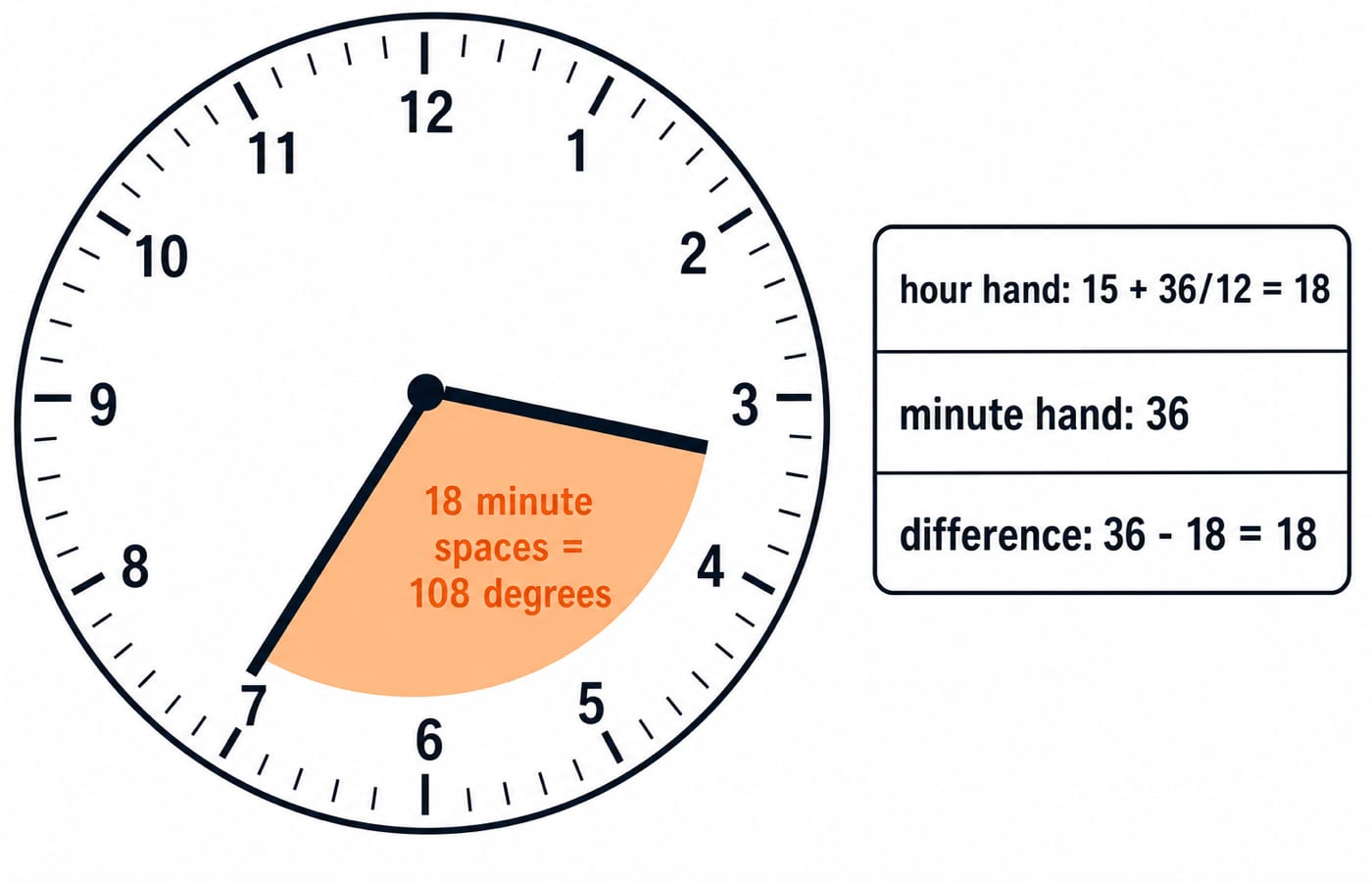
It is between 3 pm and 4 pm, and the distance between the hour hand and the minute hand of the clock is 18 minute spaces. What time does the clock show?
(a) 3 : 12 pm
(b) 3 : 27 pm
(c) 3 : 31 pm
(d) 3 : 36 pm
At 3:00 pm, the hour hand is at minute-space 15 and the minute hand at 0. The minute hand must gain 15 + 18 = 33 spaces at a relative rate of 1 - 1/12 = 11/12 space per minute. Thus t = 33 ÷ (11/12) = 36 minutes. At 3:36, the hands are at 15 + 36/12 = 18 and 36, a gap of 18. Answer: (d).
Question 2: first term from the sum of publication years
A series of books was published at ten-year intervals. When the 10th book was issued, the sum of the publication years was 19,560. When was the first book published?
(a) 1911
(b) 1910
(c) 1914
(d) 1909
Let the first year be x. The years are x, x + 10, ..., x + 90, so 10x + 10(0 + 1 + ... + 9) = 19,560. Therefore 10x + 450 = 19,560 and x = 1,911. Check: the last year is 2,001, the mean is 1,956, and 1,956 × 10 = 19,560. Answer: (a).
Question 3: repeated doubling and subtracting one
Starting with number 3, repeat 30 times the operation of doubling and subtracting 1, then what will you get
(a) 2^31+1
(b) 3*2^31
(c) 2^31-1
(d) 3*2^30
Set a₀ = 3 and aₙ₊₁ = 2aₙ - 1. With bₙ = aₙ - 1, the recurrence becomes bₙ₊₁ = 2bₙ and b₀ = 2. Hence b₃₀ = 2 × 2³⁰ = 2³¹, so a₃₀ = 2³¹ + 1. Substitution into the original rule confirms the shift. Answer: (a).
Questions 4 to 6: price rates, reverse operations, and shared tyre wear
Question 4: a piecewise price meets a linear price
The price of a commodity (in rupees per kilogram) is 100+ 0.1n, on the nth day of 2007 (n = 1, 2,---- 100) and then remains constant. On the other hand, the price of another commodity (in rupees per kilogram) is 89+ 0.15n, on the nth day of 2007 (n = 1,2,..........,365). On which date in 2007. Will the prices of these two commodities be equal?
(a) April 11
(b) May 20
(c) April 10
(d) May 21
The first price reaches 100 + 0.1(100) = 110 on day 100 and then stays there. Set the second price equal to 110: 89 + 0.15n = 110, so n = 140. In non-leap year 2007, January through April contain 31 + 28 + 31 + 30 = 120 days. Day 140 is May 20. Answer: (b).
Question 5: four thieves and a backward recurrence
A shop had a certain number of diamonds. A thief stole half of the diamonds and 2 more. A second thief stole half of the remaining diamonds and 2 more. A third thief did the same, and a fourth thief did the same. After this, no diamonds were left in the shop. How many diamonds were there in the shop initially?
(a) 12
(b) 56
(c) 6
(d) 60
If r diamonds remain before a theft, r/2 - 2 remain after it. Reverse that rule as before = 2(after + 2). Starting from zero gives 0 → 4 → 12 → 28 → 60. Running forward gives 60 → 28 → 12 → 4 → 0. Answer: (d).
Question 6: tyre-miles as conserved total wear
A car runs 10,000 miles using 5 tyres interchangeably. To have equal wear on all tyres, how many miles should each tyre have run?
(a) 5000
(b) 8000
(c) 4000
(d) 3000
Four tyres touch the road, so the journey creates 10,000 × 4 = 40,000 tyre-miles. Equal rotation across five tyres gives 40,000 ÷ 5 = 8,000 miles each. Check: 5 × 8,000 = 4 × 10,000. Answer: (b).
Questions 7 to 9: modular arithmetic, linear estimation, and an underdetermined alphametic
Question 7: adjust a remainder
Which of the following numbers must be added to 5678 to give a remainder 35 when divided by 460?
(a) 305
(b) 412
(c) 337
(d) 618
Since 5,678 = 460 × 12 + 158, the added number x must satisfy 158 + x ≡ 35 (mod 460). Therefore x ≡ -123 ≡ 337 (mod 460). Check: 5,678 + 337 = 6,015 = 460 × 13 + 35. Answer: (c).
Question 8: extrapolate a census figure under a linear assumption
Census population of a district in 1981 was 4.54 Lakhs, while in year 2001 it was 7.44 Lakhs. What was the estimated population of that district in year 2009?
(a) 8.6 lakhs
(b) 10 lakhs
(c) 7 lakhs
(d) 11.5 lakhs
The bank solution assumes that the same linear average increase continues after 2001. The increase from 1981 to 2001 is 7.44 - 4.54 = 2.90 lakhs over 20 years, or 0.145 lakh per year. Eight more years add 8 × 0.145 = 1.16 lakhs, giving 7.44 + 1.16 = 8.60 lakhs. Answer: (a).
Question 9: prove that an alphametic has no unique total
TOM + NAG = GOAT, find the value of G+O+A+T.
(a) 15
(b) 12
(c) 14
(d) Cannot be determined
Align the columns. The thousands carry makes G = 1. One consistent branch has O = 0, no units carry, M + 1 = T, and T + N = 10, while A remains free among unused digits. For T=6, O=0, M=5, N=4, A=2, G=1, 605 + 421 = 1026 and the requested total is 9. Change only A to 3: 605 + 431 = 1036, and the total is 10. Two valid totals prove non-uniqueness. Answer: (d).
Questions 10 to 12: a determined alphametic, Fermat factors, and minimum coins
Question 10: solve EAT + THAT = APPLE column by column
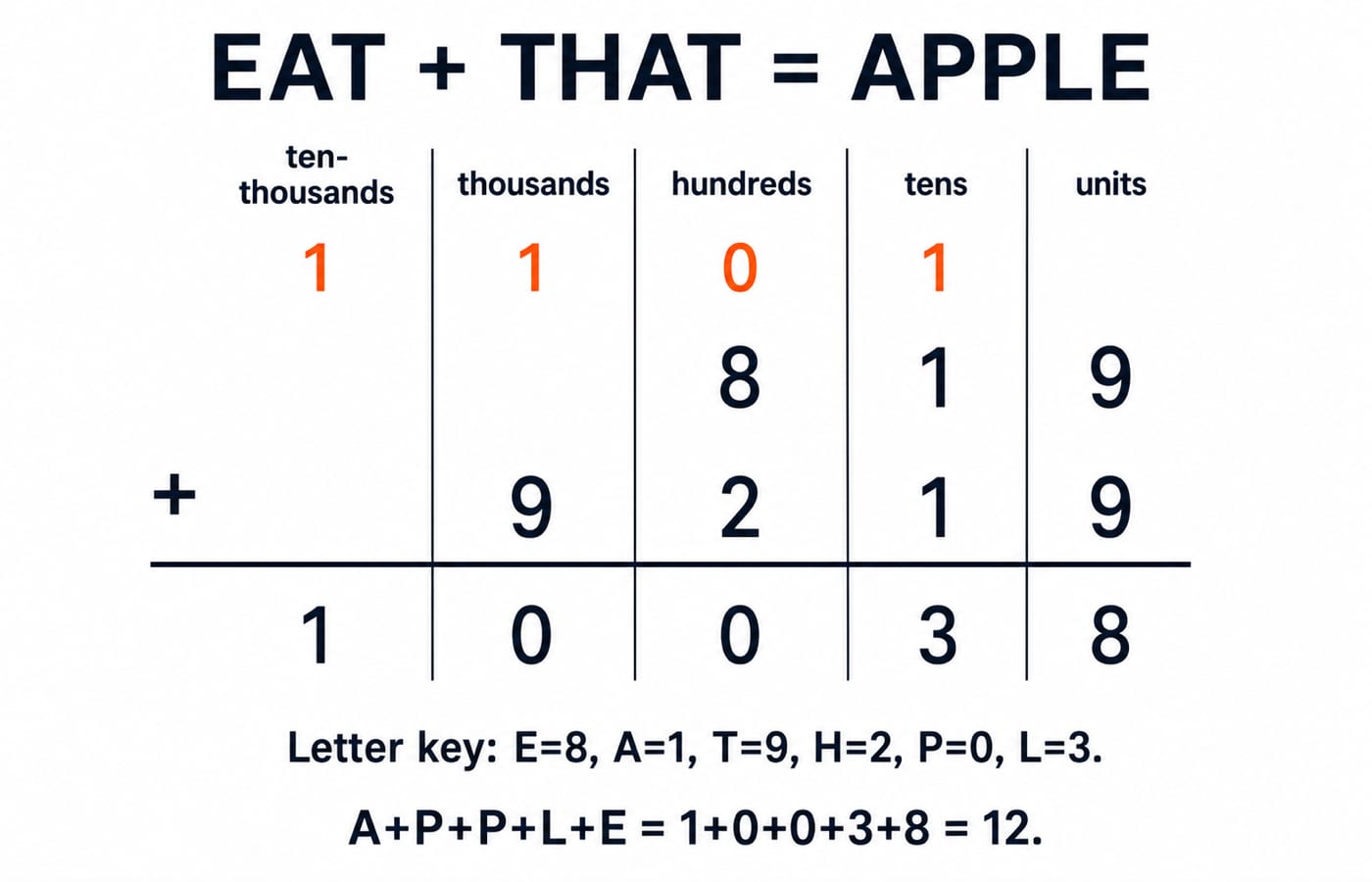
If “EAT + THAT = APPLE”, what is the sum of A+P+P+L+E?
(a) 13
(b) 14
(c) 12
(d) 15
The five-digit sum forces A = 1. Working right to left, the thousands column gives P = 0, T = 9, with a carry from hundreds. Units give 9 + 9 = 18, so E = 8 with carry 1. Tens give 1 + 1 + 1 = 3, so L = 3 with carry 0. Hundreds give 8 + H = 10, so H = 2. Check: 819 + 9,219 = 10,038, and A+P+P+L+E = 1+0+0+3+8 = 12. Answer: (c).
Question 11: factors of 2³² - 1 below 100
If x = 2³² − 1, then what is the sum of the factors of x that lie between 1 and 100?
Hint: 2^(2ⁿ) + 1 is prime for n = 1, 2, 3, 4.
(a) 314
(b) 176
(c) 143
(d) 431
Use 2³² - 1 = 3 × 5 × 17 × 257 × 65,537. Only 3, 5, and 17 can combine into products below 100. The factors strictly between 1 and 100 are 3, 5, 15, 17, 51, 85; their sum is 3 + 5 + 15 + 17 + 51 + 85 = 176. Answer: (b).
Question 12: minimum coins across three separate payments
Using only 2, 5, 10, 25 and 50 paise coins, what is the smallest number of coins required to pay exactly 78 paise, 69 paise and Rupees 1.01 to three different persons?
(a) 19
(b) 20
(c) 17
(d) 18
Minimise each separate payment. 78 = 50 + 10 + 10 + 2 + 2 + 2 + 2, using 7 coins. 69 = 50 + 10 + 5 + 2 + 2, using 5. 101 = 50 + 25 + 10 + 10 + 2 + 2 + 2, using 7. The odd totals require a 5- or 25-paise coin, while the final residuals 8, 4, and 6 force the shown 2-paise coins. Trying one fewer coin in each case cannot form the residual with the available denominations. Total: 7 + 5 + 7 = 19. Answer: (a).
Answer key and method map
Q1 (d) | Q2 (a) | Q3 (a) | Q4 (b) | Q5 (d) | Q6 (b) | Q7 (c) | Q8 (a) | Q9 (d) | Q10 (c) | Q11 (b) | Q12 (a)
Revise by method: Q1 relative speed; Q2 AP; Q3 recurrence; Q4 rate plus calendar; Q5 backward recurrence; Q6 conserved wear; Q7 congruence; Q8 linear estimation; Q9 and Q10 alphametics; Q11 factorisation; Q12 constrained minimisation.
Traps this set is designed to expose
Do not freeze the hour hand, extend the first commodity's formula beyond day 100, or halve forward when reversal is shorter. Count four working tyres before sharing wear across five. Replace a negative modular adjustment with its positive residue. State the linear assumption behind an estimate. Test whether an alphametic is unique instead of assuming it. Before taking a 25-paise coin, check whether its residual is constructible. For a broader placement-oriented map, use Aptitude for Placements: Section Topics and Weekly Plan.
Short revision route and next practice step
First, redo only the missed setups without options. Second, explain the invariant aloud. Third, repeat the full set after two days and require a substitution or independent check for every answer. Use the Aptitude for Placement course for structured placement practice, or the Aptitude for GATE course for GATE General Aptitude. Identify the setup that failed, repair that method, then attempt a new mixed set.
Keep learning
Basic Arithmetic Questions with Solutions: 12 Solved MCQs
Practise 12 arithmetic MCQs, inspect every worked step, and diagnose whether each miss came from order, scale, fraction base or translation.
Updated 20 Nov 20267 min readAptitude & Reasoning

Binary Arithmetic Operations MCQs: 12 Solved Questions with Step-by-Step Explanations
Practise 12 real exam MCQs on binary arithmetic with step-by-step solutions covering carry chains, complements, division, BCD, mixed bases and shifts.
Updated 12 Aug 20268 min read54 viewsDigital Electronics MCQs
Simplification Based Problems: 12 Solved Questions with Step-by-Step Solutions
Solve 12 simplification questions step by step, from nested signs and mixed fractions to continued fractions, approximation and structural shortcuts.
Updated 17 Nov 20266 min readAptitude & Reasoning
Polynomials and Algebraic Expressions Questions with Solutions: 12-MCQ Practice Set
Attempt these 12 questions before reading the worked solutions. Each one tests a specific algebra rule, helping you find which methods need revision.
Updated 16 Nov 20268 min readAptitude & Reasoning