Language and Semiotics for Teaching Exams: Signs, Meaning and Worked Examples
Connect the major models of signs and meaning, then apply them to language questions and a fully classified classroom display.
KnowledgeGate Team
Exam prep & CS education
Updated 26 Jul 20265 min read
Terms such as signifier, interpretant, icon, index, denotation and pragmatics are often memorised separately, so a changed example becomes confusing. One habit fixes most of it: classify a sign by the relation that makes it work, never by what it is made of. A kettle drawing, a thermometer reading and a printed sentence can sit on one classroom wall and still belong to three different sign types, for exactly that reason.
Language and semiotics: begin with the system, not the glossary
Language is a socially shared, rule-governed system of signs for making and exchanging meaning. Semiotics studies signs, sign systems and how something comes to stand for something else to an interpreter.
Four properties make this definition useful in questions:
Arbitrariness: the form-meaning link is conventional, held in place by the community rather than by nature.
Systematicity: meaning comes from contrast, so a word is defined partly by the words it is not.
Context-dependence: the same sentence can perform different acts depending on the situation.
Displacement: language refers beyond the here and now, to distant, past or imagined events.
Conventional does not mean random or individually invented. Social use stabilises the relation, which is why one speaker cannot rename tree overnight and still be understood.
Saussure's model: signifier, signified and relations within language
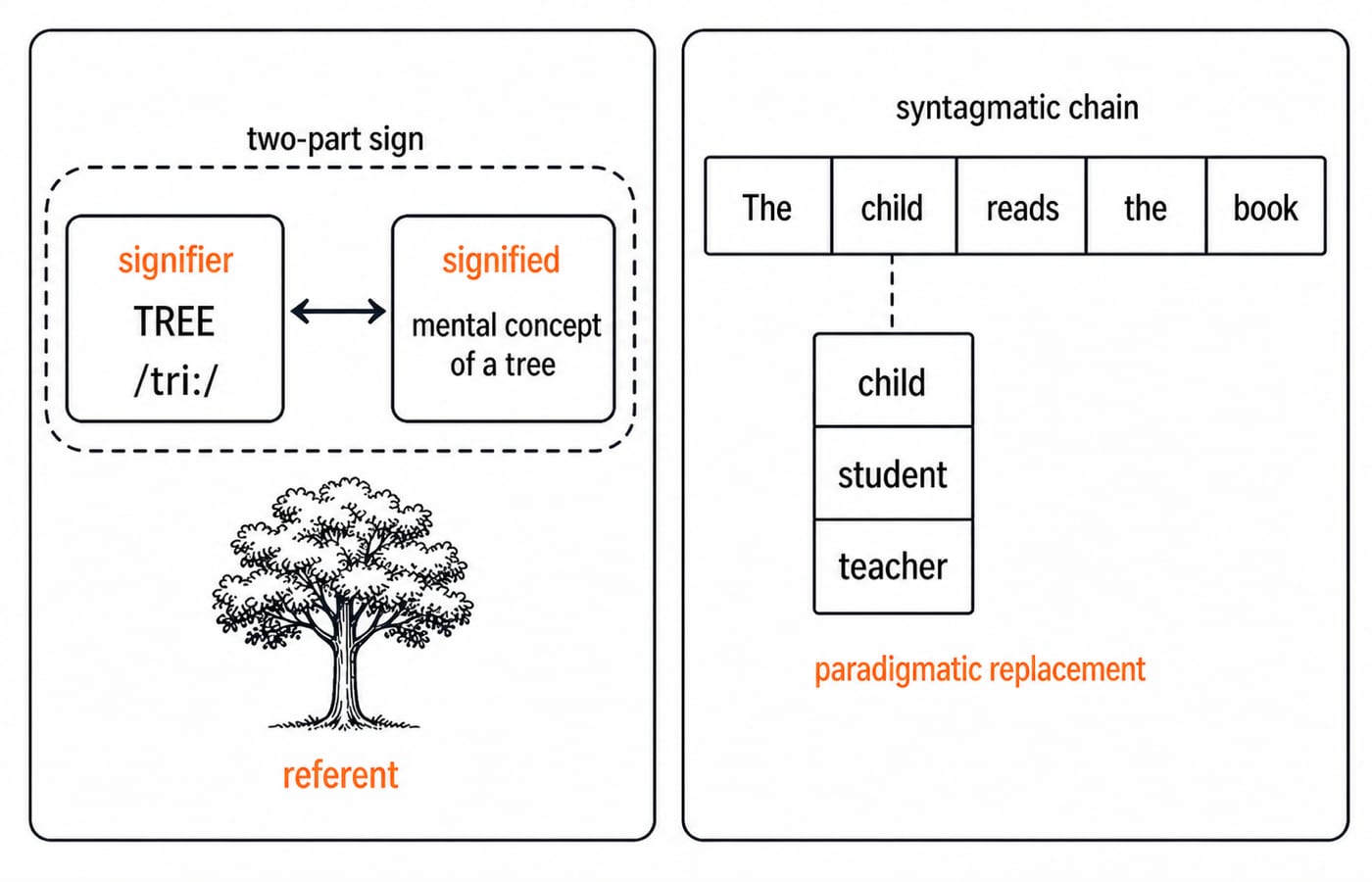
For Saussure, the linguistic sign has two parts. In TREE, the visible sequence T-R-E-E is the signifier, as is the sound pattern /triː/ in speech. The signified is the mental concept of a tree. A physical tree is the referent, not the signified.
The link is arbitrary in origin but stable through convention. English uses TREE, Hindi uses पेड़, and French uses arbre for a comparable concept. No natural rule forces one form, but speakers cannot replace it freely and remain understood.
Distinction | Meaning | Example |
|---|---|---|
| The shared system of rules and conventions | A community's grammar and vocabulary |
| An individual's use of that system | A learner's particular sentence |
Syntagmatic relation | How signs combine in a sequence |
|
Paradigmatic relation | A choice among possible signs for one position |
|
Peirce's model: representamen, object and interpretant
Peirce describes a three-part relation. The representamen is the form functioning as a sign, the object is what it refers to, and the interpretant is the meaning produced for an interpreter. Semiosis is this whole meaning-making process.
Signs can also be classified by their dominant relation:
Sign type | Dominant relation | Example |
|---|---|---|
Icon | Resemblance | A scale drawing of a classroom resembles the classroom |
Index | Physical or causal connection | Fresh footprints are connected to a person's passage |
Symbol | Learned convention | The written word |
Do not collapse the models. A signifier is not automatically identical to a representamen, and Peirce's object is not Saussure's signified. They divide related problems differently.
Denotation, connotation and context
Denotation is direct reference. White coat denotes a light-coloured garment, but in a hospital it can connote a doctor, clinical authority or scientific work. Connotations are culturally learned and context-sensitive.
In Can you open the window?, syntax identifies an interrogative form. Semantics gives the literal ability question. Pragmatics recognises the likely classroom act as a polite request.
Form alone does not decide function. The window is open may provide information or indirectly request that someone close it, depending on situation and tone. The same test runs on comprehension passages, where a line's literal sense and its intended force are scored as different things; CTET Language I & II: A Scoring Strategy drills that reading across full papers.
Semiotics worked example: classifying a classroom display
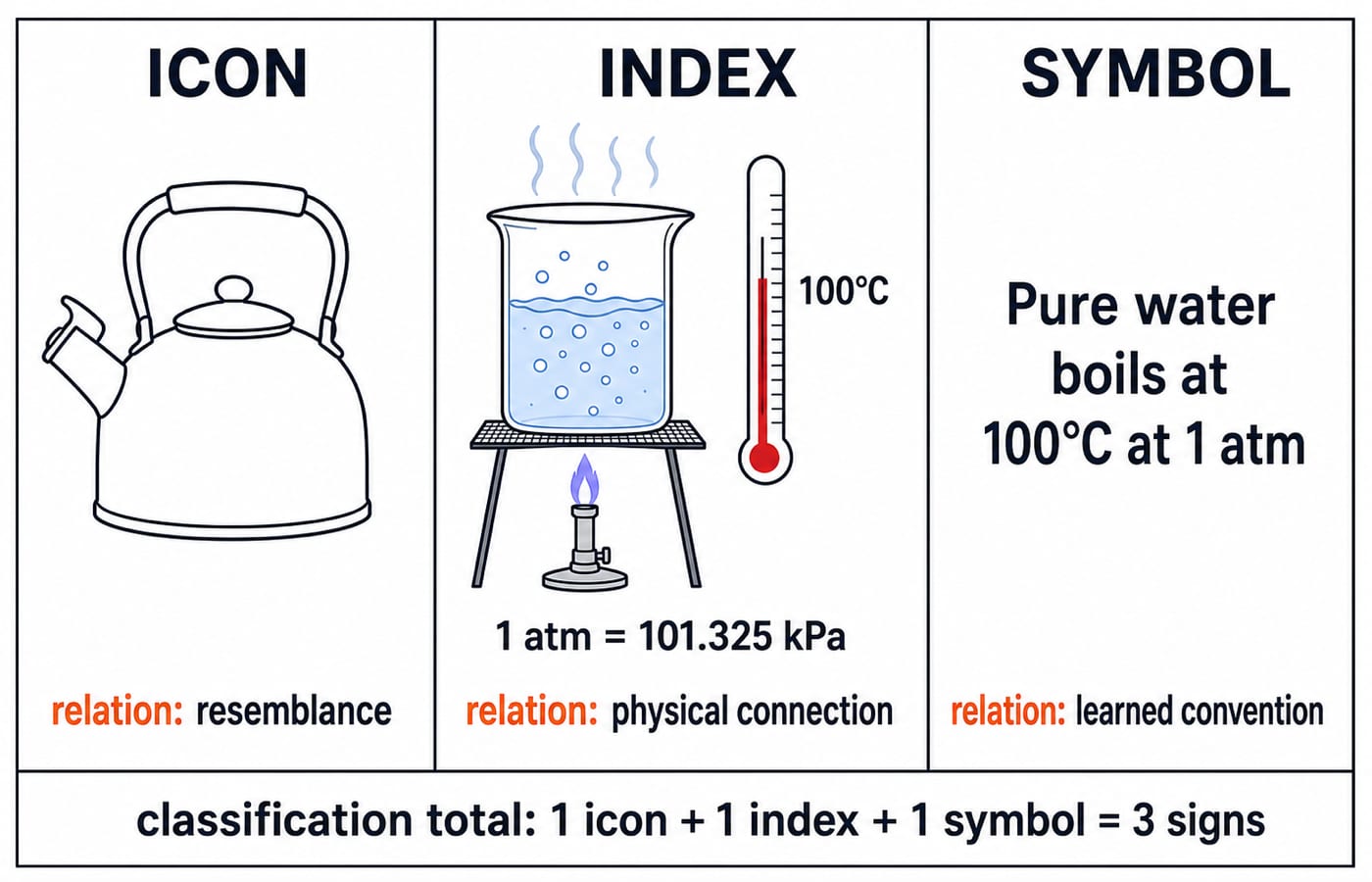
A teacher displays Pure water boils at 100°C at 1 atm, a kettle drawing, and a live thermometer at 100°C beside a heated beaker.
Classify each element of the display step by step:
Kettle drawing: It is an icon because resemblance carries the relation.
Live thermometer column: It is an index because temperature physically affects its position.
Written sentence: It is symbolic because its English words, numerals,
°Candatmrequire learned conventions.Printed token
100°C: The representamen is the visible token, the object is the represented temperature, and the interpretant is the learner's understanding of the stated boiling condition.
Three sign types are on that wall, one each: the drawing works by resemblance, the live column by physical connection, the sentence by convention. Step 4 does not add a fourth sign; it re-reads the same printed token at a finer grain, through Peirce's triad. Swap the live thermometer for a photograph of one and the classification flips to icon, because a picture resembles its subject while a rising column is caused by it.
Semiotics traps: signified, arbitrariness and medium confusion
Wrong idea: signified means physical object. In TREE, the signified is the mental concept; the physical tree is the referent.
Wrong idea: arbitrary means random on every use. TREE, पेड़ and arbre show that conventions differ, while each community stabilises its own use.
Wrong idea: the medium decides the sign type. Live smoke indexes fire causally, a smoke photograph is iconic through resemblance, and SMOKE is symbolic through convention. Ask, "What relation makes this sign work here?"
Also keep signifier separate from representamen, and semantics separate from pragmatics. For Can you open the window?, semantics gives the ability question; pragmatics identifies the likely request.
How teaching exams test language and semiotics
Questions built from these concepts commonly take four forms:
Match a theorist to a model.
Identify signifier versus signified in a new example.
Classify an icon, index or symbol by its working relation.
Distinguish literal meaning from contextual or pragmatic force.
Rapid check: a dark cloud used as evidence of coming rain is indexical through physical connection. Its photograph is iconic through resemblance. The printed word RAIN is symbolic through convention. The reasoning, not the noun, is the scoring rule.
NET aspirants can use UGC NET Paper 1 vs Paper 2 for the broader paper split. Teacher eligibility test aspirants can follow CTET & UPTET Teaching Eligibility Test Prep.
The short version and a 24-hour drill
Saussure asks how a linguistic sign joins signifier and signified.
Peirce asks how representamen, object and interpretant form a sign relation.
Icons resemble, indices connect, and symbols depend on convention.
Denotation is direct reference, while connotation is associated meaning.
Pragmatics explains meaning in use.
Within 24 hours, redraw both models once from memory. Then find nine signs around you, three that work by resemblance, three by physical connection and three by convention, and write one line each on why. Finish by explaining the three wrong ideas above without looking at your notes.
Choose the route matching the exam attempted. Use the NTA UGC NET Paper 1 Course for general Paper 1 communication context, or the CTET Paper 1 Course when the immediate route is CTET Paper 1.
Keep learning

ICT in Education MCQs: 12 Solved Questions on Digital Learning Tools
Solve 12 ICT in Education MCQs, then use clear explanations and a five-layer model to separate files, tools, platforms and public initiatives.
Updated 3 Oct 20268 min readUGC NET Computer Science

Requirements Elicitation Techniques and Use Case Development: Worked Library Example
Follow a fictional library reservation from interviews and observation through testable requirements, a UML use-case model, UC-07, and acceptance checks.
Updated 28 Sep 20266 min readUGC NET Computer Science

Quality Factors: McCall’s and ISO 9126 Models with a Worked Scoring Example
Build both quality models around one maintainability audit. This guide maps their vocabulary, calculates McCall-style and ISO-style scores, and ends with exam-focused checks.
Updated 25 Sep 20265 min readUGC NET Computer Science

Cohesion and Coupling MCQs: 10 Solved Questions on Functional Independence
Practise 10 solved MCQs on cohesion, coupling, functional independence, module dependencies, and the distinctions that make closely matched options easier to separate.
Updated 24 Sep 20267 min readUGC NET Computer Science