EMRS Computer Science: Tier 1 vs Tier 2, and how to split your prep
EMRS Computer Science recruitment explained: how Tier 1 and Tier 2 differ, what each stage tests, and how a CS graduate should divide prep between them.
KnowledgeGate Team
Exam prep & CS education
10 Jul 20265 min read
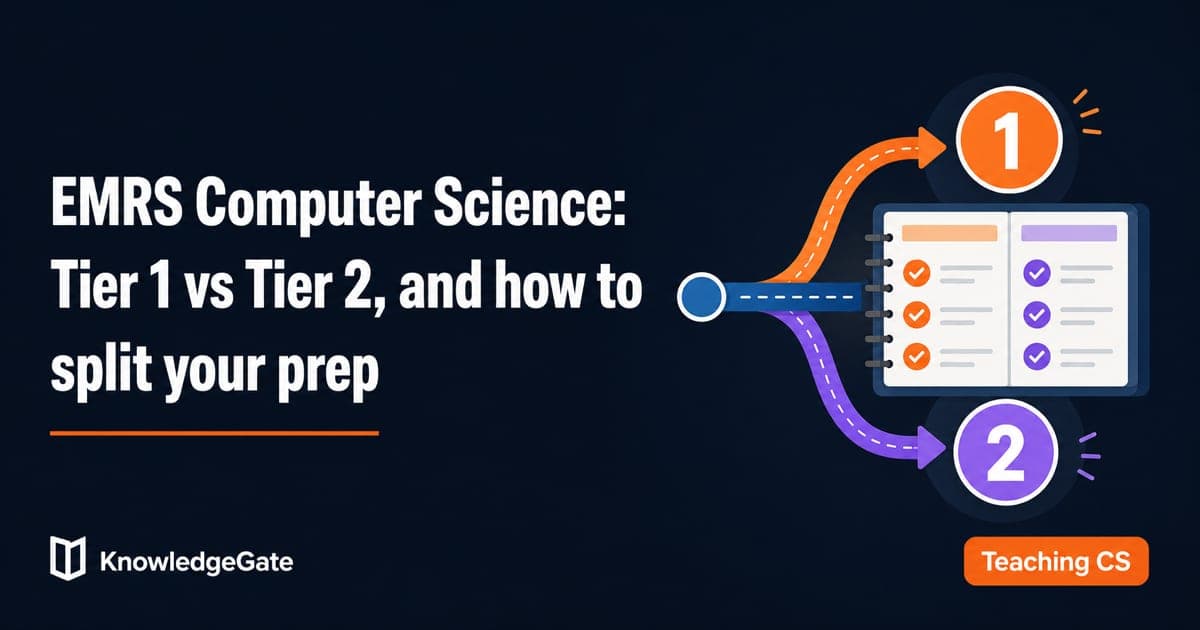
Eklavya Model Residential Schools (EMRS) recruit Computer Science teachers through a two-tier written selection, and the single most common planning error is treating both tiers as one undifferentiated pile of study. They are not. Tier 1 and Tier 2 test different things, and a Computer Science graduate who understands the split can spend their hours where they actually count.
NESTS, the National Education Society for Tribal Students under the Ministry of Tribal Affairs, runs this recruitment centrally as a single ESSE cycle, so one notification covers EMRS schools in every state. Those schools are residential and serve students from tribal communities: the child you teach a loop to in the morning period is the one you meet again in the evening study hour. Marks, question counts, durations, negative marking and eligibility are settled only by the current notification at nests.tribal.gov.in.
EMRS Computer Science: a two-tier selection
The two tiers differ on four things that change how you prepare:
Purpose: Tier 1 filters a wide field for broad readiness and pace, while Tier 2 separates the shortlisted on Computer Science command and its teaching.
Study focus: Tier 1 wants general awareness, reasoning, numerical ability and language; Tier 2 wants algorithms, programming, databases, networks, operating systems and CS pedagogy.
Practice method: Tier 1 rewards short timed sets and fast pattern recognition; Tier 2 rewards concept revision, worked problems, code tracing and explaining a topic aloud.
Elimination route: Tier 1 ends attempts through uneven speed or a neglected general section; Tier 2 ends them through shallow accuracy and weak classroom judgement.
Which tier merely qualifies you and which one carries into the merit is set cycle by cycle. Prepare as though both count: a qualifying paper you fail still ends the attempt.
EMRS Tier 1: the general and aptitude screen
Tier 1 typically leans on the general capabilities every teacher post screens for: general awareness, reasoning and mental ability, numerical ability, language and comprehension, and teaching aptitude.
Engineering study trains you to sit with one problem, test an idea in code, consult documentation, and reason from first principles. Those habits turn expensive on a fast general-aptitude screen, where a familiar question form has to trigger a method within seconds. Correct it by drilling timed mixed sets, learning standard shortcuts by heart, fixing a skip point, and reviewing which patterns cost you time.
So prepare Tier 1 for breadth and speed, not depth. Enough timed practice to clear the screen with margin, and not one hour more.
Tier 2: where Computer Science decides the seat
Tier 2 is where a CS graduate should be strongest. The subject names will look familiar from your degree. What changes is the depth Tier 2 asks for, and the fact that you have to be able to teach each one:
Programming and problem solving, as likely to hand you a short program to read as to ask you to write one.
Data structures and algorithms, at the level where you justify a complexity bound rather than quote it.
Database Management Systems: normalise an unfamiliar relation, then write the SQL for the same question.
Operating Systems, processes, scheduling, memory and deadlocks, worked as board examples.
Computer Networks, layered models and protocols, including the arithmetic of addressing and not the diagram alone.
Computer organisation and fundamentals, the block CS graduates revise last and school syllabi lean on first.
Alongside the subject comes the pedagogy of Computer Science: how a topic is sequenced, taught and assessed with a class in front of you. In a residential school that is less abstract than it sounds, because the teacher who explains recursion in the period is the one supervising the study hour where a student is still stuck on it.
The NESTS answer key for the ESSE 2025 Tier 2 paper was released for its MCQ part specifically, so do not assume the tier is entirely tick-the-box. Practise writing an explanation out in full, not only recognising the right option. Tier 2 is where the selection is really made, so it earns the deepest share of your time.
Our EMRS Computer Science bundle is organised around this subject core plus the teaching side, so both halves of Tier 2 live in one place.
EMRS Computer Science: how much of your week each tier gets
These are shares of your own study week, whatever its total hours. Run them from week one, not from the day Tier 1 results appear.
Tier 2 Computer Science depth, half your week, roughly five sessions in ten. In each one, revise a concept, solve two or three representative problems, trace the code or logic by hand, then explain it aloud as if teaching it.
Tier 1 aptitude and general awareness, a quarter of your week, worked as timed mixed sets under a fixed clock. Mark every question that ran long, and close with an accuracy and speed review instead of extending the timer.
Teaching aptitude and CS pedagogy, a tenth of your week, in short regular slots rather than one block. Tie objectives, common misconceptions and assessment to the technical topic you studied that day, so the two grow together.
Previous-year and practice questions, the remaining fifteen percent, at midweek and again at the end. Attempt them closed-book, label each wrong answer as a concept, recall, reading or timing error, and schedule the matching revision.
Some cycles add a further stage beyond the two written tiers, so anchor the plan to subject depth, which carries whatever the structure turns out to be.
Run both tiers in parallel from week one. Subject depth is built by repeated contact, recall and correction, and it compounds slowly. It cannot be assembled in the short gap between the two stages.
Because the EMRS subject core is the same CS-teaching base that DSSSB, KVS, NVS, RSSB, and state PGT and TGT posts test, one serious preparation base serves several exams. See how the exams line up in Teaching jobs for Computer Science graduates compared.
EMRS Computer Science: the short version
Tier 1 screens you on general and aptitude ground; Tier 2 decides the seat on Computer Science and how you teach it. Run the split every week: protect the subject-depth sessions, practise Tier 1 against the clock, and turn every wrong answer into scheduled revision.
Start from the EMRS Computer Science bundle, browse related posts on the EMRS teaching jobs category, and confirm every official number at nests.tribal.gov.in before you lock your calendar. Your Computer Science is already the strongest card you hold; the split decides whether it reaches the paper that counts.
Keep learning
Common Editing Ctrl Keys Explained: Copy, Cut, Paste, Undo and Redo with Worked Examples
Learn what each common Ctrl key does, then trace the document, clipboard, cursor and edit history through precise examples without confusing Copy, Cut or Undo.
Updated 11 Oct 20266 min readTeaching Recruitment (Computer Science)
Browsers and Search Engines MCQs: 9 Solved Questions with Explanations
Solve nine published browser and search engine questions, check each answer, and rebuild the browser, cache, crawler and indexing distinctions that exam distractors blur.
Updated 6 Oct 20267 min readTeaching Recruitment (Computer Science)
IT Act, 2000 Explained: Key Sections, Digital Signatures and Worked Exam Examples
Build an exam-ready map of the IT Act, then apply it to an exact digital-signature walkthrough and a section 43, 66, 66C and 66D caselet.
Updated 2 Oct 20266 min readTeaching Recruitment (Computer Science)
Emerging Trends Introduction MCQs: 12 Solved Questions with Explanations
Solve 12 Emerging Trends Introduction questions with clear answer logic, exam-year labels and a compact trap check for focused revision.
Updated 27 Sep 20268 min readTeaching Recruitment (Computer Science)