RSSB Basic vs Senior Computer Instructor: which post and how to prepare
RSSB Basic vs Senior Computer Instructor compared: who each Rajasthan post suits, how the two selections differ, and how to prepare the shared CS core once.
KnowledgeGate Team
Exam prep & CS education
10 Jul 20266 min read
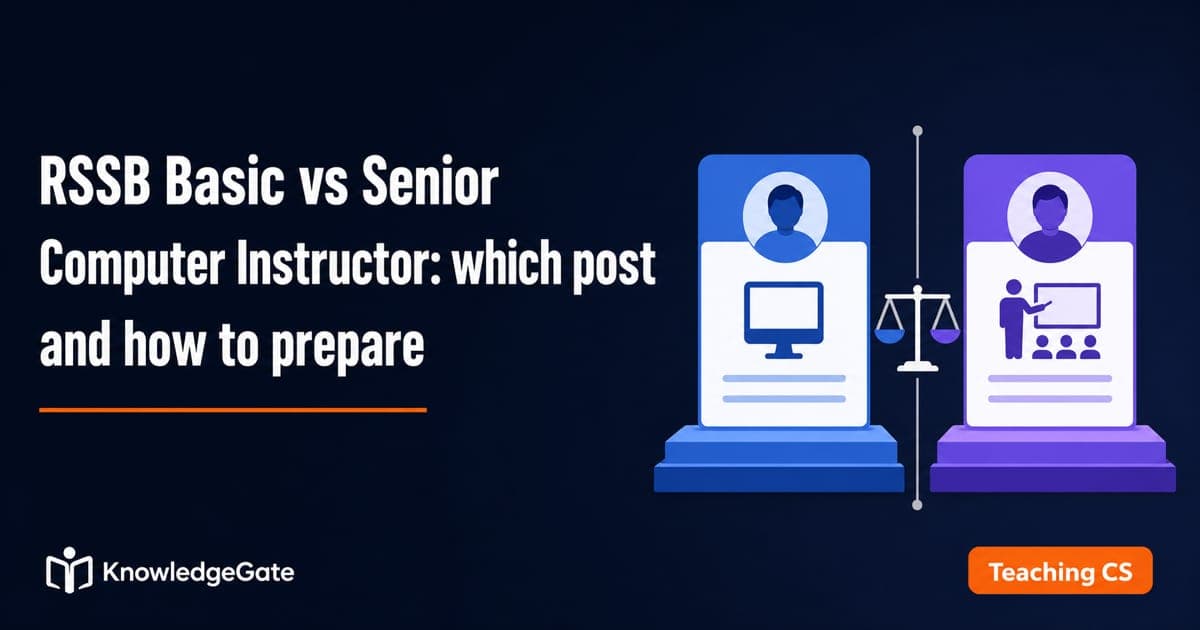
The Rajasthan Staff Selection Board (RSSB) recruits computer instructors at two levels, Basic Computer Instructor and Senior Computer Instructor, and applicants routinely apply to the wrong one, or prepare for both as if they were identical. They share a core, but they are distinct posts with distinct expectations, and choosing well is half the battle.
The short answer is that the two overlap far more than they differ, and the difference that matters sits in one place. Both selections run on a general Paper 1 and a Computer Science Paper 2, and Paper 1 is effectively common ground. What changes between Basic and Senior is how far Paper 2 reaches and how deep it goes. Eligibility, marks, question counts, durations and vacancies are set post by post in the current notification at rssb.rajasthan.gov.in, and they can change between cycles.
RSSB Basic vs Senior Computer Instructor: what actually differs
Both posts are Rajasthan computer-instructor roles filled through a written examination, and both are prepared the same way up to a point. Paper 1 is the general half: mental ability, logical reasoning and analytical ability, basic numeracy, data interpretation, decision making, general science and general awareness. That list does not change between Basic and Senior, and neither does most of Paper 2.
Our two courses are built to the two syllabi, and set side by side the divergence is a short list. It is worth knowing before you pick a post.
Shared across both subject papers. Digital logic, computer organisation, operating systems, databases, data structures, C, object-oriented programming in C++ and Java, Python, data communication and network security, emerging trends and AI, and pedagogy. That is the bulk of Paper 2 either way.
Carried on the Basic side. System analysis and design, and data processing in MS Office, alongside a substantial internet and web technologies block.
Carried on the Senior side. Algorithms as a subject in its own right, separate from data structures, plus software engineering, a formal computer-fundamentals block, and web development where Basic carries internet and web technologies.
Read that as a difference of pitch rather than of syllabus. Basic sits at the applied, tools-and-systems end of Computer Science and asks you to operate and explain; Senior sits at the design-and-engineering end and asks you to design and analyse. Underneath both, it is the same material at two altitudes.
Which RSSB post suits you: a four-step check
Match the post to your qualifications and your genuine subject depth, not to whichever notification opens first. Open both official notices side by side and work down this order.
Eligibility. Copy each post's qualification wording exactly, then check its recognition, equivalence, age and category conditions against your own documents. Eliminate any post with an unmet or unsupported requirement; this is a hard filter.
Syllabus match. Mark each listed topic green, amber or red for your current command, then compare the relearning each needs. Weight the topics only one post carries: system analysis and design and web technologies on the Basic side, algorithms and software engineering on the Senior side. If both survive eligibility, this is your first tie breaker.
Selection and service terms. Compare the stated marking rules, merit calculation, duties, pay level and posting conditions against your priorities. Another tie breaker, never a substitute for eligibility.
Depth self-test. Answer the three questions in the next paragraph unaided, and read the tally only after eligibility has settled. A tie breaker.
Answer honestly. Can you normalise an unfamiliar relation to 3NF, justify each step and write the matching SQL? Can you trace an algorithm and justify its time complexity? Can you explain processes, scheduling, memory and deadlocks, or trace addressing through the network layers?
All three yes supports Senior, where algorithm design and software engineering are examined in their own right. One or two yes, with fundamentals strongest, points to Basic. None means build the base before committing to either. Eligibility still decides first; the self-test only breaks a tie.
RSSB Paper 2: the Computer Science core both posts share
Build that shared core in this order; each block leans on the one above it.
Programming, starting in C. Both papers assume you can read and write C before they ask anything about C++, Java or Python. If the programming is shaky, nothing stacked on it holds.
Data structures, then their cost. Standard operations and when each structure is the right choice. Senior asks the same material again as algorithm design and complexity.
Databases as far as SQL you can write. The relational model, normalisation, and queries you can compose from a requirement rather than merely recognise in an option.
Operating systems and networks. Processes, scheduling, memory and deadlocks; layered models, protocols and addressing. Both syllabi lean on these two heavily.
Digital logic and computer organisation. The hardware layer both papers keep returning to, and the one software-minded candidates leave last.
Pedagogy, from the start. Both of these are teaching posts, and both syllabi carry a pedagogy block. Treat it as a subject with its own revision, not a formality.
Because the core overlaps so heavily, you build the foundation once and then push depth for the Senior post. You are not studying two syllabi. You are studying one and scaling it.
We run a dedicated course for each level, the RSSB Basic Computer Instructor course and the RSSB Senior Computer Instructor course, so you can pitch your preparation at the right level rather than guessing.
RSSB Paper 1: the general portion CS candidates underrate
Paper 1 is where a Computer Science candidate is most likely to lose a seat they should have won. It asks for general awareness and general science, reasoning and mental ability, numerical ability and data interpretation, and decision making, and none of it rewards subject depth. It is also common ground, so whatever you build here counts for both posts.
The trap is familiar. You trust your subject strength and never practise reasoning and arithmetic under time pressure, then you walk in against candidates who drilled them for months. Treat Paper 1 as a real scoring section with a fixed weekly slot from week one. Reasoning turns into quick marks for a trained CS mind, which is why leaving it late costs so much.
How to prepare for one RSSB post or both
A practical approach for a candidate keeping both options open:
Build the shared base first, in the order above. It serves both posts and is where most subject marks live.
Give Paper 1 a steady, timed weekly slot. Short mixed sets under a clock, from the first week rather than the last month.
Then add the level-specific block. For Senior, algorithms as a subject and software engineering. For Basic, system analysis and design, MS Office data processing, and internet and web technologies.
Solve previous-year papers early, one from each post. Both courses carry a previous-year set and full mock tests for each paper, and nothing calibrates a post's level and style faster than its own paper.
If you would rather prepare both levels together, the RSSB Basic and Senior Computer Instructor bundle keeps both in one place, so the shared base is built once and the extra Senior depth sits on top of it.
This computer-teaching core turns up again in DSSSB, KVS, NVS, EMRS and the state PGT and TGT papers, so the base you build for RSSB is rarely wasted if you widen your search. Teaching jobs for Computer Science graduates compared sets those exams next to each other.
RSSB Basic vs Senior: the short version
Basic and Senior Computer Instructor are two RSSB posts on one selection shape: a common general Paper 1, and a Computer Science Paper 2 that shares most of its syllabus. Basic reaches into system analysis and design, MS Office data processing and web technologies; Senior reaches into algorithms, software engineering and web development, and asks for more depth across everything the two share. Decide on eligibility first and honest subject depth second, build the shared base once, then add the level-specific layer.
Browse related Rajasthan posts on the RSSB teaching jobs category, then confirm your eligibility and the pattern for your chosen post at rssb.rajasthan.gov.in before you apply.
Keep learning
Common Editing Ctrl Keys Explained: Copy, Cut, Paste, Undo and Redo with Worked Examples
Learn what each common Ctrl key does, then trace the document, clipboard, cursor and edit history through precise examples without confusing Copy, Cut or Undo.
Updated 11 Oct 20266 min readTeaching Recruitment (Computer Science)
Browsers and Search Engines MCQs: 9 Solved Questions with Explanations
Solve nine published browser and search engine questions, check each answer, and rebuild the browser, cache, crawler and indexing distinctions that exam distractors blur.
Updated 6 Oct 20267 min readTeaching Recruitment (Computer Science)
IT Act, 2000 Explained: Key Sections, Digital Signatures and Worked Exam Examples
Build an exam-ready map of the IT Act, then apply it to an exact digital-signature walkthrough and a section 43, 66, 66C and 66D caselet.
Updated 2 Oct 20266 min readTeaching Recruitment (Computer Science)
Emerging Trends Introduction MCQs: 12 Solved Questions with Explanations
Solve 12 Emerging Trends Introduction questions with clear answer logic, exam-year labels and a compact trap check for focused revision.
Updated 27 Sep 20268 min readTeaching Recruitment (Computer Science)