

E-Governance Concepts and Models Explained: G2C, G2B, G2G, G2E and a Worked Service Example
Separate e-governance relationship models from information-flow models and maturity stages, then test the ideas with a step-by-step scholarship portal calculation.
KnowledgeGate Team
Exam prep & CS education
Updated 7 Nov 20265 min read

An online government page, a payment portal and a fully integrated public service may all carry the e-governance label, but they are not equivalent. The actors differ, as do the ways information creates value and the stage of service maturity. In the scholarship example, actor relationships, information flow and maturity stage combine in one measurable service. Every number in that example is a hypothetical teaching value, not a statistic from any government scheme.
E-Governance: Meaning, Scope and the Boundaries of the Term
E-governance is the use of digital systems and information flows to support public services, administration, coordination, participation, transparency and accountability. Technology is the means. The governance outcome is the test.
Many study sources use e-government more narrowly for digitised administration and service delivery. They use e-governance for the wider relationships among government, citizens, businesses and employees. This is a useful exam distinction, but not every authority uses the two terms identically.
Also separate digitisation from process redesign. Converting a paper form into a downloadable PDF creates digital access. Redesign begins when the service removes duplicate checks, joins departments or gives the applicant one traceable workflow. A PDF alone is not an integrated service. Place this concept within the broader UGC NET Computer Science syllabus areas rather than memorising its labels in isolation.
The Four Relationship Models: G2C, G2B, G2G and G2E
Use one rule: identify the government endpoint, then identify the actor at the other end of the interaction.
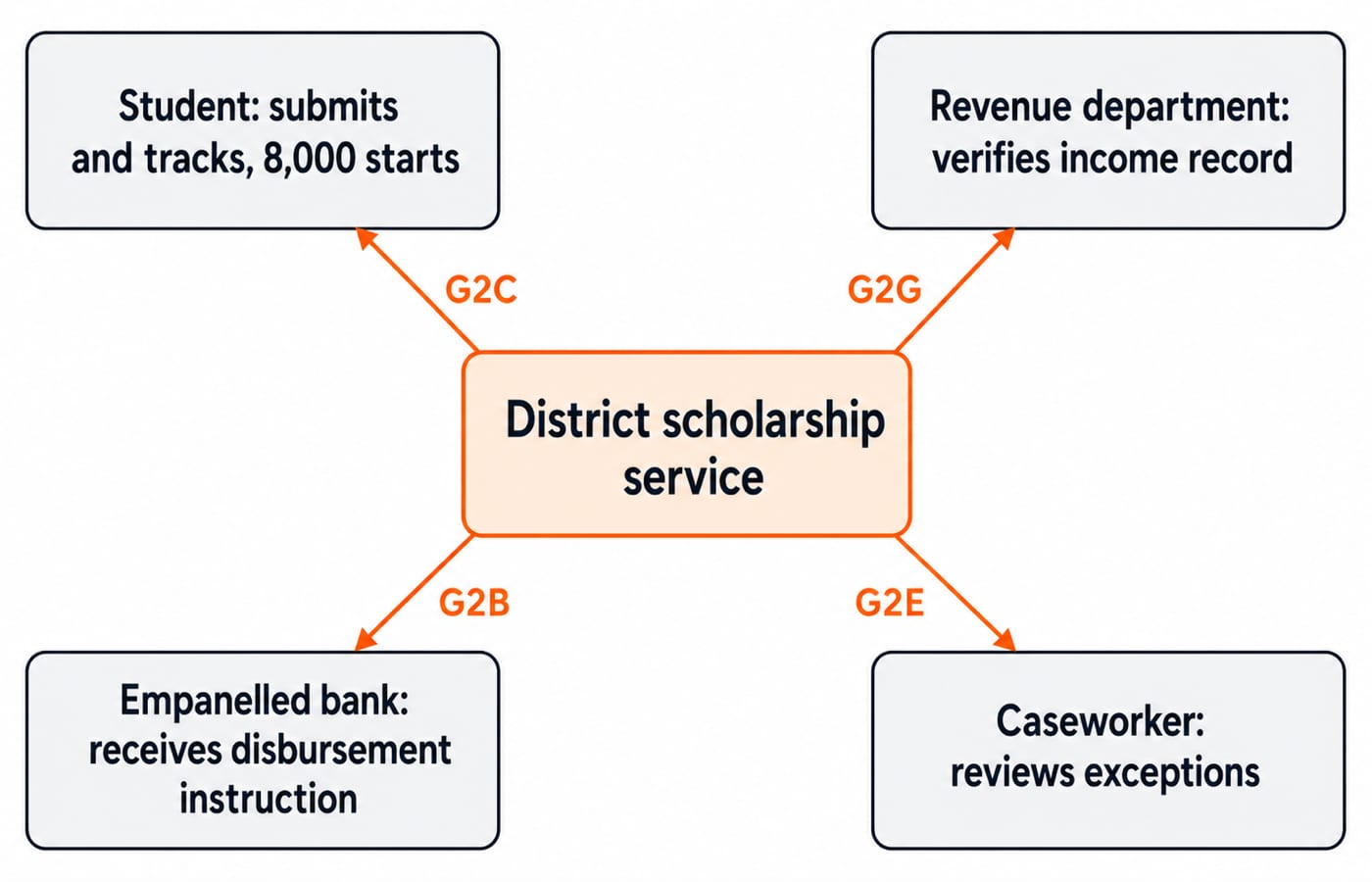
G2C, government to citizen: a student submits and tracks a scholarship application.
G2B, government to business: an empanelled bank receives an authorised disbursement instruction.
G2G, government to government: the education department requests an income record from the revenue department.
G2E, government to employee: a caseworker uses an internal dashboard to review exceptions.
One service can contain all four relationships. Therefore, do not classify the entire scholarship portal once and assume the answer applies to every step. Classify the specific edge named in the question. The student's status check is G2C even though an earlier verification was G2G. Likewise, the caseworker's review remains G2E even when its result later triggers a G2B instruction to the bank.
The label describes the relationship, not ownership of every system involved. An empanelled private bank in a public workflow still forms the business endpoint.
Do Not Mix Up Information-Flow Models and Service-Maturity Stages
Information-flow models are conceptual lenses for how information or participation creates public value. Wider dissemination publishes eligibility rules broadly. Critical-flow sends important information, such as rejection reasons, to the affected applicants. Comparative analysis places comparable district completion rates side by side. E-advocacy or mobilisation gathers and organises accessibility feedback. Interactive-service creates a two-way loop, such as an appeal with a trackable response.
Service maturity answers a different question. At the information stage, a student reads eligibility rules. At interaction, the student asks a question or downloads a form. At transaction, the student submits the application online. At integration or transformation, departments verify data and return status through one joined workflow.
Keep three prompts separate: G2C, G2B, G2G and G2E answer between whom? Information-flow models answer how does information or participation create value? Maturity stages answer how complete and integrated is the digital service? A portal can be G2C and still remain informational because it only publishes rules.
All three classifications can describe the same portal at the same time.
Worked Example: Measure a Scholarship Portal Without Confusing Activity with Outcome
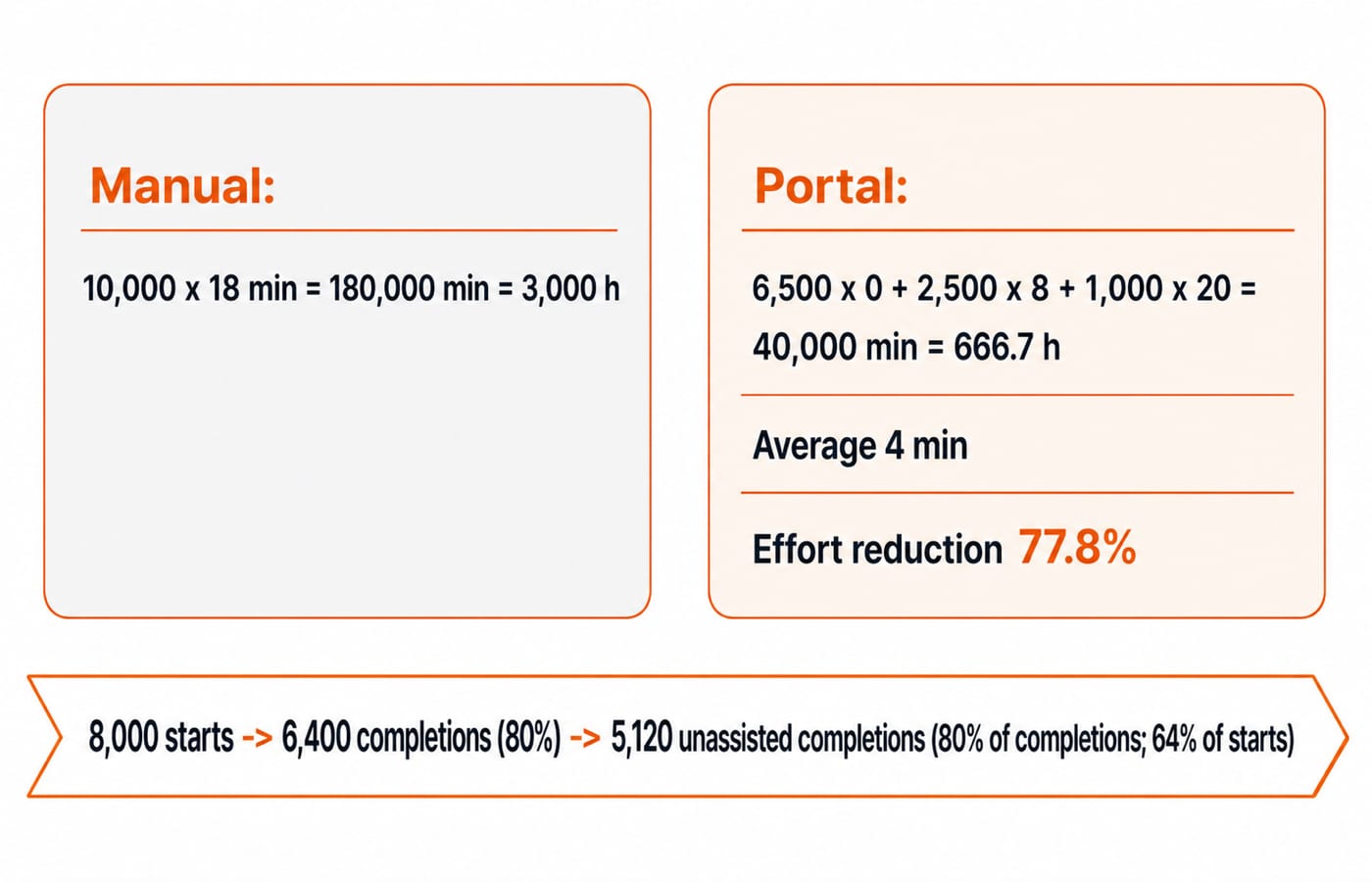
A district receives 10,000 hypothetical applications. Manual intake takes 18 staff-minutes per application:
10,000 x 18 = 180,000 staff-minutes
Convert minutes to hours:
180,000 / 60 = 3,000 staff-hours
Under the redesigned portal, the applications follow three intake routes:
Route | Applications | Staff-minutes each | Total staff-minutes |
|---|---|---|---|
Clean, automated checks | 6,500 (65%) | 0 | 0 |
Standard review | 2,500 (25%) | 8 | 20,000 |
Exception review | 1,000 (10%) | 20 | 20,000 |
The portal therefore needs 0 + 20,000 + 20,000 = 40,000 staff-minutes, which is 40,000 / 60 = 666.7 staff-hours, rounded to one decimal place. Average effort is 40,000 / 10,000 = 4 minutes per application.
The effort reduction is:
(180,000 - 40,000) / 180,000 x 100 = 77.8%
Now examine the citizen-side funnel. Of 8,000 people who start the digital form, 6,400 submit it. Completion is 6,400 / 8,000 x 100 = 80%. Of those 6,400 completions, 5,120 finish without an assisted visit. Unassisted completion is 5,120 / 6,400 x 100 = 80% of completions. Measured against all starts, it is 5,120 / 8,000 x 100 = 64% of starts. Both statements are correct only because their denominators are named.
Lower staff time indicates process efficiency. It does not prove fairness, security or successful benefit delivery. An efficient-looking service may still exclude people who lack access or concentrate data unsafely.
Security, Privacy, Inclusion and Accountability Are Part of the Model
Test the service with four questions. Is each item of data collected for a stated purpose? Is access limited by role? Can an applicant see status and correct an error? Is there an assisted or offline path for someone who cannot complete the digital flow alone?
Controls should attach to actual workflow points. Encrypt the application and the interdepartmental verification exchange. Log caseworker access and require stronger authentication for staff actions. Keep ordinary review separate from exception approval, retain only necessary records, and provide a traceable grievance or appeal route. These controls matter because faster processing cannot compensate for unsafe handling, invisible decisions or exclusion. Any current legal requirement, scheme rule or deadline must be checked against the relevant authority's current official notification or policy before it is used.
Common Traps and How to Eliminate Them
Classifying the whole portal once: classify the exact interaction. This workflow contains G2C, G2G, G2B and G2E.
Treating a relationship model as a maturity level: ask “between whom?” for G2X and “how complete?” for maturity.
Calling any website transformational: look for an end-to-end transaction and cross-department integration, not merely online information.
Equating registrations with success: distinguish starts, submitted applications, unassisted completion, processing effort, error correction and the final service outcome.
Assuming efficiency proves good governance: assess privacy, security, accessibility, explainability and appeal separately.
The quickest correction is to name the object being measured before choosing a label or formula. An actor pair, an information flow, a service stage and a performance metric belong to four different analytical layers.
How Objective Exams Test the Topic, Then the Short Version
Common questions match G2X labels to scenarios, arrange maturity stages, distinguish wider dissemination from critical-flow, select the correct denominator for a completion rate, or identify why a portal is interactive but not integrated.
Remember:
Relationship model equals actor pair.
Information-flow model equals the public-value route.
Maturity stage equals digital depth.
Metric equals named numerator over named denominator.
Good governance equals service performance plus safeguards and accountability.
Revise the wider subject through the UGC NET Computer Science category and the NTA UGC NET Paper 2 course. After concept revision, use the Paper 2 test series as a practice route. Use high-yield UGC NET Computer Science topics to choose the next area, not as a claim about a fixed paper pattern.
Go deeper with the full courseUGC NET Computer Science (Paper 1 + Paper 2)
Keep learning

e-Governance Portals Explained: Service Models, Workflow and Worked Metrics
Learn how portals fit within e-governance, classify G2C, G2B, G2G and G2E interactions, trace a certificate workflow and calculate service metrics.
Updated 30 Oct 20266 min readTeaching Recruitment (Computer Science)
Digital India and e-Governance: Models, Service Architecture and Worked ICT Examples
See how an e-governance service works from request to decision. Follow a fictional application, calculate workload and uptime, and test its controls.
Updated 23 Aug 20265 min readDigital Logic

Cloud Computing Explained: Service Models, Worked Calculations and Exam Traps
Build a clean cloud-computing concept map, classify common scenarios, and solve VM-hour, availability and replicated-storage calculations step by step.
Updated 26 Oct 20265 min readUGC NET Computer Science

SaaS vs PaaS vs IaaS: Cloud Service Models with Worked Examples
Learn to classify SaaS, PaaS and IaaS by the lowest layer a customer operates. Then apply the same boundary to responsibility and capacity calculations.
Updated 3 Nov 20265 min readComputer Networks