

SaaS vs PaaS vs IaaS: Cloud Service Models with Worked Examples
Learn to classify SaaS, PaaS and IaaS by the lowest layer a customer operates. Then apply the same boundary to responsibility and capacity calculations.
KnowledgeGate Team
Exam prep & CS education
Updated 3 Nov 20265 min read

You may remember that SaaS means software as a service, then misclassify a scenario as soon as it mentions virtual machines, source code, browser access and auto-scaling together. The deciding idea is simple: SaaS, PaaS and IaaS describe a responsibility boundary, not merely whether software is online. Classify each scenario by the lowest technical layer the customer operates. For numerical questions, calculate only from the supplied responsibility matrix or capacity values; features such as auto-scaling do not set the service model.
SaaS, PaaS and IaaS are responsibility boundaries
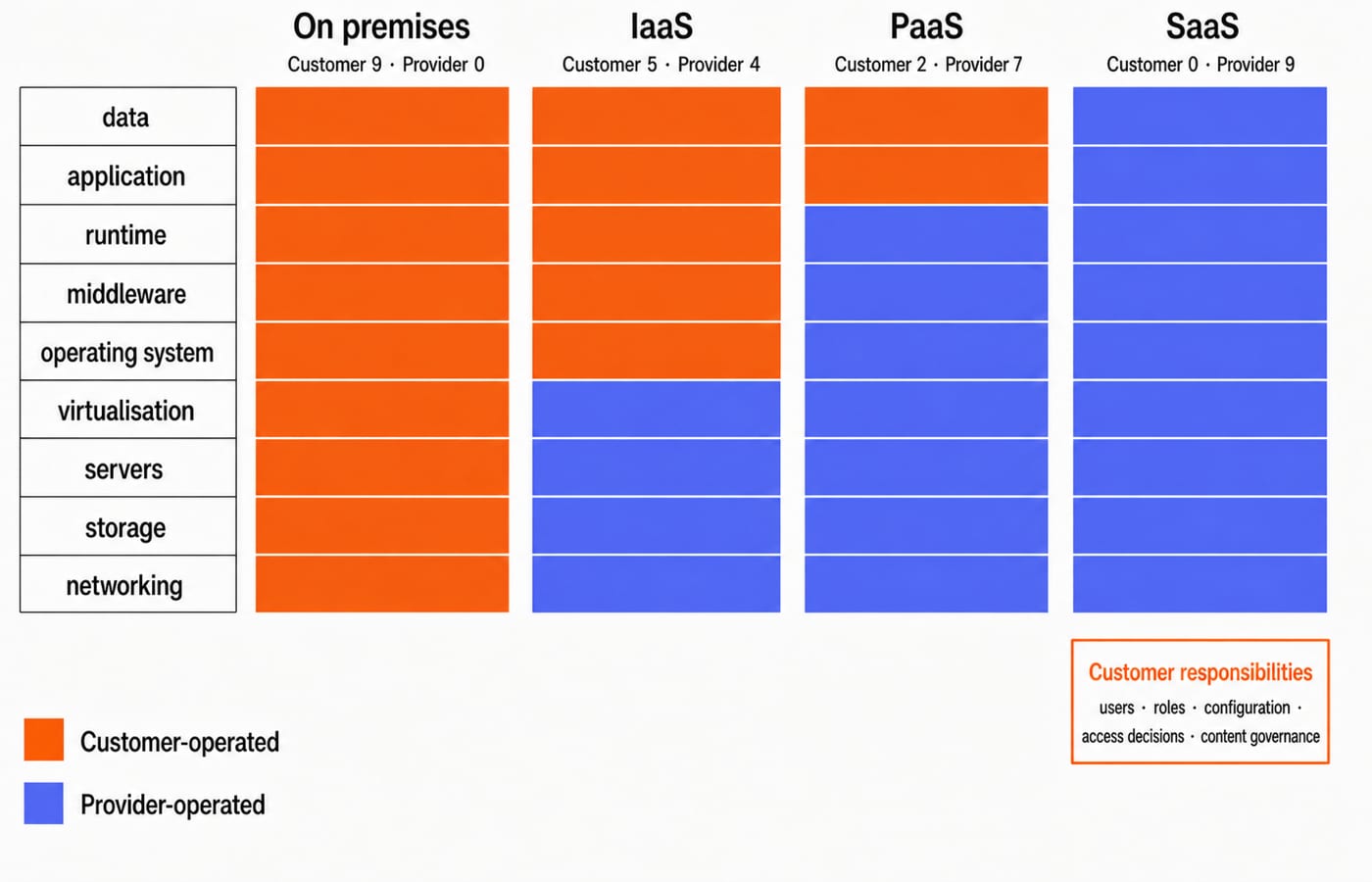
A cloud service model divides technical operation between a provider and a customer. Use this bottom-to-top teaching stack: networking, storage, servers, virtualisation, operating system, middleware, runtime, application and data. A real contract may divide duties more finely.
Responsibility view | Provider operates | Customer operates |
|---|---|---|
On premises | None of the nine layers | All nine layers |
IaaS | Networking, storage, servers, virtualisation | Operating system, middleware, runtime, application, data |
PaaS | Networking through runtime | Application, data |
SaaS | The delivered technical stack | No technical-stack layer in this simplified count |
For SaaS, zero customer-operated technical layers does not mean zero responsibility. The customer still controls users, roles, configuration, access decisions, input quality, lawful data use and content governance. Provider operation does not transfer content ownership or governance.
Recognise each cloud service model from what the customer receives
Model | Customer receives | Provider operates | Customer operates | Fast recognition cue |
|---|---|---|---|---|
IaaS | Virtualised compute, storage and networking | Infrastructure through virtualisation | OS, software above it and data | Customer gets VM or infrastructure-level control |
PaaS | A managed environment for deploying code | Infrastructure, OS, middleware and runtime | Application code and data | Code deployment without OS administration |
SaaS | A complete provider-run application | Delivered technical stack | Accounts, permissions, settings and content | Deliverable is the working application |
A root-access VM where a team installs Linux is IaaS. A managed platform accepting source is PaaS. Hosted email used as delivered is SaaS. Browser access proves nothing because IaaS consoles and PaaS dashboards also use it.
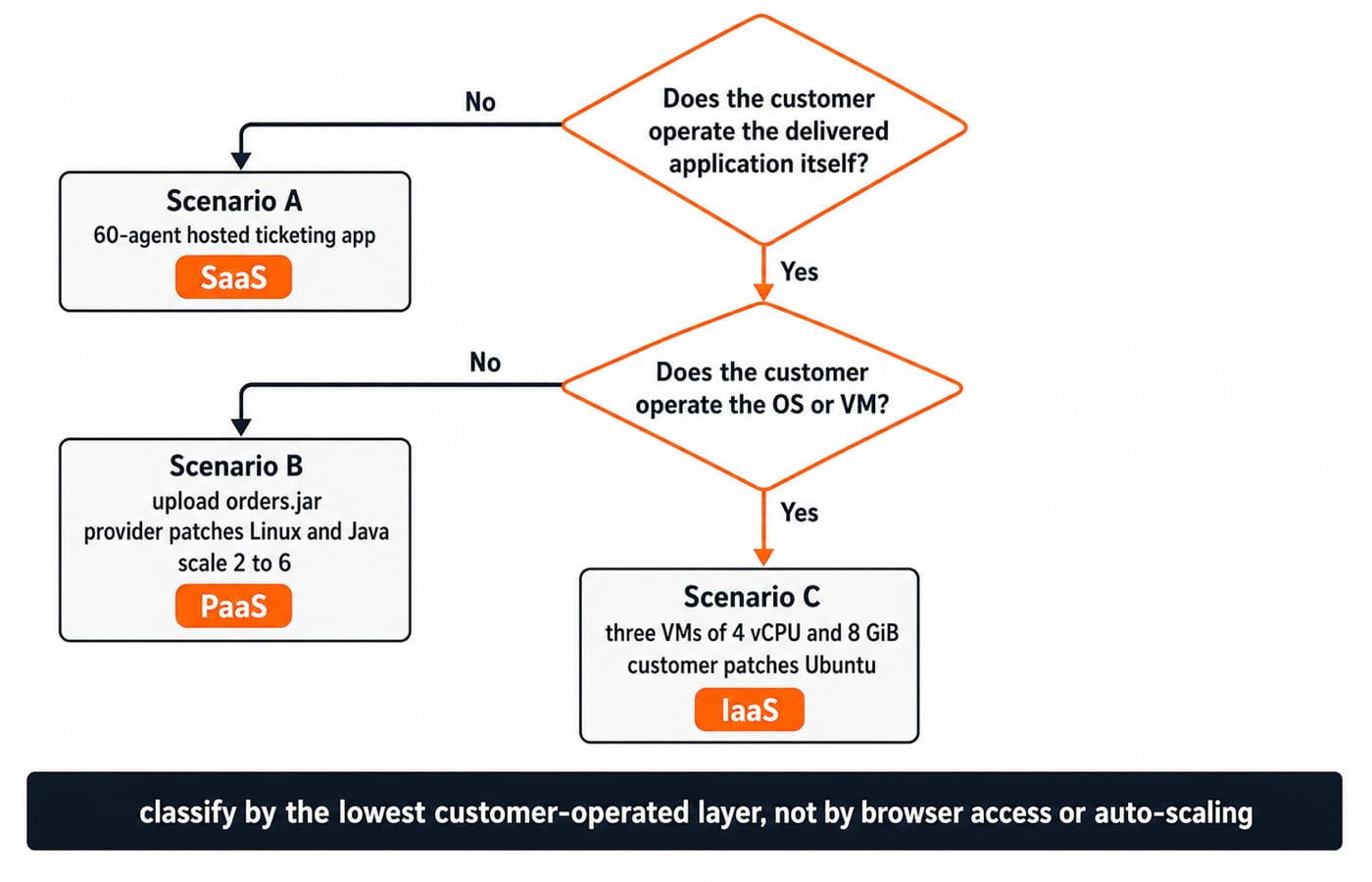
Worked classification: find the lowest layer the customer operates
Use this three-step method:
Ignore labels such as cloud, managed and online.
Underline the lowest technical layer the customer must operate.
Match that boundary to the nine-layer table.
Starting at the OS means IaaS. Starting at application code and data means PaaS. Only using and configuring a delivered application means SaaS.
Scenario A: A 60-agent team uses a hosted ticketing application. The vendor updates the application and patches the OS. The team creates users, assigns roles and enters tickets. It configures and supplies content rather than operating the application, so this is SaaS. The number 60 is irrelevant.
Scenario B: Developers upload orders.jar, set an environment variable and select an auto-scaling range of 2 to 6. The provider patches Linux, Java and the application server. The customer operates code and data, not runtime or OS, so this is PaaS. Auto-scaling is not decisive.
Scenario C: Administrators receive three VMs, each with 4 vCPU and 8 GiB RAM. They install and patch Ubuntu, configure the runtime and deploy the application. The OS is their lowest operated layer, so this is IaaS. The provider operates virtualisation below it.
Worked responsibility count: calculate only from the given stack
In the nine-layer stack, an IaaS customer operates five layers: OS, middleware, runtime, application and data. PaaS leaves two: application and data. SaaS leaves zero technical-stack layers, but retains the non-stack duties already listed.
Moving from IaaS to PaaS gives:
Customer-operated layers removed
= 5 - 2 = 3Fraction removed
= 3/5Percentage removed
= (3/5) x 100 = 60%
The answer is 60% of the customer-operated layers in this constructed nine-layer model. It is not 60% less work, lower cost or higher productivity.
If the customer must also manage middleware, its count becomes three. The reduction is (5 - 3)/5 x 100 = 2/5 x 100 = 40%. The changed matrix changes the result, so never memorise a universal percentage.
Worked capacity example: model and sizing are separate questions
In Scenario C, each VM has 4 vCPU and 8 GiB RAM. Reserve 1 vCPU and 2 GiB for support processes. Each worker needs 1 vCPU and 1.5 GiB.
CPU capacity
= floor((4 - 1)/1) = floor(3) = 3workers.Memory capacity
= floor((8 - 2)/1.5) = floor(6/1.5) = floor(4) = 4workers.The lower value wins, so CPU is the bottleneck and one VM supports 3 workers.
For eight workers, required VMs = ceil(8/3) = 3. Two VMs give 2 x 3 = 6 slots, while three give 3 x 3 = 9, so three is the minimum. Provider specifications may use different capacities and reservations.
In Scenario B, suppose one instance handles 120 requests per second, forecast demand is 410, and the sizing rule requires capacity 25% above that forecast.
Target capacity
= 410 x 1.25 = 512.5requests per second.Required instances
= ceil(512.5/120) = ceil(4.2708...) = 5.Five lies within the configured range of 2 to 6 instances.
It remains PaaS because the provider operates the OS and runtime. Capacity, tenancy, elasticity and service model are separate properties. Sizing identifies no model without an operational boundary.
Common SaaS, PaaS and IaaS traps
Reject these shortcuts:
Online software means SaaS. IaaS and PaaS interfaces can also be online.
A VM makes the whole system IaaS. A SaaS provider may use VMs.
Auto-scaling means PaaS. Scaling is a capability, not a boundary.
Do not mix service and deployment models. SaaS, PaaS and IaaS divide responsibility. Public, private, community and hybrid describe where or for whom resources are deployed. Private IaaS and public SaaS, PaaS or IaaS are all possible.
Containers, serverless functions and managed databases are not automatic fourth answers. If only three models are offered, use the stated boundary and choose the closest. For real products, follow the documented contract over the classroom stack.
IaaS to PaaS transfers lower-layer operation, not ownership of application logic. SaaS changes the deliverable to a working application. Cloud adoption does not remove identity, configuration or data-governance duties.
How questions test service models, and what to do next
Questions commonly ask you to match a scenario, identify who patches a layer, order models by customer control, separate service from deployment models, or calculate from a supplied matrix.
Use this six-line routine:
Draw the stack.
Mark provider-operated layers.
Mark customer-operated layers.
Find the lowest customer-operated layer.
Ignore distracting features.
Run arithmetic only from the stated values.
For the broader cloud map, Cloud Computing: Concepts, Service Models, Evolution and a Worked Capacity Plan explains characteristics, evolution, deployment models and architecture. SaaS/PaaS/IaaS questions are narrower: locate the responsibility boundary, classify the scenario and calculate only from supplied values. The Computer Networks map places that task alongside related networking topics.
The short version
IaaS gives infrastructure control, PaaS gives an application-building environment, and SaaS gives a working application. The responsibility boundary, not the marketing label, determines the answer.
Use Zero to Hero Complete CS Course for core CS, CS Fundamentals for Placements by Sanchit Sir for interview revision, or the CS Fundamentals category as a neutral hub. Draw the stack, find the boundary, then calculate from supplied values.
Keep learning
Cloud Computing: Concepts, Service Models, Evolution and a Worked Capacity Plan
Learn what makes a service a cloud, how its two classification axes differ, and how elasticity changes compute and storage capacity.
Updated 30 Oct 20266 min readComputer Networks

Cloud Computing Explained: Service Models, Worked Calculations and Exam Traps
Build a clean cloud-computing concept map, classify common scenarios, and solve VM-hour, availability and replicated-storage calculations step by step.
Updated 26 Oct 20265 min readUGC NET Computer Science

Cloud Storage and Databases Explained: Models, Replication and Worked Examples
Understand when to use object, block or file storage and when a database fits better. Follow two reproducible examples for IoT capacity and replica quorums.
Updated 30 Oct 20266 min readComputer Networks
Cloud Deployment Models: Public, Private, Community and Hybrid with a 60-VM Worked Example
Learn a four-question method to classify cloud deployment models, then carry one 60-VM workload through public, private, community, and hybrid designs.
Updated 11 Sep 20265 min readComputer Networks