BPSC Teaching Computer Science Preparation: A Practical 16-Week Plan
Use a sustainable 14-hour weekly model to diagnose six CS lanes, repair gaps, rotate practice, review mocks and finish with two focused revision passes.
KnowledgeGate Team
Exam prep & CS education
Updated 30 Jul 20266 min read68 views
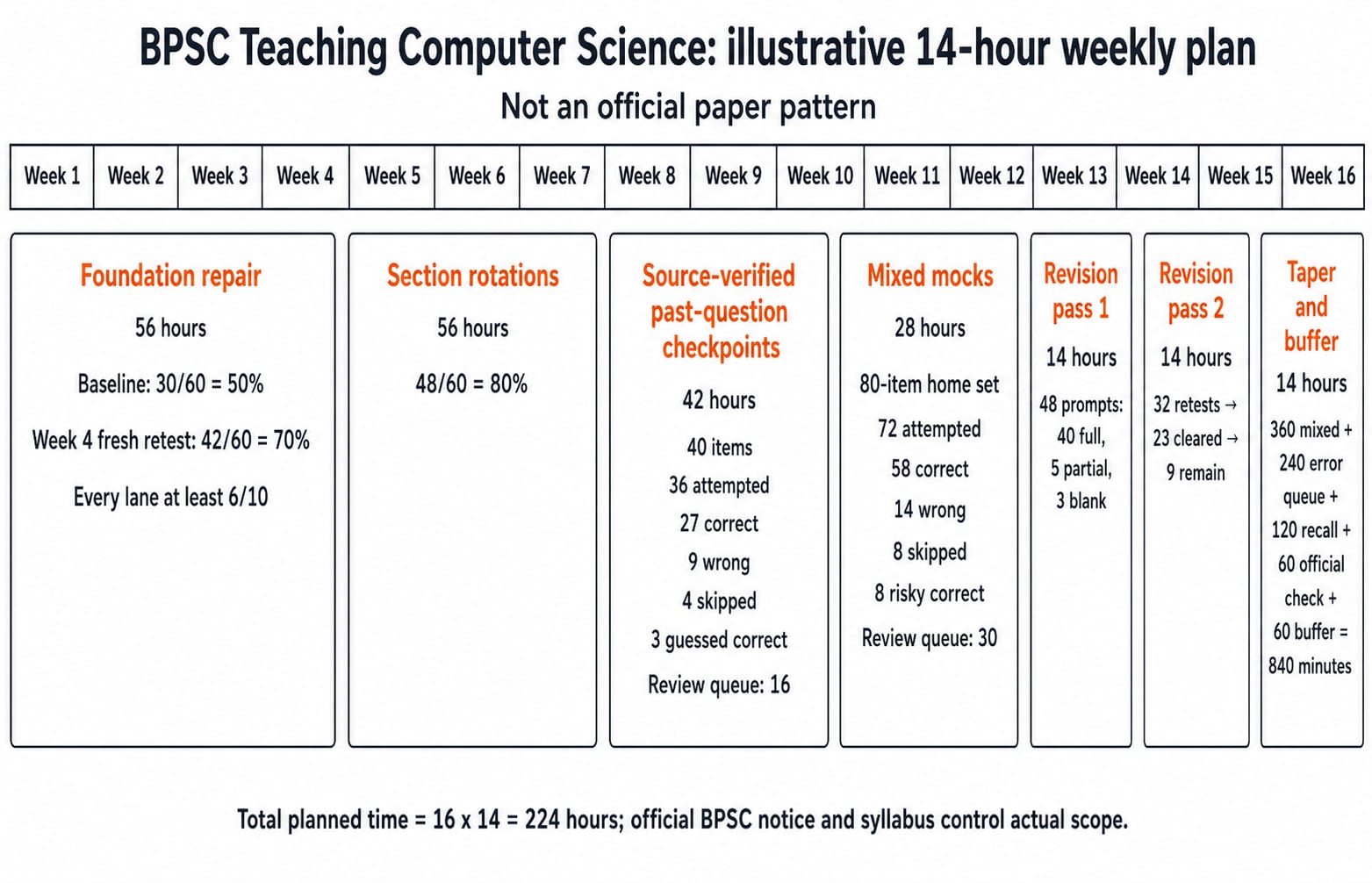
Sixteen weeks can produce real improvement, but missed evenings and delayed mock analysis quietly consume the calendar. Fourteen protected hours a week for sixteen weeks is 224 hours: four weeks of foundation repair, four of lane rotation, three of past-question checkpoints, two of mixed mocks, two of revision and a taper. Orientation for your own cycle sits on BPSC TRE Exam Preparation.
1. Protect 14 hours before assigning a single topic
Use Monday to Thursday at 90 minutes each, Friday at 60, Saturday at 240 and Sunday at 180. The total is (4 x 90) + 60 + 240 + 180 = 840 minutes = 14 hours, with breaks outside it.
Divide the 840 into CS concept repair 270, CS questions 240, supporting subjects 90, review and error logging 150, recall 60, and planning 30. Check: 270 + 240 + 90 + 150 + 60 + 30 = 840. Those 90 minutes cover English Language, General Awareness and Primary Maths, the three non-CS buckets; if your cycle's syllabus drops one, give the minutes to the weakest CS lane. BPSC Teaching Computer Science Syllabus: Topic Map and Boundaries sets out all fifteen buckets.
2. Weeks 1-4: diagnose six lanes, then repair foundations
Start with a 60-question home diagnostic, ten per lane. The six lanes hold the twelve Computer Science buckets: Programming and Data Structures (Programming Fundamentals, Programming Languages, Python, Data Structures), DBMS (Database Systems), Operating Systems, Networks, Organisation and Digital Logic (Computer System Architecture, Digital Electronics), and Theory and Software Engineering (Theory of Computation, Software Engineering, Digital Society and Ethics). That is 4 + 1 + 1 + 1 + 2 + 3 = 12. Suppose the scores come back 5, 7, 4, 6, 3, 5 in that order: 5 + 7 + 4 + 6 + 3 + 5 = 30/60 = 50%.
Week 1 pairs Organisation and Digital Logic with Operating Systems, Week 2 pairs Programming and Data Structures with Theory and Software Engineering, and Week 3 pairs Networks with DBMS, each on the fixed 270 concept minutes. Week 4 retests all lanes on fresh questions. Scores of 7, 8, 7, 7, 6, 7 total 42/60 = 70%. No lane may fall below 6/10; one that does stays under repair. Where a whole bucket is missing rather than weak, the BPSC TRE 4.0 Preparation Course carries it in sequence.
3. Weeks 5-8: rotate sections and keep retesting weak areas
Week 5 pairs Programming and Data Structures with DBMS, Week 6 Operating Systems with Networks, and Week 7 Organisation and Digital Logic with Theory and Software Engineering, a different pairing from Weeks 1 to 3. Week 8 is a six-lane spiral.
Divide each 90-minute weekday block into 35 minutes of closed-book reconstruction, 40 for six fresh questions and 15 for correction: 35 + 40 + 15 = 90. Use 15 of those 35 minutes to retest the previous week's error cards. Release an error only after a fresh-value or fresh-stem solution is correct and explained without notes. Week 8 scores of 8, 9, 8, 8, 7, 8 would give 48/60 = 80%, after 30/60 and 42/60. A lane that stalls twice needs its bucket reopened, not another question set.
4. Weeks 9-11: let source-verified past questions set checkpoints
Call a question a past-year question only when it traces to an issued BPSC paper, answer key or another primary record. For Computer Science that means the completed cycles, TRE 1 through TRE 3, which our timed practice draws from. A coaching reconstruction is practice, and an expected TRE 4.0 pattern is not a document: plan from the one issued. The BPSC official portal holds the advertisement, syllabus, notice, corrigendum and question-booklet sections for your cycle.
In a 40-item checkpoint, suppose the learner attempts 36, gets 27 correct and 9 wrong, and skips 4. Attempted accuracy is 27/36 x 100 = 75%; completion is 36/40 x 100 = 90%. With three guessed correct answers, review 9 wrong + 4 skipped + 3 guessed correct = 16 items, not merely 13. Classify them as 7 concept, 5 recall and 4 reading-or-process errors: 7 + 5 + 4 = 16. Week 9 diagnoses, Week 10 repairs and retests, and Week 11 uses another source-verified set.
5. Weeks 12-13: use mixed mocks as diagnosis
Run an 80-question, 100-minute home simulation to practise review, not to predict a result. It stands in for the concerned-subject paper alone, since the written examination also carries a language part and a general part; BPSC Teaching Eligibility and Exam Structure works through which of them apply to your post. If 72 are attempted, with 58 correct, 14 wrong and 8 skipped, attempted accuracy is 58/72 x 100 = 80.6%, completion is 72/80 x 100 = 90%, and total correct rate is 58/80 x 100 = 72.5%.
Mark eight correct answers that were guessed or slow. Review 14 wrong + 8 skipped + 8 risky correct = 30 items. Their earliest causes are 12 concept, 7 recall, 6 process or time-management, and 5 condition-reading errors: 12 + 7 + 6 + 5 = 30. Repair for at least as long as the mock took. Week 12 builds the queue; Week 13 retests each cause on fresh items.
6. Weeks 14-15: complete two different revision passes
Week 14 is the breadth pass: 48 closed-book prompts, eight per lane. If 40 are fully answered, 5 partly answered and 3 blank, 40 + 5 + 3 = 48, while 8 fail the release rule. Spend 480 minutes on prompts at a 10-minute average ceiling, 240 on fresh application and 120 on review: 480 + 240 + 120 = 840 minutes.
Week 15 is error-only. Combine those 8 failures with 24 unresolved checkpoint and mock items: 8 + 24 = 32 retests. Clear 23 after a correct fresh answer and explanation, leaving 32 - 23 = 9. Add no new chapter for appearance.
7. Week 16: taper, absorb missed days and keep the plan honest
Keep the ceiling: mixed work 360 minutes, the nine-item error queue 240, recall 120, a document check 60, and buffer 60. Check: 360 + 240 + 120 + 60 + 60 = 840. Spend that 60 re-reading the advertisement and any corrigendum against your topic tracker. If the exam is not close, begin another cycle.
If Monday's 90 minutes disappear, replace 45 minutes of Saturday's low-priority new questions and 45 of Sunday's. Never exceed 840. After losing two sessions, preserve due retests and revision, then move one lower-priority lane forward. After losing a whole week, extend the calendar rather than doubling up, unless your exam date forbids it. Never compress 14 + 14 = 28 hours into the next week.
8. Short version and the next 90 minutes
Protect 14 hours, diagnose before sequencing, retest before rotating, review guessed answers too, and run breadth revision before error-only revision. Start with 15 minutes to save your cycle's syllabus, 45 for 30 baseline questions, 20 to tag errors, and 10 to calendar three sessions: 15 + 45 + 20 + 10 = 90. From there the BPSC TRE 4.0 Test Series supplies the timed sets Weeks 9 to 13 need, its unit tests split across Computer Science, General Awareness, and Mental Aptitude and Reasoning.
Keep learning
BPSC Headmaster Selection Process: Written Exam, Merit List and Document Verification
Trace the completed 2024 BPSC Head Master route from one objective paper to provisional merit and certificate checks. Includes checked arithmetic and a practical six-week plan.
Updated 14 Aug 20264 min readBPSC Teaching
BPSC Teaching vs KVS/NVS: Bihar Posting, Transfers and Best Fit
Choose by document fit, mobility and work context, not by the recruiting body's name. Compare the Bihar state cadre against central-school postings and score the routes against your own constraints.
Updated 7 Aug 20266 min readBPSC Teaching
BPSC Teaching CS PYQs: Four-Pass Revision Plan
Turn one 40-question PYQ set into four rounds that expose weak concepts, repair them, add a practice clock and test mixed recall with a usable error log.
Updated 5 Aug 20265 min read65 viewsBPSC Teaching

BPSC Computer Science: DBMS, SQL and Data Structures Worked Guide
Follow one student-result example from functional dependencies and 3NF through SQL aggregation, queues, stacks, hashing and max-heap extraction.
Updated 2 Aug 20266 min readBPSC Teaching