KVS NVS Computer Science Preparation Plan: 16 Weeks, One Core, Two Checks
Build one realistic 16-week study spine for KVS and NVS Computer Science, while keeping each organisation's post, syllabus and role checks separate.
KnowledgeGate Team
Exam prep & CS education
Updated 26 Jul 20266 min read
Preparing for KVS and NVS Computer Science separately leaves you revising the same Python, DBMS and networking twice, with no clear view of where the two organisations actually differ. Almost the whole Computer Science load is shared, so one 16-week spine can carry both, provided the post, role and selection checks stay separate. The hour figures and practice scores here are targets you set for yourself; scope, paper and eligibility come from the active notice and the post-specific syllabus.
Fix the post and official source before Week 1
Create three target rows: KVS PGT Computer Science, NVS PGT Computer Science and NVS TGT Computer Science. The joint Recruitment Notification 01/2025, dated 13 November 2025, listed PGT Computer Science for both organisations and TGT Computer Science under NVS, not KVS. Post availability moves from cycle to cycle, so read that as the 2025 vacancy position rather than a fixed rule about who recruits what.
For each live row, record the current notice URL, the syllabus URL, the date you last checked for corrigenda, whether eligibility is confirmed, and the selection stages. Re-check that row in the week you apply, because a corrigendum can move eligibility or stages after the first notice. The KVS and NVS Computer Science exam preparation hub keeps the study material in one place, and the KVS and NVS Computer Science Exam Explainer maps the stages in more detail.
Protect a 12-hour week, but promise only 11
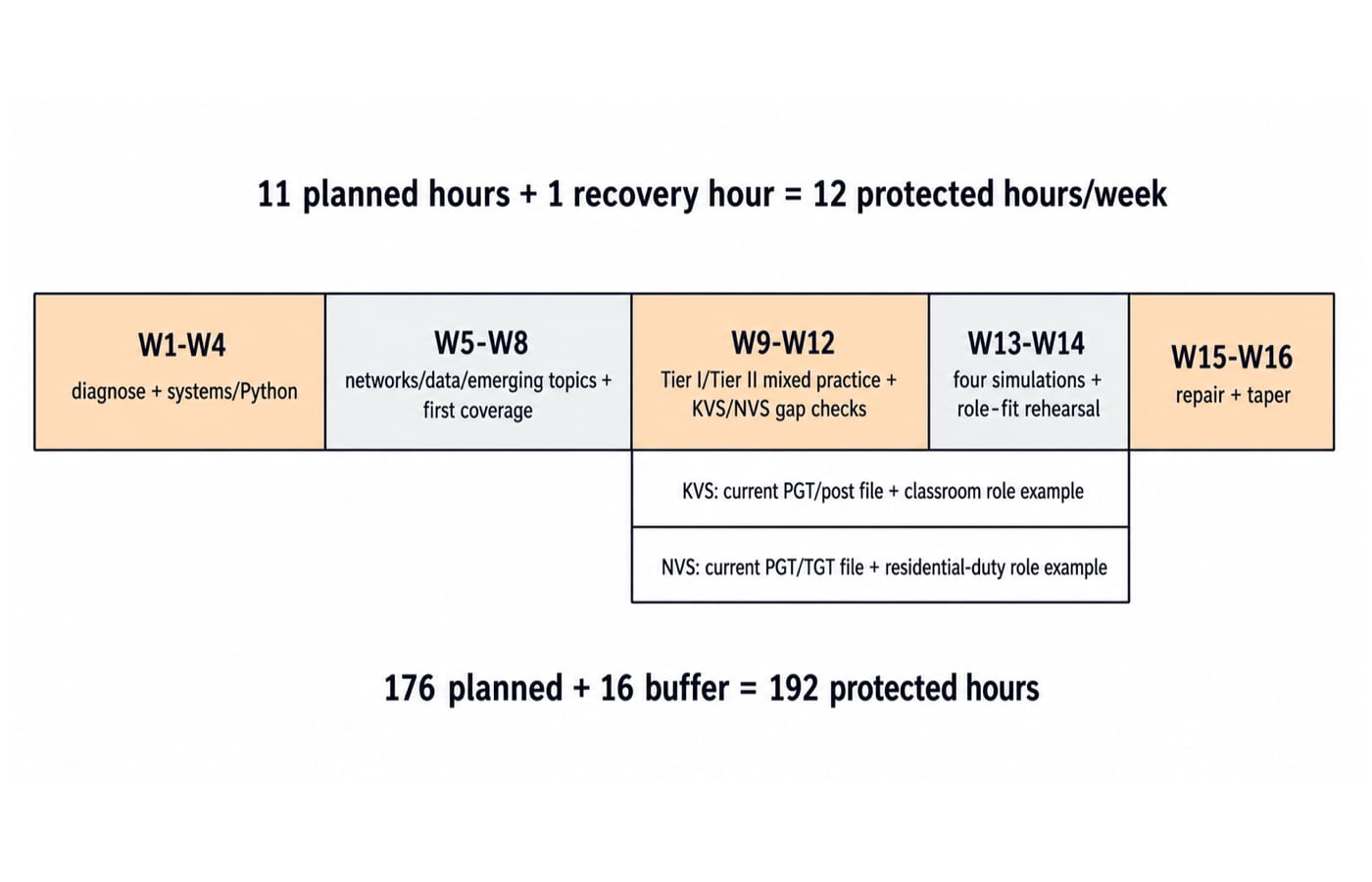
Study 75 minutes Monday through Thursday, 60 on Friday, 180 on Saturday and 120 planned on Sunday. Keep a separate 60-minute Sunday recovery block.
4 x 75 + 60 + 180 + 120 + 60 = 720 minutes = 12 hours
Promise only 11 weekly hours. Across 16 weeks, that is 16 x 11 = 176 planned hours, plus 16 x 1 = 16 buffer hours, or 192 protected hours.
For Weeks 1 to 8, split the 11 hours into 7 shared CS + 2 Tier I foundation + 1 post-gap/descriptive + 1 review. For Weeks 9 to 16, use 5 CS revision + 2 Tier I + 2 Tier II practice + 1 organisation/role check + 1 review.
Weeks 1 to 4: diagnose once, then repair the foundation
Take a fresh 40-question diagnostic, not a claimed previous-year paper. Use eight five-question blocks: systems; Boolean logic and number systems; Python basics; Python collections; networks; DBMS and SQL; digital society and emerging technology; and Pandas and data handling.
For scores 2/5, 1/5, 4/5, 3/5, 2/5, 4/5, 3/5, 2/5, the sum is 2 + 1 + 4 + 3 + 2 + 4 + 3 + 2 = 21, so 21/40 = 52.5%. Mark 0 to 2 red, 3 amber and 4 to 5 green. Systems and Boolean/number systems take the first repair slots, and nothing marked green gets a fresh study slot before the Week 9 revision phase.
Following the 2025 PGT syllabus, use Week 1 for systems, OS basics, Boolean logic and number systems; Week 2 for problem solving, Python and control flow; Week 3 for strings, lists, tuples and dictionaries; and Week 4 for functions, modules and files. NVS TGT candidates run the same four-week order against the TGT syllabus, which sets its own topic boundaries.
Weeks 5 to 8: finish coverage and expose post gaps
Continue the 2025 PGT map: networks and web concepts in Week 5; relational DBMS, SQL and Python-SQL connectivity in Week 6; society, law, cyber safety and emerging technologies in Week 7; and Pandas, Matplotlib, recall and backlog clearance in Week 8. If the active syllabus adds or drops a unit, move the week that owns it rather than squeezing it into Week 8.
Each week, complete two 25-question sets and two descriptive drills. That gives 2 x 25 = 50 questions weekly, then 4 x 50 = 200 questions and 4 x 2 = 8 drills for the phase. Split each drill 5 minutes to outline, 15 to write and 10 to check, and hold that rhythm even when the answer feels short.
At Week 8, build a gap sheet with one row per topic and columns for KVS PGT, NVS PGT, NVS TGT, the official evidence you found, and the next action. A blank evidence cell is a research task before it is a study task. The KVS NVS Tier 2 Computer Science course covers the Tier II ground in that order.
Weeks 9 to 12: practise together, then check separately
For a Tier I rehearsal, use the 100-question split from Notification 01/2025: 20 each for reasoning, numerical ability, basic computer literacy and general knowledge, plus 10 English and 10 in the chosen other Modern Indian Language. With 72 correct, 12 wrong and 16 unattempted, 72 + 12 + 16 = 100. Under that notice's +3/-1 rule, 72 x 3 - 12 = 216 - 12 = 204/300. Track that raw score across rehearsals; shortlists move with the post and the category, so your own trend line is the comparison worth having.
Week 10 adds two 60-question objective Tier II sets and four descriptive drills. In Weeks 11 and 12, do one mixed Tier I set and one Tier II set each week. Log every miss as concept, recall, misread or rushed choice. The Teaching Exam Mock Strategy for CS Papers turns that log into the next practice block.
This is where the two tracks separate. For KVS, confirm the current post, eligibility and stages. For NVS, confirm PGT and TGT scope and the residential-school duties before you draft role-fit examples. The written papers stay common ground, so keep one practice routine and split only the post checks.
Weeks 13 to 14: simulate, score and rehearse role fit
Schedule two current-format simulations weekly, four in total, reviewing each before the next. Notification 01/2025 set a Tier II scheme of 60 objective marks and 40 descriptive marks, with a 0.25 penalty on objective errors. For 44 correct, 10 wrong and 6 unattempted, 44 + 10 + 6 = 60, then 44 - (10 x 0.25) = 44 - 2.5 = 41.5/60. Adding 26/40 on the descriptive section gives 41.5 + 26 = 67.5/100.
Take an interview score of 74/100 and apply that notification's 85:15 weighting: 0.85 x 67.5 + 0.15 x 74 = 57.375 + 11.1 = 68.475, or 68.48/100. Notice how little the interview moves the total. Six extra marks on the written paper add 5.1 to it; twenty extra interview marks add only 3.
Create two role examples. For KVS, 36 learners share 18 computers in pairs, swapping driver and reviewer after 12 minutes. For NVS, 30 residential learners share 10 computers in threes during a 45-minute supervised-study block, rotating operator, tester and explainer every 15 minutes. Tie the NVS example to the residential responsibilities the notification names, supervised study and student welfare among them.
Weeks 15 to 16: taper and recover without panic
Week 15 has three 75-minute red-topic repairs, two 60-minute descriptive/mixed blocks, and one current-format simulation with review. Take the final simulation early in Week 16. Afterward, use only recall sheets, previous errors and confirmed topics. Add no new source.
If Week 6 loses Wednesday's 75 minutes and Friday's 60, the debt is 75 + 60 = 135 minutes. Sunday's recovery hour leaves 135 - 60 = 75 minutes. Move that block into Week 7 by dropping optional note rewriting, not a syllabus item, and keep the 12-hour ceiling. If a whole week disappears, do not plan 22 hours next week. Keep the 11-hour core, prioritise red official-syllabus rows and reduce duplicate practice only if the exam calendar allows.
The short version and the next action
Confirm the live post, protect 11 study hours plus one buffer, cover the shared core through Week 8, practise through Week 12, add the separate role and selection checks in Weeks 13 and 14, then taper. Where the active notification disagrees with the 2025 figures used here, the notification wins. Next, take the diagnostic and fill the three-row target sheet. For both stages together, use the KVS NVS Computer Science bundle.
Keep learning

NVS PGT Computer Science: A Topic-by-Topic Practice Map
Turn a topic list into checks you can actually solve. Map your NVS PGT Computer Science preparation through binary conversion, Python tracing, SQL results and IP addressing.
30 Sep 20265 min readKVS & NVS

NVS PGT Computer Science 60-Day Study Plan: Revision and Mock Strategy
Turn the final 60 days into four clear phases, with a worked 201-hour timetable, error-led revision blocks, timed mocks, recovery buffers, and a calm taper.
Updated 12 Aug 20265 min readKVS & NVS
PGT Eligibility: Is B.Ed Mandatory for KVS, NVS and State Recruiters?
A recruiter-first guide to the PGT teacher-training question, using dated KVS, NVS and DSSSB clauses, candidate profiles and a reusable eligibility audit.
Updated 10 Aug 20265 min read124 viewsKVS & NVS
KVS vs NVS vs EMRS: Choose the Right School System for Your Teaching Career
Compare KVS, NVS and EMRS through current post rules, lifestyle limits and a weighted personal-fit matrix. See why changing priorities can change the answer.
Updated 7 Aug 20267 min read84 viewsKVS & NVS