

Electronic Payment Systems Explained: Concepts, Worked Settlement and Exam Traps
Learn how payment instruments, participants, clearing and settlement fit together. Includes a two-bank netting calculation, EDI distinctions and security traps.
KnowledgeGate Team
Exam prep & CS education
Updated 10 Nov 20265 min read
A card, a wallet and a bank transfer look different on screen, but exam questions often test the same hidden stages underneath them. The usual confusion is mixing the instrument with the organisations and processes that complete the payment. The useful model separates initiation, authentication, authorisation, clearing, settlement and reconciliation, then tracks one batch across two banks.
What an electronic payment system actually does
An electronic payment system coordinates rules, participants, messages and infrastructure to take a payment instruction from a payer to a beneficiary, then complete clearing and settlement. The Reserve Bank of India FAQ on the Payment and Settlement Systems Act sets out the formal Indian legal vocabulary for these terms.
Keep four ideas separate:
The instrument initiates a payment, such as a card or electronic cheque.
The channel carries the instruction, such as an app or merchant terminal.
The rail or network routes and processes messages among participants.
The settlement asset and accounts discharge inter-institution obligations.
An approval message is not proof of interbank settlement. Remember: initiate -> authenticate -> authorise -> clear -> settle -> reconcile. Systems may combine stages, but the functions remain distinct.
Classify payment methods by function
Classify by where value comes from, who initiates and how the instruction reaches the beneficiary.
Method | Where value is held | Who initiates | Intermediary | Natural direction |
|---|---|---|---|---|
Card | Deposit or issuer credit line | Payer | Issuer, acquirer, network | Usually pull |
Account-to-account EFT | Deposit account | Payer or authorised payee | Banks, operator | Push or authorised pull |
Stored-value or prepaid wallet | Loaded value | Payer | Wallet provider, banks | Usually push |
Electronic cheque | Deposit account | Payer issues, payee presents | Banks, clearing | Pull after issue |
Electronic cash, classical concept | Digital value | Payer | Issuer or electronic-cash system | Push |
A credit card uses issuer credit, a debit card draws on a deposit account, and a stored-value instrument uses loaded value. A QR code only captures data or initiates. If a physical card becomes a phone tap, has the system changed? Not necessarily: its funding source and settlement rail may remain the same.
Participants and the payment lifecycle
The visible parties are the payer or customer and payee or merchant. Behind them may sit a remitter or issuer bank, beneficiary or acquiring bank, payment service provider or gateway, network operator, clearing mechanism and settlement institution. Issuer and acquirer are card-centric terms, and some rails hide roles from users.
The payer sends an instruction and authenticates. Authorisation checks credentials, limits and funds, then returns a response. Clearing validates transactions and calculates obligations. Settlement moves value between settlement accounts. Reconciliation matches outcomes to customer, merchant and internal records.
EDI, e-commerce and EFT are not synonyms
EDI carries structured business documents; EFT moves funds electronically; e-commerce is the wider commercial activity. For the document side, Electronic Data Interchange and E-Commerce: Secure Workflows, Cyber Law and Worked Examples follows standards, acknowledgements, replay controls and the full order-to-invoice lifecycle. For the payment side, a valid invoice still precedes authorisation, clearing and settlement.
Approval of an order is not approval of a payment. Dispatch does not transfer funds, an invoice does not settle its amount, and an EFT confirmation still needs reconciliation to the commercial records.
Worked example: authorisation to net settlement
A simplified two-bank batch has three payments:
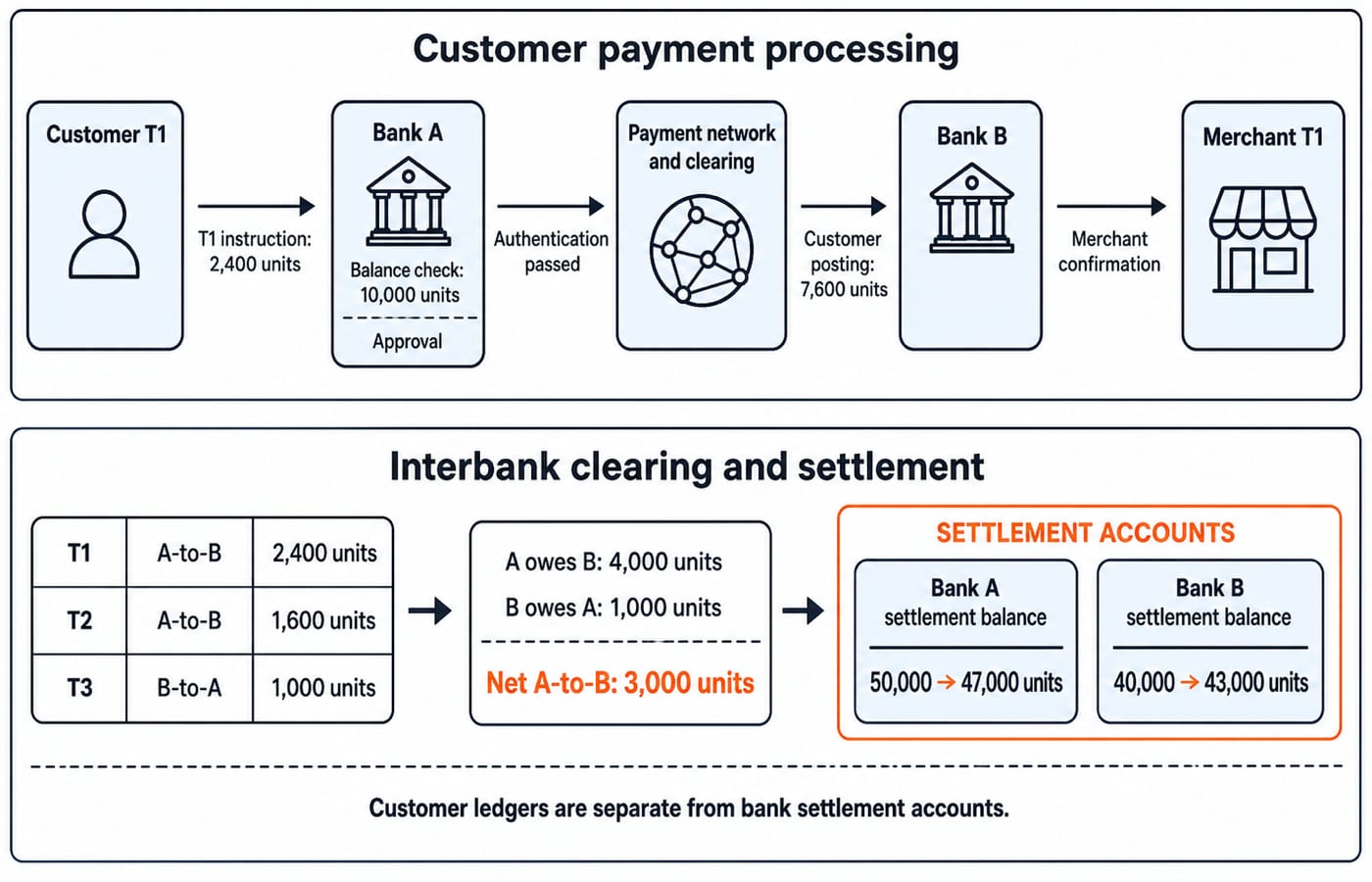
T1: a Bank A customer pays a Bank B merchant 2,400 units.T2: another Bank A customer pays a Bank B merchant 1,600 units.T3: a Bank B customer pays a Bank A merchant 1,000 units.
For T1, authentication validates the presented credentials. Bank A authorises against credentials, limits and funds. The customer's available balance is 10,000 units before posting, so the debit leaves 10,000 - 2,400 = 7,600 units. Merchant approval means the transaction may proceed, not that the banks have settled. The customer account and bank settlement accounts are different ledgers.
Clear the batch:
Bank A's gross obligation to Bank B is 2,400 + 1,600 = 4,000 units.
Bank B's gross obligation to Bank A is 1,000 units.
Gross two-way value is 4,000 + 1,000 = 5,000 units.
Net obligation is 4,000 - 1,000 = 3,000 units from Bank A to Bank B.
Settlement balances start at Bank A 50,000 units and Bank B 40,000 units. After netting, A has 50,000 - 3,000 = 47,000 units, and B has 40,000 + 3,000 = 43,000 units. Check conservation: 47,000 + 43,000 = 90,000 units, the same as 50,000 + 40,000 = 90,000 units.
Netting replaces opposing settlement obligations with one 3,000-unit transfer without altering customer payments. RBI explains that India's PSS Act gives netting a legal basis and recognises settlement finality. For database atomicity and concurrency, see Transactions and Concurrency Control in DBMS. Database consistency is not interbank legal settlement.
Security objectives, controls and failure cases
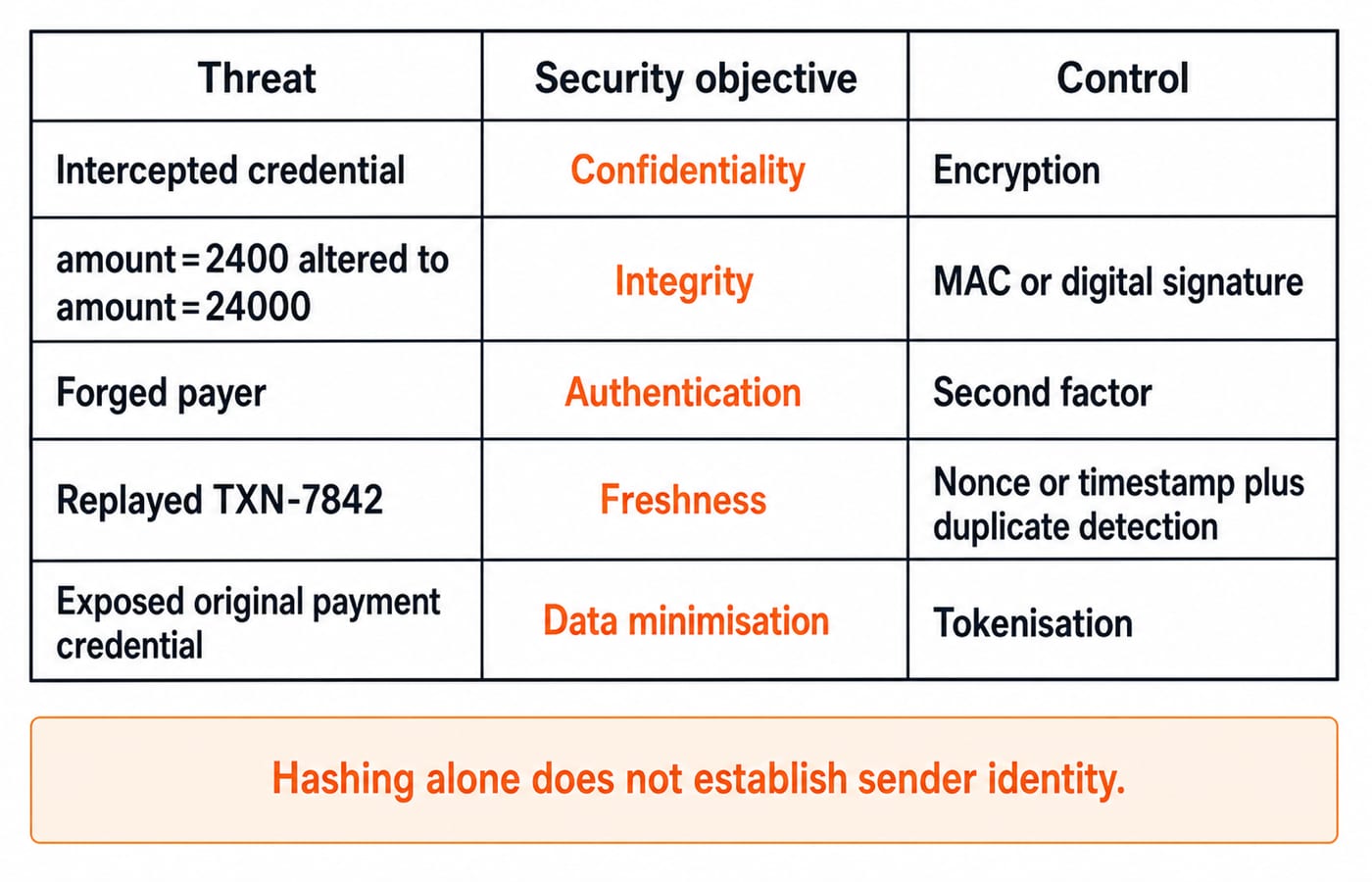
Match controls to risks. Intercepted credentials threaten confidentiality, so encryption protects them. Changing amount=2400 to amount=24000 threatens integrity; a correctly used MAC or digital signature detects it. A hash alone does not authenticate the sender.
A forged payer attacks authentication, so a second factor strengthens the check. Replaying TXN-7842 attacks freshness; a nonce or timestamp plus server-side duplicate detection rejects reuse. Tokenisation reduces credential exposure. Availability keeps service usable, auditability preserves evidence, and non-repudiation needs cryptographic and operational evidence. No single control secures everything.
Authentication asks who presents the instruction; authorisation asks whether it may proceed. A failed payment does not complete, a reversal unwinds a posting, a refund returns value, and a dispute requires investigation. Handling depends on the system.
Common electronic payment exam traps
Authorisation, clearing and settlement are synonyms. For
T1, ask: may it proceed, what does each bank owe, and has the obligation been discharged?Gross value, net obligation and customer balance can be mixed. Label the ledger: 5,000 units gross, 3,000 units net A-to-B, and 10,000 to 7,600 units customer balance.
Encryption proves identity. It protects confidentiality; authentication needs identity evidence.
EDI transfers funds. EDI exchanges business documents, while EFT moves funds.
Every electronic payment is instant, or a QR code is the rail. Timing depends on the system; a QR code supplies initiation data.
The short version and the next step
Questions may test definitions, participant matching, lifecycle order, netting, EDI versus EFT or threat-to-control mapping. A reliable answer labels the instrument, role, stage and ledger before choosing an option.
Keep this five-line recap:
Identify the instrument, channel and rail.
Name the participants and their roles.
Order authenticate, authorise, clear, settle and reconcile.
Keep customer balances separate from bank settlement accounts.
Map each threat to the security property it violates.
Use the RBI FAQ for official terminology. Then study the wider syllabus through NTA-UGC-NET Paper 2, test recall with the UGC NET CS Test Series, and use the UGC NET CS Exam Preparation category as the broader course hub.
Go deeper with the full courseUGC NET Computer Science (Paper 1 + Paper 2)
Keep learning

Digital Payment Systems Explained: UPI Flow, Net Settlement and Exam Traps
Separate payment instruments, interfaces and rails, then follow a transfer of 750 units and reduce three inter-bank flows to one net obligation.
Updated 29 Oct 20266 min readUGC NET Computer Science

Electronic Data Interchange (EDI): Document Flow, Standards and a Worked Order
Learn how EDI moves structured business documents between systems. Trace PO-7842 through acknowledgement, shipment, receipt and invoice calculations.
Updated 9 Nov 20265 min readUGC NET Computer Science

Electronic Data Interchange (EDI) and E-Commerce: Layers, X12 Segments and Legal Validity Explained
Learn EDI from the business document to the X12 envelope, then follow it through a VAN, a 997 acknowledgment, signature verification and Indian cyber law.
Updated 26 Oct 20265 min readGATE Strategy & Roadmap

Electronic Data Interchange and E-Commerce: Secure Workflows, Cyber Law and Worked Examples
Follow purchase order PO7421 through mapping, secure transport, acknowledgements, validation, replay protection, invoicing, and audit evidence.
Updated 1 Aug 20266 min readGATE Strategy & Roadmap