

Digital India Mission Explained: 3 Vision Areas, 9 Pillars and a Worked Example
Build a clean map of Digital India, distinguish e-Governance from e-Kranti, and use a hypothetical 500-applicant case to practise classification and percentages.
KnowledgeGate Team
Exam prep & CS education
Updated 28 Oct 20266 min read
Digital India, e-governance, e-Kranti, its three vision areas and its nine pillars occupy different levels. A hypothetical scholarship service can involve several pillars, so classify each feature by its main function before calculating a percentage. The 500-applicant figures below are teaching values, not reported programme results.
Start with the mission, not a list of schemes
Digital India is the Government of India's programme for transforming India into a digitally empowered society and knowledge economy. According to MeitY's official Digital India overview, it was launched on 1 July 2015. It is not one app, portal, ministry or e-governance project.
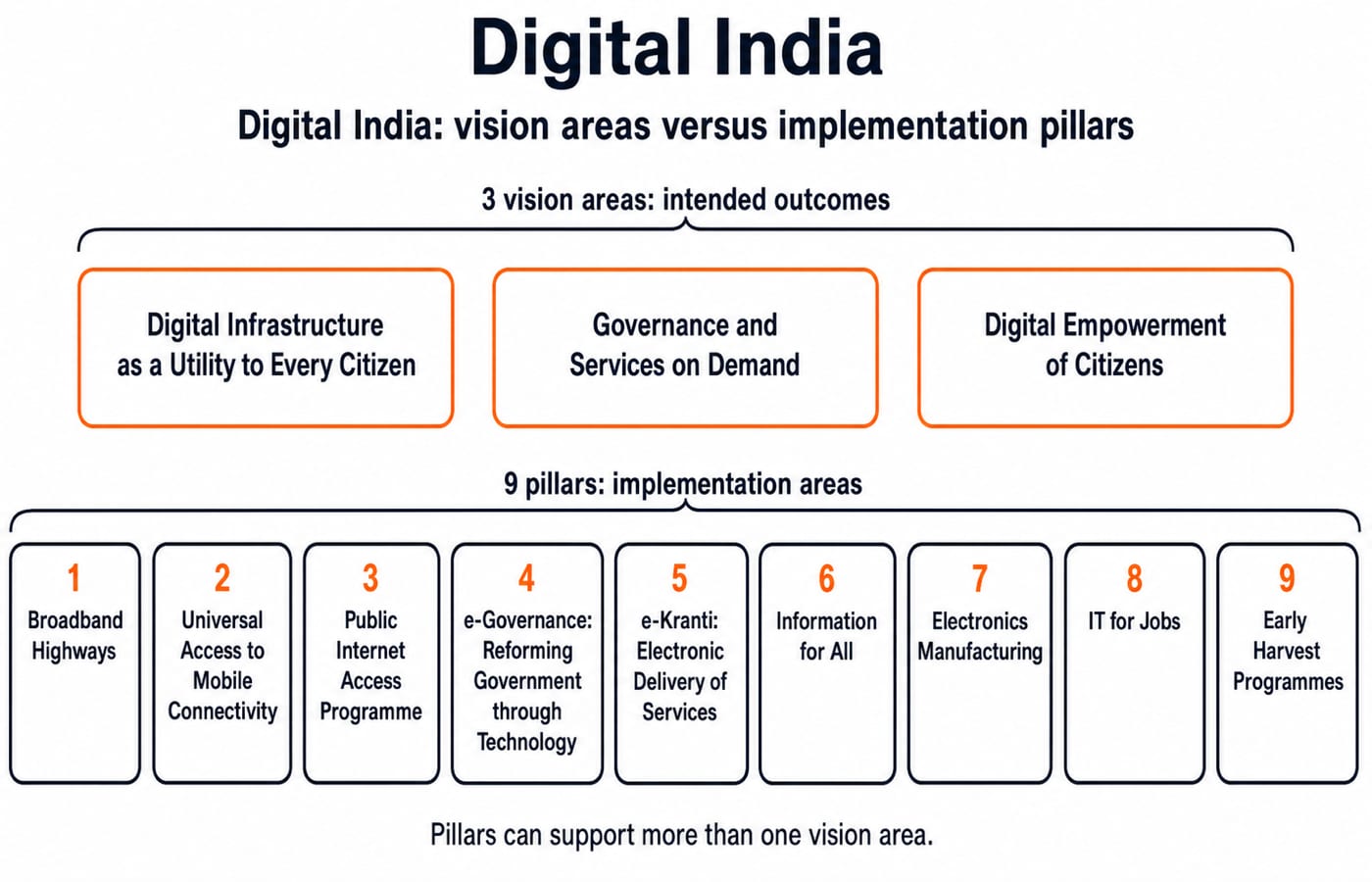
Keep this hierarchy in mind: one programme purpose, three broad vision areas, nine implementation pillars, and many initiatives or services. It is not a strict one-to-one tree. One initiative can support several vision areas.
Digital services rely on information and communication technology (ICT). If hardware, networks, the internet and digital-service basics still blur together, first revise ICT for Teaching Exams: Fundamentals Explained.
Understand the three vision areas by the question each answers
The three official vision areas describe intended outcomes:
Vision area | Question it answers | Recognition cue |
|---|---|---|
Digital Infrastructure as a Utility to Every Citizen | What access or trusted digital foundation exists? | Broadband plus a secure identity |
Governance and Services on Demand | How is a public service integrated, available and delivered? | Online application with tracking |
Digital Empowerment of Citizens | Can citizens access, understand and use digital resources? | Accessible digital content plus user capability |
The nine pillars organise action areas. Therefore, Broadband Highways answers a pillar question, not a vision-area question. Digital Empowerment of Citizens answers a vision question, not a pillar question. In technical terms, infrastructure is the foundation, software services process and deliver transactions, and applications are what users interact with.
Learn the nine pillars as functions, not as a chant
The official Digital India pillar page gives the names and descriptions in this order:
Broadband Highways: backbone connectivity.
Universal Access to Mobile Connectivity: coverage gaps.
Public Internet Access Programme: assisted public access.
e-Governance: Reforming Government through Technology: process reform.
e-Kranti: Electronic Delivery of Services: electronic service delivery.
Information for All: open and two-way information.
Electronics Manufacturing: domestic electronics capability.
IT for Jobs: digital work skills.
Early Harvest Programmes: quick-start visible projects.
As a study aid, not an official grouping, cluster pillars 1 to 3 as access foundation, 4 to 6 as government and citizen delivery, and 7 to 9 as capacity plus early execution. Official numbering remains the source of truth.
The most confusable pair is pillars 4 and 5. e-Governance concerns redesigning processes through simpler forms, electronic submission, repositories and interoperability. e-Kranti concerns delivering electronic services in sectors such as education, health, agriculture, financial inclusion, justice and planning. These distinctions come from the official descriptions. Historical targets on that page are not evidence of present achievement.
Worked example: classify a scholarship service and calculate completion
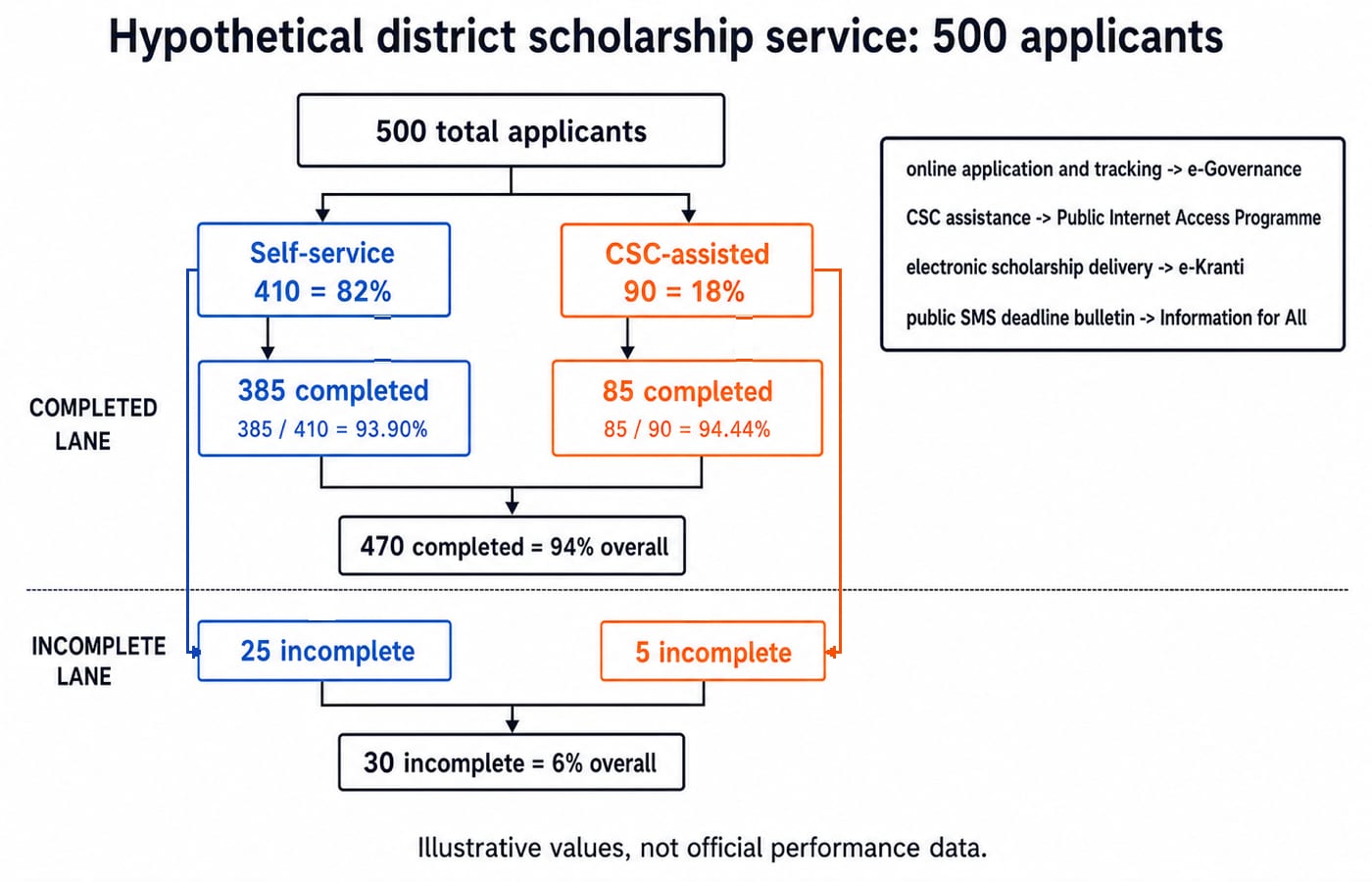
For portal workflow and operational metrics, see e-Governance Portals Explained. This case instead maps scholarship features to Digital India's visions and pillars before calculating route completion. Its online application and tracking screen primarily tests e-Governance. A Common Service Centre (CSC) assisted route maps to the Public Internet Access Programme. Electronic scholarship delivery maps to e-Kranti, while a public SMS deadline bulletin maps to Information for All. Certificate retrieval from a digital repository also supports the infrastructure and services-on-demand visions. Calling these the primary pillars avoids false exclusivity.
There are 500 applicants. Of them, 410 apply independently online and 90 use the CSC route.
Self-service share =
410 / 500 × 100 = 82%.Assisted share =
90 / 500 × 100 = 18%.Route check =
82% + 18% = 100%.
Now suppose 25 self-service applications and 5 CSC-assisted applications remain incomplete.
Completed self-service =
410 - 25 = 385.Completed CSC-assisted =
90 - 5 = 85.Total completed =
385 + 85 = 470.Overall completion =
470 / 500 × 100 = 94%.Total incomplete =
25 + 5 = 30, so incomplete share =30 / 500 × 100 = 6%.Overall check =
94% + 6% = 100%.
Route-specific completion uses each route as its denominator. Self-service completion is 385 / 410 × 100 = 93.90%, and CSC-assisted completion is 85 / 90 × 100 = 94.44%, both rounded to two decimal places.
These figures do not explain why applicants chose a route, prove that the service was inclusive, or show that any official programme target was met.
Separate Digital India, e-governance, e-Kranti and services
Term | Level | Scope | Example cue |
|---|---|---|---|
Digital India | Umbrella programme | Broad programme purpose | The complete mission hierarchy |
e-governance | General approach | Use of ICT and reform of government processes | Simplified digital workflow |
e-Governance pillar | Digital India implementation area | Reforming government through technology | Electronic submission and tracking |
e-Kranti pillar | Digital India implementation area | Electronic delivery across service sectors | Scholarship delivery |
A portal or service is an implementation instance, not another name for the programme. In the case above, Digital India supplies the umbrella, simplification and tracking express e-governance, the scholarship transaction is electronic service delivery, and the CSC is an access channel.
Digitisation and transformation also differ. Scanning a paper certificate changes its format. Accepting, validating, tracking and delivering a scholarship through an integrated workflow changes the service process. A digital form alone does not guarantee better governance.
How exams turn the mission into questions
Four common question shapes need four answer rules:
List recall: reproduce the nine official pillar names in order.
Matching: identify a feature's primary pillar.
Assertion-reason: separate programme, vision and pillar logic.
Numerical caselet: identify the correct denominator before calculating.
From the worked case, the CSC route share is 18%, total completion is 94%, and CSC-assisted completion is 94.44%.
Assertion: e-Kranti and e-Governance are two separate pillars of Digital India. Reason: One focuses on electronic delivery across service sectors, while the other focuses on reforming government processes through technology. Both statements are true, and the reason explains the assertion.
For elimination, simplify forms and collect only necessary information points to e-Governance: Reforming Government through Technology. Common Service Centres as delivery points points to the Public Internet Access Programme.
Avoid traps that turn a correct fact into a wrong answer
Three vision areas treated as three pillars → wrong level → label visions as outcomes and pillars as action areas.
e-Governance merged with e-Kranti → process reform confused with service delivery → identify the stem's main function.
Every government website called complete e-governance → a page confused with an integrated process → check for submission, validation, tracking and delivery.
One initiative mapped to exactly one vision → overlapping support ignored → use
primaryonly when the question requires one best answer.An old target quoted as current achievement → historical context presented as status → verify its date and source.
Date and source discipline: Attribute the 1 July 2015 launch to the official Digital India overview and the pillar names to the official pillar page. Treat dated targets as historical unless a current official source confirms them.
Use a 60-second routine: underline whether the stem asks for a vision, pillar, initiative or metric; identify the main function; check the denominator; then eliminate options from the wrong hierarchy level.
Short version and the next practice step
Recall the chain: 1 umbrella programme → 3 vision areas → 9 implementation pillars → many initiatives and services. Without looking back, recalculate 82%, 18%, 94%, 6%, 93.90% and 94.44%, then redraw the three-versus-nine concept map.
For full Paper 1 teaching, use the NTA UGC NET Paper 1 Course. If the concepts are covered and you need timed practice, use the UGC NET Paper 1 Test Series. The UGC NET Preparation Courses and Test Series page lets you compare the current learning and practice routes.
Finally, verify the three vision labels and nine pillar names against the official Digital India pages. Then solve at least five relevant practice questions without memorising historical targets as present facts.
Go deeper with the full courseUGC NET Computer Science (Paper 1 + Paper 2)
Keep learning
Digital India and e-Governance: Models, Service Architecture and Worked ICT Examples
See how an e-governance service works from request to decision. Follow a fictional application, calculate workload and uptime, and test its controls.
Updated 23 Aug 20265 min readDigital Logic
Digital Electronics for GATE: Official Syllabus Map, Weightage Logic and Prep Order
Turn the compact GATE CS Digital Logic syllabus into a practical study sequence, then learn how to audit past-paper weightage without treating it as a forecast.
Updated 30 Oct 20265 min read87 viewsDigital Logic

OOP Basics in Java: Classes, Objects and the Four Pillars with Runnable Examples
Connect Java's OOP syntax to design decisions with a complete Account example. Trace two objects through validation, overriding and runtime dispatch to exact output.
Updated 14 Oct 20265 min readJava

Object-Oriented Programming (OOP): Four Pillars and a Worked Dynamic-Binding Example
Build a precise OOP mental model, then follow two Employee objects through a Java program to see overloading, overriding and runtime dispatch in action.
Updated 10 Aug 20266 min readProgramming Languages Survey