

Digital Footprint Explained: Active vs Passive Traces with a Worked Audit
Learn how active and passive digital traces differ, then audit Nisha's 30 known records and see why a later count of 31 uses a wider boundary.
KnowledgeGate Team
Exam prep & CS education
Updated 5 Nov 20265 min read

Deleting a post can feel like erasing it once it leaves your profile. But a digital footprint includes records created around it by platforms, devices and analytics systems. This distinction matters whenever a question asks what survives deletion and who can still hold it. Learners preparing for government teaching jobs must separate visible content from the wider trail.
Digital footprint: the exact concept and its boundaries
A digital footprint is the data traces associated with a person's or account's use of digital systems. Digital identity is how that person or account is represented. Digital reputation is how others judge it. A footprint can influence both, but the terms are not interchangeable.
An active footprint comes from data a person deliberately contributes, such as a post, comment, file or voluntary profile field. A passive footprint comes from data recorded around use without deliberate publication, such as a session log, device identifier, page-view event or background location entry. Classify a trace by how it is created, not whether its effect is good or bad.
A private message can form part of a footprint, and a passive trace is not automatically public. The earlier Digital Society Explained overview places footprints within digital citizenship, inclusion, rights and ethics; this audit instead classifies individual traces, quantifies a fixed ledger and tests what deletion changes.
How one online action becomes several traces
A trace lifecycle moves through action, collection, association with an account or device, storage, sharing or copying, retention, and deletion or anonymisation under the holder's rules. One page visit can produce a requested page, access record, session cookie and analytics event. These are distinct records.
Keep three forms separate: supplied content from the user, observed metadata such as time and device details, and inferences derived by combining records. An inference can be wrong. Correlation does not make it an intentionally supplied fact.
Deleting an item removes the displayed original, not necessarily independent shares, screenshots or permitted retained records. Persistence depends on what was copied, who holds it and the retention process. Web technologies for teaching exams explains the browser, URL and HTTP path behind the visible action.
Worked audit setup: Nisha's seven-day trace ledger
source/action | count | active or passive | why | intended visibility | possible holder |
|---|---|---|---|---|---|
Public posts | 3 | Active | Deliberately posted | Public | Service |
Public comments | 5 | Active | Deliberately written | Public | Service |
Voluntary profile updates | 2 | Active | Entered voluntarily | Account-visible | Service |
Cookie or session-log records | 8 | Passive | Recorded around use | Service-visible | Service |
Background location entries | 4 | Passive | App recorded them with permission enabled | Service-visible | App service |
Device-identifier records | 2 | Passive | Recorded around use | Processor-visible | Service or processor |
Page-view analytics records | 6 | Passive | Analytics recorded visits | Service-visible or processor-visible | Service or analytics processor |
These are 30 known records, not bytes, people reached or a risk score. Events may create multiple or duplicated records, and outsiders cannot enumerate every server-side item.
Calculate the active/passive split, then test deletion
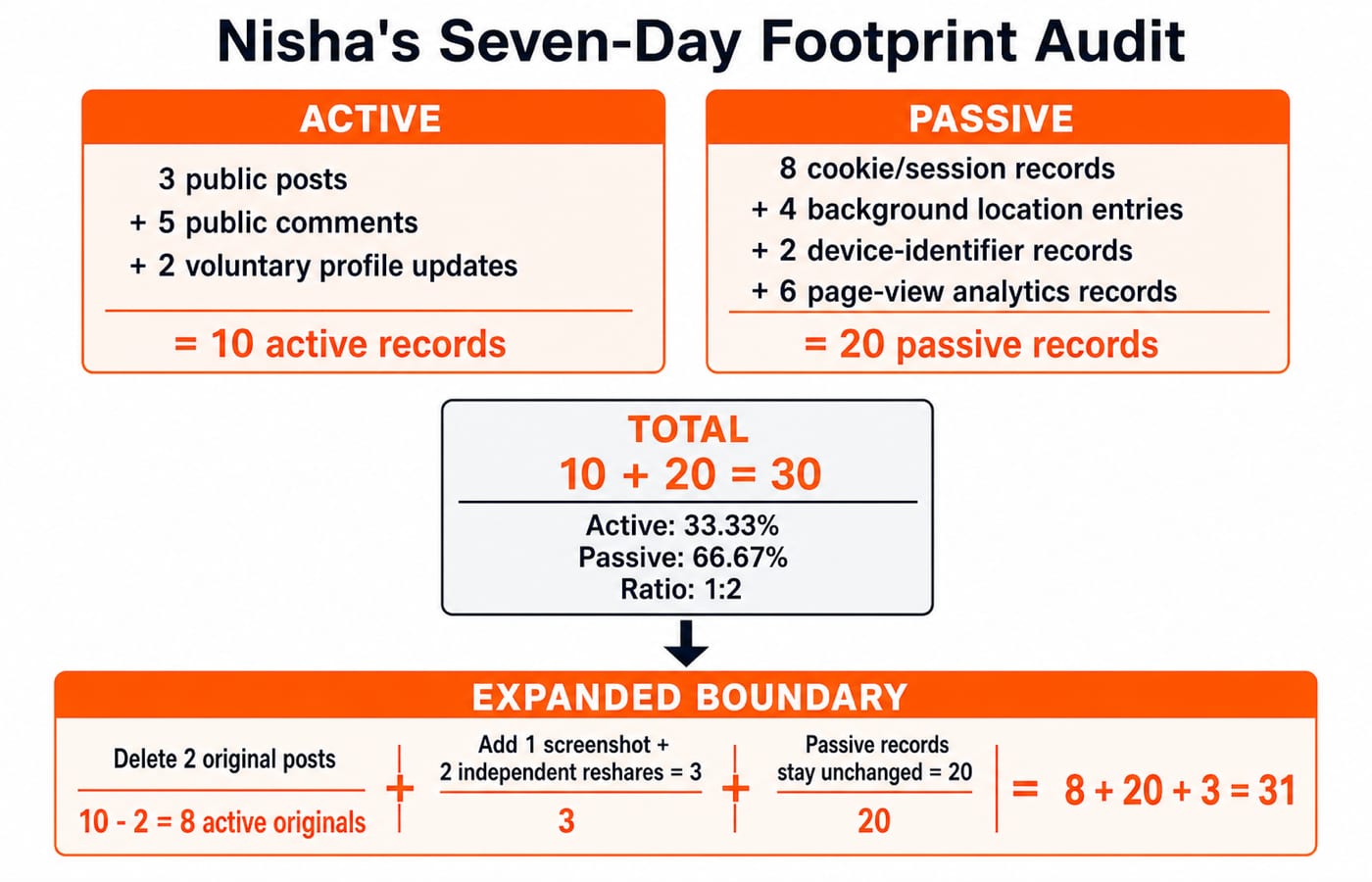
Active records = 3 posts + 5 comments + 2 profile updates = 10.
Passive records = 8 cookie/session records + 4 location entries + 2 device identifiers + 6 page-view records = 20.
Total known records = 10 + 20 = 30.
Active share = (10 / 30) x 100 = 33.33%.
Passive share = (20 / 30) x 100 = 66.67%.
Active-to-passive ratio = 10:20 = 1:2.
This ledger does not prove passive traces are always more numerous.
Nisha now deletes 2 of her 3 original posts, so active originals visible through her account fall from 10 to 8. One deleted post had already produced 1 screenshot and 2 independent reshares, and all three copies remain in this example.
Under the expanded boundary, 8 remaining active originals + 20 passive records + 3 outside copies = 31 known associated artefacts.
The rise reflects copies excluded from the first ledger. Deletion created nothing. Different boundaries make the totals non-comparable.
Judge exposure without inventing a universal risk formula
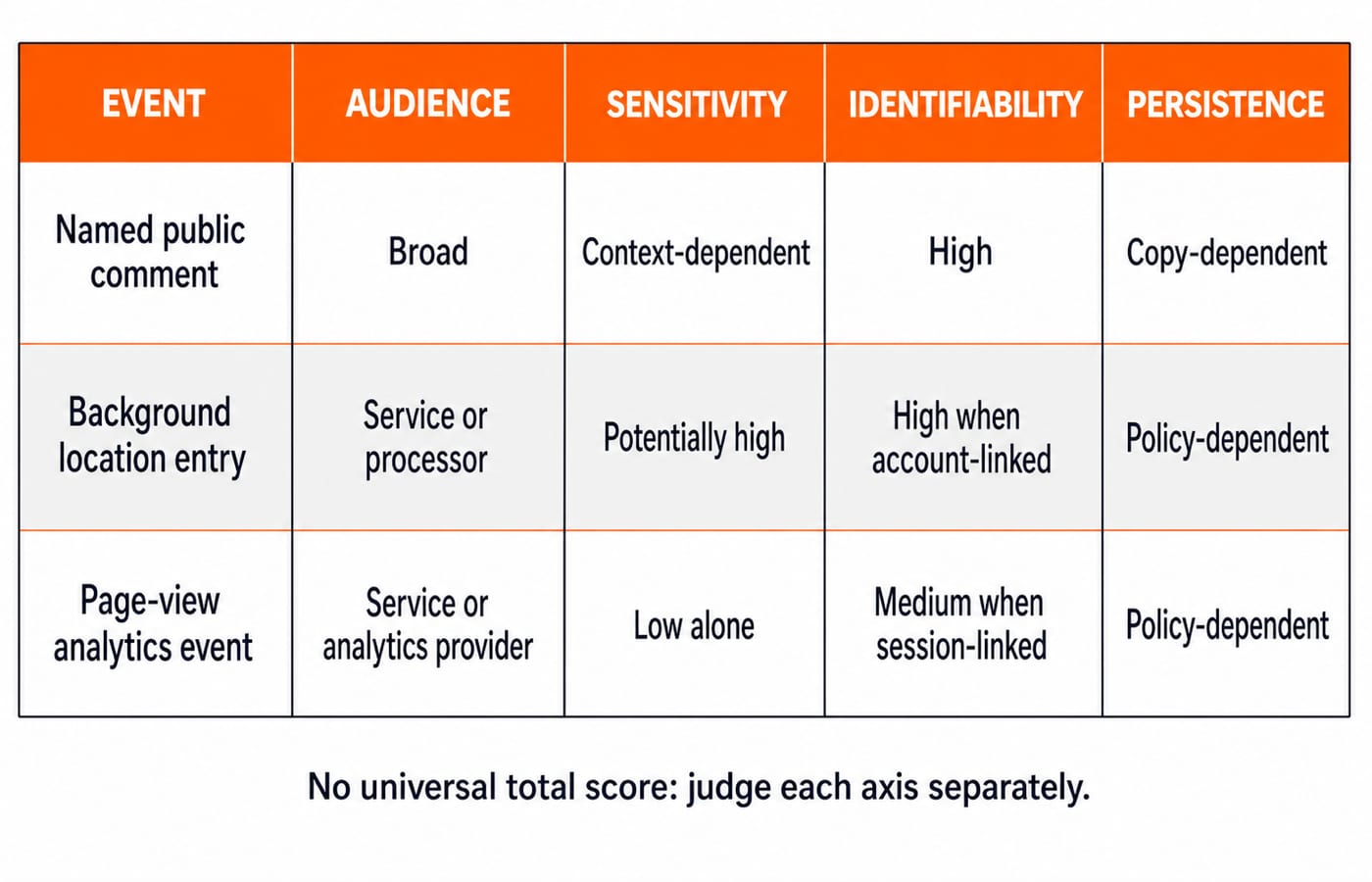
Judge each trace separately by audience, sensitivity, identifiability and persistence.
Artefact | Audience | Sensitivity | Identifiability | Persistence |
|---|---|---|---|---|
Named public comment | Broad | Context-dependent | High | Copy-dependent |
Background location entry | Service or processor | Potentially high | High when account-linked | Policy-dependent |
Page-view analytics event | Service or analytics provider | Low alone | Medium when session-linked | Policy-dependent |
Active does not mean risky, passive does not mean harmless, public does not mean accurate, and private does not mean no footprint. Risk depends on content, context, access and combined data.
Never invent weights for a universal footprint score. Use weights only when a numerical question supplies them. Here, 33.33% and 66.67% describe ledger composition, not privacy harm or cyber risk.
Privacy, security and ethics: choose the least intrusive workable design
Privacy asks whether collection and use suit the purpose. Security asks whether data is protected from unauthorised access or change. Ethics asks whether treatment is fair, necessary and respectful, even if allowed. Digital reputation is an outcome, not a substitute for these lenses.
A teacher proposes a leaderboard for 40 learners with full name, e-mail, phone and score, four fields per row, merely to show rank. A better design would:
Publish inside the authenticated class space.
Replace three direct identifiers, name, e-mail and phone, with one assigned roll code.
Keep roll code, score and rank.
Restrict access to the 40 learners.
Apply a stated classroom rule that removes the file after 30 days.
This preserves ranking while reducing identifiers, audience and retention. Minimisation, meaningful notice, controlled access, correction and bounded retention are useful decision principles; applicable law determines the specific duty.
How exams test digital footprints, and the traps to avoid
Practice formats include identifying a definition, classifying traces, choosing the most privacy-preserving response, and evaluating statements with NOT or EXCEPT. Check the examining body's current official notification for its syllabus and pattern.
Try this statement-set drill:
I. "A public comment deliberately posted by its author is an active trace."
II. "A background location entry recorded automatically by an enabled app is a passive trace."
III. "Deleting the original post guarantees that every screenshot and reshare disappears."
The correct selection is I and II only. I is deliberate contribution, II is automatic recording, and III fails because independently held copies are outside the original delete action.
Reject six traps: footprint means only social media; incognito means no records; active means beneficial; passive means malicious; private means no footprint; all copies vanish with the original.
The short version and next study step
Ask six questions: What action occurred? Which data was created? Was the trace deliberate or automatic? Who holds it? Who can access it? Which copies or retention rules affect deletion? Nisha's original boundary has 10 active and 20 passive records, a 33.33% to 66.67% split. The later 31 uses a wider boundary.
Teaching-recruitment learners can inspect current coverage in the DSSSB TGT CS 2026 Section B Course and RSSB Basic Computer Instructor Course.
Keep learning

Digital Society Explained: Core Concepts, a Worked Inclusion Audit and Exam Patterns
Learn to separate access, skills and outcomes, audit digital inclusion with a worked funnel, apply data minimisation and solve common exam cases.
Updated 15 Oct 20266 min readTeaching Recruitment (Computer Science)

Physical Security Assets and Risk Factors: Worked Audit, Controls and Exam Traps
Follow a fictional college server-room audit from asset inventory to residual risk. Calculate four priorities, test power continuity, and avoid common exam traps.
Updated 6 Nov 20266 min readUGC NET Computer Science

Theory of Computation for GATE: Syllabus Map, Weightage Audit and Preparation Order
Map the official Theory of Computation syllabus, audit its completed GATE 2026 paper weightage, and revise finite automata, PDA and Turing machines in dependency order.
Updated 30 Oct 20265 min read63 viewsTheory of Computation

E-Commerce and Digital Transactions Explained: Models, Flow and a Worked Funnel
Separate e-commerce from e-business, follow one order through its systems, and learn how to choose the right denominator in a transaction funnel.
Updated 11 Nov 20266 min readTeaching Recruitment (Computer Science)