

Database Connectivity in Java: JDBC Transactions with a Worked Transfer
Follow one JDBC money transfer from connection setup to verified update counts, commit, query, forced failure and rollback, with exact balance calculations.
KnowledgeGate Team
Exam prep & CS education
Updated 21 Nov 20266 min read
A short JDBC program can look like only "open, query, close", but its result crosses four boundaries: the Java API, the driver, the database session and the transaction; memorising methods is not enough if you confuse a connection with a successful transaction, concatenate input, or read a ResultSet before moving its cursor. JDBC in Java Tutorial: Connections, Queries and Transactions with Examples owns runnable H2 setup, connection and query mechanics, and a single guarded inventory update; a two-account transfer adds the harder requirement that debit and credit commit together. Moving 250.00 from Asha's account 101 to Ravi's 202 produces update counts 1 and 1, balances 1250.00 and 950.00, and a forced failure after the debit shows that rollback preserves the total 2200.00. The Coding & Skill Development Courses page places JDBC in the broader programming path.
JDBC is the contract between Java code and a database
The path is Java application -> JDBC API -> JDBC driver -> DBMS. JDBC supplies interfaces, the driver handles the protocol, and the DBMS runs SQL against stored data. A connection proves that a session exists, not that later work will succeed.
JDBC type | Role | Exact use in the worked transfer |
|---|---|---|
| Obtains a | Get connection C1 |
| Owns session and transaction controls | Set auto-commit false, commit or rollback |
| Holds fixed SQL plus bound values | Debit |
| Exposes query rows through a cursor | Read balances in account ID order |
| Carries database-access failure information | Trigger rollback and preserve the original exception |
Statement accepts SQL text, PreparedStatement fixes the SQL shape and binds values, and CallableStatement calls stored procedures. Here, 250.00, 101 and 202 are values. Placeholders cannot represent identifiers.
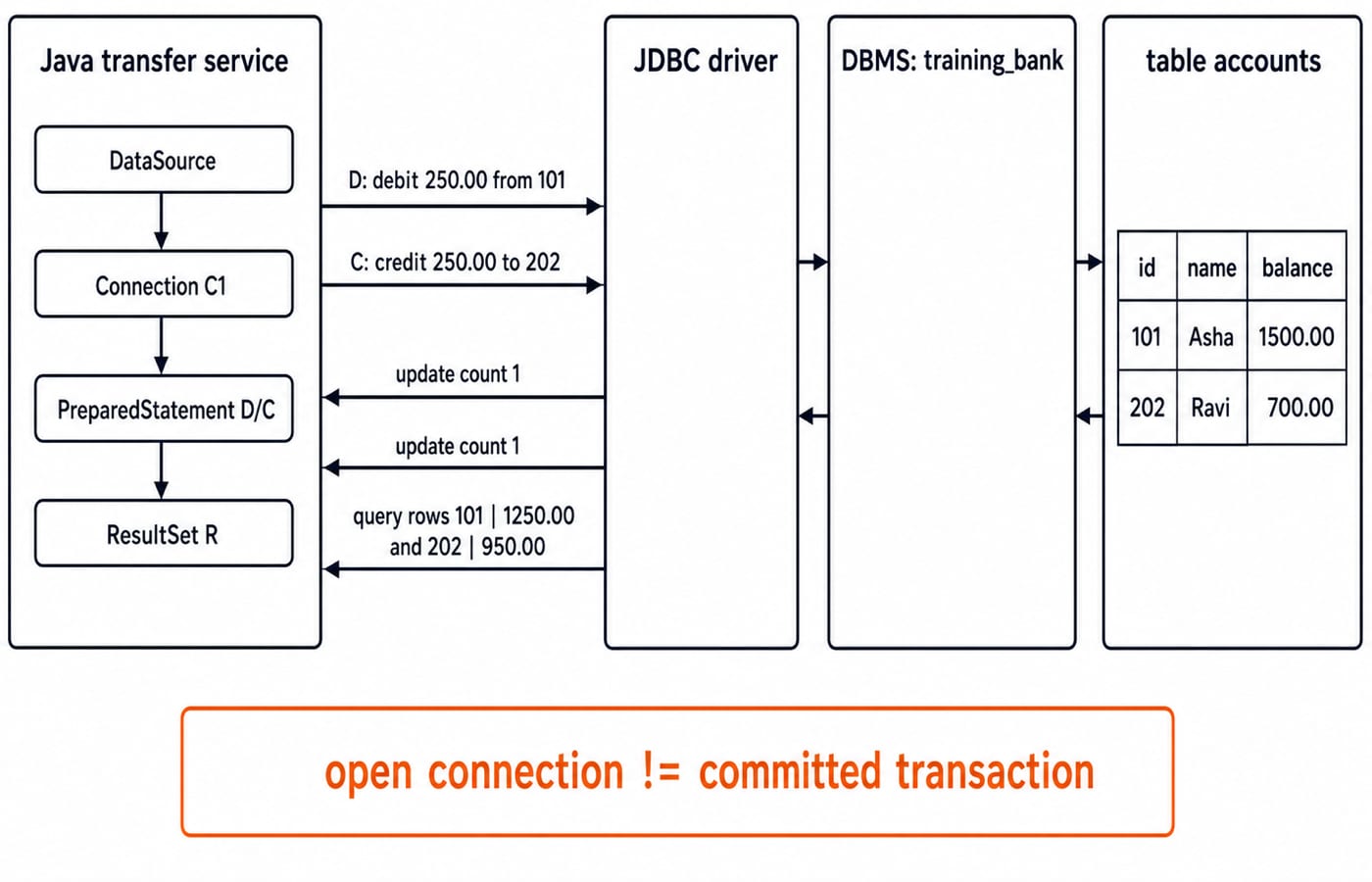
Fix the schema, rows and transaction invariant
Use accounts(account_id INTEGER PRIMARY KEY, holder VARCHAR(40) NOT NULL, balance DECIMAL(10,2) NOT NULL CHECK (balance >= 0)). This assumes a transactional engine; DDL support varies by DBMS. Represent the amount as new BigDecimal("250.00"), not binary floating point.
Initially, 101, Asha, 1500.00 and 202, Ravi, 700.00 give 1500.00 + 700.00 = 2200.00. A transfer may redistribute that total, never change it.
The debit template is UPDATE accounts SET balance = balance - ? WHERE account_id = ? AND balance >= ?, bound as (250.00, 101, 250.00). The credit template is UPDATE accounts SET balance = balance + ? WHERE account_id = ?, bound as (250.00, 202). These are ordinary SQL queries applied to invented teaching rows.
Open and close JDBC resources deliberately
Nest try-with-resources: outer Connection con = dataSource.getConnection(), inner debit and credit statements, then a check statement and ResultSet. Resources close even on failure, but closure does not choose commit or rollback. DataSource configuration determines what close() does physically.
Save boolean previousAutoCommit = con.getAutoCommit(), call con.setAutoCommit(false), and restore the saved value in finally only once the transaction has actually been resolved. Restoring it is not neutral cleanup: JDBC commits any open transaction the moment auto-commit is switched back on, so a restore after a failed rollback can commit the half-finished transfer. If rollback itself fails, leave auto-commit unchanged; the connection must be discarded rather than returned to a pool for reuse.
Prepare SELECT account_id, holder, balance FROM accounts WHERE account_id IN (?, ?) ORDER BY account_id, bind 101 and 202, then call rs.next() before reading. The cursor starts before row one. Expect 101, Asha, 1250.00 and 202, Ravi, 950.00.
Worked transfer: account for every state change
This compact transaction validates both intended changes before committing:
BigDecimal amount = new BigDecimal("250.00");
int fromId = 101, toId = 202;

try (Connection con = dataSource.getConnection()) {
    boolean previousAutoCommit = con.getAutoCommit();
    con.setAutoCommit(false);
    boolean resolved = false;
    SQLException pending = null;
    try (PreparedStatement debit = con.prepareStatement(DEBIT_SQL);
         PreparedStatement credit = con.prepareStatement(CREDIT_SQL)) {
        debit.setBigDecimal(1, amount);
        debit.setInt(2, fromId);
        debit.setBigDecimal(3, amount);
        int debitCount = debit.executeUpdate();
        if (debitCount != 1) throw new SQLException("Debit changed " + debitCount + " rows");

        credit.setBigDecimal(1, amount);
        credit.setInt(2, toId);
        int creditCount = credit.executeUpdate();
        if (creditCount != 1) throw new SQLException("Credit changed " + creditCount + " rows");

        con.commit();
        resolved = true;
    } catch (SQLException ex) {
        pending = ex;
        try {
            con.rollback();
            resolved = true;
        } catch (SQLException rollbackEx) {
            ex.addSuppressed(rollbackEx);
        }
        throw ex;
    } finally {
        if (resolved) {
            try {
                con.setAutoCommit(previousAutoCommit);
            } catch (SQLException restoreEx) {
                if (pending != null) pending.addSuppressed(restoreEx);
                else throw restoreEx;
            }
        }
    }
}
Debit: 1500.00 - 250.00 = 1250.00, count 1. Credit: 700.00 + 250.00 = 950.00, count 1. Then 1250.00 + 950.00 = 2200.00, unchanged. Count 0 forbids commit. A rollback error is attached without losing the original cause. The resolved flag keeps the finally block honest: it is set only after commit or rollback succeeds, so a rollback failure never triggers an auto-commit restore. That prevents an accidental commit caused by the restore, but it does not prove that close() rolled back: a connection pool must discard or reset the failed connection according to its error policy. The same guard prevents a restore failure from masking the original exception. Never log passwords or full connection strings.
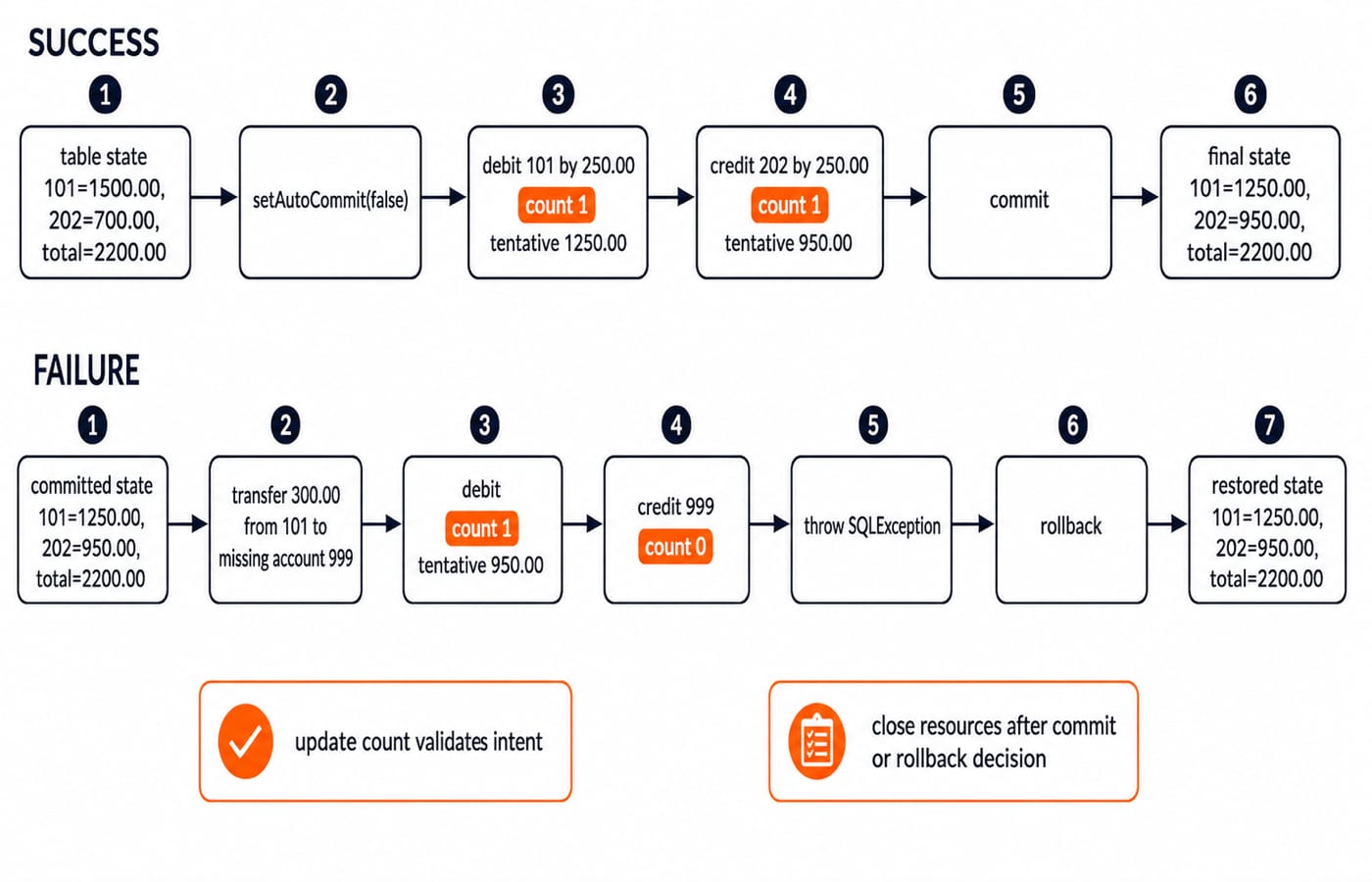
Trace the rollback path
Start again from 101=1250.00 and 202=950.00. Sending 300.00 to missing account 999 tentatively gives 1250.00 - 300.00 = 950.00, debit count 1, but credit count 0. The deliberate SQLException triggers rollback. Account 101 returns to 1250.00, 202 stays 950.00, 999 remains absent, and 1250.00 + 950.00 = 2200.00 stays committed. With auto-commit on, the debit could survive alone.
A debit of 1400.00 from balance 1250.00 matches zero rows because of balance >= ?, so no credit runs. Do not pre-read and then issue an unconditional debit. The conditional update makes one statement decide, although locking and isolation depend on the DBMS and configured level.
Prevent common JDBC defects
Mistake | Consequence | Repair |
|---|---|---|
Concatenate account input into SQL | Input can alter SQL structure | Bind values |
Use | Binary rounding can affect money arithmetic | Use |
Leave auto-commit on | Debit and credit become separate commits | Disable it for the unit of work |
Ignore update count | A missing account looks successful | Require exactly one changed row |
Read | Cursor is before the first row | Advance and test |
Suppress | Caller sees false success | Roll back and rethrow |
Binding separates values from SQL text. Dynamic identifiers and optional clauses need controlled construction, and binding cannot fix every injection or authorisation defect. Open late, finish one transaction, restore state, close deterministically, and load credentials from configuration. Measure pool sizes, timeouts and performance in the real system.
Test understanding through causality
Typical checks ask you to arrange the lifecycle, match JDBC types to roles, choose executeQuery() for row-producing SQL or executeUpdate() for an update, predict counts, trace commit and rollback, identify cursor position, spot concatenation, or calculate final rows.
Check: (1) starting total, (2) debit count, (3) balances after commit, (4) credit count for missing 999, (5) balance of 101 after rollback. Answers: (1) 2200.00; (2) 1; (3) 1250.00 and 950.00; (4) 0; (5) 1250.00. ResultSet reads rows; Connection controls this transaction. A connection can succeed while a statement fails, and resources can close after rollback.
The short version and the next step
Retrieve seven steps: obtain a connection; disable auto-commit; prepare fixed SQL; bind typed values; execute and validate both counts; commit on complete success or rollback; restore state and close. The arithmetic is 1500.00 - 250.00 = 1250.00, 700.00 + 250.00 = 950.00, total 2200.00.
Now restart from 1500.00 and 700.00, then transfer 425.50. You should get debit 1074.50, credit 1125.50, counts 1 and 1, and total 2200.00. Change the target to 999 and explain why rollback restores 1500.00 and 700.00.
Redraw both diagrams, implement that variation with BigDecimal, and test success, missing-target and insufficient-funds paths. Use Complete Java to build the wider foundation, or Java: Concepts, MCQs & Coding Questions when you want concept and question practice together.
Keep learning
JDBC in Java Tutorial: Connections, Queries and Transactions with Examples
Build and run one Java 17 program that creates an H2 table, inserts three products, filters them safely, then rolls back and commits two stock updates.
Updated 1 Nov 20266 min readJava

Java Distributed Technologies: RMI, JDBC, JMS and Two Worked Exam Traces
Build one coherent model of Java distributed APIs, then solve a lost RMI reply and a two-client JDBC stock race using exact traces.
Updated 8 Aug 20266 min readProgramming Languages Survey
Direct Memory Access (DMA) Explained: Bus Cycles, Transfer Modes and a Worked Example
DMA becomes easier when you trace bus ownership, addresses and timing as one transfer. This guide follows a 6 KiB block through burst, cycle-stealing and transparent modes.
Updated 30 Oct 20266 min read163 viewsComputer Organization & Architecture

Register Transfer and Microoperations in COA: RTL Notation, Bus Design, and Every Microoperation Type with Worked Examples
RTL becomes easy when you treat every statement as parallel hardware action at one clock edge. This guide works through buses, subtraction, bit masks, insertion, and signed shifts.
Updated 2 Aug 20266 min read93 viewsComputer Organization & Architecture