

Enterprise JavaBeans (EJB) Architecture Explained: Bean Types, Container Services and a Transaction Walkthrough
See where the EJB container sits, how each bean type behaves, and what the database and message queue retain when a booking transaction commits or rolls back.
KnowledgeGate Team
Exam prep & CS education
Updated 21 Nov 20265 min read
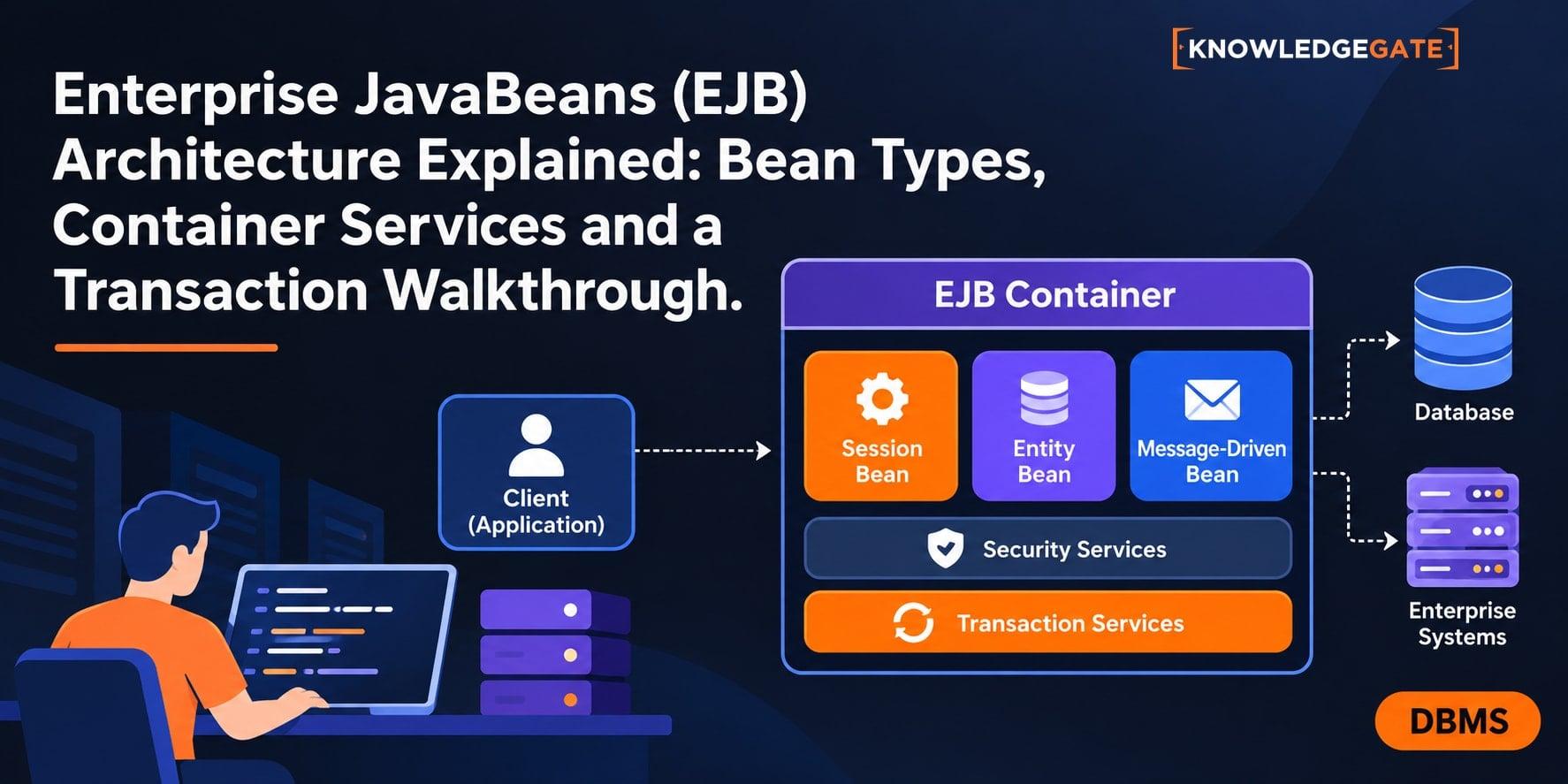
EJB is often memorised as a list of bean types, leaving the crucial boundary between client code, the container, the bean and external resources vague. The reserve("B-204", "LAB-3", 3) example traces a stateless bean, transaction T-501, a database row and a message-driven bean through commit and rollback, making each responsibility visible.
EJB architecture: the container sits between the client and the bean
EJB historically means Enterprise JavaBeans. The current official name is Jakarta Enterprise Beans, and version 4.0 uses the jakarta.ejb namespace. Older notes may use javax.ejb or EJB. The Java hub places that naming change in the wider language ecosystem.
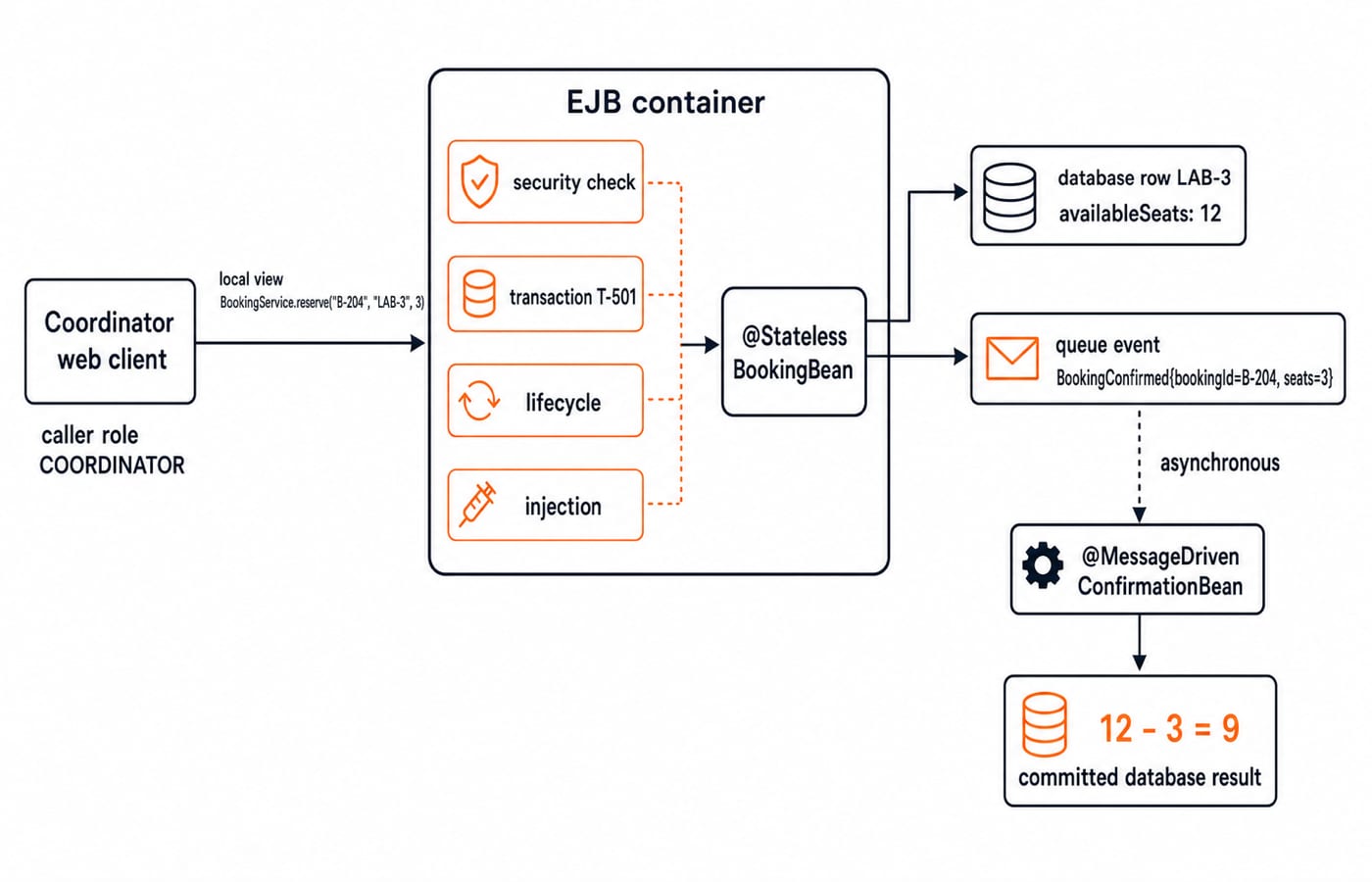
A web, REST or application client calls a local, remote or no-interface view. The container intercepts the call and invokes a session bean, with persistence, messaging and other resources behind it. The client uses that view instead of constructing a managed bean with new.
The Jakarta Enterprise Beans 4.0 core specification assigns business methods to the bean provider and lifecycle, injection, transaction boundaries, security checks, resource management, concurrency control and interception to the container.
Choose among stateless, stateful, singleton and message-driven beans
Bean kind | State or access model | Container behaviour | Suitable use |
|---|---|---|---|
| No conversational state between calls; any pooled instance may serve any client | Selects a ready instance |
|
| Conversational field state retained for one client across calls | Client-associated lifecycle, with optional passivation and activation | Multi-step booking draft |
| One shared instance per application per JVM, with concurrent access | Application-lifetime instance plus concurrency control | Shared configuration snapshot |
| Asynchronous listener hidden behind a destination or endpoint | Equivalent instances can process messages concurrently | Confirmation event consumer |
Classic-exam note: Older EJB models describe entity beans as persistent business data components. This legacy model is not a Jakarta Persistence entity. Enterprise Beans 4.0 places the EJB 2.x entity-bean contracts in its optional-features specification.
Quick rule: no client memory means stateless; private conversation, stateful; application-wide instance, singleton; queued work, message-driven.
Worked success path: reserve three seats inside transaction T-501
Room LAB-3 starts with availableSeats = 12, and booking B-204 does not exist. A COORDINATOR calls reserve("B-204", "LAB-3", 3) without an incoming transaction.
@Stateless BookingBean exposes a local BookingService view. Its reserve method has @TransactionAttribute(REQUIRED). The container:
Authenticate the caller and allow the
COORDINATORrole.Select a ready stateless instance.
Start
T-501, because no client transaction exists.Inject or expose the persistence and messaging resources.
Invoke the business method.
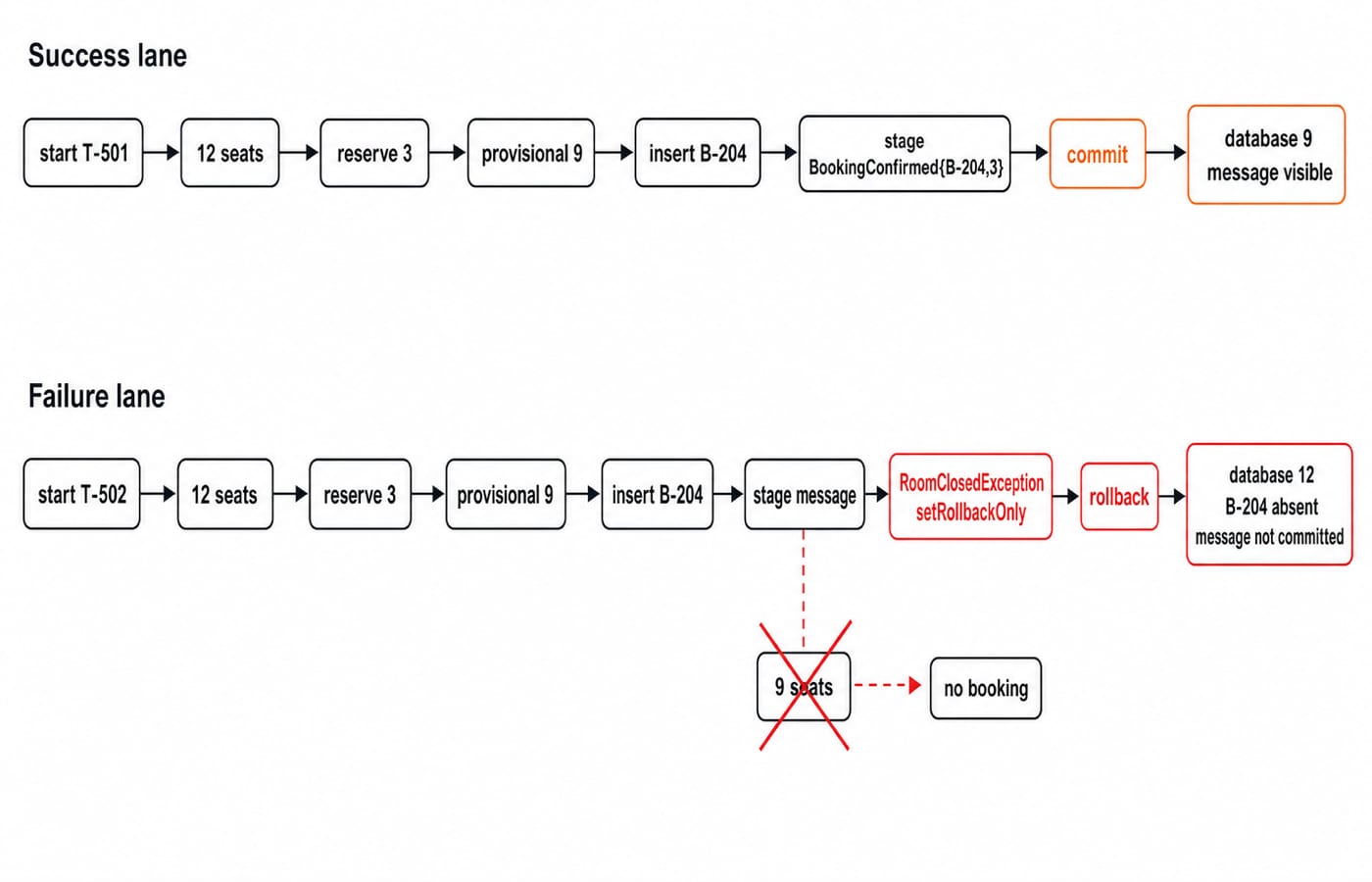
The method validates 3 > 0 and 12 >= 3, computes 12 - 3 = 9, updates the seat row and inserts {id: B-204, room: LAB-3, seats: 3}. Through an injected Jakarta Messaging context enlisted in T-501, it sends BookingConfirmed{bookingId=B-204, seats=3}. The database writes and message send remain tentative until the container commits T-501.
After commit, @MessageDriven ConfirmationBean receives the event asynchronously and records one confirmation attempt in this scenario. This does not promise exact order or exactly-once delivery. Multiple instances may process concurrently, and messages may arrive out of sequence.
REQUIRED joins an existing transaction or starts one when none exists, as here. It is also the container-managed default, but the annotation keeps this example explicit.
Worked rollback path: the provisional 9 must return to 12
Reset the state: LAB-3 availableSeats = 12, no B-204, and no committed confirmation event. The same call starts T-502, provisionally changes 12 to 9, inserts the booking and sends the event through the same enlisted messaging context. Before commit, RoomClosedException("LAB-3 unavailable") occurs. The method calls EJBContext.setRollbackOnly() before the failure leaves the business path.
Rollback restores the observable state: seats are 12, booking B-204 is absent, and no staged confirmation is committed for consumption. The partial result availableSeats = 9 with no booking is incorrect.
Under container-managed demarcation, bean code must not call JDBC commit, setAutoCommit or rollback. It can mark the active transaction for rollback through setRollbackOnly(), while the container performs the actual rollback.
Stateful is client conversation, not merely an object with a field
Assume add returns the updated total. Ria obtains one stateful DraftBookingBean with selectedSeats = 0. Her call add("LAB-3", 2) returns 2; add("LAB-5", 1) returns 3; total() returns 3. Kabir has a separate conversation starting at 0, so his add("LAB-3", 1) returns 1. The output sequence is 2, 3, 3, 1.
That reasoning is invalid for a stateless bean. Any ready pooled instance may serve a call, so a later call is not entitled to see an earlier client's instance field. A stateful bean instead retains conversational state for its associated client.
An idle, passivation-capable stateful instance may be passivated and activated while preserving eligible conversational state. Passivation is not database persistence, and a stateful bean may declare itself non-passivation-capable. Stateless beans are not passivated. Compare this lifecycle with ordinary object identity in Object Oriented Technology Explained.
Client views and container services: identify who owns each concern
Bean code owns | Container or platform infrastructure owns |
|---|---|
Validate requested seats | Select an instance |
Calculate | Apply the |
Create | Start or join |
Decide which event to send | Inject resources |
Commit or roll back | |
Control concurrent access and deliver lifecycle callbacks |
A local view supports same-application calls. A remote view supports location-independent calls with remote semantics. A no-interface view exposes local business methods through the bean class. A container-provided reference is not proof that the client holds the raw instance.
@Stateless, @Stateful, @Singleton, @MessageDriven and @TransactionAttribute declare intent; the container does the runtime work.
Legacy note: Home and component interfaces belong to the classic model. They do not justify constructing a bean directly.
How exams and interviews can test EJB architecture
Questions commonly ask you to identify conversational state, asynchronous processing, classic entity beans, container services, client views and separate client counters. Map each clue to its state owner and call style before choosing an answer.
Repair these six common traps:
Trap | Repair |
|---|---|
Stateless means one new instance per request | The container may pool instances |
Stateful means durable database state | It means client conversational state |
Message-driven means a synchronous client method call | The client addresses a destination or endpoint |
Singleton means one instance across every JVM | The guarantee is per application per JVM |
| It bypasses the managed reference |
Entity bean equals every modern persistence entity | Classic entity beans and Jakarta Persistence entities are different models |
In 30 seconds, underline state, client, shared, asynchronous, persistent and container. Draw client -> view -> container -> bean -> resource, assign ownership, then choose. For wider practice, use Coding & DSA Courses for Placements.
Short version and the next study step
The client sees a managed view, and the container wraps calls with runtime services. Session beans run synchronous business logic using stateless, stateful or singleton state models; message-driven beans consume asynchronous work. T-501 commits 12 - 3 = 9 plus B-204. T-502 rolls back to 12, with no booking or committed message. Continue with the Complete Java Course for foundations or Java Course: Concepts, MCQs and Coding Questions for structured practice, then redraw both transaction lanes from memory.
Keep learning
MPLS Explained: Label Switching, Header Fields and a Packet Walkthrough
See where an MPLS label comes from, why it changes at each hop, how the shim header is encoded, and when ordinary IP forwarding resumes.
Updated 12 Sep 20266 min read71 viewsComputer Networks
CSS Container Queries: Build a React Card That Adapts to Its Container
Build one portable React card that responds to the space its parent provides. Follow its layout, padding and title size at three exact container widths.
Updated 25 Oct 20266 min readWeb Development
C++ Iterators and Invalidation: Container Rules and Safe Erase Loops
Learn to read iterator ranges, match algorithms to categories, and mutate standard containers without using stale handles. Includes two fully traced erase examples.
Updated 18 Sep 20266 min read62 viewsC++
C++ deque, list and forward_list: Choose the Right Non-Vector Container
Use one controlled sequence-editing workload to compare deque, list and forward_list. See where search cost, iterator validity and memory locality change the decision.
Updated 30 Oct 20266 min readC++