

Arrays in Java: Indexing, Traversal and Worked Examples
Build a reliable model of Java arrays, then trace mutation, traversal, copying, logical deletion and ragged rows with exact values.
KnowledgeGate Team
Exam prep & CS education
Updated 20 Nov 20266 min read
Java array questions become difficult when one fixed-capacity object carries two sizes: physical length and logical element count. Indexed reads may be constant time while insertions and deletions still move several values.
Use Arrays in Java: Declaration, Traversal, 2D Arrays and Worked Examples for declaration syntax, java.util.Arrays utilities and a broad marks traversal. Sequential-data-structure reasoning begins with state changes: shift in the correct direction, track logical size, trace aliases through method calls, and distinguish a bad index from a null element.
Build the correct Java array model
An array is a fixed-length Java object whose numbered slots share one component type. Valid physical indices run from 0 to array.length - 1, and array.length is a field. A sequential structure backed by an array usually needs a separate size variable for the number of active elements.
int[] values = {14, 9, 21, 17, 0, 0};
int size = 4;
The physical length is 6, the logical size is 4, and the active indices are 0 through 3. Accessing values[4] is legal Java but reads a spare slot outside the active sequence; values[6] throws ArrayIndexOutOfBoundsException. New numeric slots default to 0, reference slots to null, and boolean slots to false.
Trace one-dimensional insertion and deletion step by step
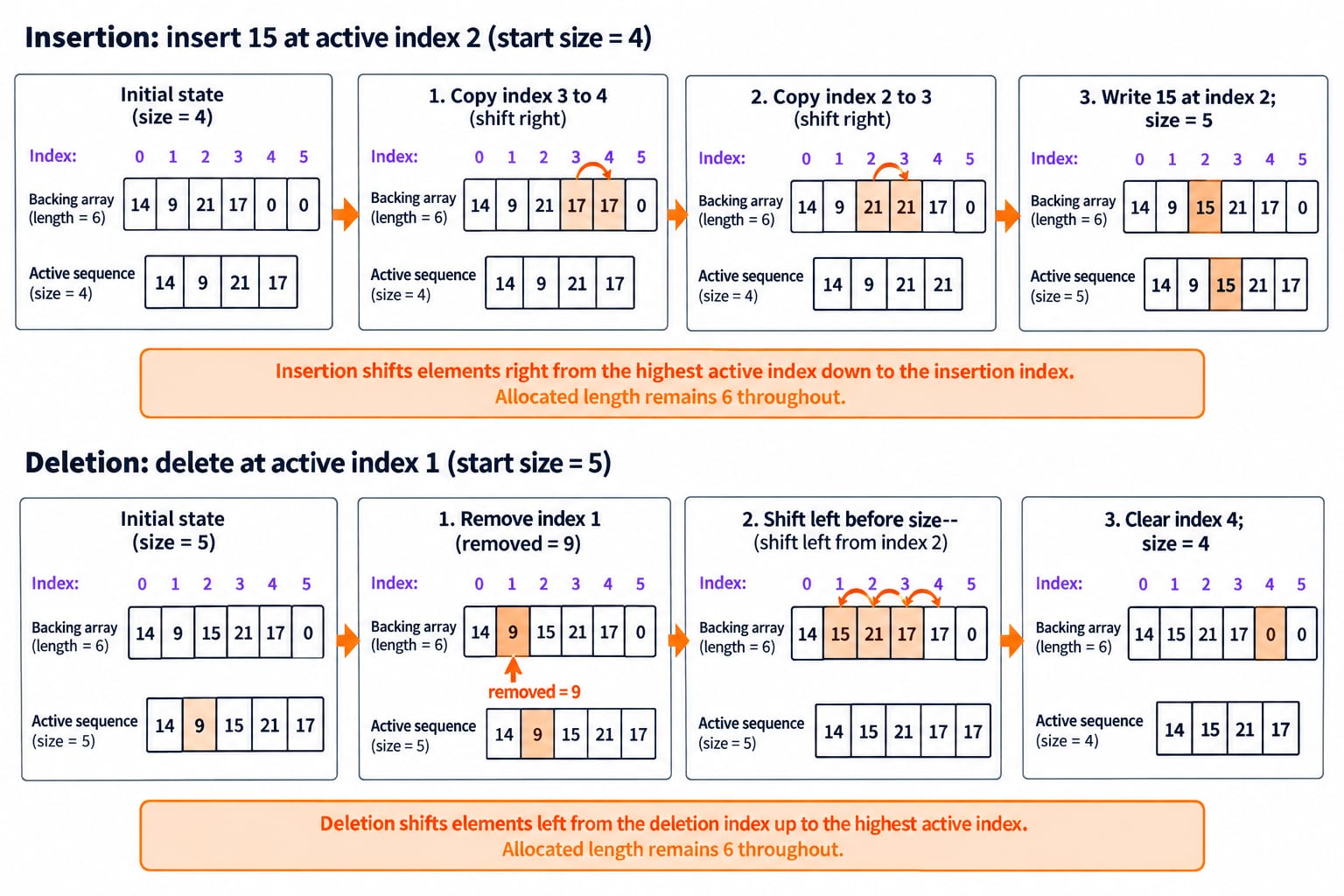
Insert 15 at active index 2. Existing elements must shift right from the highest active index downward so that no source is overwritten:
int insertAt = 2;
for (int i = size; i > insertAt; i--) {
    values[i] = values[i - 1];
}
values[insertAt] = 15;
size++;
Now delete active index 1, whose value is 9. Elements shift left from the deletion point upward. After the shift, decrement size first, then clear the newly inactive slot:
int deleteAt = 1;
int removed = values[deleteAt];
for (int i = deleteAt; i < size - 1; i++) {
    values[i] = values[i + 1];
}
size--;
values[size] = 0;
Operation | Backing array after the operation | Active sequence |
|---|---|---|
Start: size = 4 | [14, 9, 21, 17, 0, 0] | [14, 9, 21, 17] |
Copy index 3 to 4 | [14, 9, 21, 17, 17, 0] | [14, 9, 21, 17] |
Copy index 2 to 3 | [14, 9, 21, 21, 17, 0] | [14, 9, 21, 21] |
Write 15 at index 2; size = 5 | [14, 9, 15, 21, 17, 0] | [14, 9, 15, 21, 17] |
Shift left before size-- | [14, 15, 21, 17, 17, 0] | [14, 15, 21, 17, 17] |
Clear index 4; size = 4 | [14, 15, 21, 17, 0, 0] | [14, 15, 21, 17] |
Insertion moves two existing values, from indices 3 and 2. Deletion moves three values, originally at indices 2, 3 and 4. The final active sequence is [14, 15, 21, 17], while the allocated length remains 6.
Connect access, update, search and logical deletion to cost
Physical storage and operation cost are separate questions. Reading or updating a known valid index does not depend on the array length, but finding an unknown value and preserving order during insertion or deletion may inspect or move a suffix.
Operation | Time | Reason |
|---|---|---|
Read or update a known index | O(1) | The index identifies one slot directly |
Linear search | O(n) | The target may be absent or in the final active slot |
Traverse all active elements | O(n) | Each active slot is visited once |
Insert at active index p | O(n - p) | The suffix shifts right |
Delete at active index p, preserving order | O(n - p - 1) | Later elements shift left |
If order does not matter, deletion can overwrite the removed slot with the final active value and decrement size in constant time. That changes the sequence order, so it is not a substitute when order carries meaning. For resizable lists and other implementations built around these trade-offs, continue with DSA using Java.
Trace aliases, real copies and method calls
Assignment aliases one array object, while Arrays.copyOf allocates another top-level array. A method call makes the distinction visible:
static void mutateThenRebind(int[] x) {
    x[1] = 40;
    x = new int[] {7, 8};
    x[0] = 99;
}

int[] original = {10, 20, 30};
int[] alias = original;
int[] copy = Arrays.copyOf(original, original.length);
mutateThenRebind(original);
After the call, original and alias both observe [10, 40, 30], while copy remains [10, 20, 30]. The write of 40 reaches the shared original object before the local parameter is rebound. The later write of 99 reaches only the new local array. Java passes the reference value by value; for object arrays, Arrays.copyOf still copies references rather than cloning their objects.
Read two-dimensional and ragged arrays as arrays of arrays
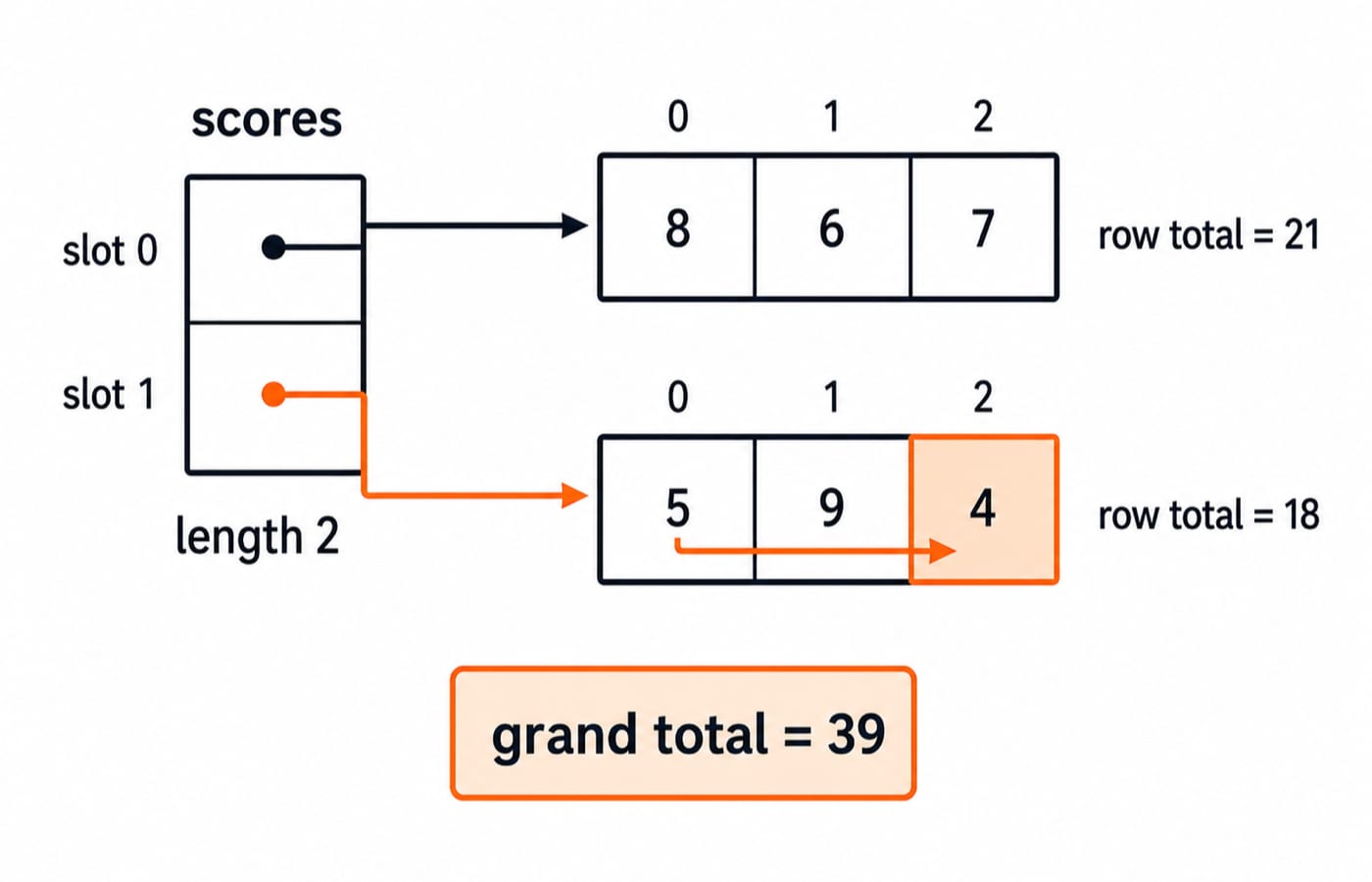
Consider int[][] scores = {{8, 6, 7}, {5, 9, 4}};. Here, scores.length = 2, while scores[0].length = 3 and scores[1].length = 3. The access scores[1][2] returns 4. A nested loop visits values in row order, 8, 6, 7, 5, 9, 4. The row totals are 8 + 6 + 7 = 21 and 5 + 9 + 4 = 18, giving a grand total of 21 + 18 = 39.
The model matters: scores refers to an outer array whose two slots refer to separate row arrays. Java therefore permits ragged rows. For int[][] steps = {{2, 4}, {6, 8, 10}, {12}};, the row lengths are 2, 3 and 1. steps[1][2] is 10, but steps[2][1] is outside the one-element third row and fails at runtime.
Do not use the shortcut columns = scores.length. A row length comes from the chosen row. To handle arbitrary ragged data, the inner loop condition must be j < scores[i].length.
Separate primitive slots from reference slots
Compare int[] counts = new int[3]; with String[] labels = new String[3];. The first array contains three primitive 0 values. The second contains three null references. After labels[0] = "red", slot 0 stores a reference to a created or reused String object, while slots 1 and 2 remain null.
That difference produces two distinct failures. labels[0].length() returns 3, but labels[1].length() throws NullPointerException because slot 1 contains no object reference to follow. In contrast, labels[3] throws ArrayIndexOutOfBoundsException because a length-three array has no fourth slot. One error concerns the value in a valid slot; the other concerns an invalid index. Read String Handling in Java: Pool, Immutability, Interview Questions for the deeper String object and reference model.
Fix shift and size traps that produce wrong outputs
Four direction and boundary checks catch the failures that are specific to an array-backed sequence:
Wrong step | Result | Repair |
|---|---|---|
Shift an insertion suffix from low to high | A copied value overwrites the next source and cascades right | Shift from the highest active index down to the insertion point |
Shift a deletion suffix from high to low | An overwritten value cascades left | Shift from the deletion point upward |
Traverse to values.length after logical deletion | Spare or stale slots enter the result | Traverse while i < size |
Insert when size == values.length | Writing values[size] is out of bounds | Check capacity or allocate a larger array before shifting |
The preservation rule decides direction: insertion shifts right from high to low, while deletion shifts left from low to high. After either operation, 0 <= size && size <= values.length must remain true.
How questions test Java arrays, then the short version
Questions often ask for the exact backing array after each shift, the active sequence after logical deletion, the number of moved elements, alias effects, row bounds and default values. In the worked trace, insertion at index 2 moves two elements and deletion at index 1 from five active elements moves three. Direct access remains O(1), while an order-preserving insertion or deletion is linear in the shifted suffix.
Keep the model compact: length is physical and fixed; size is logical and changeable; active indices stop at size - 1; assignment aliases; Arrays.copyOf creates a new top-level array; and each ragged row owns its length. Study the sequence in the Java Course: Concepts, MCQs & Coding Questions, then rerun the insertion at index 0 and deletion at the final active index. Predict the backing array and exact assignment count before executing the code.
Keep learning
Arrays in C++: Sequential Storage, Indexing and Worked Examples
Build one C++ array from declaration to traversal, updates, memory addresses, fixed-capacity insertion and deletion, then extend the model to two dimensions.
Updated 27 Aug 20265 min readC++
Arrays in Java: Declaration, Traversal, 2D Arrays and Worked Examples
Build a correct mental model of Java arrays, then trace sums, aliases, jagged rows, sorting, binary search and common mistakes through exact examples.
Updated 30 Oct 20266 min readJava
Arrays in C++ MCQs: 12 Solved Questions with Explanations
Solve 12 published array MCQs with clear explanations of indexing, pointers, character buffers, declarations and multidimensional arrays.
Updated 29 Oct 20268 min readData Structures MCQs

NumPy Basics in Python: Arrays, Indexing and Broadcasting with Worked Examples
Follow one marks array from creation to shape checks, slicing, broadcasting and reductions, then learn how views, copies and common NumPy traps affect results.
Updated 30 Oct 20265 min readPython