

Data Link Layer Access Control: Choose the Right MAC Method and Solve Mixed Numericals
Learn to classify MAC methods, build one timing model, and solve collision windows, contention probabilities and controlled-access efficiency without mixing assumptions.
KnowledgeGate Team
Exam prep & CS education
Updated 10 Nov 20266 min read

A student can know every formula, plug tau into the minimum-frame formula instead of 2tau, and get 150 bits instead of the correct Lmin = 300 bits. The real problem is choosing the wrong formula for the stated model, which halves the answer.
Identify the sharing rule, compute timing, then use only the matching formula. CS Fundamentals for Exams & Placements maps the syllabus.
Data Link Layer access control starts with one shared-medium question
Medium access control decides which station may transmit on a shared link and how competition is handled. Its scope is one link, unlike routing algorithms, which select network paths, or the transport-layer choice between TCP and UDP.
Start with the family, not the expanded protocol name:
Family | Who decides the turn? | Can collisions occur in the stated model? | Cost | Typical clue |
|---|---|---|---|---|
Channelization | A fixed frequency, time or code allocation | No, under ideal partitioning | Inactive shares may be wasted | FDMA, TDMA, CDMA |
Random access | Any ready station contends | Yes | Idle contention and retransmission | ALOHA, CSMA |
Controlled access | A coordinator, reservation or token grants a turn | No, under the ideal permission model | Control traffic and coordination delay | Polling, reservation, token |
Focus on fixed partition versus contention versus explicit permission.
For definitions, ALOHA maxima, and a 10 Mb/s minimum-frame example, use the Data Link Layer Access Control overview. The unified 20 Mb/s model compares propagation, supplied-load ALOHA, p-persistent probability, TDMA, polling, and token efficiency under shared assumptions.
One timing model connects propagation, frame length and collision windows
Take four backlogged stations on a 1,500 m link. Propagation speed is 2 x 10^8 m/s, rate is R = 20 Mb/s, and frame length is L = 1,200 bits.
The one-way propagation delay is:
tau = 1,500 / (2 x 10^8) = 7.5 microseconds
Frame-transmission time and normalised delay are:
T = L/R = 1,200 / (20 x 10^6) = 60 microseconds
a = tau/T = 7.5/60 = 0.125
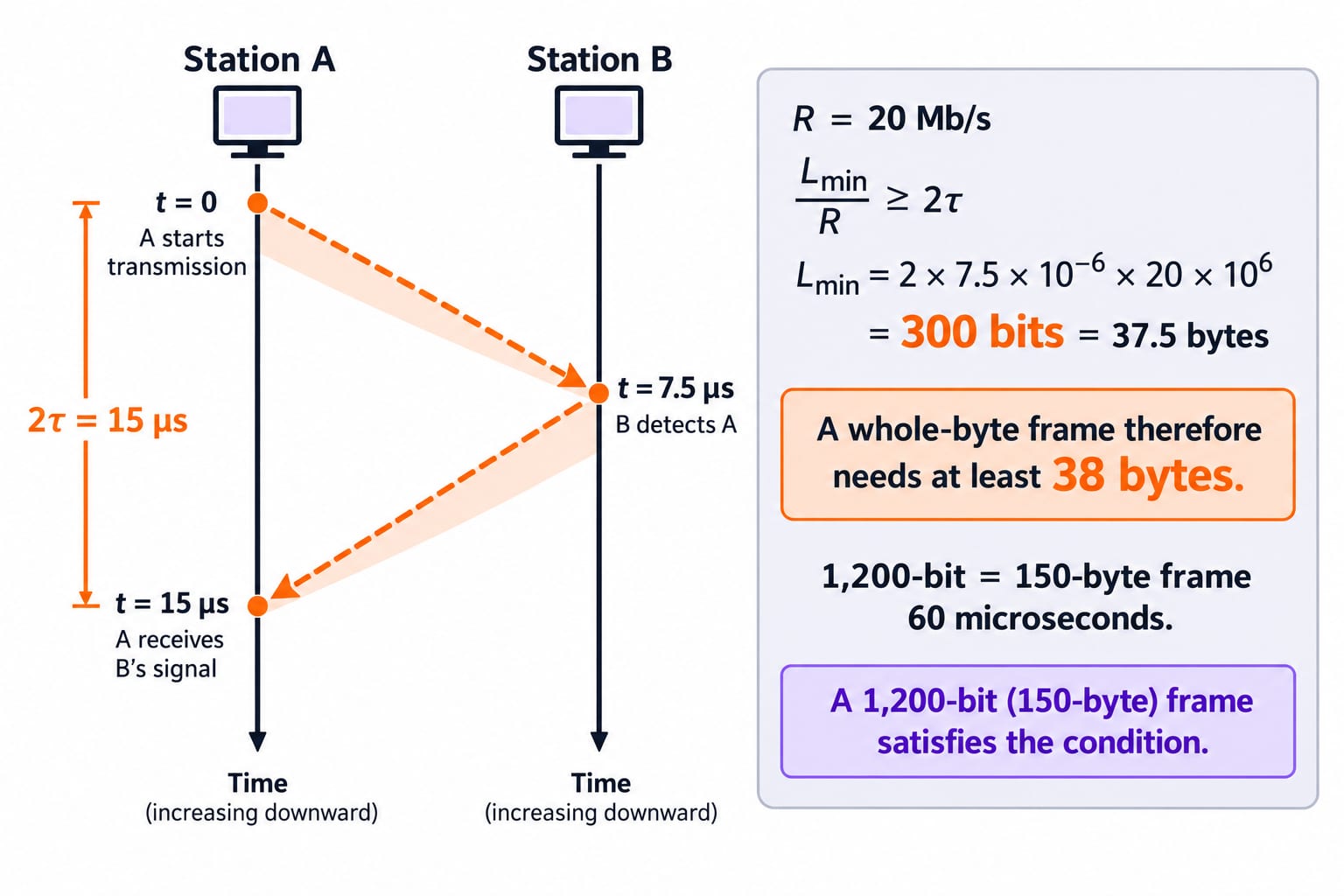
Propagation consumes one-eighth of a frame time. Distant stations can briefly sense idle, while 2tau = 15 microseconds sets the required collision-detection window.
For this idealised shared bus, Lmin/R >= 2tau. Therefore:
Lmin = 2 x 7.5 x 10^-6 x 20 x 10^6 = 300 bits = 37.5 bytes
A whole-byte frame therefore needs at least 38 bytes. The given 1,200-bit = 150-byte frame lasts 60 microseconds and satisfies the condition. This belongs to the stated model, not a named Ethernet standard.
Random access without mixing ALOHA and CSMA assumptions
Let the offered load be G = 0.8 attempts per frame time. Pure ALOHA gives:
S = Ge^(-2G) = 0.8e^(-1.6) = 0.1615
Slotted ALOHA gives:
S = Ge^(-G) = 0.8e^(-0.8) = 0.3595
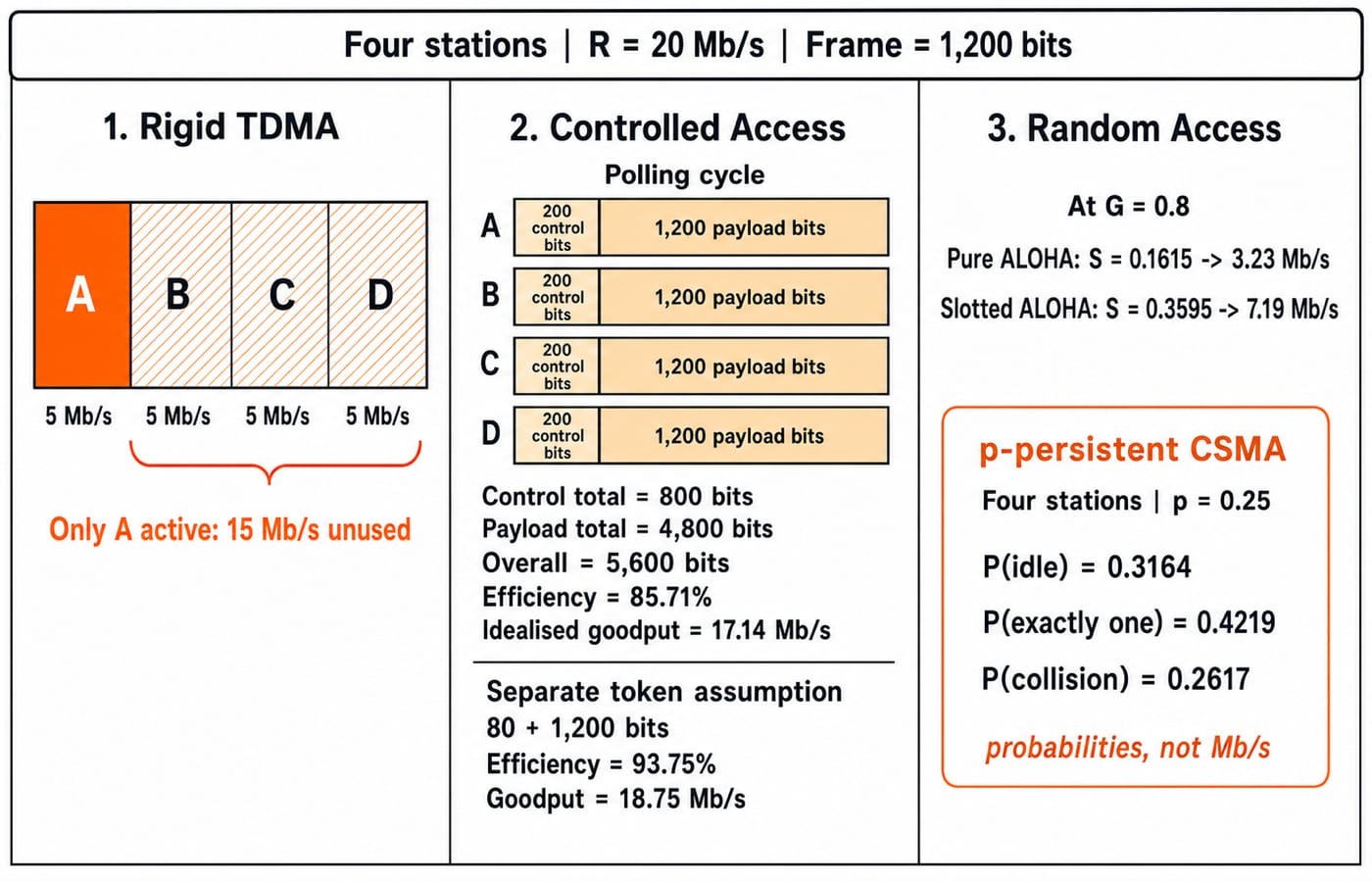
At 60 microseconds per frame, 1/(60 x 10^-6) = 16,666.7 frame times fit in one second. The rounded results are about 2,692 successful frames/s or 3.23 Mb/s for Pure ALOHA, and 5,992 frames/s or 7.19 Mb/s for Slotted ALOHA. They apply at the supplied G, not at each protocol's universal maximum.
Now let four stations use slotted p-persistent CSMA with independent p = 0.25 decisions after sensing idle:
P(idle) = 0.75^4 = 0.3164P(exactly one) = 4 x 0.25 x 0.75^3 = 0.4219P(collision) = 1 - 0.3164 - 0.4219 = 0.2617
Exactly one transmitter succeeds; zero is idle, not collision. Sensing reduces blind transmissions but cannot remove the 7.5 microsecond propagation delay. These probabilities are not a complete CSMA throughput model.
Channelization and controlled access trade collisions for coordination
In rigid TDMA, four equal slots divide 20 Mb/s into four raw 5 Mb/s shares, excluding framing and guards. If only one station is active, reserved slots leave 15 Mb/s unused in that cycle.
For polling, keep all stations backlogged. Each 200-bit permission is followed by one 1,200-bit frame:
Payload per cycle:
4 x 1,200 = 4,800 bitsControl per cycle:
4 x 200 = 800 bitsTotal:
4,800 + 800 = 5,600 bitsEfficiency:
4,800/5,600 = 0.8571Idealised payload goodput:
0.8571 x 20 = 17.14 Mb/s
This excludes propagation and other headers. With an 80-bit token before each 1,200-bit turn, token efficiency is 1,200/(1,200+80) = 0.9375, giving 18.75 Mb/s. Do not rank it against polling without comparable delay, control and failure assumptions.
Choose a MAC method by traffic pattern and coordination cost
Classify the method from the stem's operating rule before choosing a formula.
If the stem fixes four equal 5 Mb/s slots on the 20 Mb/s link, classify it as channelization using rigid TDMA. The controlling assumption is equal slots with no overhead.
If the stem sends a 200-bit permission before each 1,200-bit frame, classify it as controlled access using polling. Continuous backlog and the per-turn control bits determine the 85.71% efficiency.
If the stem gives offered load G = 0.8 and asks for throughput, classify it as random access using ALOHA. A sensing variant such as p-persistent CSMA remains contention, with P(exactly one) = 0.4219 under the stated assumptions.
Stated model | Worked result | Assumption that controls the result |
|---|---|---|
Rigid TDMA | Four raw 5 Mb/s shares | Equal slots, no overhead |
Polling | 17.14 Mb/s payload goodput | Continuous backlog, 200 control bits per turn |
Token passing | 18.75 Mb/s payload goodput | 80-bit token, all other overhead excluded |
Pure ALOHA at | 3.23 Mb/s | Pure ALOHA vulnerable period |
Slotted ALOHA at | 7.19 Mb/s | Slot-aligned attempts |
p-persistent CSMA |
| Four stations, independent |
Fixed partitions bound each turn but waste inactive shares. Controlled access prevents contention collisions but adds coordination. Random access handles bursty arrivals but loses capacity through idle decisions and collisions. Traffic, topology and overhead determine the right choice.
How mixed access-control questions are built and solved
A mixed problem may ask you to classify a rule, calculate tau, T or a, choose a vulnerable-period formula, find exactly-one probability, derive a minimum frame, or remove cycle overhead. Practice these combinations with questions on cross-concept DLL access control.
Use a fixed sequence:
Write the model and every simplifying assumption. This prevents you from applying a formula built for a different access rule.
Convert rates to bit/s and delays to seconds. This keeps incompatible units from corrupting the calculation.
Identify whether the answer is a probability, normalised throughput, frames/s, bit/s or efficiency. This prevents you from reporting the right calculation in the wrong form.
Calculate, then check the range and unit against
tau = 7.5 microseconds,T = 60 microseconds,Lmin = 300 bitsand polling efficiency0.8571. These checkpoints expose a halved collision window, an invalid range or a mismatched unit.
Test the sequence:
At 40 Mb/s over the same 1,500 m,
taustays 7.5 microseconds, butLmin = 2 x 7.5 x 10^-6 x 40 x 10^6 = 600 bits = 75 bytes.If polling control falls from 200 to 100 bits per station, the cycle is
4 x (1,200+100) = 5,200 bits. Efficiency is4,800/5,200 = 92.31%, so idealised goodput is0.9231 x 20 = 18.46 Mb/s.
Cross-concept traps and their corrections
Using tau instead of 2tau: this halves the collision window and minimum frame. Separate one-way delay from round-trip detection.
Treating G as successful load:
Gis attempted load;Sis normalised successful throughput.Calling an idle p-persistent slot a collision: zero transmitters is idle; two or more is collision.
Comparing 0.4219 with 17.14 Mb/s: one is a probability, the other a payload rate.
Merging families: channelization pre-allocates resources; controlled access grants turns. Sensing does not erase propagation, and detection is not avoidance.
Check the layer too. MAC rules neither assign IP subnets nor select end-to-end routes. IP Addressing and Subnetting Explained is the next numerical topic, not another access-control method.
Data Link Layer access control in the short version
Partition means channelization, permission means controlled access, and contention means random access. Propagation creates the collision window. Finish every calculation in the requested unit. For this worked model, use 7.5 microseconds, 300 bits, 0.4219 and 85.71% as scenario-specific checkpoints, not universal constants.
As a self-check on the same link, change only the frame length to 2,400 bits. Then tau remains 7.5 microseconds and Lmin remains 300 bits because distance, speed and rate are unchanged, while T = 2,400/(20 x 10^6) = 120 microseconds and a = 7.5/120 = 0.0625.
For structured study, use Zero to Hero - Complete CS Course for a broad semester-and-fundamentals path, or CS Fundamentals for Placements by Sanchit Sir for placement-oriented revision.
Keep learning

Data Link Layer Access Control: Medium Access Protocols with Worked Examples
Understand where access control sits inside the MAC sublayer, compare random, controlled and channelized access, and solve the ALOHA and CSMA/CD calculations students commonly mix up.
Updated 4 Aug 20266 min read88 viewsComputer Networks

Data Link Layer Flow Control: Stop-and-Wait, Sliding Windows and Worked Numericals
Build a reliable method for DLL flow-control problems by tracing one link from frame timing to windows, receiver credit, sequence-space limits and ACK policy.
Updated 12 Nov 20266 min readComputer Networks

Data Link Layer and MAC Sublayer Explained: ALOHA and CSMA/CD Worked Examples
Build a precise layer map, follow an Ethernet frame across a router, and solve Pure ALOHA, Slotted ALOHA, and CSMA/CD numericals step by step.
Updated 13 Nov 20266 min readComputer Networks

DLL Overview and MAC MCQs: 12 Solved Data Link Layer Questions
Test your Data Link Layer basics with 12 solved MCQs. Attempt each one first, then use the compact explanations to fix the rule behind the answer.
Updated 30 Oct 20267 min readComputer Networks MCQs