CSMA/CD and ALOHA for GATE: Efficiency and Minimum Frame Size Numericals Solved
Separate one-way delay from round-trip delay, then solve the standard CSMA/CD frame-size and ALOHA throughput numericals step by step.
KnowledgeGate Team
Exam prep & CS education
Updated 24 Aug 20265 min read
Multiple-access numericals usually reduce to one of two patterns: an ALOHA throughput calculation or a CSMA/CD minimum-frame-size calculation. The formulas are short, but a one-way delay used where a round trip is required can halve the answer.
Keep 2*Tp separate from Tp, and keep bits separate from bytes. With those two disciplines, both question types become direct substitutions.
Why CSMA/CD needs a minimum frame size
In CSMA/CD, a station listens before transmitting and continues monitoring the medium while it sends. If two distant stations begin close enough together, their signals collide. The first station must still be transmitting when information about the worst-case collision reaches it.
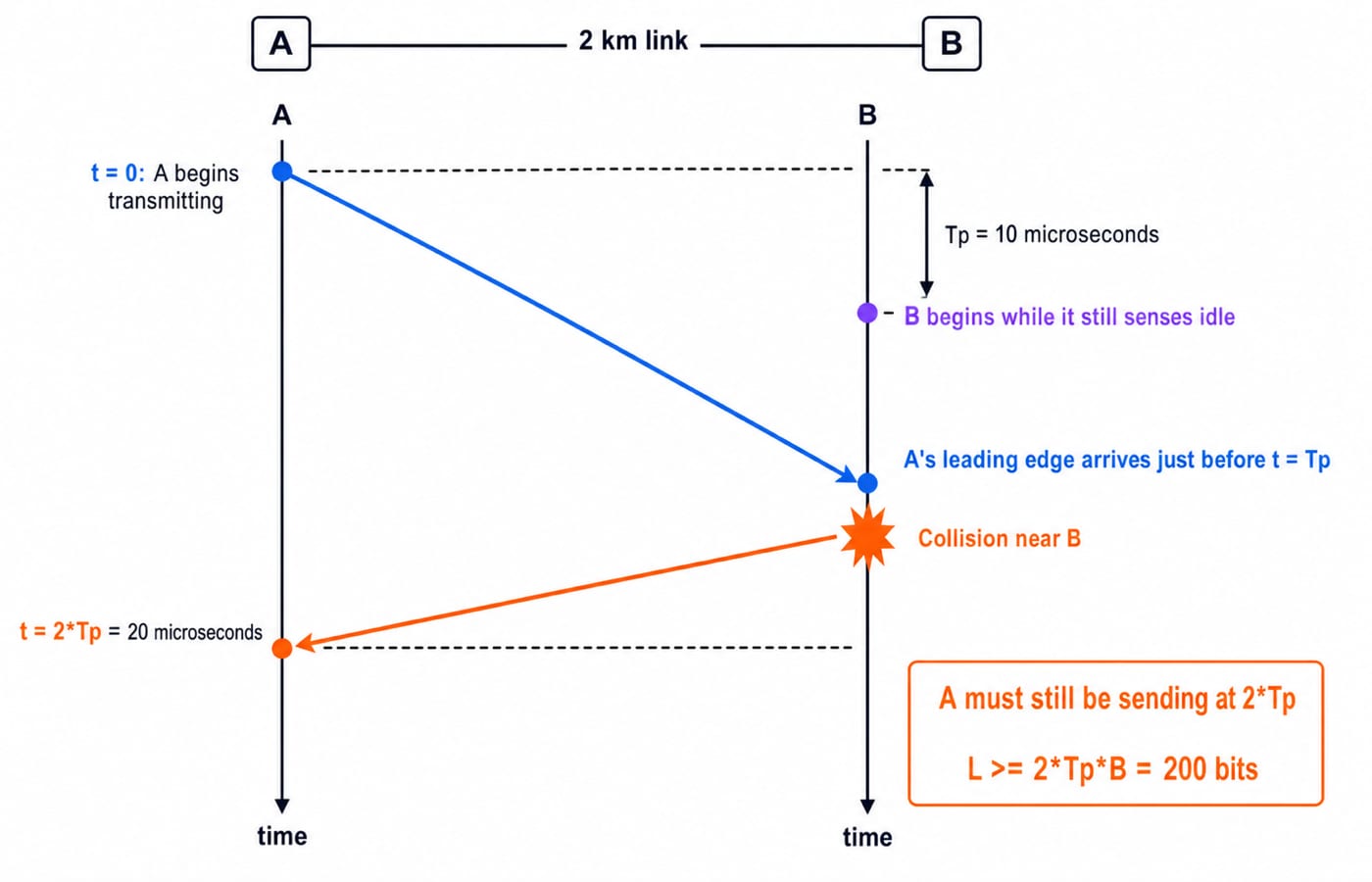
Let Tp be the one-way propagation delay across the maximum link distance. A signal may need nearly Tp to reach the far end, collide with a transmission that begins there, and then need nearly another Tp for the collision disturbance to return. The worst-case detection time is therefore 2*Tp.
If Tt is frame transmission time, collision detection requires:
Tt >= 2*Tp
At bandwidth B bits per second, a frame of L bits takes Tt = L/B. Therefore:
L_min = 2*Tp*B = 2*(d/v)*B
Here d is maximum distance and v is propagation speed. The formula is a timing condition: the sender must occupy the medium long enough to hear the round trip.
Minimum-frame-size numerical
Suppose bandwidth B = 10 Mbps, distance d = 2 km, and propagation speed v = 2*10^8 m/s. Convert the distance first:
d = 2 km = 2000 m
Now compute one-way propagation delay:
Tp = d/v
Tp = 2000 / (2*10^8) s
Tp = 10^-5 s = 10 microseconds
Collision detection needs the round trip:
2*Tp = 2*10 microseconds = 20 microseconds
Finally, multiply time by link rate:
L_min = 20*10^-6 s * 10*10^6 bits/s
L_min = 200 bits
The units cancel cleanly: seconds times bits per second leaves bits. A frame shorter than 200 bits could finish before the worst-case collision indication returned, so 200 bits is the floor for this model.
If the question asks for bytes, convert only after finding bits: 200/8 = 25 bytes. Do not divide the 10 Mbps bandwidth by eight in the middle unless every later quantity is also in bytes.
ALOHA throughput: pure versus slotted
ALOHA measures offered load G in attempted frames per frame time. Throughput S is the average number of successfully delivered frames per frame time.
For Pure ALOHA:
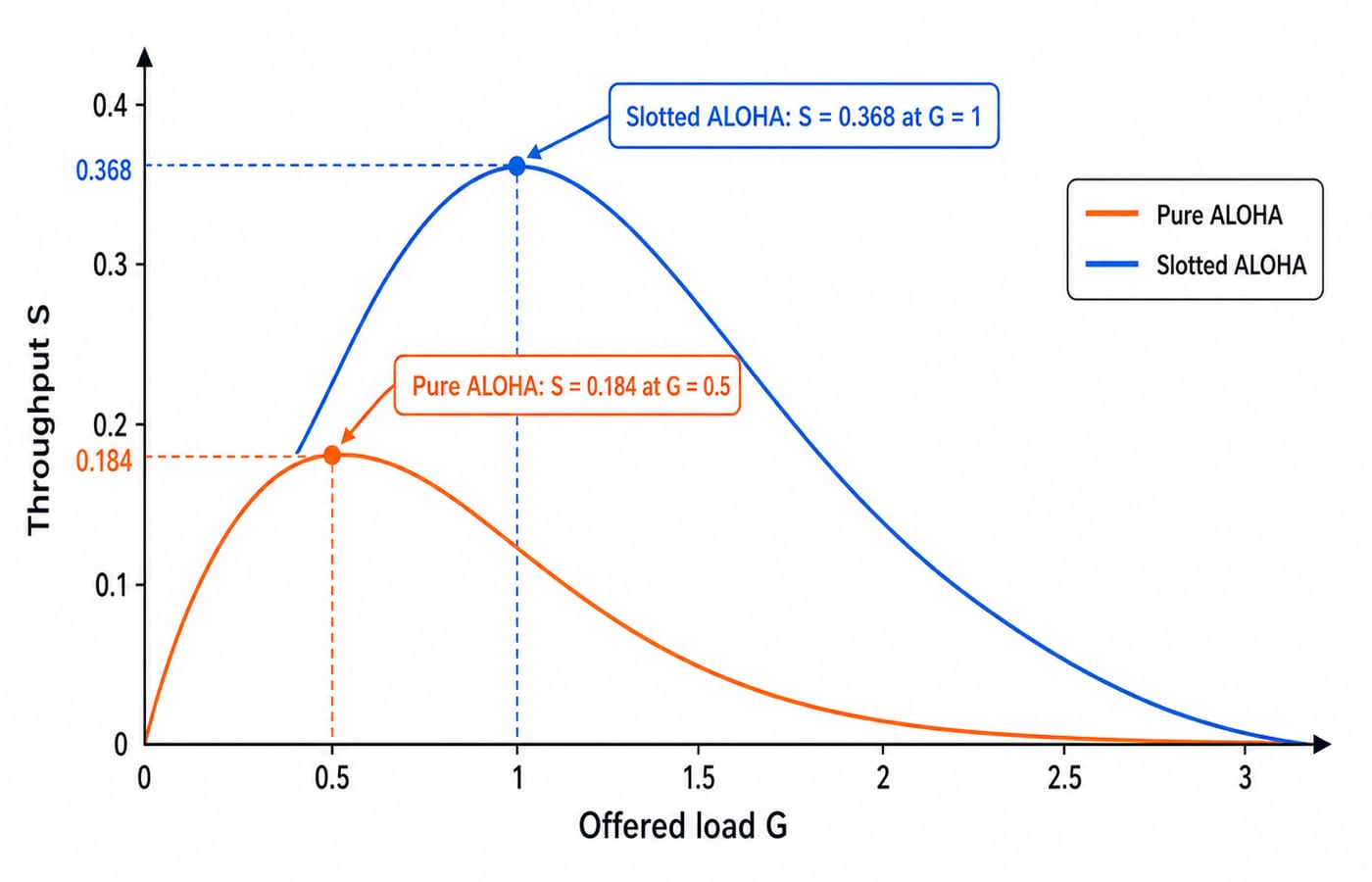
S = G*e^(-2G)
Its maximum occurs at G = 0.5, giving S_max = 1/(2e), approximately 0.184. A frame is vulnerable to any overlapping frame that begins within one frame time before or after its own start, so the vulnerable period is two frame times.
For Slotted ALOHA:
S = G*e^(-G)
Its maximum occurs at G = 1, giving S_max = 1/e, approximately 0.368. Transmissions can start only at slot boundaries, so the vulnerable period falls to one frame time.
Slotting halves the vulnerable window and doubles peak throughput from about 18.4 percent to about 36.8 percent. Do not swap the two optimal G values.
ALOHA throughput numerical
Take a 200 kbps channel carrying 200-bit frames. One frame transmission time is:
Tt = 200 bits / 200000 bits/s
Tt = 0.001 s = 1 ms
For Slotted ALOHA at its maximum, each 1 ms slot delivers an average of about 0.368 successful frames:
0.368 frames/ms * 1000 ms/s = 368 frames/s
Each frame carries 200 bits, so useful bit throughput is:
368 frames/s * 200 bits/frame = 73600 bits/s = 73.6 kbps
For Pure ALOHA, maximum throughput is approximately 0.184 successful frames per 1 ms frame time:
0.184 frames/ms * 1000 ms/s = 184 frames/s
184 frames/s * 200 bits/frame = 36800 bits/s = 36.8 kbps
The useful rates are also 0.368 and 0.184 times the 200 kbps channel rate, which gives an independent check on both answers.
CSMA/CD efficiency when a is given
Let a = Tp/Tt, the ratio of propagation time to frame transmission time. A standard approximation for CSMA/CD efficiency is:
Efficiency = 1/(1 + 6.44a)
Suppose frame length is 1000 bits, bandwidth is 10 Mbps, and Tp is 10 microseconds. First find Tt:
Tt = 1000 bits / (10*10^6 bits/s)
Tt = 100*10^-6 s = 100 microseconds
Then:
a = 10/100 = 0.1
Efficiency = 1/(1 + 6.44*0.1)
Efficiency = 1/1.644 = 0.6083, approximately 61 percent.
A smaller a improves efficiency. Shorter propagation distance reduces Tp, while a longer frame increases Tt. Both make propagation overhead smaller relative to useful transmission time.
The traps and how GATE tests them
The first trap is 2*Tp versus Tp. Minimum frame size uses the round-trip time because a collision must travel back to the sender. The second is unit consistency: Mbps is bits per second, and frame length is often given in bytes.
For ALOHA, Pure peaks at about 0.184 when G = 0.5, while Slotted peaks at about 0.368 when G = 1. Their vulnerable periods are two frame times and one frame time respectively. For CSMA/CD, minimum frame size grows with both distance and bandwidth because either can make a short frame finish too early.
Questions ask for minimum frame length, maximum throughput in frames per second, efficiency from a, the vulnerable period, or whether a collision is detected in time. ALOHA and CSMA/CD form the numerical core of random access. Controlled access and channelization complete the wider access-control map. Confirm the current Computer Networks scope on the official GATE 2027 test papers and syllabus page.
The short version and next step
Keep three formulas on one line: L_min = 2*Tp*B, Slotted ALOHA peaks at 1/e, and Pure ALOHA peaks at 1/(2e). If a CSMA/CD efficiency question supplies a, use 1/(1 + 6.44a).
Drill channel-access numericals in the GATE Test Series, then build their MAC-layer theory with GATE Guidance by Sanchit Sir. The practice collection includes about 2,500 Computer Networks questions, including MAC and channel access. Continue through the GATE preparation category.
Keep learning
Data Transmission Modes and Connection Types: Simplex, Half-Duplex and Full-Duplex
Learn to classify simplex, half-duplex, full-duplex, point-to-point and multipoint links, then calculate completion time without relying on memorised examples.
Updated 22 Oct 20265 min readComputer Networks
Computer Networks Interview Questions: Trace OSI, TCP/IP and Routing Step by Step
Follow one synthetic web request across DNS, ARP, TCP, NAT and longest-prefix routing, then turn each step into a strong interview answer.
Updated 18 Oct 20266 min readComputer Networks

Basics of Cyber Security: CIA Triad, Risks and a Worked Defence
Learn a consistent security vocabulary, connect common attack paths to suitable controls, and calculate how two defensive layers reduce account takeovers.
Updated 14 Oct 20266 min readComputer Networks

Cyber Threats and Attacks Explained: Types, Worked DDoS Example and Exam Traps
Learn to separate threats, vulnerabilities, vectors and attacks, then apply the distinctions to a calculated DDoS scenario and exam-style questions.
Updated 10 Oct 20266 min readComputer Networks