

Data and Statistics Basics MCQs and Short Answers: Mean, Data Literacy and AI
Practise a mixed set on data and statistics basics. Check six MCQs with option-by-option reasoning, then build five short answers with definitions, purpose and worked examples.
KnowledgeGate Team
Exam prep & CS education
Updated 7 Nov 20268 min read

Mean, data literacy, model evaluation and generative AI are often revised as isolated definitions, so similar-looking options become easy to confuse. Mean is an arithmetic average; data literacy involves interpreting and communicating data; model evaluation measures performance on unseen data; generative AI creates new content from learned patterns. Attempt each MCQ before reading its explanation. For every short answer, write in this order: definition, purpose and example. If you need a wider revision frame first, review the ICT concepts used in teaching and computer-science exams, then return and solve without notes.
How to use this mixed practice set
Use three passes: answer all six MCQs without notes, carefully justify every accepted and rejected choice, then wait one day and redo the misses.
For Questions 7 to 11, give one sentence for the definition, one for why it matters, and one numerical or real-world example. Keep the two checks separate: record the MCQ score out of 6, then mark each short answer for those three elements. A combined score would hide whether the weakness is recognition or explanation.
Mean and data-literacy MCQs
Question 1: Which statistical measure represents the average value?
A. Mean
B. Mode
C. Median
D. Range
Answer: A. Mean. The arithmetic mean is the sum of the observations divided by their count. For 12, 18, 20 and 30:
Sum = 12 + 18 + 20 + 30 = 80
Count = 4
Mean = 80/4 = 20
Using the same values, the median is (18 + 20)/2 = 19, and the range is 30 - 12 = 18. There is no mode because no value repeats. Each distractor therefore names a real statistical measure, but not the requested arithmetic average. The stem is testing which measure has the required role.
Question 2: Data literacy mainly refers to the ability to:
A. Store large datasets
B. Read, understand and communicate data insights
C. Develop machine learning algorithms
D. Build neural networks
Answer: B. Consider attendance values of 42, 45, 39 and 44 students. Their total is 170, so the four-day average is 170/4 = 42.5 students. Recording or storing those four values is data handling. Reading them, calculating the average, explaining what it indicates about attendance, and communicating that insight is data literacy. Developing machine learning algorithms and building neural networks are specialised technical activities, not the main meaning of data literacy.
Generative AI and intelligent-agent MCQs
Generative AI creates new content from learned patterns, while intelligent agents choose actions based on rules, goals or expected utility. The Approaches to AI guide compares the four broad views of AI and builds the rational-agent frame. Here, the calculation focuses on choosing one action by expected utility.
Question 3: Which of the following tasks is performed by generative AI?
A. Generating new text or images
B. Managing network cables
C. Sorting database records
D. Compiling programs
Answer: A. Producing fresh text or images from learnt patterns is generative. Cable management is physical infrastructure, database sorting rearranges existing records under a deterministic rule, and compilation translates source code under language rules. Those three tasks do not generate new content.
Question 4: Generative AI models are mainly designed to:
A. Classify existing data
B. Detect anomalies
C. Generate new content similar to training data
D. Compress large datasets
Answer: C. A model trained on 10,000 labelled product images may produce a new synthetic product image. It is similar to training data, not a copy of a training item. Classification labels an existing image, anomaly detection flags an unusual image, and compression reduces storage size.
Question 5: Which AI model is used to generate images?
A. GAN
B. Decision Tree
C. KNN
D. Linear Regression
Answer: A. GAN, short for Generative Adversarial Network. Its generator proposes synthetic images. Its discriminator estimates whether an image is real or generated, giving the generator a signal that helps it improve. Decision trees and KNN are commonly used for prediction or classification, while linear regression predicts a numerical outcome. The two-network contest is the key clue: generator versus discriminator.
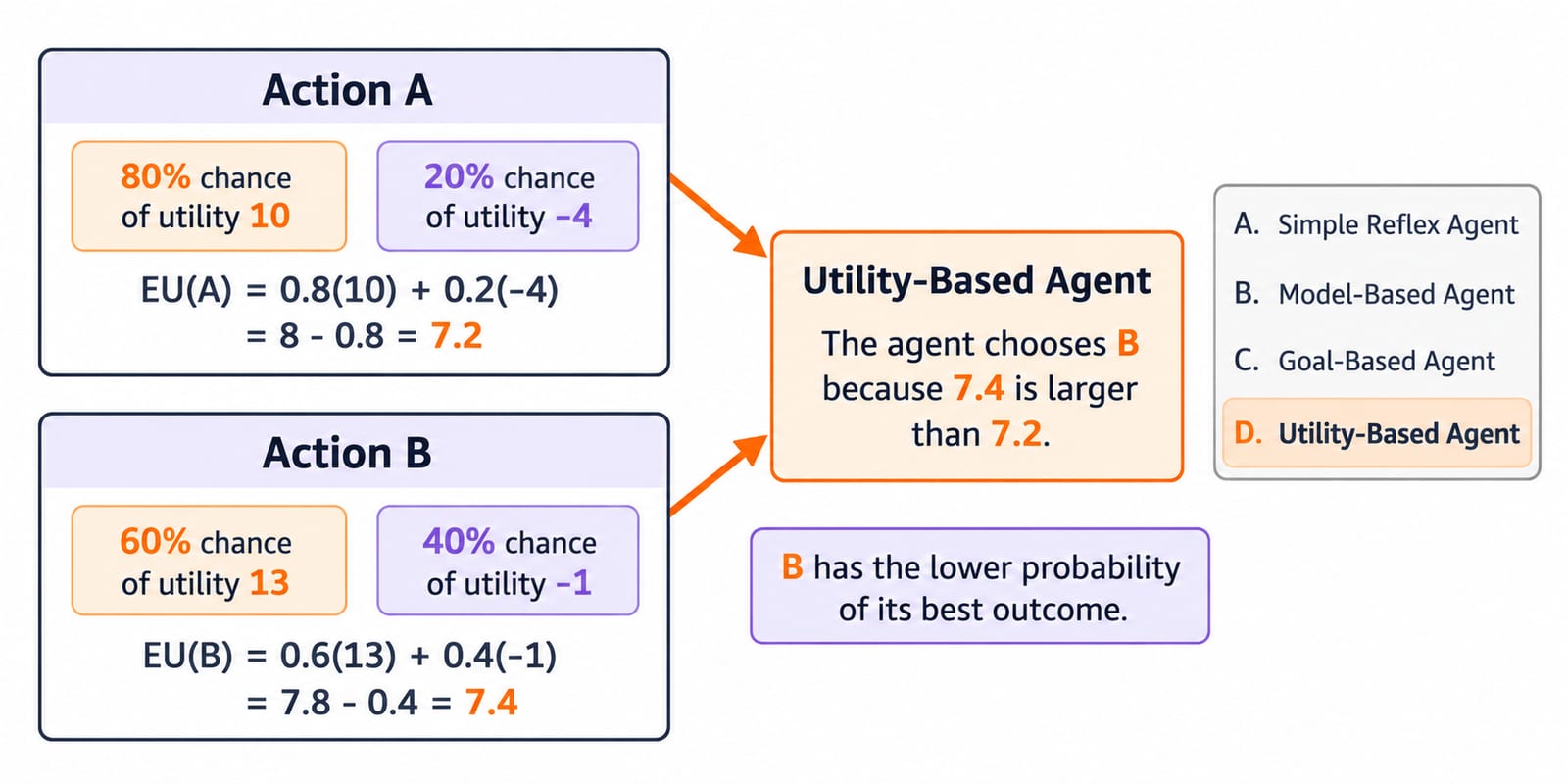
Question 6: Which type of intelligent agent chooses actions based on maximizing expected utility?
A. Simple Reflex Agent
B. Model-Based Agent
C. Goal-Based Agent
D. Utility-Based Agent
Answer: D. Utility-Based Agent. It compares the expected utility of possible actions. For Action A, an 80% chance of utility 10 and a 20% chance of utility -4 gives:
EU(A) = 0.8(10) + 0.2(-4) = 8 - 0.8 = 7.2
For Action B, a 60% chance of utility 13 and a 40% chance of utility -1 gives:
EU(B) = 0.6(13) + 0.4(-1) = 7.8 - 0.4 = 7.4
The agent chooses B because 7.4 is larger than 7.2, even though B has the lower probability of its best outcome. A reflex agent follows current-condition rules, a model-based agent tracks state, and a goal-based agent seeks an acceptable goal without necessarily ranking outcomes by utility.
Data collection and AI modelling short answers
Question 7: What is data collection? Explain its main methods with examples.
Definition: Data collection is the process of gathering and measuring information about specified variables for later analysis.
Purpose: Method and measurement quality affect every later conclusion or trained model. A biased survey or faulty sensor produces weak evidence.
Methods and examples: Surveys gather self-reported data, so a survey can record weekly study hours from 200 students. Observation and sensors capture events or measurements, so a smartwatch can record heart-rate readings of 72, 88 and 76 beats per minute. Transaction logs record actions, so an online shop can record 150 product-page views and 12 purchases, giving a view-to-purchase rate of 12/150 = 0.08 = 8%. The collection method determines what each value can support: self-reports describe reported behaviour, sensors measure signals, and logs record platform events.
Question 8: What is modelling in AI? Explain its importance with an example.
Definition: Modelling in AI means using an algorithm to learn patterns from past data so that it can make a prediction or decision on new data.
Purpose: A model turns collected examples into a reusable decision rule. Its performance must still be evaluated on suitable unseen data.
Example: A viewer has watched 8 science-fiction titles, 2 comedies and 1 documentary. A recommendation model scores three unseen titles at 0.82, 0.61 and 0.34 for predicted interest, then ranks the 0.82 title first. The ranked scores turn past viewing patterns into a decision about which unseen title to present first.
Data, evaluation and mean short answers
Question 9: What is Data Literacy? Explain the difference between data and information?
Definition: Data literacy is the ability to understand, analyse, interpret, use and communicate data. Data consists of raw facts. Information is data that has been processed and given useful context.
Purpose: The distinction stops a raw value being treated as a conclusion without context.
Example: 25°C is data. “25°C indicates a warm day in JP Nagar” is information because location and interpretation have been added. Whether 25°C is warm depends on context, so “warm” is not a universal threshold.
Question 10: What is Evaluation in AI? Why is it necessary to use Test Data?
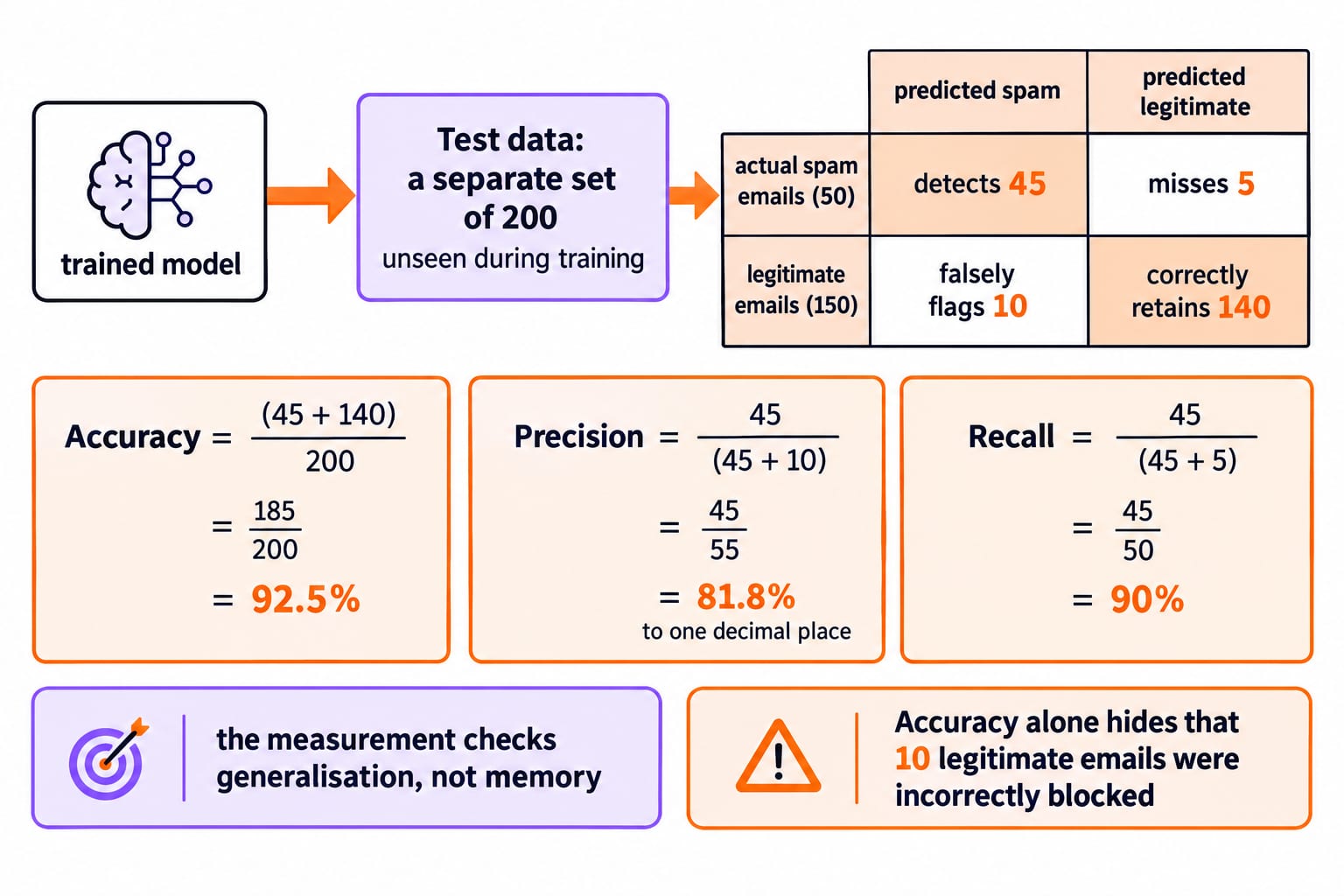
Definition: Evaluation compares a trained model's predictions with known outcomes. Test data must be unseen during training so the measurement checks generalisation, not memory.
Purpose and example: A spam filter is trained on 800 emails and tested on a separate set of 200. Among 50 actual spam emails, it detects 45 and misses 5. Among 150 legitimate emails, it falsely flags 10 and correctly retains 140.
Accuracy = (45 + 140)/200 = 185/200 = 92.5%Precision = 45/(45 + 10) = 45/55 = 81.8%to one decimal placeRecall = 45/(45 + 5) = 45/50 = 90%
Accuracy alone hides that 10 legitimate emails were incorrectly blocked.
Question 11: What is Mean in Statistics? Explain its importance with an example?
Definition: The mean is a measure of central tendency: mean = sum of observations / number of observations.
Purpose: It summarises and helps compare groups, but a large outlier can pull it away from a typical value.
Example: For scores 70, 75, 80, 85 and 90, sum = 70 + 75 + 80 + 85 + 90 = 400, count = 5, and mean = 400/5 = 80. Replace 90 with the outlier 150: new sum = 70 + 75 + 80 + 85 + 150 = 460, and new mean = 460/5 = 92. The rise from 80 to 92 shows why the mean needs the data distribution.
Five distinctions to revise after checking the answers
Use one clear discriminator to separate each pair.
Pair | Concrete distinction |
|---|---|
Mean vs median | Mean uses every value in a sum and division; median uses the ordered middle position. |
Raw data vs information | Data is a raw fact; information adds processing, meaning or context. |
Generative task vs classification | Generation creates a new sample; classification labels an existing sample. |
Training data vs test data | Training data fits the model; unseen test data measures its performance. |
Goal-based vs utility-based agent | A goal says whether a state is acceptable; utility ranks acceptable outcomes. |
One wording trap remains. In Question 1, “average” refers to the arithmetic mean because that is how the option set is framed. In everyday speech, people sometimes use “average” more loosely. In a solved question, read the full stem and choices before deciding which statistical meaning is intended.
Answer-check routine and next practice step
The MCQ key is 1-A, 2-B, 3-A, 4-C, 5-A, 6-D. For each answer from Questions 7 to 11, check that you included the definition, the importance or purpose, and a correct, relevant example. Recompute every numerical result, and rewrite any response that has only a definition.
Next, redo the concepts you missed and choose structured practice for the teaching recruitment you are preparing for. Use the DSSSB TGT Computer Science Section B course, the RSSB Basic Computer Instructor course, or the Govt Teaching Jobs course category as the relevant route. Explain every rejected MCQ option once, because that is where the similar terms stop blending together.
Keep learning

Descriptive Statistics for ML: Mean, Variance, IQR and Robust Summaries
Work through one seven-value feature to see how ordinary and robust summaries react to a long right tail. Then turn the results into careful preprocessing choices.
Updated 11 Nov 20266 min readML & Data Science

C++ Allocators and std::pmr: Build a Batch Arena for Short-Lived Data
Build a bounded C++20 batch arena for 1,500 short-lived strings, measure what the target library requests, and choose a PMR resource that fits the lifetime.
Updated 26 Oct 20266 min read62 viewsC++
IBPS Clerk Eligibility: Graduation, Local Language and Computer Literacy Checklist
Check the three evidence gates used for IBPS Customer Service Associate eligibility: graduation, the opted local language and documented computer literacy.
Updated 30 Oct 20264 min read118 viewsIBPS Exams
Statistics for Competitive Exams: Concepts, Shortcuts and Solved Examples
Learn how to choose the right statistic, turn data into a useful table, calculate efficiently, and catch errors through solved examples and sanity checks.
Updated 6 Nov 20266 min readAptitude & Reasoning