

Career Paths for CS Graduates Who Don’t Want to Code All Day
Explore QA, business analysis, technical writing, and customer success roles for CS graduates, with practical tasks to test each path.
KnowledgeGate Team
Exam prep & CS education
Updated 12 Nov 20266 min read
A computer science degree can lead to much more than a full day spent writing code. You may enjoy understanding how a product should work, finding defects, explaining a complex system, or helping customers get value from software. Those strengths can point toward rewarding technology careers—provided you understand what each role involves and build evidence that you can do the work.
“Less coding” does not always mean “no technical work.” Many roles use SQL, scripts, logs, APIs, test tools, or product configuration. Job titles also vary between companies. Treat the paths below as starting points, then check real job descriptions in your target location.
1. Quality assurance and software testing
QA professionals help teams find problems before software reaches users. Depending on the job, you may review requirements, plan test cases, explore the product, reproduce bugs, record clear evidence, or build automated checks. Manual testing roles can involve little code at first; automation-focused positions usually expect scripting or programming.
This path may fit you if you are observant, patient, and curious about edge cases. You like asking what might fail and can explain a problem in steps another person can repeat. A CS foundation helps you understand how features, databases, browsers, and APIs fit together, even when you are not implementing the product yourself.
Try a small project: choose a permitted demo app or your own project. Write test cases for a sign-up flow, including valid input, missing fields, unusual characters, and recovery after an error. For one issue, document the environment, steps, expected result, actual result, and a screenshot. Never probe a system without permission.
The U.S. Bureau of Labor Statistics overview of software developers, QA analysts, and testers describes distinct responsibilities within that occupational group. Use it as a general role reference; hiring practices differ across markets and employers.
2. Business or systems analysis
Analysts help people agree on a problem and what a technology solution should do. A business analyst might interview users, map a process, document requirements, clarify acceptance criteria, and coordinate with product or engineering teams. A systems analyst may focus more on how existing applications and workflows interact. Data analyst roles are a different path again and can involve substantial SQL, spreadsheets, or Python.
You may enjoy analysis if you ask useful follow-up questions, organise ambiguous information, and can explain trade-offs clearly. The work is often collaborative: a good analyst listens to different stakeholders, spots missing assumptions, and turns a broad request into something a team can evaluate.
Try a small project: map a familiar process, such as booking an appointment. Identify the user, steps, decisions, exceptions, and information the system needs. Write three requirements and a simple acceptance check for each. You can add a process diagram or a short recommendation to your portfolio.
Before applying, check whether the listing is for business, systems, product, or data analysis. Similar titles can ask for very different mixes of communication, domain knowledge, SQL, reporting, and technical design.
3. Technical writing and documentation
Technical writers make information easier to use. They may create setup guides, API documentation, tutorials, release notes, troubleshooting steps, or internal runbooks. The work involves learning a product, confirming details with subject-matter experts, organising information around a reader’s task, and revising for accuracy and clarity. Some roles include writing examples or testing instructions; they do not necessarily require daily software development.
A CS graduate can bring useful context: you may recognise the difference between a command, a configuration value, and a code example. Strong writing still matters. Technical knowledge does not replace clear structure, careful editing, and empathy for readers who are new to the topic.
Try a small project: choose a tool you know and write a one-page “first successful setup” guide. Include prerequisites, numbered steps, expected output, and a recovery note for a common failure. Ask a classmate to follow it without your help, then revise any step that caused confusion.
The U.S. Bureau of Labor Statistics profile for technical writers describes work communicating complex information and collaborating with technical staff. Use it to understand the broad occupation; individual company roles differ.
4. Customer success and technical customer-facing roles
Customer success teams help customers adopt a product and reach their intended outcomes. Depending on the company, the work may include onboarding, training, usage reviews, answering product questions, coordinating support, and sharing customer feedback with product teams. Technical account managers and implementation specialists may configure integrations, explain APIs, or plan deployments, so technical depth can range from light to substantial.
This path may fit you if you enjoy explaining ideas, building trust, and following a problem through to resolution. Listening and written communication are central. A CS background can help you speak with engineering teams and understand why a customer’s setup behaves differently from the expected workflow.
Try a small project: prepare a short onboarding guide or screen-by-screen walkthrough for a tool you know. Explain the user’s goal, the first steps, how to confirm success, and where to get help. Practise describing one technical concept to both a beginner and a technical teammate.
Customer success is not identical to general customer service. The BLS profile for customer service representatives offers a reference point for customer-facing duties, but success roles may include product adoption and account work. Ask about onboarding versus support duties, account ownership, targets, travel, and escalation expectations before accepting a role.
Compare the day-to-day work
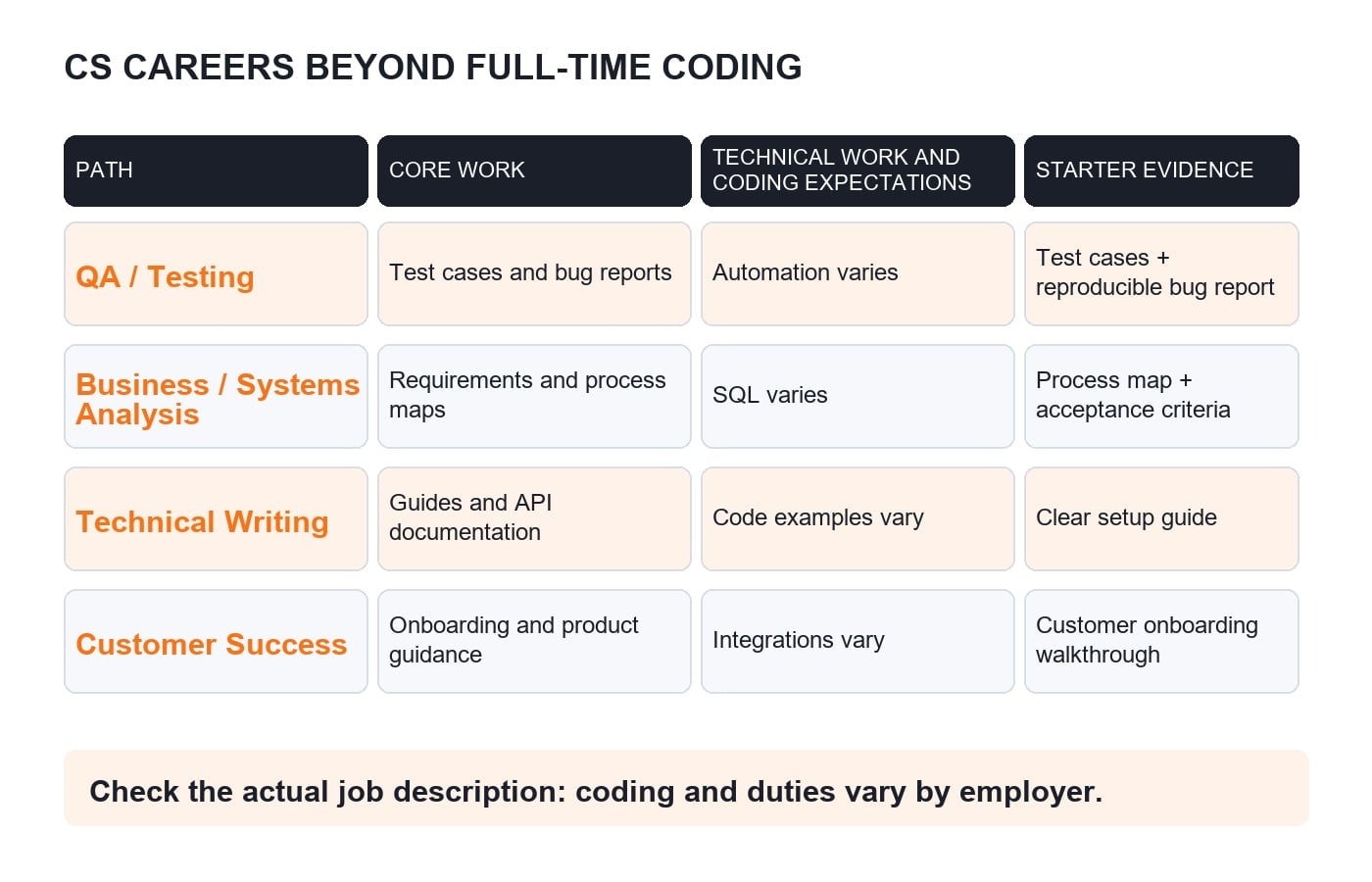
Path | Main contribution | Technical work and coding expectations | Portfolio evidence to start |
|---|---|---|---|
QA / testing | Find, reproduce, and prevent defects | Test automation, scripts, SQL, or none in some manual roles | Test cases and a clear bug report |
Business / systems analysis | Clarify needs and connect them to a workable solution | SQL, APIs, diagrams, or configuration depending on role | Process map, requirements, and acceptance criteria |
Technical writing | Help readers understand and use technical products | Code examples or command-line checks; coding varies | Setup guide or API tutorial |
Customer success | Help customers adopt products and resolve obstacles | Product configuration, APIs, logs, or little coding | Onboarding walkthrough or troubleshooting guide |
Use this as a comparison, not a guarantee. The same title can involve different work at different organisations. Read responsibilities and required skills carefully, and ask interviewers what a typical week looks like.
How to choose a first path
Start with tasks, not personality labels. Pick two paths that sound interesting and complete one small exercise for each. Then compare how you felt doing the work and whether you can show a useful result. Ask a mentor, classmate, or working professional to review the evidence and tell you what is unclear.
Next, collect several current job descriptions for each path. Note repeated requirements, tools, and communication tasks. Build one focused portfolio sample that answers those requirements. A small, well-explained artifact is more useful than a long list of tools you have only encountered once.
Keep core technical skills in view even when your target role is not a developer position. Programming fundamentals, databases, networking basics, and the ability to read logs or documentation help you collaborate across teams. KnowledgeGate’s CS Fundamentals for Placements and Coding for Placements are options if you want to strengthen that foundation. For related guidance on presenting your strengths to employers, read How to Use AI in Your Job Search Without Losing Your Own Voice.
You do not have to reject coding completely to choose another tech path. Decide how much coding you want in your working week, test the adjacent tasks, and use the evidence you create to choose your next step.
Keep learning

C++20 Modules: Interface Units, Imports and Build Order with a Worked Library Split
Follow one small C++20 module from its exported interface through a hidden implementation and importing client. Trace the result and build dependency graph.
Updated 30 Aug 20266 min readC++
Final Year Placement Preparation Plan: A 90-Day Schedule for Aptitude, Coding and Interviews
Run aptitude, coding and interviews as three connected streams across 90 days. The schedule includes weekly hours, phase checkpoints and a rule for missed days.
Updated 29 Oct 20266 min readOperating Systems

MPPSC vs HPSC Teaching: A Decision Rule for CS Graduates
Compare MPPSC and HPSC teaching routes with a qualification gate, a syllabus portability map and a weighted fit score before committing your study hours.
Updated 29 Oct 20266 min readMPPSC Teaching

DSSSB vs State PSC Teaching: A Route Guide for CS Graduates
Choose a primary government teaching route by checking your documents, transferable CS preparation, posting preference, and notification readiness.
Updated 3 Aug 20266 min read76 viewsDSSSB Computer Science