CTET Eligibility 2026: Qualification Routes and What to Verify Officially
CTET eligibility runs route by route: D.El.Ed and related elementary routes for Paper 1, graduation plus B.Ed and other routes for Paper 2, and the 2023 B.Ed edge case. The September 2026 bulletin now directs candidates to current NCTE and recruiting-agency rules.
KnowledgeGate Team
Exam prep & CS education
Updated 26 Jul 20265 min read
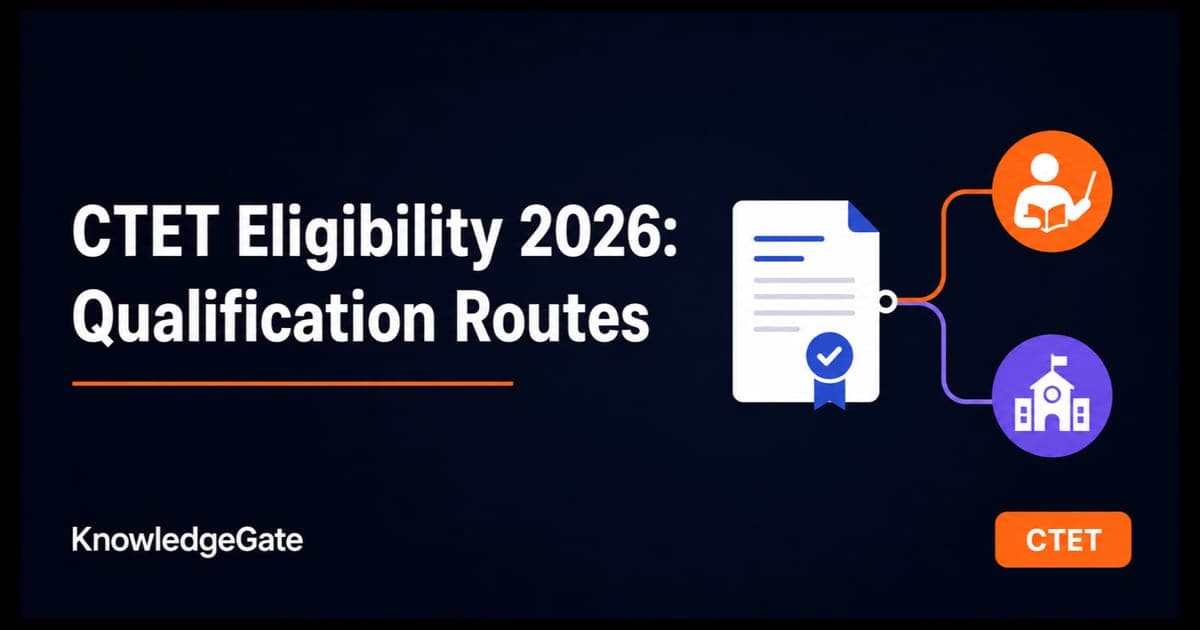
CTET eligibility is decided route by route, not degree by degree. What matters is which teacher-training qualification you hold or are completing (D.El.Ed, B.El.Ed, B.Ed) and which paper that qualification may unlock under the current rules. Much of the confusion online comes from mixing Paper 1 and Paper 2 routes or relying on pre-2023 B.Ed advice that no longer matches the current legal position.
Two authorities decide your case, and it helps to know which one owns what. NCTE sets the minimum qualification for each route, and the recruiting agency verifies your documents when you apply for a post. The current CTET bulletin at ctet.nic.in points at both.
CTET Paper 1 vs Paper 2: what each paper certifies
CTET has two papers. Paper 1 certifies you to teach classes 1 to 5 (primary), and Paper 2 certifies you for classes 6 to 8 (upper primary). They are separate qualifications with separate eligibility routes, and if your qualifications cover both, you can sit both in the same cycle.
Eligibility tells you which papers you can write. Which one you should write is a different question, and our CTET Paper 1 vs Paper 2 comparison works through that choice.
CTET Paper 1 eligibility: the D.El.Ed family of routes
Paper 1 runs through elementary teacher-training qualifications. Four routes recur across the NCTE qualification framework and the CTET route tables built on it:
Senior secondary plus a 2-year D.El.Ed (Diploma in Elementary Education), passed or appearing in the final year.
Senior secondary plus a 4-year B.El.Ed (Bachelor of Elementary Education).
Senior secondary plus a 2-year Diploma in Education (Special Education).
Graduation plus a 2-year D.El.Ed.
Each route carries its own minimum-marks clause, and they are not interchangeable. Recent CTET bulletins have allowed up to 5 per cent relaxation in those qualifying marks for reserved categories. The threshold itself comes from the NCTE rule for the exact route you are claiming, so identify your route first and read the clause attached to it.
Notice what is absent from that list: a plain B.Ed. That absence is not an oversight; it is the result of a 2023 Supreme Court ruling.
CTET Paper 2 eligibility: graduation plus B.Ed, and the elementary routes
Paper 2 accepts elementary and secondary teacher-training routes alike, which is why its entry is the wider of the two. Five routes recur:
Graduation plus a B.Ed (Bachelor of Education). The standard route for most Paper 2 aspirants.
Graduation plus a 2-year D.El.Ed.
Senior secondary plus a 4-year B.El.Ed.
Senior secondary plus a 4-year integrated B.A/B.Sc.Ed or B.A.Ed/B.Sc.Ed.
Graduation plus a B.Ed (Special Education).
Here the minimum-marks clause usually attaches to graduation or to the teacher-training qualification, depending on which route you claim. A graduation-plus-B.Ed claim and a graduation-plus-D.El.Ed claim can carry different thresholds, so read the clause for the route you actually hold.
CTET qualification matrix: routes mapped to papers
Qualification route | Paper 1 (classes 1 to 5) | Paper 2 (classes 6 to 8) |
|---|---|---|
Senior secondary + 2-year D.El.Ed | Listed | Not by itself |
Senior secondary + 4-year B.El.Ed | Listed | Listed |
Senior secondary + 2-year Diploma in Education (Special Education) | Listed | Not typically |
Graduation + 2-year D.El.Ed | Listed | Listed |
Graduation + B.Ed | Removed after the 2023 ruling (see the amendment section) | Listed |
Senior secondary + 4-year integrated B.A/B.Sc.Ed | Not typically | Listed |
Graduation + B.Ed (Special Education) | Not typically | Listed |
Two rows in that table cause most of the confusion. Graduation plus B.Ed is the widest Paper 2 route and the one people most often stretch to Paper 1, where it no longer reaches. Senior secondary plus a 4-year B.El.Ed is the only school-leaving-level qualification in the table that opens both papers on its own.
The NCTE amendment edge case: B.Ed holders and Paper 1
In 2018, an NCTE amendment allowed B.Ed graduates to qualify for classes 1 to 5 with a bridge-course condition. In August 2023, the Supreme Court set that amendment aside. The route has outlived the law online, which is why B.Ed-for-Paper-1 advice, old bulletin PDFs and forwarded screenshots are still in circulation years after they stopped being correct.
The practical consequences:
If you hold only a B.Ed, plan for Paper 2. Do not build a Paper 1 attempt on a screenshot of a pre-2023 bulletin.
If you qualified Paper 1 under the old B.Ed route in an earlier cycle, how that certificate is treated is decided by the body issuing the vacancy. Raise it with them in writing before you count on it.
Whatever your case, work from the qualification clause in the current bulletin and the NCTE rule it cites, not from the older route matrix that circulated before 2023.
CTET eligibility 2026: percentages, relaxations and final-year candidates
Three cross-cutting rules matter across both papers.
Final-year candidates count. The September 2026 application instructions let you mark the qualifying exam as Passed or Appearing in Final Exam. Appearing gets you into the hall; it does not settle the route, which still has to satisfy the NCTE clause when your result arrives.
Marks relaxations exist but are clause-specific. Recent CTET bulletins have allowed up to 5 per cent relaxation in qualifying marks for reserved categories. The relaxation applies to the threshold in your route clause, so the two have to be read together rather than separately.
Age and attempts are generous. Recent CTET bulletins state that the qualifying certificate is valid for life and place no restriction on attempts. They do not prescribe an upper age limit, but recruitment rules can impose their own conditions.
Eligible for both papers? Decide with your preparation in mind
If current official rules let you apply for both papers, sitting both can be efficient because the Child Development and Pedagogy base is shared. Structured coverage for that plan sits in the CTET 2026 (Paper 1 & 2) bundle, one plan covering both papers.
Locked to a single paper by eligibility, or by preference? The standalone CTET Paper 2 course covers Child Development and Pedagogy, Mathematics and Science, Social Studies and both languages for the classes 6 to 8 exam, and CTET Paper 1 does the same for primary. If a state TET is also on your list, our UPTET category page maps the coverage there.
The short version
Paper 1 routes sit in the D.El.Ed family: D.El.Ed, B.El.Ed and special-education qualifications, each with its own minimum-marks clause.
Paper 2 routes cover graduation plus B.Ed alongside the elementary and integrated teacher-education routes.
The 2018 plain-B.Ed route for Paper 1 was set aside by the Supreme Court in 2023; verify the current NCTE rule before applying.
Recent CTET application flows recognise Passed and Appearing in Final Exam, and recent bulletins have allowed up to 5 per cent relaxation for reserved categories.
Before you apply, open the current CTET bulletin at ctet.nic.in and check three things against your own certificates: the qualification clause for your exact route, the minimum-marks figure and the relaxation you intend to claim, and whether the recruiting body you are aiming at adds conditions of its own.
Once eligibility is settled, the real work is the syllabus, and that is a choice about papers, not clauses. Start with the paper comparison, pick your target, and let the plan do the rest.
Keep learning
Guidance, Counselling and Mental Health for Teaching Exams: Concepts, Cases and Exam Traps
Learn to separate guidance, counselling and mental-health support, then apply the distinctions to learner cases without crossing a teacher's professional boundaries.
Updated 23 Oct 20266 min readCTET & UPTET
Classroom Management and Communication for Teaching Exams: Complete Notes and Worked Scenarios
Connect classroom management, communication, feedback, discipline, and teacher immediacy, then practise an exam-style vignette with a step-by-step solution.
Updated 19 Oct 20266 min readCTET & UPTET
Teaching-Learning Aids and ICT Integration for Teaching Exams: Notes with Worked Classroom Examples
Learn how to select and sequence teaching-learning aids, recognise genuine ICT integration, and solve classroom scenarios with worked calculations.
Updated 15 Oct 20265 min readCTET & UPTET
Nature, Objectives and Characteristics of Teaching: Concept Notes for Teaching Exams
Learn to separate what teaching is, what change it seeks and how an effective teaching process operates. A worked fraction lesson connects every concept.
Updated 10 Oct 20265 min readCTET & UPTET