RRB NTPC PYQ Analysis: Separate CBT 1 Screening From CBT 2 Merit
Do not mix CBT 1 and CBT 2 questions in one notebook. Use separate ledgers to measure screening coverage, later-stage accuracy, error types and repair actions.
KnowledgeGate Team
Exam prep & CS education
Updated 12 Aug 20265 min read
If you pour CBT 1 and CBT 2 questions into one PYQ notebook, you cannot tell whether your screening skill is improving or your later-stage merit profile is strong enough. Use two ledgers that separate stage purpose, raw performance, error type and next action. A raw score you compute from a practice drill measures your own paper and nothing else: it is not a cutoff, and it is not a normalized mark. If you want the stage sequence already built, the railway exam preparation courses hub carries the current RRB NTPC path.
Start with the stage role, not one combined PYQ score
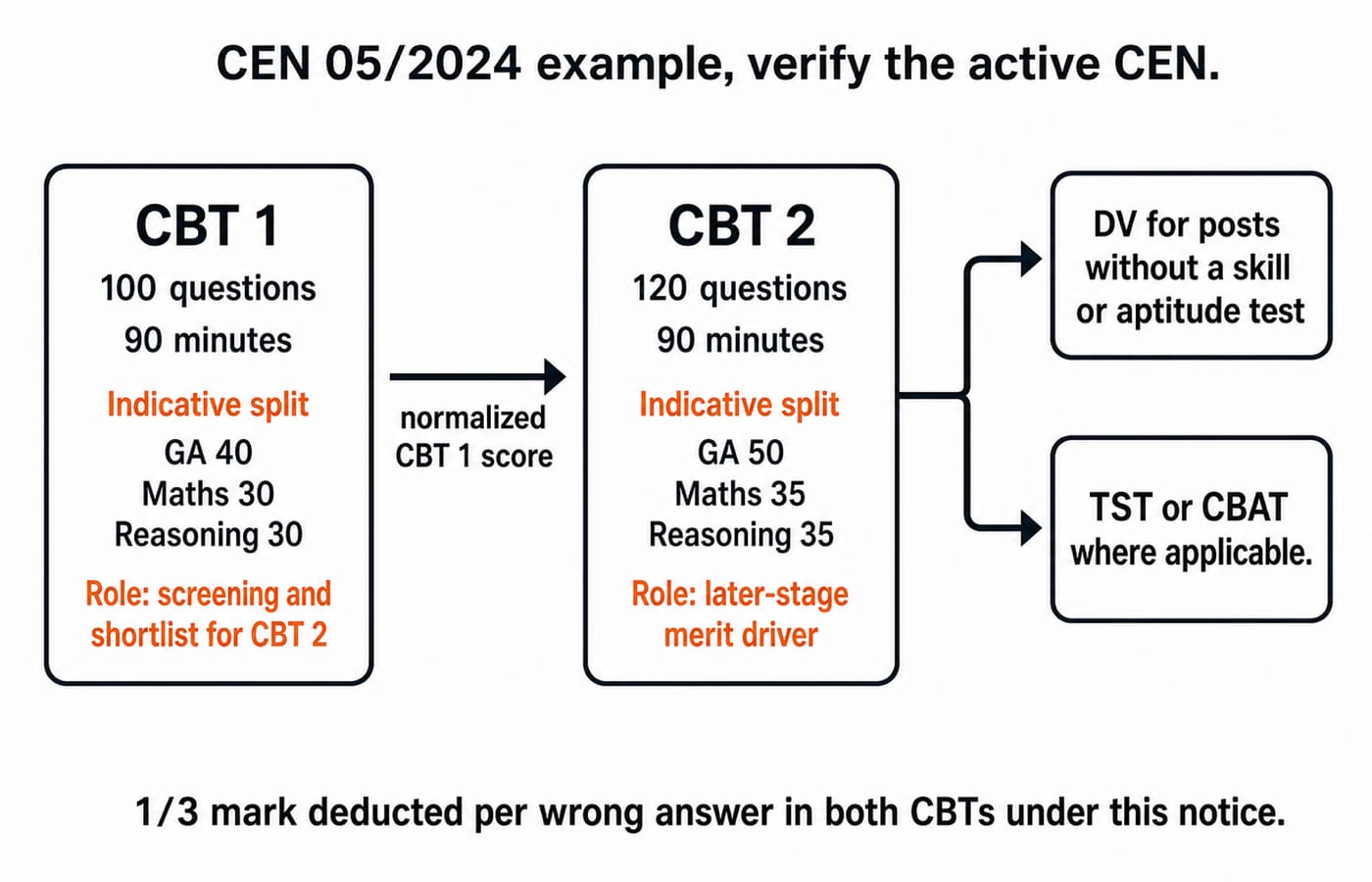
The Railway Recruitment Board Chandigarh CEN 05/2024, published on 13 September 2024, described CBT 1 as screening in nature. Its normalized score shortlisted candidates for CBT 2. Normalized CBT 2 marks then supported later shortlisting, either directly for document verification or first for the applicable typing or aptitude test. That does not make CBT 1 disposable. A weak CBT 1 never reaches the CBT 2 desk, and for posts carrying a typing or aptitude test, CBT 2 merit opens that test rather than settling the result.
For that cycle, sections 13.1 and 13.2 gave an indicative CBT 1 pattern of 100 questions in 90 minutes: 40 General Awareness, 30 Mathematics and 30 Reasoning. CBT 2 had 120 questions in 90 minutes: 50, 35 and 35 respectively. Both deducted one-third mark per wrong answer. CEN 06/2024 result bulletins later reflected the same stage logic: CBT 1 shortlisted for CBT 2, while CBT 2 merit fed the next applicable stage.
Those counts belong to that cycle. The board rewrites the scheme of examination from notice to notice, so read that section in the CEN you are actually applying under before you build a drill around any of it. Which topics inside those sections keep returning is a separate question, worked in RRB NTPC previous year analysis: why General Awareness dominates the topic split.
Split every PYQ before calculating
Maintain two ledgers, CBT 1 screening and CBT 2 merit-building. Record source CEN or cycle, stage, section, correct, wrong, skipped, time, error type and next action. Put any set whose stage cannot be verified in a separate unverified tray and exclude it from comparisons.
Use three calculations: attempted = correct + wrong; attempt accuracy = correct / attempted x 100; and, only where the notice specifies one-third negative marking, illustrative raw score = correct - wrong/3. Never call that last value a normalized score. As Why PYQs Beat Buying Another Question Bank explains, analysis must end in a repair action, not a pile of solved pages.
Work CBT 1 as a screening diagnostic
A 100-question CBT 1 practice drill, section by section:
Section | Correct | Wrong | Skipped | Illustrative raw |
|---|---|---|---|---|
General Awareness | 22 | 8 | 10 |
|
Mathematics | 19 | 5 | 6 |
|
Reasoning | 20 | 4 | 6 |
|
Totals are 61 correct, 17 wrong and 22 skipped. Attempted questions are 61 + 17 = 78, so accuracy is 61/78 x 100 = 78.2%. The illustrative raw score is 61 - 17/3 = 55.33; the section values also total 55.33. Those 17 wrong answers cost 5.67 marks, the value of nearly six correct ones. That is the real price of guessing at this rate.
The unresolved pools are GA 8 + 10 = 18, Mathematics 5 + 6 = 11 and Reasoning 4 + 6 = 10, or 39 overall. GA is the largest repair pool, while 22 skips flag a coverage problem. The next drill should test whether unresolved questions fall below 39, not chase a guessed qualifying score.
Work CBT 2 as a merit-building profile
A separate 120-question CBT 2 practice drill:
Section | Correct | Wrong | Skipped | Accuracy | Illustrative raw |
|---|---|---|---|---|---|
General Awareness | 32 | 12 | 6 |
|
|
Mathematics | 25 | 6 | 4 |
|
|
Reasoning | 25 | 5 | 5 |
|
|
Totals are 82 correct, 23 wrong and 15 skipped. Attempted questions are 105, so accuracy is 82/105 x 100 = 78.1%. The raw calculation is 82 - 23/3 = 74.33; section values total 74.33.
GA has 18 unresolved questions; Mathematics and Reasoning have 10 each. Prioritise GA accuracy and recall while maintaining the two stronger sections. The IBPS PO paper analysis: topic-wise weightage method applies the same section-evidence approach to a different paper, if you want to see it worked outside railways.
Compare rates, not unequal raw totals
CBT 1 coverage is 78/100 = 78%, accuracy is 78.2% and unresolved count is 39. CBT 2 coverage is 105/120 = 87.5%, accuracy is 78.1% and unresolved count is 38. Comparing 82 correct with 61 correct alone is unfair because the denominators differ.
The past CEN timing gives an arithmetic average of 90 x 60 / 100 = 54 seconds per CBT 1 question and 90 x 60 / 120 = 45 seconds per CBT 2 question. Those averages are not per-question budgets. A data-interpretation set or a puzzle-based reasoning block will eat far more than 54 seconds, and the fast General Awareness recall questions are what fund them.
Next, run one 100-question, 90-minute CBT 1 drill and one 120-question, 90-minute CBT 2 drill, followed by 45 minutes on the CBT 2 drill's 38 unresolved items. Raise GA accuracy above 72.7% without letting CBT 2 coverage fall below 87.5%.
Avoid conclusions a PYQ sheet cannot support
Do not treat 55.33 as marks carried into every later decision, or 74.33 as the sole final score for every post. Check the post-specific TST or CBAT rules. Do not compare either raw value with a circulating cutoff because raw and normalized scores are not interchangeable. Finally, do not combine both stages in one frequency table.
A merged table quietly reweights your own paper: 40 General Awareness questions out of 100 and 50 out of 120 are different shares, so the combined count flatters whichever stage you attempted more of.
Close with a seven-day stage-separated audit
Day 1, verify and sort one paper per stage. Day 2, take the 100-question CBT 1 drill in 90 minutes. Day 3, classify its 39 unresolved items. Day 4, take the 120-question CBT 2 drill in 90 minutes. Day 5, classify its 38 unresolved items. Day 6, spend 45 minutes on GA and 30 minutes each on Mathematics and Reasoning. Day 7, re-solve logged misses and recalculate each stage separately.
A concept error needs a short relearn and two fresh questions. A method error needs an untimed re-solve. For a reading error, underline the missed qualifier. For a time skip, set a first-pass decision rule. Keep the item logged until you can explain the correct route and why the earlier route failed.
The short version: CBT 1 analysis asks whether broad, controlled coverage can clear a screening gate. CBT 2 analysis asks where later-stage merit is being lost, subject to the post's next stage. Use the RRB NTPC Complete Preparation Course for stage-organised lessons, practice and mocks, and confirm every active-cycle rule on the official RRB website.
Keep learning
RRB NTPC Posts Explained: Match Duties and Skill Tests to Your Preference Order
Compare the six graduate roles in CEN 06/2025 by typical duties, work setting, medical standard and skill stage. Then build a personal preference order using elimination and a weighted example.
Updated 16 Aug 20266 min read94 viewsRRB NTPC
RRB NTPC Normalisation and Cutoffs: Read Raw Marks, Percentile and RRB Score
Learn what raw marks, percentile, RRB Score and Normalized Marks mean, then use worked examples to compare your score with the correct cutoff row.
Updated 14 Aug 20264 min read64 viewsRRB NTPC
RRB NTPC CBAT Preparation: Build Accuracy Across All Five Tests
Find the weak process hidden by one total practice score. Build a separate CBAT baseline, run precise repair drills, and retest every battery on fresh material.
Updated 10 Aug 20265 min readRRB NTPC
RRB NTPC Typing Skill Test: A 35-Day Speed and Accuracy Plan
Follow a five-week typing routine that begins with a three-passage baseline, adds speed only after accuracy holds, and ends with realistic unseen tests.
Updated 7 Aug 20265 min readRRB NTPC