

Continuous and Comprehensive Evaluation (CCE) for CTET: Meaning, Grading and Worked Example
CCE is more than frequent testing. Learn how continuous evidence, broad development, feedback and separate scholastic records work through a fraction lesson and a dated CBSE grading example.
KnowledgeGate Team
Exam prep & CS education
Updated 5 Nov 20266 min read
CTET questions sometimes confuse continuous evaluation with daily testing and comprehensive evaluation with a longer academic test. CCE instead gathers evidence across time and domains, then uses it to improve teaching. The February 2026 CTET information bulletin lists CCE under Child Development and Pedagogy. Separate four ideas: the evidence cycle, scholastic and co-scholastic breadth, the dated CBSE grading scheme and the decision that follows the evidence.
CCE meaning: continuous and comprehensive
Continuous means evaluation is built into the teaching-learning process across the academic session. The sequence is: assess, diagnose the gap, give feedback or corrective teaching, then reassess. "Regular" means neither incessant testing nor a daily written paper. Evidence must lead to a response.
Comprehensive means covering scholastic and co-scholastic development through varied testing and non-testing tools. A useful three-domain memory aid is: cognitive for knowledge and thinking, affective for attitudes and values, and psychomotor for performance skills. One task need not measure all three domains.
The exam-ready definition is simple: CCE gathers varied evidence over time about a learner's broad development and uses it for improvement. A terminal examination samples achievement at one point. Alone, it cannot show diagnosis, feedback, remediation and growth. These meanings follow the dated CBSE CCE manuals on the official CBSE academic resources page.
For measurement, tool choice, validity and criterion judgments, use Assessment and Evaluation for Teaching Exams: Complete Notes with Worked Examples. CCE focuses on evidence across time and separate scholastic and co-scholastic records.
The CCE framework: time, purpose, scope and evidence
Question | CCE element | Typical evidence | Teacher action |
|---|---|---|---|
What does the learner know before teaching? | Diagnostic | 5-item readiness check | Adapt the starting point |
What is changing during learning? | Formative | Exit slip, oral explanation, observation | Give feedback and reteach |
What was achieved at the end of a defined period? | Summative | End-unit task | Report attainment |
How broadly is the learner developing? | Comprehensive scope | Academic work plus descriptor-based observations | Plan support without mixing unlike scores |
A quiz is not formative merely because it is short or internal. The same 10-item quiz is formative when its 6/10 result changes the next lesson, but summative when it only reports end-unit attainment.
Scholastic attainment and co-scholastic observations should remain parallel streams. A mathematics score should not change because of neatness, obedience or teacher preference. Broad development should not become one combined percentage.
Fully worked CCE classroom example: equivalent fractions
A Class V teacher sets one scholastic outcome: "Identify equivalent fractions with an area model and justify them by multiplying both terms by the same non-zero number." These checkpoints are teacher-created evidence, not a CCE scoring formula.
On Monday, a six-card diagnostic asks the learner to group equivalent fractions. The learner groups only two correctly and pairs 1/2 with 1/3 because both have numerator 1. This exposes a false same-numerator rule.
On Tuesday, the teacher overlays equal-sized rectangle grids for 1/2, 2/4 and 6/12. The learner shades the same area and writes the factors x2 and x6. On Wednesday, the learner sorts five of six new cards correctly but cannot justify 6/9 = 2/3. The teacher asks the learner to divide both terms by 3, then compare the shaded areas.
On Friday, the learner scores 8/8, completes 3/5 = 9/15 and explains why multiplying both terms by 3 preserves value. A separate rubric records listening, evidence-based disagreement and answer revision. Collaboration moves from 2/4 to 3/4 but is not added to the 8/8 mathematics result.
Written sorting, a visual model, oral explanation and observation produce evidence across several days. The diagnostic identifies a gap, teaching targets it, and a later check records improvement. One isolated 8/8 would report attainment but not the full CCE cycle.
Formative, summative and the historical CBSE grading scheme
Formative assessment supplies evidence that is actually used to adjust learning or teaching. Summative assessment judges attainment after a defined period. CCE can include both, so it does not mean "only formative assessment" or "no final assessment".
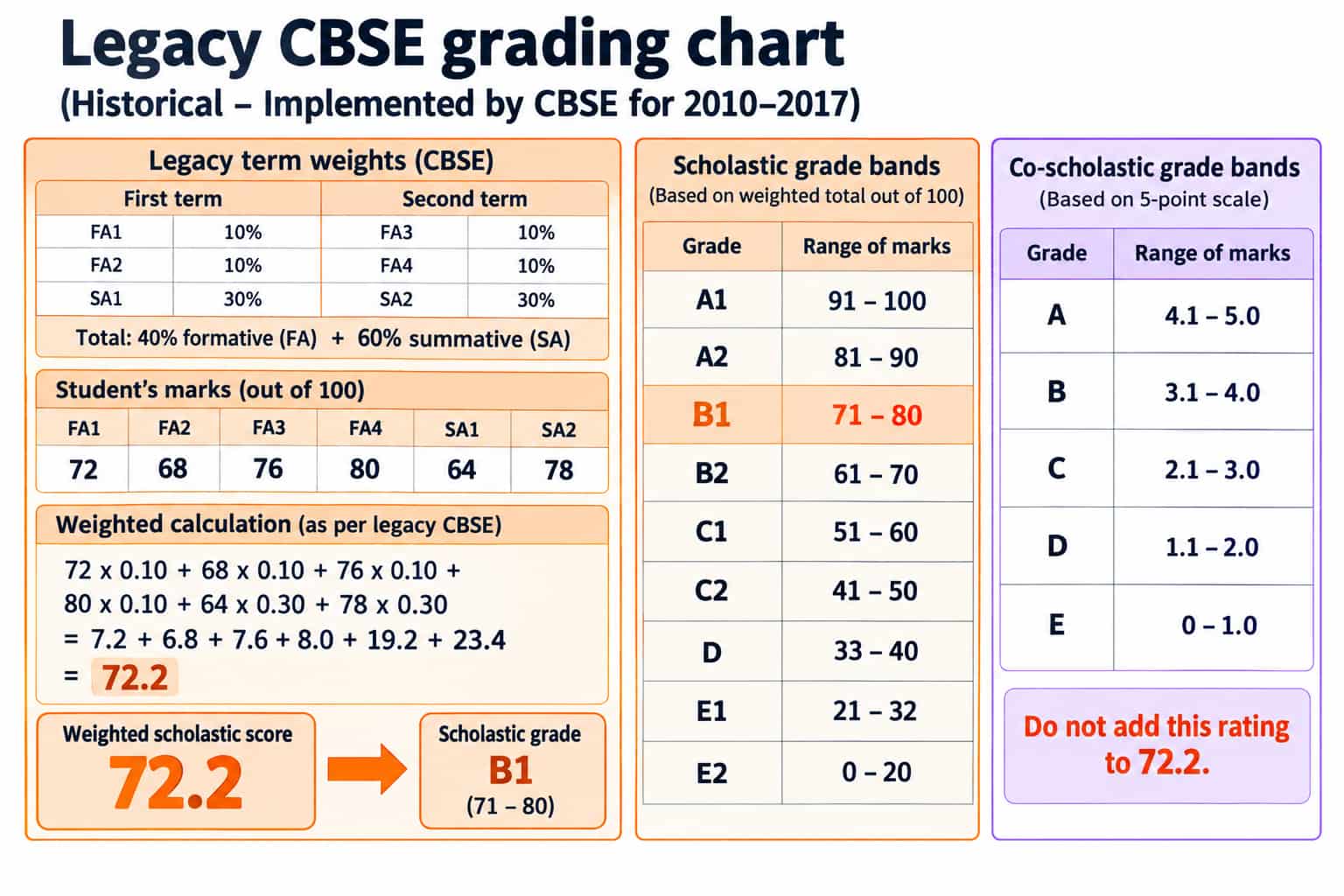
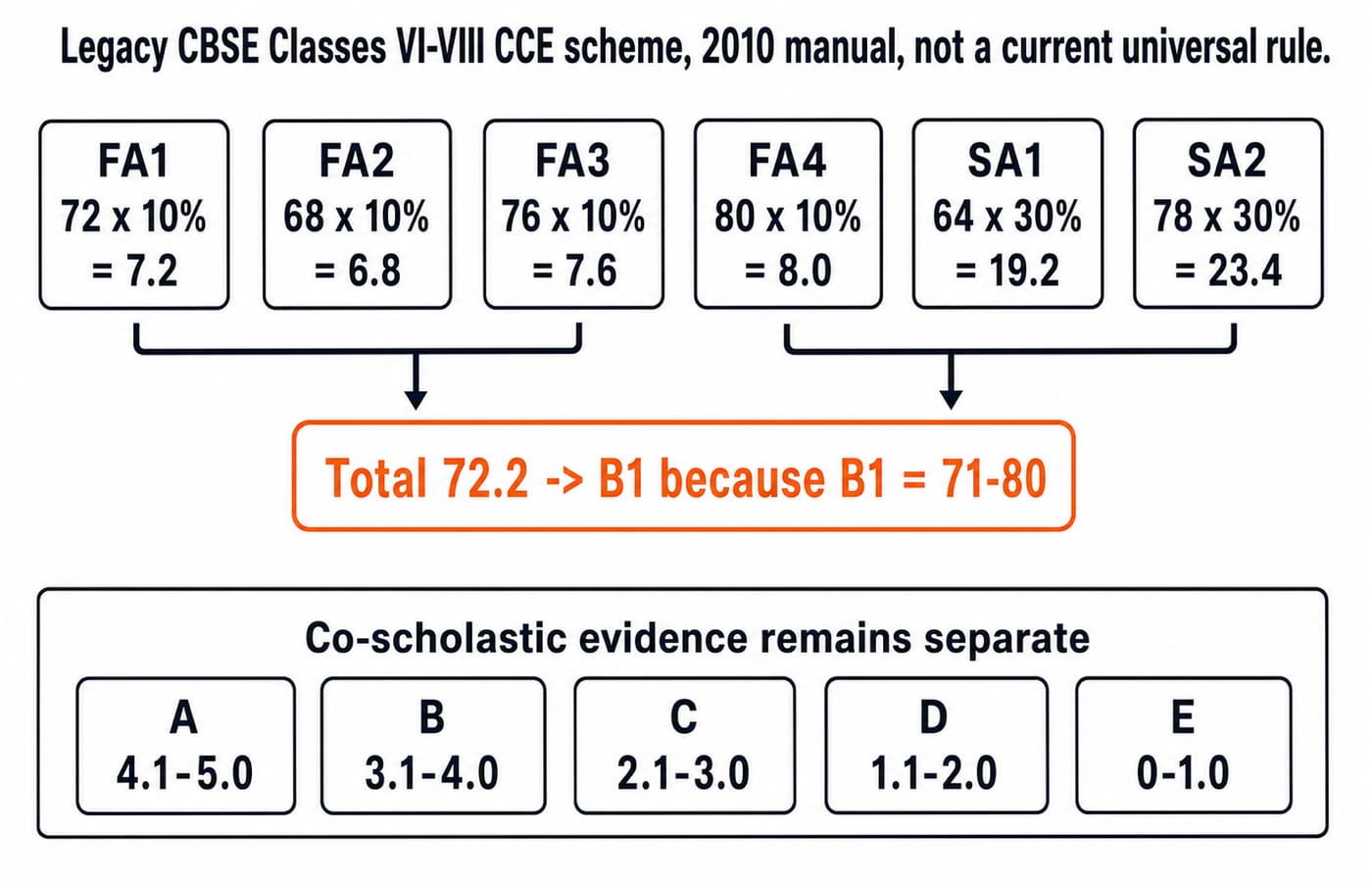
The 2010 CBSE manual described a legacy Classes VI-VIII scheme. The first term used FA1 10%, FA2 10% and SA1 30%. The second used FA3 10%, FA4 10% and SA2 30%. That produced 40% formative and 60% summative weight. It is not a current universal school rule.
Take FA1 = 72, FA2 = 68, FA3 = 76, FA4 = 80, SA1 = 64 and SA2 = 78:
72 x 0.10 + 68 x 0.10 + 76 x 0.10 + 80 x 0.10 + 64 x 0.30 + 78 x 0.30
= 7.2 + 6.8 + 7.6 + 8.0 + 19.2 + 23.4 = 72.2
On that manual's scholastic scale, 72.2 falls in B1, the 71-80 band.
Grade | Range | Grade | Range | Grade | Range |
|---|---|---|---|---|---|
A1 | 91-100 | A2 | 81-90 | B1 | 71-80 |
B2 | 61-70 | C1 | 51-60 | C2 | 41-50 |
D | 33-40 | E1 | 21-32 | E2 | 0-20 |
The manual reported co-scholastic areas separately: A 4.1-5.0, B 3.1-4.0, C 2.1-3.0, D 1.1-2.0 and E 0-1.0. Do not add this rating to 72.2.
Historical note: These weights and boundaries illustrate a dated CBSE implementation. They are not the definition of CCE, not a CTET scoring rule and not the current rule of every school or board.
The purpose of CCE and what good implementation changes
Monday's two correctly grouped cards expose a false same-numerator rule. Wednesday's five-of-six sort leads to a common-factor intervention. Friday's 8/8 records transfer and still leaves the next teaching decision open. Marks without changed action do not complete the feedback loop.
CCE reduces dependence on one high-stakes snapshot, recognises different evidence, makes teaching responsive to gaps, encourages self-evaluation and supports holistic reporting. It does not automatically remove stress or bias. Quality depends on valid tasks, clear criteria, manageable records and evidence-based teacher judgement.
Use CTET CDP: High-Yield Concepts and Theorists for development principles, major theorists, learning, motivation and inclusive education. CCE narrows that map to assessment evidence, feedback and separate records.
How CTET turns CCE into questions
The February 2026 CTET information bulletin page places assessment for learning versus assessment of learning, school-based assessment, and CCE perspective and practice in Child Development and Pedagogy for both papers. Check it for current details.
CCE questions test whether evidence guides teaching, assessment tools vary and scholastic and co-scholastic evidence remain distinct:
Item A: After 6/10, one teacher moves on. Another analyses two error types and reteaches. The second uses evidence formatively.
Item B: Choose among one annual test, daily tests, or a quiz plus project plus observation with feedback. The third best represents CCE.
Item C: A teacher averages an academic quiz with behaviour. Reject it because scholastic and co-scholastic evidence should not be collapsed casually.
The equivalent-fractions sequence shows how assessment can support a better teaching decision without mixing academic attainment with collaboration. For practice across CTET and UPTET routes, use the CTET and UPTET Teaching Eligibility Test Prep category.
Common CCE traps and their corrections
Trap | Why it fails | Correct idea |
|---|---|---|
Continuous means daily tests | Frequency alone gives no improvement cycle | Gather planned evidence across time |
Comprehensive means many written tests | More of one tool is still narrow | Cover broad domains with varied tools |
Formative means any internal test | Location and length do not determine purpose | Use evidence to change learning or teaching |
CCE removes summative assessment | The two purposes are different | Use formative and summative evidence appropriately |
Co-scholastic means personal opinion | Unstructured judgement invites bias | Observe behaviour against stated descriptors |
40% FA, 60% SA and A1-E2 define CCE | Those values belong to a dated scheme | Separate the philosophy from its historical implementation and check the named source |
For option elimination, reject answers that only increase test frequency without diagnosis, feedback, correction, varied evidence or reassessment. They use "continuous" superficially. Reject options mixing academic attainment with conduct.
CCE for CTET: the short version and next step
Continuous = evidence across time.
Comprehensive = scholastic plus co-scholastic breadth.
Formative = evidence used for improvement.
Summative = judgement after a defined period.
CCE cycle = assess, diagnose, feedback or remediate, reassess.
Historical warning = legacy CBSE weights and grade bands belong to their dated manual, not to the definition.
Prepare at primary level with the CTET Paper 1 2026 course and at upper-primary level with the CTET Paper 2 2026 course.
Go deeper with the full courseCTET Paper 1 2026 — प्राथमिक शिक्षक (कक्षा 1–5)
Keep learning

Concept of Pedagogy: Meaning, Types, Maxims and How Teaching Exams Test It
Build an exam-ready understanding of pedagogy through clear definitions, comparison tables, theorist cues, teaching maxims and solved classroom scenarios.
Updated 22 Jul 20266 min readCTET & UPTET
NLP Processing Stages Explained: Trace One Sentence from Tokens to Pragmatic Meaning
Follow one two-sentence input through tokenisation, morphology, parsing, literal meaning, coreference and contextual inference without mixing up the stages.
Updated 27 Oct 20265 min readML & Data Science

Universal and Existential Quantifiers Explained: Scope, Meaning and Worked Examples
Learn universal and existential quantifiers from zero, then evaluate finite domains, translations, negations and nested formulas with worked examples.
Updated 15 Sep 20266 min read187 viewsEngineering Mathematics

Ecosystem Fundamentals MCQs: 10 Solved Questions on Meaning and Ecological Organisation
Solve 10 ecosystem MCQs with clear explanations of ecological organisation, productivity, sustainability, environmental ethics, energy balance and conservation.
Updated 29 Oct 20267 min readMCQ Practice