Universal and Existential Quantifiers Explained: Scope, Meaning and Worked Examples
Learn universal and existential quantifiers from zero, then evaluate finite domains, translations, negations and nested formulas with worked examples.
KnowledgeGate Team
Exam prep & CS education
Updated 15 Sep 20266 min read52 views
Remembering that ∀ means "for every" and ∃ means "there is at least one" is easy. Errors begin when you must choose the domain, read the scope, or decide whether to seek a counterexample or a witness. On a finite domain, none of that needs guesswork: a quantified formula can be evaluated value by value and its truth or falsity explained exactly.
Related reading: set notation and quantifier and predicate-logic practice.
Quantifiers turn predicates into complete claims
Fix the domain D={-2,-1,0,1,2}. Let E(x) mean "x is even", N(x) mean "x is non-negative", and S(x) mean x²≤4. The expression E(x) is an open predicate because its truth depends on the value assigned to x. A quantifier binds that variable and creates a complete statement over the chosen domain.
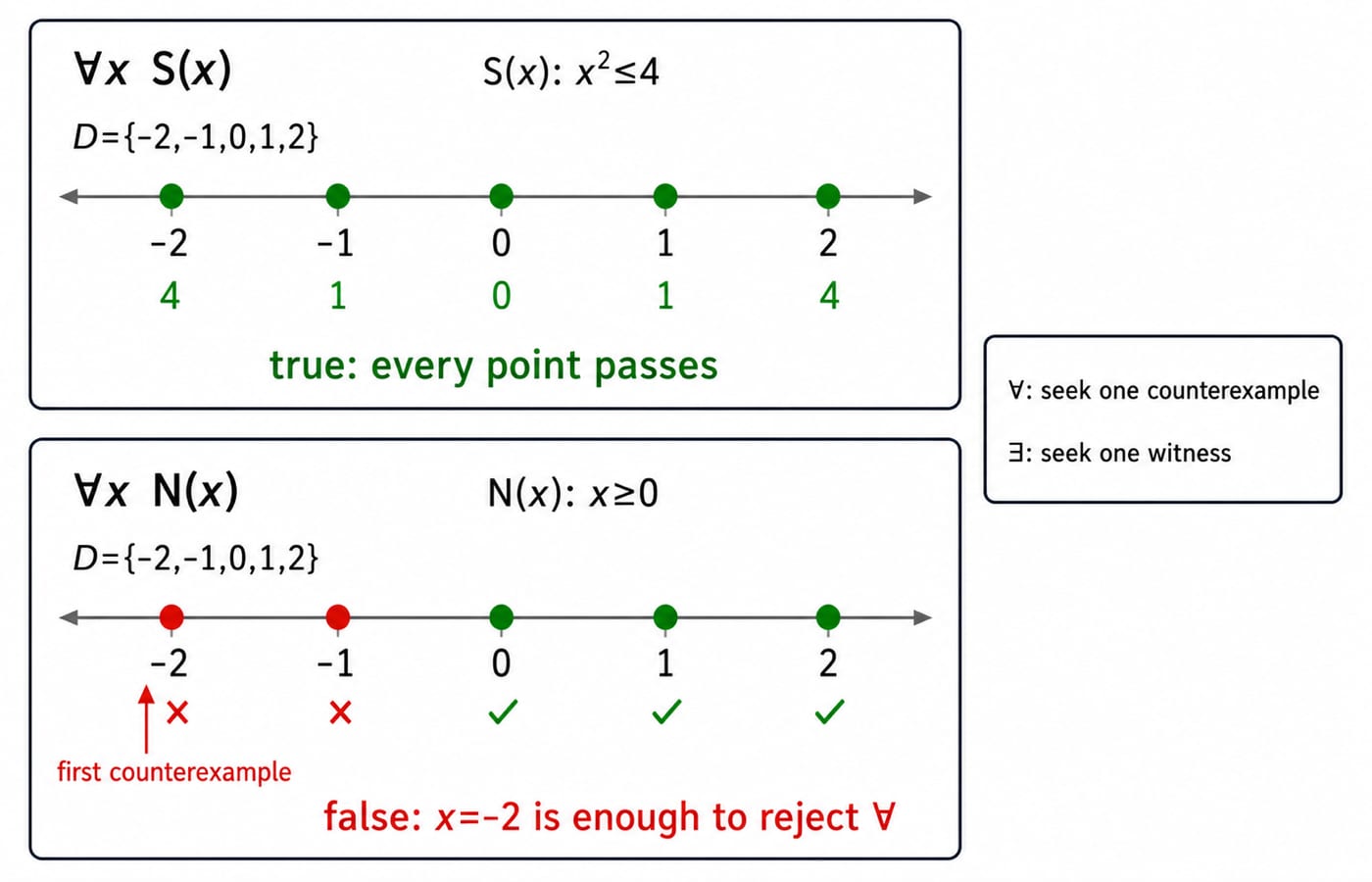
Read ∀x E(x) as "every member of D is even". It is false because x=-1 is a counterexample. Read ∃x E(x) as "at least one member of D is even". It is true because -2, 0, and 2 are witnesses. One counterexample defeats a universal claim, while one valid witness establishes an existential claim.
For the wider bridge from connectives to predicates, read Propositional and Predicate Logic: Truth Tables, Quantifiers. Quantifier meaning determines how the formulas are read.
Universal quantifier: test every value or find one counterexample
Over a finite domain, ∀x P(x) is true only if P(x) passes for every listed element. Test ∀x S(x) directly:
(-2)²=4≤4(-1)²=1≤40²=0≤41²=1≤42²=4≤4
All five values pass, so ∀x S(x) is true.
Now test ∀x N(x) in the natural order -2,-1,0,1,2. At the first value, N(-2) is false, so the universal claim is false. Checking only 0,1,2 would be incomplete. A universal claim is not a majority vote.
The domain matters as much as the predicate. Over the real numbers, ∀x(x²≥0) is true. However, ∀x(x²>0) is false because x=0 gives 0²=0, not a value greater than zero.
Existential quantifier: one valid witness is enough
The formula ∃x P(x) is true when at least one member of the domain makes P(x) true. On D, ∃x(x²=4) is true because x=-2 and x=2 are witnesses. Only one is needed, but listing both shows that existence does not mean uniqueness.
For ∃x(x²=3), the square values are 4,1,0,1,4. None equals 3, so the formula is false on this domain. One failed candidate cannot disprove an existential claim. Every candidate must fail. Universals are easy to refute, while existentials are easy to confirm, but the reverse direction requires checking the whole domain.
Again, changing the domain can change the answer. The claim ∃x(x²=2) is false over the integers but true over the real numbers, where x=√2 and x=-√2 are witnesses.
Worked example: why ∀x∃y and ∃y∀x differ
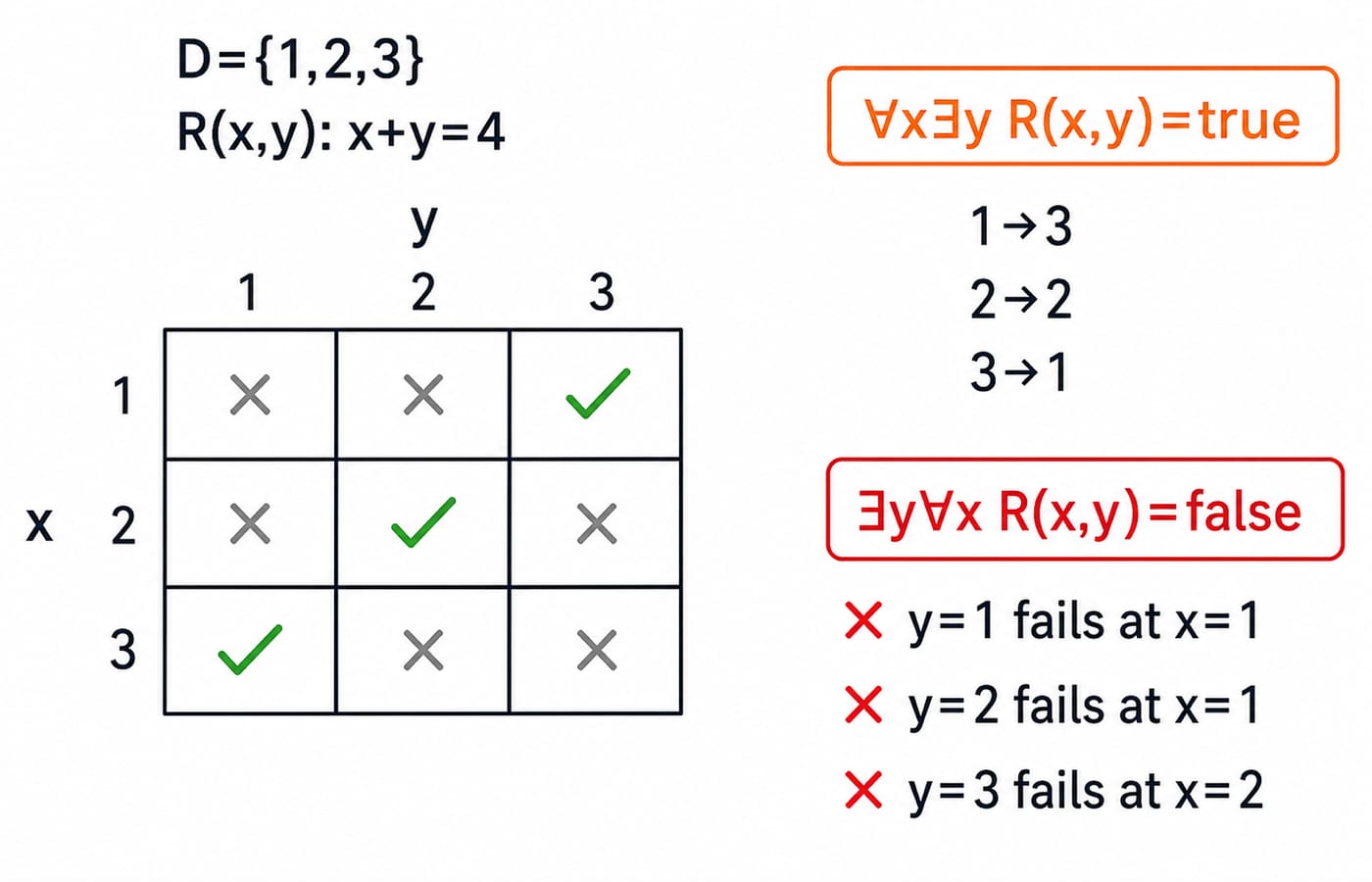
Let D={1,2,3} and let R(x,y) mean x+y=4. We must inspect all nine ordered pairs:
x \ y | 1 | 2 | 3 |
|---|---|---|---|
1 | false: | false: | true: |
2 | false: | true: | false: |
3 | true: | false: | false: |
The true cells are exactly (1,3), (2,2), and (3,1).
Evaluate ∀x∃y R(x,y) from the outer quantifier inward. For x=1, choose witness y=3. For x=2, choose y=2. For x=3, choose y=1. Every x has a permitted y, so the formula is true. The witness may change when x changes.
For ∃y∀x R(x,y), one fixed y must work for every x. Candidate y=1 fails at x=1 because 1+1=2≠4. Candidate y=2 fails at x=1 because 1+2=3≠4. Candidate y=3 fails at x=2 because 2+3=5≠4. No single y works for every x, so the formula is false. "Everyone has someone" does not imply "there is one person for everyone".
Translate English into ∀, ∃, implication and conjunction
Reuse D={-2,-1,0,1,2} with E(x) for even and N(x) for non-negative.
"Every even member is no greater than 2" becomes
∀x(E(x)→x≤2). It is true because the even values-2,0,2are all at most2."Some member is even and negative" becomes
∃x(E(x)∧¬N(x)). It is true with witnessx=-2."No even member is negative" becomes
∀x(E(x)→N(x)). It is false becausex=-2is an even counterexample that is not non-negative.
The grammar matters. "Every A is B" normally becomes ∀x(A(x)→B(x)), while "some A is B" becomes ∃x(A(x)∧B(x)). Replacing the universal implication with ∀x(A(x)∧B(x)) wrongly requires every object to be both A and B. In our domain, it would require a non-even value such as x=-1 to be even. If implication itself needs revision, use Implication and Biconditional Operators in Logic.
Scope, negation and traps that change the answer
The scope of a quantifier is the stretch of formula its variable reaches, marked by the parentheses after it. In ∀x(E(x)→N(x)) the scope is the whole implication, so each value of x is tested against the implication as one unit, never against E(x) alone.
Negation swaps the quantifier and negates the predicate:
¬∀x P(x) ≡ ∃x¬P(x)¬∃x P(x) ≡ ∀x¬P(x)
For our domain, ¬∀x N(x) becomes ∃x¬N(x) and is true with witness x=-2. Also, ¬∃x¬N(x) becomes ∀x N(x) and is false because -2 is not non-negative.
Trap | What goes wrong | Repair |
|---|---|---|
Omit the domain | The truth value may be unclear or change | State the domain before testing |
Treat "most" as | A majority is mistaken for every value | Seek one counterexample to test |
Reject | Other candidates are ignored | Search systematically for a witness |
Swap | The scope and dependency change | Read quantifiers left to right |
Reverse | "Every A is B" gets mistranslated | Mark A as the antecedent |
Quantifiers also do not distribute just because an expression looks algebraic. On D={1,2}, let P(x) mean x=1 and Q(x) mean x=2. Then ∀x(P(x)∨Q(x)) is true because each domain member satisfies one predicate. But (∀xP(x))∨(∀xQ(x)) is false because neither predicate holds for both values.
How exam-style questions test quantifiers
Representative question shapes ask you to identify a domain and bound variable, choose a witness, choose a counterexample, translate an English sentence, negate a quantified statement, or compare quantifier orders on a finite relation.
Use this quick checking routine:
Box the domain.
Underline the quantifier order.
Mark the scope with parentheses.
Write
witnessbeside∃andcounterexamplebeside∀.Test the smallest finite candidates systematically.
For nested quantifiers, follow the order from left to right and ask whether the inner witness may depend on the outer variable. For step-by-step quantifier problems solved with exactly this routine, work through Quantifiers and Predicate Logic Practice Problems. For mixed practice across the surrounding ideas, work through Propositional and Predicate Logic MCQs: 12 Solved.
Universal and existential quantifiers: the short version and next step
Keep this five-line recall ladder:
State the domain.
Identify the predicate.
Read the quantifiers in order.
Use one counterexample to reject
∀.Use one witness to establish
∃.
Changing the order can change the claim. Test the contrast on a fresh relation: over D={-1,0,1}, let R(x,y) mean x+y=0. Decide whether ∀x∃y R(x,y) and ∃y∀x R(x,y) hold, then name the witness for each x or the candidate y that fails. Continue with CS Fundamentals for Exams and Placements for adjacent core CS learning, or use GATE Guidance by Sanchit Sir as a structured route through Discrete Mathematics.
Keep learning
Classification of Finite and Infinite Groups: Orders, Cyclicity and Worked Examples
Learn how group axioms, group order, element order and generators classify finite and infinite groups through complete, checkable examples.
Updated 4 Oct 20266 min readEngineering Mathematics
Bipartite, Cycle, Regular and Complement Graphs: Tests, Formulas and a C6 Worked Example
Learn a dependable order for classifying simple graphs, then apply it to C6 and list, count and test every edge in its complement.
Updated 29 Sep 20266 min readEngineering Mathematics

Basic Terminologies in Linear Programming: Feasible Solutions, BFS and an Optimal Solution Worked Step by Step
Separate feasible, basic feasible and optimal solutions through geometry, slack variables, vertex enumeration and concise counterexamples.
Updated 25 Sep 20265 min readEngineering Mathematics
Assignment Problem and Hungarian Method: Formulation with a Complete Worked Example
Learn why greedy assignment fails, how matrix reductions preserve the optimum, and how the uncovered-value adjustment leads to a minimum cost of 140.
Updated 24 Sep 20266 min readEngineering Mathematics